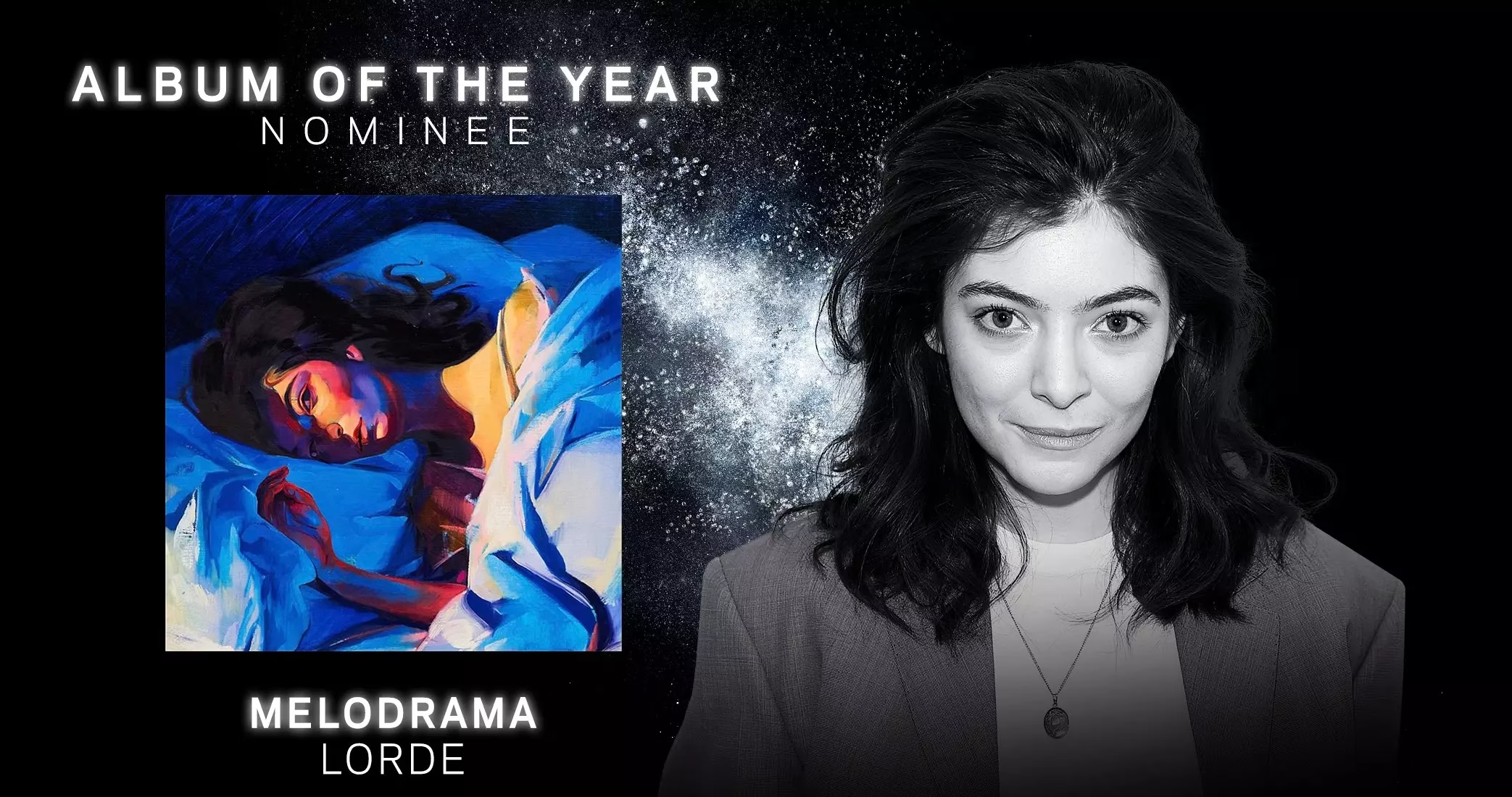
Arriving in New York to record her sophomore album, Lorde faced what seemed like an impossible task: to somehow create a musical statement as honest as her first. The New Zealand native — real name Ella Yelich-O'Connor — was just 16 when she released Pure Heroine, a widely acclaimed pop culture critique and snapshot of suburban youth. But after a dizzying rise to fame and a painful breakup, she knew her next album had to come from closer to the heart.
<iframe src="https://tools.applemusic.com/embed/v1/album/1211010237?country=us&itscg=30200&itsct=afftoolset_1" height="500px" width="100%" frameborder="0"></iframe>
With the help of producer Jack Antonoff and a team of studio veterans, Lorde channeled heartbreak and loneliness into the deeply personal LP Melodrama. The album earned Lorde her fifth GRAMMY nomination and her first for Album Of The Year.
Here, Lorde and key collaborators recount the making of Melodrama.
*Lorde (artist): It kind of takes a second, I learned, to write your way out of the record you just made. There was a real hit of, like, "I just don't have another one. It could never be good enough."
** It wasn't until I went through heartbreak, and moved out of [my parents'] home into my own house and spent a lot of time totally alone, that I realized I do have very serious, vivid feelings I needed to get out. Working with [producer Jack Antonoff] opened me up to feeling a lot; he was the perfect person to help me do that.
*Jack Antonoff (producer): I was like, "Let's just gather around a piano and see how you're feeling, and see what has happened to you since your last album that's really worth sharing." That was very important. It opened up a big space, which was, "OK, there's a way that you can talk about all of these things that have changed, and it's not going to put you on an island."
***Lorde: The first record was "we" and "us." And this record is "I." The focus does close in. I think that was necessary to get to the level of frankness that’s in there.
*Antonoff: [On Pure Heroine], Ella had these electronic sensibilities. But there are guitars on this album, there are all these analog-based instruments. It's not about minimalism anymore; it's this bigger, broader thing. It's a very different album in terms of the palette of sounds. I think that started by the fact that we wrote the album sitting around a piano.
"It wasn't until I went through heartbreak, and moved out of [my parents'] home into my own house and spent a lot of time totally alone, that I realized I do have very serious, vivid feelings I needed to get out."
Tom Elmhirst (mixing): It's my piano. I bought it from an NYU professor. … It's a really beautiful upright that was made here in New York.
Because they were working literally next door to me — upstairs at [Electric Lady Studios] — the proximity was obviously really close. … [They were in] a really nice live room with plenty of daylight, and it’s got the piano and a few other instruments set up for vocals.
They would set up a Pro Tools setup in there, and [mixer/engineer Laura Sisk], Jack and Ella would be in there doing their thing all day, all night.
****Laura Sisk (mixer/engineer): One of the coolest parts of working on this album was watching the songs come into existence. Jack and Ella are both super creative and very honest songwriters and it was thrilling to watch stories or conversations turn into songs that I absolutely love.
<iframe width="620" height="349" src="https://www.youtube.com/embed/sExX9XmTtbQ" frameborder="0" allow="autoplay; encrypted-media" allowfullscreen></iframe>
*****Lorde: ["Sober II (Melodrama)" is] the second part of one of the first songs that we wrote where I really started to understand what the album would be, which was "Sober." The two of them kind of came around the same time, this was April [2016] — I remember Jack and I went out to Coachella and we got a studio in Palm Springs.
In the first part, it's very much like the party's in full swing, and maybe sort of tipping over into that area where it might be a little too much, and then ["Sober II (Melodrama)"] is sort of singing from the perspective of the deflated room. There's such a sadness to the lights being on after a party, you know, this whole room has sort of been washed in this dark, and to see the corners of the room again can always be a little bit heartbreaking.
Elmhirst: The title song is really simple. It's not complex, and it wasn't a huge mixing process. But the clarity of the vocals and the simplicity of the track — you need a great artist to do that. I think [Lorde] did it really well.
******Antonoff: "Green Light" became a very important song to the album. It was a big moment.
*Lorde: [“Green Light” is] me shouting at the universe, wanting to let go, wanting to go forward, to get the green light from life.
<iframe width="620" height="349" src="https://www.youtube.com/embed/dMK_npDG12Q" frameborder="0" allow="autoplay; encrypted-media" allowfullscreen></iframe>
******Antonoff: There was a night that we really cracked the code on "Green Light." We had these parts. We went and saw someone play at the Barclays Center, and there was all this jangly piano going on. It sounded like someone banging on a piano. We went home and started to put that in, and that's when it started to make sense.
****Sisk: [Jack and I] often work on different aspects of the same song in separate rooms and that ability to tag-team the work lets us move at a very fast pace, which is super important given the amount of projects we collaborate on.
Randy Merrill (mastering engineer): The album was mixed by a few different engineers, all with very different styles, so tying it all together to feel like an album was a bit challenging.
Elmhirst: There was a lot of forwards and backwards on the album. I would finish mixes, and then productions would change. So it was a tricky balance of being flexible while remaining creative.
***Lorde: We labored over every little sound, every word. To a level that I think people would never even pick up on.
Merrill: On the mastering side, it was all about tapering the sounds of each of the songs to that they felt cohesive as an album, with one song flowing into another with a feeling of consistency.
*Antonoff: It was a hard album to make. If you change a breath on a vocal take, [Lorde will] notice, and she'll like it or she'll hate it. It's a meticulous process with her, and this particular album was an intense journey. I think that's what it had to be.
***Lorde: [Melodrama is] about contrast: really big and grand, and really tiny and intimate. Going from the personal, emotional stuff to the headlines and the web. It goes from the world to my bedroom.
We finished it… and I said to Jack, "You realize, I can go anywhere I want now."
* As told to Rolling Stone
** As told to Vanity Fair
*** As told to NME
**** As told to Vice
***** As told to NPR
****** As told to Billboard
(Julian Ring is a music journalist and critic. His work has appeared in Rolling Stone, NPR Music, The Wall Street Journal, and Consequence of Sound, and he has written for The Recording Academy since 2010. As a curator at Pandora, Ring reviews independent music, programs blues stations and produces creative editorial. The views expressed in this article are the author's own and do not necessarily reflect the views of Pandora Media, Inc., nor was the article written on Pandora Media, Inc.'s behalf.)
