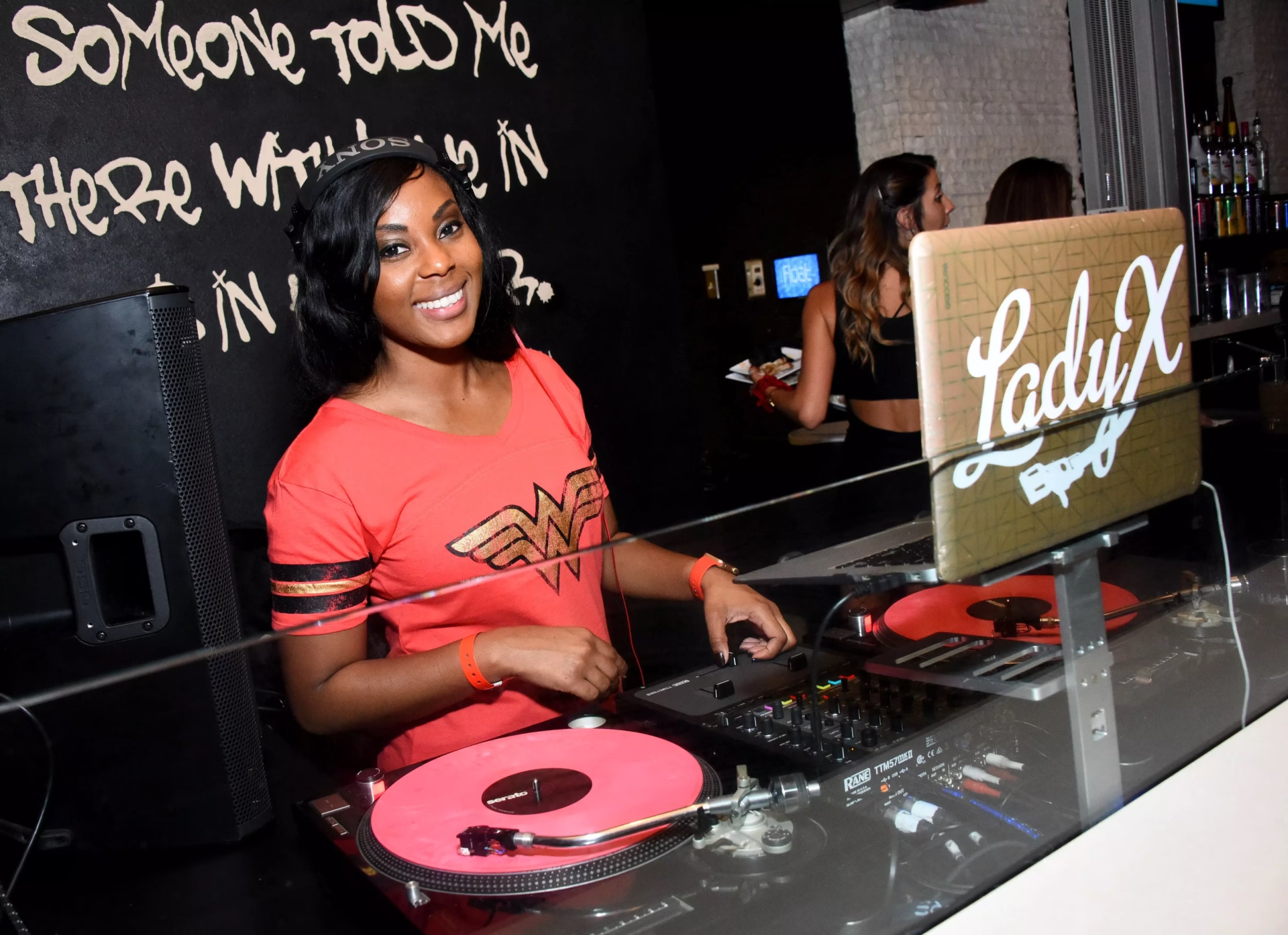
Jan. 20 is National DJ Day. Originally instituted to honor the memory of 1950s radio broadcaster, record promoter, and disc jockey Albert "Alan" Freed, National DJ Day now stands to recognize and celebrate the work of any individual actively mixing two or more sources of music from media players in order to create a seamless transition and a uniquely blended energy.
Once a term used primarily to describe the technicians and broadcasters responsible for cueing up introducing the day's latest radio hits – back then played exclusively on phonographic records – the title "DJ" has since grown to encompass artists engaged in an entire collection of genres, subgenres, and even non-musical endeavors, all the while stretching the boundaries of and expanding the accepted understanding of just what it actually means to be a DJ.
Cueing Up
Many sources debate the question of who, exactly, was the world's first disc jockey. California resident Ray Newby claimed the title on a 1965 episode of the CBS panel game show "I've Got A Secret," explaining that he had been regularly playing records over a ham radio broadcast transmitter he'd built with his college professor as early as 1909. Meanwhile, Lee DeForrest, known as the "father of the radio" for inventing the triode amp tube, claims to have made the first broadcast of recorded music in 1907 – though admittedly there was no one else with a receiver at the time who could to hear the broadcast.
In their definitive history of the development of DJing, Last Night A DJ Saved My Life, authors Bill Brewster and Frank Broughton put the question to rest, asserting that the world's very first disc jockey was actually a Thomas Edison contemporary named Reginald Fessenden, who played a recording of Handel's "Largo" over the airwaves during an experimental broadcast on Christmas Eve 1906.
The term disc jockey was eventually coined in the mid-1930s by American radio commentator Walter Winchell, before finally appearing in print for the very first time in a 1941 article in Variety, whereupon it soon became a household term for musical tastemakers who could "start an artist's career overnight."
The Fathers Of The Form
After the world's first discotheque (literally translated as "library of records") opened in Paris in 1947 under the name Whiskey á Go Go, the idea of dance clubs as a cultural institution spread around the world. Throughout the '50s and '60s in the U.S., DJs could be found everywhere from high school sock hops held in empty gymnasiums to posh big-city nightclubs.
The concept of using a pair of turntables and a mixer to minimize or eliminate the downtime between songs dates back to 1943, when English DJ and "Top Of The Pops: presenter Jimmy Savile threw what's now considered to be the world first live DJ dance party at the Grand Records Ball. But the artform took a quantum leap forward in 1969, when Francis "DJ Francis" Grasso invented beatmatching, forever changing essence of the craft, and paving the way for the explosive evolution of radio-style DJing into the multifaceted performance art we now know today.
Cuttin' Tracks, Put 'Em On Wax
The incredible successes of pop music in the 1960s created both a surplus of investment cash in the pockets of record labels, and surplus of new studios and labels looking to find and sign the "next big thing" throughout the '70s.
Beneath the predominance of radio rock, the ongoing bifurcation and recombination of other, more experimental genres that was going on in studios and band practice spaces around the country produced an immeasurable catalogue of lesser-known recordings that would eventually become a dispersed Library Of Alexandria of sorts for the DJs and producers of the future to dig through, sample, and mix.
1973 saw the first roots of hip-hop laid down in the streets of the Bronx, by way of DJ Kool Herc's massive outdoor block parties, wherein he pioneered the technique of mixing two identical records to prolong the grooviest sections of a tune to create extended rhythm breaks that worked the crowd into a fever frenzy.
Who Is Your DJ And What Do They Do?
The underground experimentation of late '70s disco and the rise of the hip-hop sound fused once again in the '80s, this time incorporating the nascent technologies of synthesizers and programmable drum machines into a new metamorphosis of sound that made its presence known at Chicago nightclub The Warehouse under the watchful eyes of resident DJ Frankie Knuckles, now considered the godfather of house music.
<iframe width="620" height="349" src="https://www.youtube.com/embed/644UU55eyzk?rel=0" frameborder="0" allow="autoplay; encrypted-media" allowfullscreen></iframe>
Right alongside the soulful disco- and gospel-influenced sounds developing in Chicago were the purposefully more industrial and intentionally harsher sounds of Detroit techno, spurred on by the endeavors of producer/DJs Kevin Saunderson, Derrick May, Juan Atkins, and others. With the soulful and uplifting melodic elements of disco stripped away by design, early techno developed around a goal of creating purely electronic dance music built on a foundation of sustained, repetitive grooves and with close thematic ties to afrofuturism.
It's All In How You Get there
As the glitzy excesses of the '80s clubbing scene opened up into the more liberated wild west of early '90s rave and warehouse culture, sometimes termed the Second Summer Of Love, the already vastly variegated subgenres of electronic music flowered once again into ever-increasingly niche subgenres, spurring the rise of musical counter cultures such as acid house, early trance, jungle, breaks, drum 'n' bass, and onward ad infinitum.
Interestingly enough, it is during this period of ostensibly strict genre lines and vastly disparate musical influences that the walls of various scenes began to dissolve. Meanwhile, dance music as a collected genre began to see its first crossover brushes with mainstream success, though it would not be for almost another two decades that electronic music would truly become inseparably entrenched in the lifeblood of popular music.
The importance of this era is in its illustrative nature of the true essence of what it means to be real DJ. Too often ideas of what scene, or what sound, or what's hip, or what's not, can get in the way of what really matters on a dancefloor, which is to leave your other concerns behind and have a damn good time.
<iframe width="620" height="349" src="https://www.youtube.com/embed/BgfvnFVZ61k?rel=0" frameborder="0" allow="autoplay; encrypted-media" allowfullscreen></iframe>
Like all forms of performance music, the essence of the art and craft of DJing rests on a tenuous balance between an understanding of musical rules and structure, and an innate willingness to toss those rules out the window, experiment, and take risks.
Ultimately, the most central aspect of the art form is to just play great music. Tastemaking, scenebuilding, ensuring the bar is selling enough drinks, and whatever else — all comes secondary.
Oh, and also – make sure you don't redline the mixer if you're the opening act. Your headliner will appreciate it.
The Recording Academy would like to wish disc jockeys everywhere a very happy National DJ Day.
Air + Style Fest 2018 To Host Zedd, Gucci Mane, Phantogram And More
