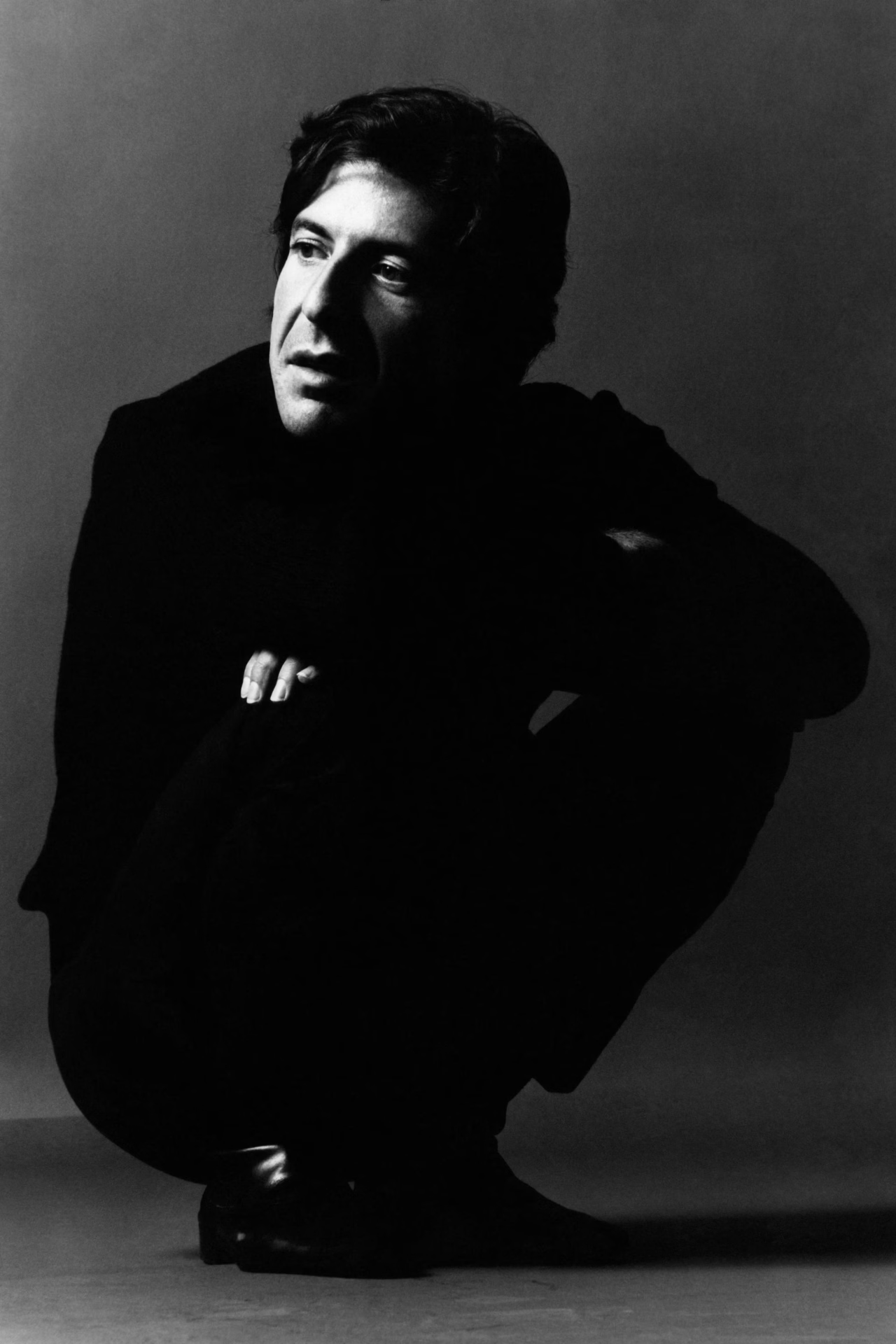
"When Dylan emerged, he blew everyone's mind," said the poet Allen Ginsberg. "Everybody except Leonard Cohen, this is."
Ginsberg was right. Even before Bob Dylan transformed modern songwriting with his expansive folk poetry, Leonard Cohen was already there. A published poet and novelist in Canada, he was fusing poetry and song long before he officially became a songwriter. The switch to music, he said years later, came out of a hope to make a decent living.
That all changed 50 years ago on Dec. 27, 1967, with the release of his debut album, Songs Of Leonard Cohen. Even the title was telling: This was not an album about singing or rock and roll. It was about songs, and songs written by the artist himself.
<iframe src="https://tools.applemusic.com/embed/v1/album/191437839?country=us" height="500px" width="100%" frameborder="0"></iframe>
His debut album was produced by John Simon, who had a creative hand in the landmark 1968 album Bookends for Simon And Garfunkel. Cohen's was an opening salvo unparalleled by any other (with the possible exception of John Prine, whose debut also contained instant folk classics.) He'd already written many of the songs that have since become modern standards, such as "Suzanne," "Hey, That's No Way To Say Goodbye" and "Sisters Of Mercy." But he never intended to sing them himself.
To commemorate the 50th anniversary of Songs Of Leonard Cohen (GRAMMY Hall Of Fame, 2015), go behind the scenes with some of the professionals who worked with Cohen on the groundbreaking LP, those who worked with him subsequently and artists whose lives and work have been forever impacted by this album and all that was to follow.
"The necessity to be cool has hurt rock. Leonard didn't conform to that idea of cool at all, which is the coolest thing of all." — Ben Folds
Judy Collins (vocalist/collaborator): A friend told me about Leonard in 1966, and said, "He's never going to amount to much, because his poetry is just totally obscure." Months later, she said he wanted to come and sing me his songs. I asked if they were obscure, and she said yes.
Leonard came to see me. His words were, "I can't sing, I can't play the guitar and I don't know if this is a song." Then he sang me "Suzanne." He also sang "Dress Rehearsal Rag."
I loved them both. I had almost finished my album, In My Life, and [label executive] Jac Holzman said, "You know, it's terrific. But it really needs something." And the something was Leonard. I recorded both songs.
John Simon (album producer): John Hammond signed Leonard to Columbia, but kept postponing recording. Leonard felt like he was festering in the Chelsea Hotel. He begged Columbia to assign another producer to him. That was me.
Collins: He came with me to a benefit I was in. I told him everybody knows "Suzanne" and wanted him to sing it. He said, "Well, I can't sing." I said, "Yes, you can," and pushed him onstage. Halfway through "Suzanne" he started weeping and walked off the stage. Backstage he said, "I can't do this." I said, "Leonard, you have to. You must do this. You're a wonderful singer." I went back onstage with him, and we sang together. That was the start.
Simon: Leonard was different from the other acts. They were kids. He was a grown-up. And an intellectual. He was already a published poet and novelist.
Ben Folds (singer/songwriter): The necessity to be cool has hurt rock. Leonard didn't conform to that idea of cool at all, which is the coolest thing of all.
Collins: Once Leonard got past the fear of performing, he became a spectacular, powerful performer. I was in awe of what happened with his work, and singing his own songs. It was really so deep.
Folds: The way he's singing, whether you like his singing or not, it makes you listen to the words. That's the main thing. As soon he opened his mouth, you think, "Well, he wasn't here to be Pavarotti. He really must have something to say."
Simon: Instead of using horns or strings, I used wordless female voices, sung by Nancy Priddy, my girlfriend at the time, who was uncredited. Until now.
Nancy Priddy (album vocalist): One night John said, "We've got to go in and finish Leonard's album." Most everything was done. He engineered too, so it was just the two of us in the middle of the night. We did little things to wind it up. I added all the harmonies, and we also hit on some tambourines and drums. John came up with all the harmony parts, and directed me. He's quite brilliant. It was an easy session, very casual — took maybe three hours, at the most.
Collins: As a guitarist [Cohen] was so good. It's not your common denominator. [His music] is very beautiful, and strikingly different.
Simon: Though Leonard joked that he had only one "chop," he was a good guitarist. He recorded "The Stranger Song" before we began, with that difficult, insistent triplet pattern that he had mastered with the fingers of his right hand. We used that triplet technique throughout.
<iframe src="https://tools.applemusic.com/embed/v1/song/192677233?country=us" height="110px" width="100%" frameborder="0"></iframe>
Sharon Robinson (collaborator/co-writer): "The Stranger Song" is the testimony of someone questioning his heart. When we were on tour, he played it alone. Listening offstage, I was moved deeply by his performance. I have never forgotten it.
Simon: "The Stranger Song" made me think about his lyrics. Although Dylan paved the way with lyrics that were more thoughtful than the average pop lyric, Leonard's have more finesse. His scansion is stricter, his rhymes truer as a rule. Whereas Dylan's language had a connection to "the people," in the tradition of Woody Guthrie, blues and folk, Leonard's lyrics reveal a more educated, exposed, literate poetry.
Priddy: Songs like "Suzanne" were amazing. We would be in awe. We'd listen together all the time throughout the project, and we loved it.
<iframe src="https://tools.applemusic.com/embed/v1/song/191437844?country=us" height="110px" width="100%" frameborder="0"></iframe>
Folds: I listened to "Suzanne" like I listened to Joni Mitchell. I listened to the story.
Simon: "Suzanne" is gorgeous. I love the track. The strings and the girls together with the vocal and guitar make a lush blanket of sound.
Folds: "Suzanne" has a simple melody, perfect to carry the poetry without making the lyrics secondary. It has only a few notes, so you recognize it, but it's so simple that the simplicity allows the poetry to exist. It's not something everybody can do. His melodies are very simple, but they're succinct.
Athena Andreadis (singer/collaborator): His melodies are like mantras, little meditations.
Robinson: "Suzanne" is a story of lovers found and lost, as is "Hey, That's No Way" and "So Long Marianne." These first songs became among his most important and defined him as an artist.
<iframe src="https://tools.applemusic.com/embed/v1/song/191438327?country=us" height="110px" width="100%" frameborder="0"></iframe>
Andreadis: "So Long Marianne" has a Greek folk sound that I was drawn to — singing of goodbyes, life, death, and the afterlife, echoing in the silences.
Robinson: I love the sound of the background vocals on "So Long Marianne." It's so '60s!
Priddy: When he sings, "When you're not feeling holy, your loneliness says that you've sinned," in "Sisters Of Mercy," it's so beautiful.
<iframe src="https://tools.applemusic.com/embed/v1/song/191438202?country=us" height="110px" width="100%" frameborder="0"></iframe>
Andreadis: A song about the muses, "Sisters Of Mercy" has been healing for me; that place at the crossroads of western therapy and eastern spirituality, woven into the song like a breath of fresh mountain air.
Folds: He was outside of the rock lexicon. He didn't say, "Girl, I wanna take you higher." He didn't pay any attention to that. So what he did write about really stood out. When you hear those words, you really hear them.
Robinson: These songs created a palpable aura of love's intimacy and complexity. You feel them in the deepest levels of the heart.
Folds: I remember Rickie Lee Jones once saying a recording needs to have a ghost in it. I think that is definitely true of this album. There are ghosts in this record.
Peter Case (singer/songwriter): The way [Cohen] put words together, the attention to sound, was the thing that hit me. I see that now but it was an unconscious influence, like Mother Goose or Chuck Berry. The words carry rhythm and sound themselves, as does the shifting of vowels in each line. That had an impact on my own writing forever.
Collins: [Cohen] finds illuminating ways into songs that is all his. Where that comes from, in part, was music he heard in temple. His music has an element of chant, an element of the Kadish, the prayer for the dead.
Simon: Leonard and I did have some differences over some arrangements. But in spite of those, there was not a speck of animosity between us. This was before his immersion in Buddhism, and his subsequent reputation as the man in black, sharing that handle with Johnny Cash. In our time together he was cheerful, funny, very rarely dark. With his wit and intelligence, he was a joy to be around.
Folds: In this business, people who make super-tight, shiny records, they have taken over. But when Leonard made this album, you know the only reason it exists is to be a framework for the poetry that is included. And that's a special kind of record.
Robinson: Listening to this album now, I'm struck by the lightness of his voice, and the fluidity of those great melodies.
Simon: We ended the album with "One Of Us Cannot Be Wrong." I liked the humor and the undercurrent of ardent young lust. As for the questionable taste of the ending with the recorder, the whistle and Leonard screeching way up high, what can I say? We were young.
<iframe src="https://tools.applemusic.com/embed/v1/song/191438573?country=us" height="110px" width="100%" frameborder="0"></iframe>
Folds: Leonard was a real artist. There are a lot of fantastic songwriters and singers, but they're not 100 percent artists. They're compromised somewhere. But someone like him, I don't think there's any compromise at all.
Andreadis: He is a true master of lyrics, unsurpassed by any other. His words point to something much bigger, deeper and more profound, a truth we all seek and recognize.
Robinson: He knew songwriting was his calling. He once said to me, "Speak to them about them." He was concerned with the heart of mankind and the things we have in common as human beings. He stayed inside the process, which was the part he loved, the discipline of the writing itself. For him, it was a process of trusting and keeping the channels open.
Folds: People like Leonard, Dylan, Kristofferson, they have hijacked a form of folk music to penetrate your brain with poetry. And making a high art of folk music is a rare gift.
Leonard Cohen's Final Poetry Book 'The Flame' Gets Release Date
(Writer Paul Zollo is the senior editor of American Songwriter and the author of several books, including Songwriters On Songwriting, Conversations With Tom Petty and Hollywood Remembered. He's also a songwriter and Trough Records artist whose songs have been recorded by many artists, including Art Garfunkel, Severin Browne and Darryl Purpose.)