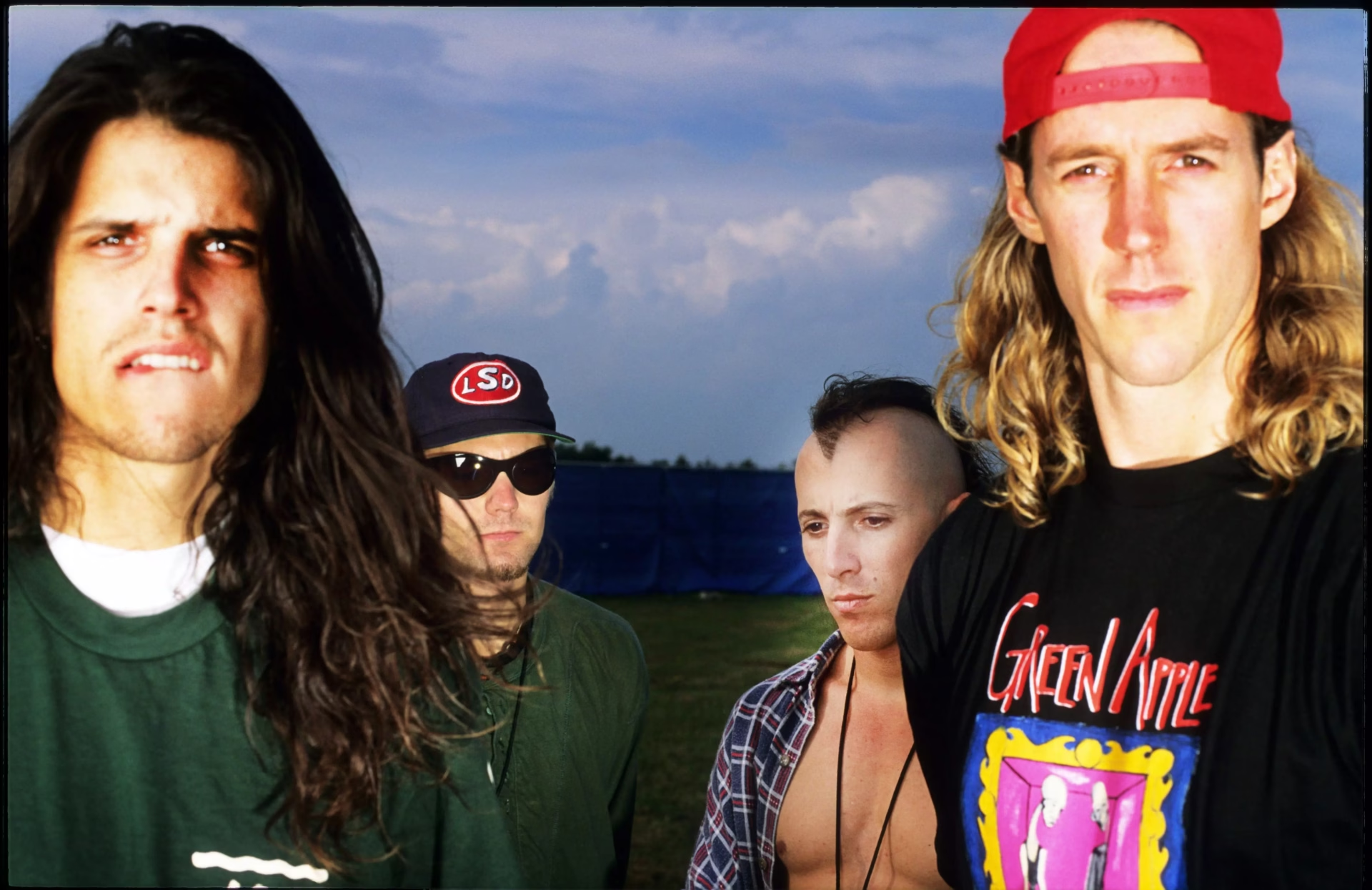
Before Tool became cult-rock icons with their own wing in the house of heavy music; before they conceived their groundbreaking second and third releases, Ænima and Lateralus — winning consecutive GRAMMYs for Best Metal Performance with album tracks "Ænima" and "Schism" — and before they splintered off to create genre-bending side projects such as A Perfect Circle, Puscifer and Pigmy Love Circus and then disappeared on a mysterious hiatus amid hints that they were in the process or writing and recording process for what is now one of the most anticipated rock albums in years — before all of that came Undertow. The band's 1993 trend-defying debut album unleashed their sound on to the world and, like it or not, announced their arrival into pop music's periphery.
<iframe width="620" height="349" src="https://www.youtube.com/embed/VUk2JNashL0" frameborder="0" allow="autoplay; encrypted-media" allowfullscreen></iframe>
In an era where labels were signing alternative flannel bands in droves and mainstream metal had clawed its way onto the daytime airwaves, Tool were decidedly neither. Los Angeles-based singer Maynard James Keenan, guitarist Adam Jones, bassist Paul D'Amour, and drummer Danny Carey didn't fit into any of the big early '90s cliques. Eschewing the rock caricatures of Singles, the grime of Seattle, the crust of thrash metal, and the sheen of radio rock, Tool's Undertow was inventive yet accessible, intellectual yet juvenile, quirky yet intense, and very, very good.
"It was a heavy album, but it was also smart," Henry Rollins tells us. "And that's one of the things that distinguished it from a lot of other heavy music that was around at the time. I can't think of any record that sounds like Undertow."
Many factors play into the way a band sounds on a given recording, and the roles largely responsible for that sonic outcome are the album's producer and engineer. Enter Sylvia Massy. A pioneer of unconventional and creative recording, Massy has worked with the likes of Johnny Cash, Tom Petty, Prince, and the Red Hot Chili Peppers, along the way building a reputation for capturing authentic, human moments of honest fragility, unhinged aggression and brilliant imperfection. Massy fostered many such moments from behind the board on Undertow. According to her, the project — and her career that followed — began with a hearty helping of happenstance.
"Without my mundane job at a record store in L.A., I may have never connected to Tool," says Massy. "In the late '80s, I was a fresh transplant from San Francisco where I had spent several years working in Bay Area recording studios with musicians like the Adolescents, Tuxedo Moon, Exodus, and a very young Kirk Hammett from Metallica. One of my first Los Angeles jobs was working at Tower Records on Sunset in West Hollywood. Not the glamorous studio job I hoped for, but I was willing to pay my dues to get a chance in the L.A. scene."
It was at Tower she met a group of recent L.A. transplants from Buffalo, N.Y., from the band Green Jellö. They hit it off and Massy recorded an album with them in a garage on an 8-track in one weekend.
"They released the album on vinyl and it got attention from Lou Maglia from Zoo [Entertainment]/BMG, who decided to put money into a proper major label release to promote their song 'Three Little Pigs,'" says Massy.
<iframe width="620" height="349" src="https://www.youtube.com/embed/Gtffv9bpB-U" frameborder="0" allow="autoplay; encrypted-media" allowfullscreen></iframe>
"Another local band named Tool had been playing at a Hollywood dive bar called Raji's and labels were starting to take notice. They were raw and exciting with progressive arrangements and intense polyrhythms," Massy explains. "As it turned out, both Green Jellö and Tool had the same drummer: Danny Carey."
By that time, Massy had graduated from Tower, progressing to assistant engineer at Larrabee Sound Studios. When she heard Maglia had also signed Tool to the Zoo roster, she offered to record both bands' drum tracks at the same time, effectively saving the label a heap of time and money, and ultimately earning her the gig as producer/engineer for both albums.
"To start, we recorded live tracks at the Green Jellö loft in Hollywood — both bands [were] playing a wild New Year's party," says Massy. "Then we tracked the rest of the initial recordings at Sound City Studios in Van Nuys. Tool's [1992] Opiate EP had songs from both the studio recordings and the live show, some intercut."
These early recordings echo with the makings of something different — something special. In the year that followed, Green Jellö renamed themselves Green Jellÿ following a lawsuit from makers of the dessert product by the same name (sans umlaut), "Three Little Pigs" climbed to No. 17 on the Billboard Hot 100, and Opiate began to create a buzz around Tool. Both the label and the band approached Massy to work on Tool's full-length debut album, to be called Undertow. In light of her budding career, she now had a big decision to make.
"I had been working with Prince during that year and he had just offered me a job at Paisley Park, but I wanted to do the Tool record. I had to make a choice, so I turned Prince down. I knew Tool was an important band, and the album Undertow would be their big breakthrough." — Sylvia Massy
But for a producer, shaping the sound of a wildly creative band of self-driven artists can be tricky. Massy joined Tool for pre-production and, with her carefully positioned help, the album's silhouette started to grow features.
"Tool was a fantastic live band, and my biggest challenge was to capture the live energy in a studio setting, so generally during the first recordings I was just letting them do their thing," says Massy. "However, on Undertow as we started pre-production in rehearsals, I could see them getting stuck with some songwriting challenges so I stepped in as a tie-breaker. They knew I was not there to change their music, just enhance it. Some of my suggestions were accepted and some were rejected, and I am always OK with that.
"I suggested using a Leslie speaker for the guitar on the song '4°' — they went for that. I suggested we record a transient Peruvian flute band and hide it subliminally in a song, they went for that. I suggested we keep and use all of Maynard's heavy breathing. They went for that. I even suggested we buy two old upright pianos and record them while they were being destroyed with sledgehammers and a shotgun. They went for that [in a song called 'Disgustipated']. But when I suggested they trim some excess time off the front of 'Intolerance,' they told me to 'f*** off.' Hah!"
<iframe width="620" height="349" src="https://www.youtube.com/embed/yk0DueDnw5A" frameborder="0" allow="autoplay; encrypted-media" allowfullscreen></iframe>
Undertow was recorded in two separate chunks as not all the songs had been written when the project began. Massy chose to start tracking the album at L.A.'s Grandmaster Recorders because its Neve 8020 console was similar to the one at Sound City, where they had done parts of Opiate and where Undertow would ultimately be completed.
"The drums were set up in a small but very tall drum room. Two guitar amps were set up with a splitter in the wood room [and] the bass speaker was isolated on the back stage of the studio," says Massy. "We dug in there for two solid months, recording several live takes of each song, then taking pieces of songs and editing the best parts together. It was tedious work on analog tape. The drums were recorded with mics on the top and bottom of each tom, and there were 5 toms, two snares and an assortment of roto toms. [It was] a heavy load for that little Neve console, but we made it work. I had the toms tuned to the key for each song, and we changed tom heads after every take!"
Not wanting to chain the band to a programmed click, Massy developed a new system — out of necessity — for integrating the click track into Tool's signature tempo changes. But it wasn't easy, especially given the technical limitations of the equipment of the era.
"I developed a way to use a drum machine to manually start, stop, change tempo, and start again on the fly," she recalls. "It was an exciting way of working and it was my way of performing with the band, with the click as my 'instrument.' Then after recording on the masters I literally measured the distance between the kick and the snare hits on the 2-inch machine and edited tempo fluctuations out of the drum tracks. Today, this type of drum editing is relatively easy to do digitally, but in 1993 I was editing the 2-inch tape with a razor blade [and] taping the pieces back together manually. The masters were full of these cuts, and when the tape was rewound you could hear the flitter of all the drum edits passing through the tape guides."
<iframe width="620" height="349" src="https://www.youtube.com/embed/5yYkYNVEf0Y" frameborder="0" allow="autoplay; encrypted-media" allowfullscreen></iframe>
After recording the first half of the record, the band took several months off to finish writing before returning to the A room at Sound City Studios to complete the album. It was here that "Flood" was recorded, which Massy names as one of her favorite songs on Undertow.
Despite the dark, heavy nature of its music, the vibe of the Undertow sessions was often light, playing on the band's innate dichotomy between intellectual and puerile. Keenan, in particular, seemed to make it his duty to never allow a dull moment in the studio. This clash of thoughtful and goofy is a key ingredient in Tool's intoxicating cocktail.
"Maynard brought his pet African Grey parrot to the sessions, and it was a very friendly bird," Massy remembers. "Maynard loves animals. He had an aviary in his home at the time with birds and lizards and scorpions and a whole menagerie of critters. What a character. Maynard was also doing stand-up comedy during off nights. He is really a funny guy, but you wouldn't think so just listening to the music. But to know Tool is to realize all the lyrics have hidden double meanings, usually not what you'd expect."
"My job was to put a frame on a very unique and innovative musical 'painting.' The piece of art that Tool made was worthy of the finest gilded frame, and I tried very hard, and was well rewarded. But the art was theirs." — Sylvia Massy
One of the hardest elements of Tool's sound to define is Jones' guitar playing. While Carey's drumming flexes prowess and taste, and has inspired a generation of timekeepers, Jones' fretwork casts the brushstroke of Tool's sonic painting with a sort of neon grey hue, at times full and round, then funky and chopped, or shimmering and haunted — but all original.
In fact, Jones' creativity was not bound to the music. He is also an accomplished video director, animator, makeup artist and set designer, and has worked on household-name films such as Jurassic Park and Terminator 2.
"Adam, who is an amazing artist, showed me the technique of scribbling on Polaroids while they are developing to get unique colors and designs," says Massy. "We took dozens of Polaroids during the sessions, and I continued to make these types of Polaroid art portraits during my later sessions with Johnny Cash, Tom Petty, Rick Rubin, and System Of A Down. The Polaroid documents from these sessions are some of my greatest personal treasures."
One of the most transfixing and intense moments on Undertow comes in the middle of the song "Bottom" where a new voice enters like a new inmate in your cell — the unmistakable voice of Rollins.
<iframe width="620" height="349" src="https://www.youtube.com/embed/KTpYEL_PAzI" frameborder="0" allow="autoplay; encrypted-media" allowfullscreen></iframe>
"[Rollins Band] had done shows with Tool in America in 1992. Later that year, Maynard asked me to write something and put it on the song 'Bottom,' which I did," recalls Rollins. "It was a few takes and then I was out of there."
"Henry's performance was hair-raising, and every vein popped out of his neck as he barked his poetry into the floor," says Massy. "That's how he and Maynard both perform — bending over and facing the floor, basically spewing words into the microphone. Using a handheld mic is the only way to capture the great performances from these guys. The illustration of the "De-evolution Of Vocals" that I drew for my Recording Unhinged book describes Henry's vomitus singing technique."
Illustration: Courtesy of Sylvia Massy
In a way, Rollins' appearance on the album also symbolized Tool's baptism into the fires of the public eye, as within a year both Rollins Band and Tool would have popular videos on MTV. The stop-motion videos for "Sober" and "Prison Sex," both directed by Jones, left an inescapable and disturbing imprint on the fresh eyes and ears stumbling upon Tool for the first time.
A quarter-century later, the horror of these videos may not ignite the same shock level in modern viewers, considering how far the extreme genres of music and film have taken the art form. But the cohesive imagery still perfectly expresses the music's frustration and volatility. As is the case with any tried-and-true classic album, one wonders if Undertow sounded just as urgent, as powerful and as timeless upon initial completion.
"At the time the album was finished and mixed, we listened back and thought, 'Well, it doesn't sound like anything else, but we like it,'" says Massy. "Undertow was made without trying to follow anyone else's lead. That is why it endures to this day. And for me it was a milestone in my career. It was when people started knocking on my door, instead of the other way around. It's been 25 years since Tool's Undertow was released, yet I still get messages from Tool fans about it. It made an impact on a lot of people."
One could argue that Undertow did as much to push the craft of recording forward as it did to make household names out of the band. As Rollins put it, "It's a perfect record." For Massy, it marked the birth of a new approach to what's possible in the recording studio.
"It was there in those sessions that the idea of 'Recording Unhinged' began, when we destroyed the pianos and dragged in street musicians to play on the record," says Massy. "I resolved to break the rules on every recording session from that point on, and I have kept my word."