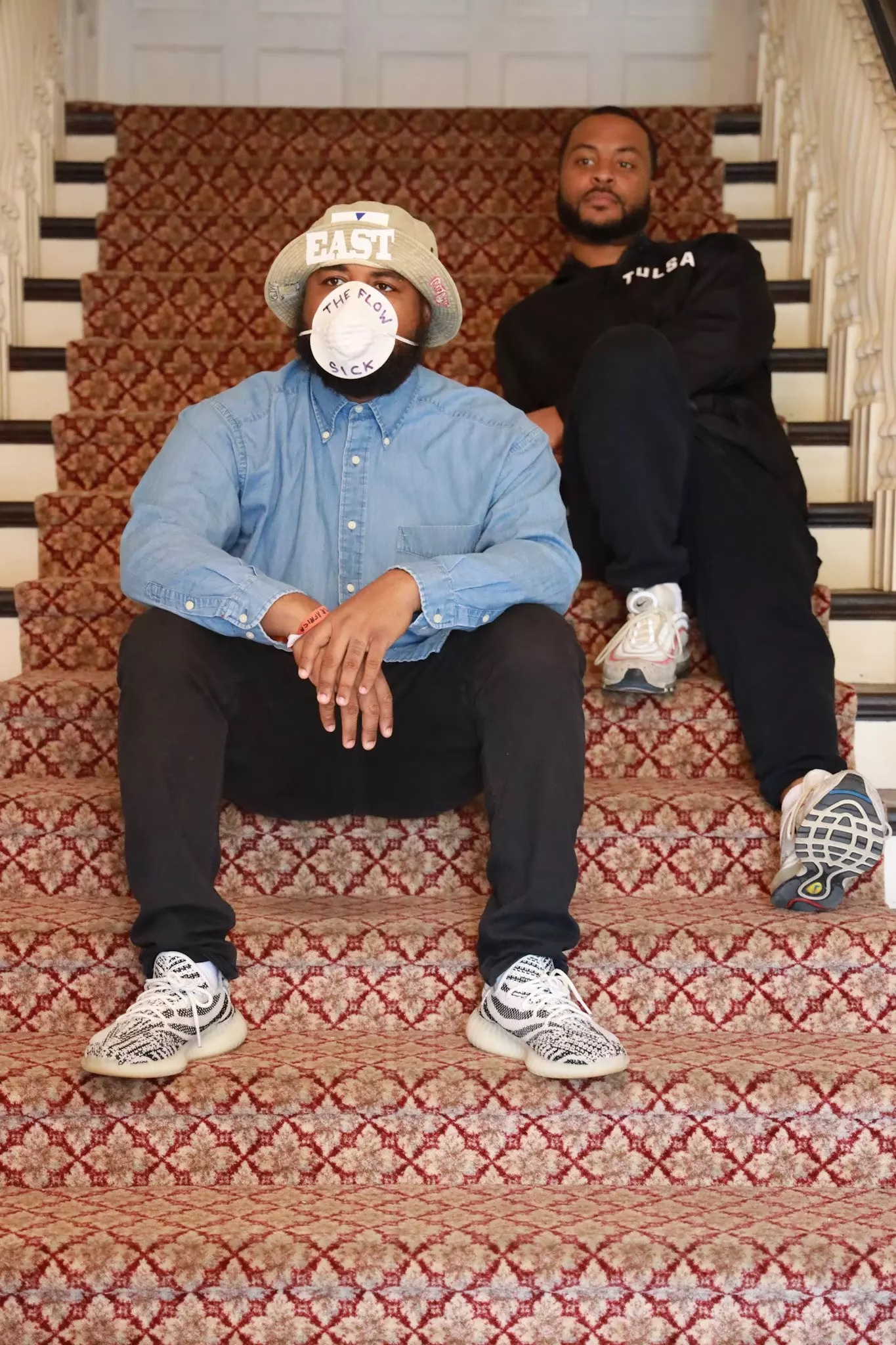
The foundation for Tulsa's hip-hop renaissance was laid nearly 100 years ago. Amid segregation in the early 1920s, the Greenwood District was the epicenter of African-American culture, entrepreneurship and wealth.
It was labeled as Black Wall Street. However, its legacy and impact were larger than a single strip of asphalt. Four square miles were littered with black-owned businesses, from barbershops to grocery stores to construction companies. Anything that the community needed to survive and thrive was present in abundance.
But on a summer night in 1921, one of the largest race riots in history changed the flourishing fabric of the city forever. Bombs were dropped from the sky and incinerated crimson brick structures down to fragmented black pieces of debris. Flames engulfed homes and forced families to watch cherished pieces of their livelihood turn to ruin. With one stroke of racial terror, a city that was once paved with metaphorical streets of gold became a literal hell on earth.
The history of the Tulsa Race Massacre was not taught in Oklahoma's public schools. For some, the concept of Black Wall Street was brought to them by hip-hop artist The Game, who named his now-defunct record label Black Wall Street Records. The company did not yield an immediate return in the hip-hop community universally, but artists in Tulsa took it upon themselves to promote the legacy of their hometown.
Fire In Little Africa is an album that aims to revitalize and embody the creative and entrepreneurial spirit that was stripped away from its citizens nearly a century ago. During one four-day weekend in March, hip-hop artists, producers, and engineers from around Oklahoma were brought to Tulsa to create a project to solidify themselves as a respected region for emerging talent.
The Greenwood Cultural Center was the host for the first night of studio sessions. Microphones, monitors and laptops were set up in every room available, some barely bigger than walk-in closets. Each room assumed a name from a business lost during the Tulsa Race Massacre; photos of the town’s survivors hung on the wall, seemingly monitoring each artist’s creative output.
"We’re just the vessels," rapper Steph Simon said. "The ancestors are telling us why this needs to happen."
Day 2 took place in the historical Skyline Mansion. The kitchen, living room, bedrooms, and even the basement—PVC pipes, ducts, concrete and exposed wood support beams abound—were turned into recording spaces. Photographers and videographers scattered about, working tirelessly to capture every moment of history being made.
On the second floor balcony, one couldn’t help but think of the irony taking place at the moment. A mansion designed to resemble the home of Confederate soldier Robert E. Lee and once owned in the 1920s by Ku Klux Klan member Tate Brady is now a revolving door of artists of various races creating one of America’s greatest cultural exports.
"I want to be GRAMMY-nominated, just to show people it’s possible," Simon said, on his walk from the kitchen studio to the second floor.
Though the aspiration is lofty, it’s not without precedent. The GRAMMY-nominated group the Gap Band ("Outstanding" and "You Dropped A Bomb On Me") was born in Tulsa and is a nod to the streets its band members frequented - Greenwood, Archer, and Pine. Additionally, the band’s lead singer, Charlie Wilson, earned 13 GRAMMY nominations as a solo artist and bolstered his hip-hop notoriety through collaborations with Snoop Dogg and Kanye West.
<style>.embed-container { position: relative; padding-bottom: 56.25%; height: 0; overflow: hidden; max-width: 100%; } .embed-container iframe, .embed-container object, .embed-container embed { position: absolute; top: 0; left: 0; width: 100%; height: 100%; }</style><div class='embed-container'><iframe src='https://www.youtube.com/embed/17lkdqoLt44' frameborder='0' allowfullscreen></iframe></div>
Still, Simon hopes that Tulsa’s music scene can become self-sustainable so artists won’t need to move outside of the city to jumpstart their careers. For others, the idea of relocating to take advantage of more resources is alluring.
"That’s something I’ve been debating for a few years but it’s easier said than done," rapper St. Domonick said. “It might be necessary if I want to speed up the process because I know the type of artist that I am and the type of city that we’re in. [People] might not get it for a while."
While Oklahoma’s creative scene is thriving, the need for prominent music businesses remains. Tulsa is hours away from the major hubs—Los Angeles, New York and Atlanta—that host many of the labels, publishing companies, and agents that an artist would need for mainstream success. For now, creative projects like Fire In Little Africa are supported by the George Kaiser Foundation and other non-profits in the city.
But Tulsa still has promise. Rolling Stone dubbed the city as a contender to become the next Austin—the live music capital of the world. Tulsa doesn’t host a SXSW-style event that brings in $355 million per year, nor does it produce an annual two-weekend festival with 450,000 attendees like Austin City Limits. But it does have the same humble beginnings and collaborative nature that attracted many musicians to Austin years ago.
Venues like Soundpony and The Colony open their stages up for emerging acts like Dialtone, Tizzi, 1st Verse, and Damion Shade to showcase their latest work in front of their hometown. The support from the crowds and cozy design of the venues even made 12-time GRAMMY winner Jack White a fan.
"The first day I came into town, just looking at it, I was really upset that nobody had ever told me about Tulsa," he told Tulsa World. “I walked into Cain’s Ballroom, and I basically almost fired my booking agent the moment I walked into that room. Why do I not know about this place? Why have I never been booked here? Why have you never even mentioned this? It was one of the most beautiful places I had ever seen. And the vibe when we played the show, it was just incredible.”
Though Fire In Little Africa won’t be released until 2021, the conversations around its significance have already begun. In a conversation with Tulsa’s professionals, thought leaders, and activists, rapper Thomas Who? candidly reminded everyone involved with the album, creators and supporters, alike, "If it doesn’t jam, it doesn’t matter."
Others hope for an impact that will resonate beyond the music scene.
"This is about saving black humanity," said Dr. View, Director of Education and Diversity Outreach for the Bob Dylan and Woody Guthrie Centers.
"Hopefully we can spark the minds of our generation," St. Domonick added. "If it’s not ours then hopefully it’s the generation after us."
One could easily piece together a full day’s playlist with Tulsa talent alone. Tracks off of St. Domonick’s 11:11 provides a unique blend of bounce and lyrical prowess to start the day. Steph Simon’s Born On Black Wall Street and Visions From the Tisdale supply residents and newcomers with audio roadmaps to help them navigate through every neighborhood within the city. Cuts like 1st Verse’s "Vsxoasis" produce the perfect soundtrack to drive down the unburdened Tulsa streets at twilight.
Ego and self-importance have yet to plague the artists who call Tulsa home. Communal success is a prerequisite for every studio session and live show—a practice that resembles the culture curated in Greenwood 100 years ago.
It’s unknown what Fire In Little Africa will do for its creators and the city it was conjured in. At the very least, it will serve as a new platform to educate the world about its tragic yet triumphant history and become a launching pad for a new generation of advocates.
"I want everyone to have a better sense of the town and our ability," St. Domonick said. "I want this to leave as ‘to be continued,’ to let people know that something great is coming."
How The Global Coronavirus Pandemic Is Directly Impacting Songwriters, Musicians And Artists
