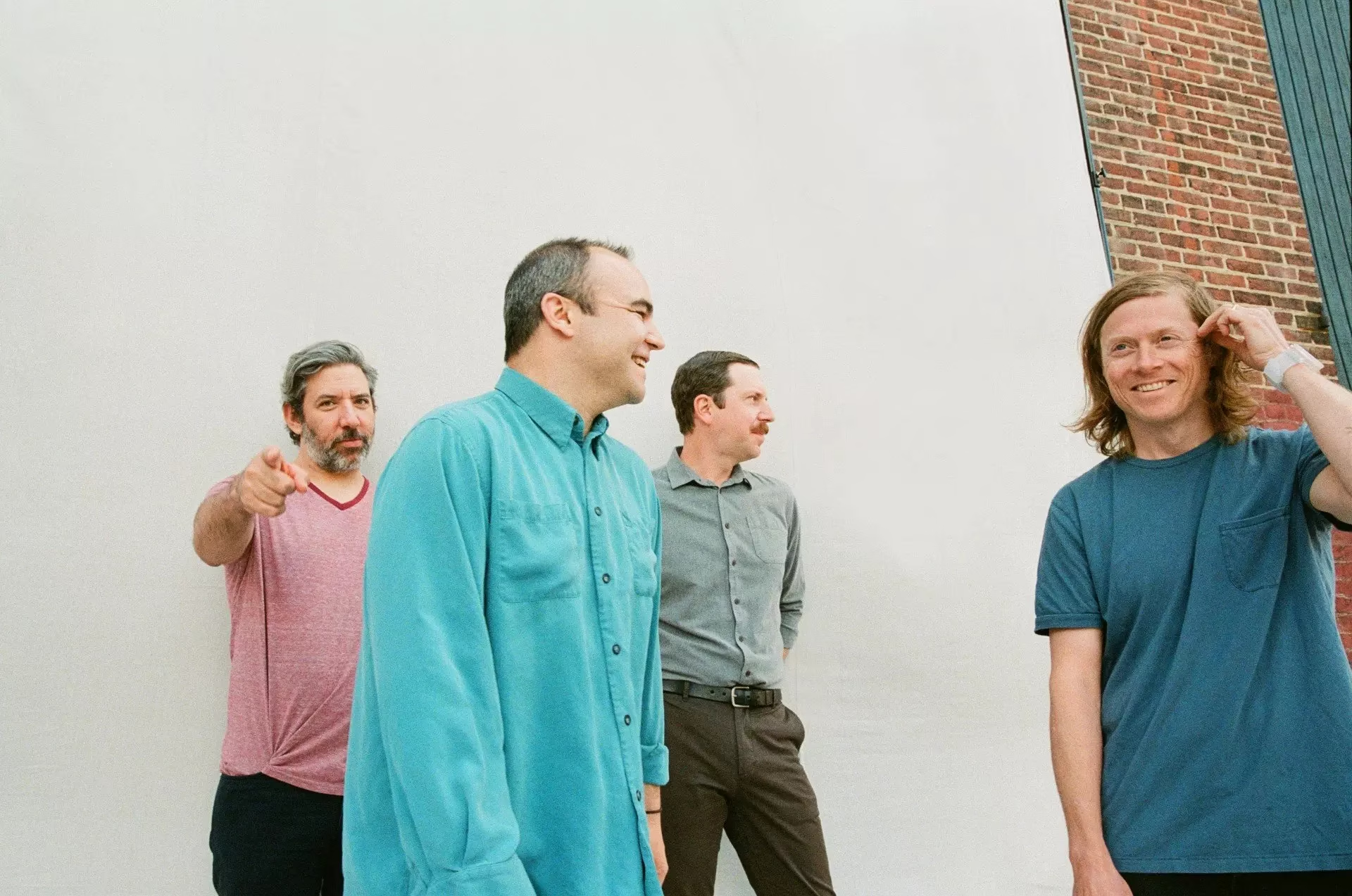
One of the most painful losses of the COVID-19 era has undoubtedly been the total and complete shutdown of live music—something synth-soul kingpins Future Islands, who are arguably best known for their hyper-vigorous, electrifying shows, mourn at their core. For years, since their 2006 inception, touring was practically all the Baltimore four-piece did—a cycle that only intensified after their 2014 network television debut on "The Late Show With David Letterman," where they made headlines with a stunning, viral performance of their breakout single, "Seasons (Waiting On You)."
"I'll take all of that you got!!" exclaimed the talk show host after Future Islands' groundbreaking set, which featured frontman Samuel T. Herring's now-famous head-bobbing shuffle, chest thumps and Sam Cooke-meets-Tom Waits growl. And so would the rest of the world: Following their network television debut, the band embarked on 22 straight months of touring. They dove in so hard, Future Islands (a.k.a. Herring, keyboardist Gerrit Welters, guitarist William Cashion and drummer Michael Lowry) barely had time to asses the changes their group had undergone in such a short amount of time. On their follow-up to Singles, 2017's The Far Field, the band wrote and recorded quickly and aimed to stick to a peppy Singles formula they knew worked. "I had misgivings about the release of that record," Herring tells GRAMMY.com over Zoom. "Going into The Far Field, we tried to act like nothing had changed. We were like, 'Let's not think about how everything has changed and just try to be the same band.' But really what we should have done was be like, 'Everything has changed and this is weird and we should write about it.'"
<style>.embed-container { position: relative; padding-bottom: 56.25%; height: 0; overflow: hidden; max-width: 100%; } .embed-container iframe, .embed-container object, .embed-container embed { position: absolute; top: 0; left: 0; width: 100%; height: 100%; }</style><div class='embed-container'><iframe src='https://www.youtube.com/embed/HYI1T0BwO70' frameborder='0' allowfullscreen></iframe></div>
Today, Future Islands are doing exactly that on their sixth studio album, As Long As You Are (out on Oct. 9 via 4AD), which finds them honestly processing their evolution as a band—and as individuals—in the way they might have liked to do on The Far Field. Synth-laden lead single "For Sure" breathes a sigh of relief at being able to truly lean on a partner ("When you say 'us' / You make me trust"), while opener "Glada" ponders new beginnings and whether or not Herring is worthy of love ("Who am I? / Do I deserve the sea again?").
Meanwhile, from an arrangements perspective, while The Far Field made a point of sticking to the pop-minded Singles blueprint, As Long As You Are frequently shifts to a more meditative, atmospheric mood, not unlike their third release, 2011's underrated On The Water.
Calling GRAMMY.com from Sweden, where his partner lives, Herring joined the rest of the group from their respective Baltimore homes to talk about the life-changing events leading up to As Long As You Are, being unable to perform in the Covid-19 era and the emotional catharsis Future Islands want to create in their music.
Sam, how long have you been in Sweden now?
Samuel T. Herring: I've just been here for four weeks on this trip. Me and my partner were separated for the first five months of the pandemic as far as the March lockdown because of borders closures and stuff. Then a loophole opened and I was able to get back here, but I have to travel back in a week to do the album release. So, I'm hoping that I can travel back without issue when it's time. It was hard to be apart for that long with everything happening in the world.
Of course. Putting aside the pandemic release timing, when did you start thinking about writing As Long As You Are?
Herring: We were already talking about this album when The Far Field came out and we were on tour. I had misgivings about the release of that record and definitely my contribution, I felt that I didn't work hard enough and I was a bit unhappy with that record. When we did Singles, the album before The Far Field, there was, we were on tour for 22 months. And then when we got off the road...we took ourselves off the road. We had offers that we left on the table because we're like, “We've been on the road 22 months for this record. If we don't get off, then we're just going to keep touring. And then we don't, how long will it be until we write the next record?”
But we never really had too many conversations about what happened to us in that 22 months with the exposure and the growth of the band. We hadn't adapted. We were still adapting to how big this thing had gotten for us. Something that was our baby, that we had slowly seen grow over time and worked so hard to get there... it just like exploded through Singles. The stages were bigger, the shows were bigger, the crowds were bigger. There were just more things, more responsibilities. And going into The Far Field, we tried to, I think, act like nothing had changed. We're just like, “Let's not think about how everything's changed and try to be the same band.” But really what we should have done was be like, “Everything has changed and this is weird and we should write about it.”
<style>.embed-container { position: relative; padding-bottom: 56.25%; height: 0; overflow: hidden; max-width: 100%; } .embed-container iframe, .embed-container object, .embed-container embed { position: absolute; top: 0; left: 0; width: 100%; height: 100%; }</style><div class='embed-container'><iframe src='https://www.youtube.com/embed/cdFhiNVQfb0' frameborder='0' allowfullscreen></iframe></div>
I think when we released [The Far Field], it was like, “Oh no, this is the wrong record or at this time.” Because I still think that record, in time, will be a classic part of our oeuvre. It's an important step for us and this album we had to make. Because sometimes you just have to release, you just have to put out what comes. But at the same time, I felt that we could have dug a little bit deeper and I, personally, could have dug a lot deeper.
So, we were already having this conversation in 2017. And then in 2018, still touring on The Far Field, we started to write on the road for the very first time. We would set up for sound checks and we were pretty streamlined at that point.
The thing is, when you're writing a record, it's the creative process. And when you're on tour, it's the business—a machine cycle, you know what I mean? Touring is the business: get to work, be on time, knock it out and then, do it again and do it again. So, you're constantly going from this tour cycle, which is machine work to then creative work and it's really difficult. And in the old days, we didn't have time to cut off between records. We couldn't afford to do that.
So, we would do two months of touring. We'd have two weeks off and we'd write a song or two, and then we'd take it out on the next two months’ [tour]. And if it survived, then it stayed in the set. And then once we had five or six songs after a year, a year and a half of touring constantly, then we would record an album and then keep touring, in between tours and then keep going.
We did that for five years, 2008 to 2012, until we wrote Singles. And what happens when you write songs like that, as we capture these tensions that are happening in [our] life at the moment. Not so much with Singles, but with The Far Field, I felt like we got off this turbulent tour, this long tour, we were just burnt out and we start writing. And the first three or four songs were just filled with so much emotion because of all of what we've just been through.
So really, As Long As You Are was... We just wanted to take our time and create a more balanced record.
<style>.embed-container { position: relative; padding-bottom: 56.25%; height: 0; overflow: hidden; max-width: 100%; } .embed-container iframe, .embed-container object, .embed-container embed { position: absolute; top: 0; left: 0; width: 100%; height: 100%; }</style><div class='embed-container'><iframe src='https://www.youtube.com/embed/yC_2tlsnpMw' frameborder='0' allowfullscreen></iframe></div>
Yeah, I can’t really begin to imagine the explosion of opportunities that must have hit you all after the "David Letterman" performance. And if you’re a band that hasn’t really seen that level of opportunity yet, maybe you just go has hard as you can, while you can. And you have to mindfully, intentionally make yourselves stop and reflect, or else you burn out. Do you remember if or when that moment came for you?
Herring: Definitely for me. But I felt that at the end of 2012—at the end of five years of touring—I felt burnout, and like, I don't know if I can keep doing this. And then we write our most accomplished record at the time after that, and then we do it again and then it's like, Oh, I don't know if I can do this. And then you do it again because the fact is you can't, I can't quit you.
It's a great love in a sense, this thing. Our friendship as a band that we've seen the world together and been through so many things in our lives together. Me and William and Gerrit have been playing since the beginning of 2003. So, it's like, 17 and a half years playing shows and being in vans and backstages. All of these cycles and becoming a part of people's lives, the audience, the people that have supported us. There's not a big difference between the people that have been there since 2006 and the people that have been there since 2016. The people that support what we do, they're a huge part of the equation that allows us to live our lives and to make this art.
And that's part of what the performance is about every time. Giving people what they came to see. That's what, that's a big thing about what Future Islands is about. It's about sweating for it.
Sometimes literally!
Herring: Yeah, very literally. But yeah, the burnout comes just because... I've said this in a few interviews, it's like you don't eat for a few years and then when you're in front of a buffet, you don't stop eating when you're full. You keep stuffing your mouth until you're sick and then you shove food in your pockets for later. And that's part of what you will always do. It's hard to go against that human instinct, but I think, we're getting older.
There's a maturing process, which I think is a big part of taking a step back and looking at what we've accomplished in a positive way. I used to worry that the “Letterman” performance put us into too much of a box, that it would make people think about us a certain way forever. But maybe its lasting legacy will be positive in that it makes people think about us at all.
"You don't find truth when you're writing that for someone else, you find truth when you're writing for yourself." — Samuel T. Herring
What would that box look like, you think?
Herring: Well, part of it is sound. I remember when we put out our third record, On The Water, I was like, “This record's going to be great because it's not going to allow anybody to generalize or think that they know what we sound like. Because In Evening Air, which is still such a great record to me, was a little bit more propulsive. And then On The Water was a reaction to that. It's like beautiful and ambient and swelling sounds and slow sounds. And so it was like, yeah, this will allow us to do whatever we want. I feel like The Far Field was us writing for the person that loves “Seasons,” like writing a record for them. Here's some other songs that are like “Seasons” that we wrote for you, unwittingly.
I just think we were writing great songs that were like, “Oh, people dig this vibe, we can do that.” You don't find truth when you're writing for someone else, you find truth when you're writing for yourself. That's the stuff that is going to resonate with people. When you're finding truth in yourself and sharing that truth in your art. That's what's going to resonate with people. And it may resonate with fewer people than if you're trying to reach a bunch of people, but if it resonates, but it's going to resonate very deeply with those fewer people. And that's more important than trying to reach a larger a crowd with something that could ring hollow in time.
<style>.embed-container { position: relative; padding-bottom: 56.25%; height: 0; overflow: hidden; max-width: 100%; } .embed-container iframe, .embed-container object, .embed-container embed { position: absolute; top: 0; left: 0; width: 100%; height: 100%; }</style><div class='embed-container'><iframe src='https://www.youtube.com/embed/GK4lD3Uf8_o' frameborder='0' allowfullscreen></iframe></div>
To me, As Long As You Are kind of sounds like a nice mix of more ambient On The Water energy, and then also there are a few fast-paced Singles-esque songs. Was striking a career-overview balance something you were thinking about?
William Cashion: I think we just wanted to make the record have a more varied sound than The Far Field did. And then I go back to some of the ghost and the dust that we had on records like In Evening Air or On The Water. These little experimental, weird, distorting sounds. We wanted to experiment in the studio. Just kind of push the edges of what we do. And part of that is the approach to the songwriting. From The Far Field, every song on that record was written with me, Sam and Gerrit in a room jamming. And that was something I remember we talked about. “Seasons” was written like that.
That song really did something special. We [thought], that's a good formula. Let's not mess with that. But in doing that, we kind of ignored other aspects of our writing. So, we have songs on this record that were written with all of us in a room, like “The Painter” and “Hit the Coast” and “I Knew You.” But then there's a song like “Thrill.” That's a song that Gerrit brought forth to the band, and then “Born In A War,” that came from me, and Mike worked on an idea and brought it to the guys. And then there was a couple of old ideas that I brought to the band back in 2015, like “City's Face.” But the version that's on the album is nothing like the original demo of that song.
I’m sure you’re going to be asked many times, so I apologize in advance for the repetition. But as a band that has built such a huge following around your live performance, how is the prospect of not touring this record sitting with you—aside from the "A Stream Of You And Me" show in October?
Cashion: Well, we're trying to figure out new ways to get out there. Because that's really what we understand the best: touring. And so, if we can't do that, we're talking about starting to write the next record. After this record comes out, we've already got a couple of songs that were recorded for As Long As You Are, and at least one of them we think might be on the next record. But who knows what the next batch of songs will sound like. We keep talking about it, but we can't really focus on it, I don't think, until after October 9 when the record comes out. So once it's out, then we'll try to think about writing and performing again, because it's looking like it might be another year before we can tour again.
It would be nice if we had another release [by then]. I don't want to put pressure on ourselves by saying we're going to [release something else]. We don't want to pressure ourselves by forcing ourselves to do another record in a year. But that would be nice, or maybe an EP. But our records have this pattern, starting with In Evening Air, when we took all the time in the world. On The Water was made really quick, in like a year. And then we took our time with Singles and then The Far Field was really quick, like in a year. And so As Long As You Are, we're continuing the pattern. We took our time with this record, and I'm really hoping that we don't inadvertently continue the trend and make the next record really fast simply because we want to get the record out in time for whenever we tour next fall or whatever. If we tour then.
<style>.embed-container { position: relative; padding-bottom: 56.25%; height: 0; overflow: hidden; max-width: 100%; } .embed-container iframe, .embed-container object, .embed-container embed { position: absolute; top: 0; left: 0; width: 100%; height: 100%; }</style><div class='embed-container'><iframe src='https://www.youtube.com/embed/MlQunle406U' frameborder='0' allowfullscreen></iframe></div>
Herring: Do you guys, do Gerrit and Mike, do you want to talk on that? Being off the road?
Mike Lowry: It's a huge bummer. I'm all about being on the road and playing shows and I feel like I still hadn't really accepted the reality of our situation until a couple months ago. Still, every day is an exercise in accepting that it's just not going to happen and there's nothing I can do about it. And that's definitely been a challenge because, for me, performing live is a big part of how I, especially being a drummer, share my art with people. It's extremely disheartening. I'm kept up at night sometimes thinking about, “Maybe we could do this,” and there's just no way around. The whole world is going through this thing. It is just f**king driving me crazy, honestly. But I'm trying to use the time wisely and try to work out some things in some other areas, musically.
Do you guys remember Dan Deacon’s Baltimore Round Robin shows? Maybe it’s time to get a livestream going with every still-active Baltimore band.
Herring: At Le Poisson Rouge! I'll text Dan Deacon right now about it.
We only have time for one more question, so I’ll leave you with this: All of your records, in their own way, thoughtfully blend themes of internal pain and optimism. As Long As You Are is certainly no different. How do you all stay hopeful in 2020?
Herring: Well, I've been asked about optimism in the new album and then talking about optimism in our past songs, even in darkness. And I think as much as it's something that I personally, lyrically and emotionally, as a performer, want to share with an audience, it's also something I want for them, for the audience to be able to feel strength in vulnerability, to be able to be emotional and open with the people around them, the people that they know, their friends and family, but also the people they don't know. The way we lack empathy in our society at times, the way we misunderstand or mischaracterize one another... But I think some of the optimism that's inborn in Future Islands' music is my own hope for myself and my hope for the guys and their families and my own fears. My own fears of what my dark mind creates, like my own battles with depression and my own understanding that I also need to hear it.
I need to speak it because that gives me hope too. It's inborn of something that I need to hear, and that I need to tell myself to keep me going. Because I think it's really easy to forget about all the people who care about us in our lives, especially at a time like this, where we're so overcome. And I think even going through being away from my partner in this beginning of the pandemic, I didn't feel personally slighted because I knew the whole world is affected by this. So I'm like, well, at least I'm not alone in that. But, I have friends also say, "Yeah, but you can still feel that." I think it's just important to look out for one another.
Future Islands has always been about that catharsis. We've always wanted to create that in our music and in our live shows, which unfortunately we can't do right now. But we are about keeping people moving, whether their hearts or their feet.
Yeah. "Balance" in particular has always, well, balanced me out when I’m stressed.
Herring: It just takes time.
Dan Deacon Talks 'Mystic Familiar', Meditation & Befriending Val Kilmer