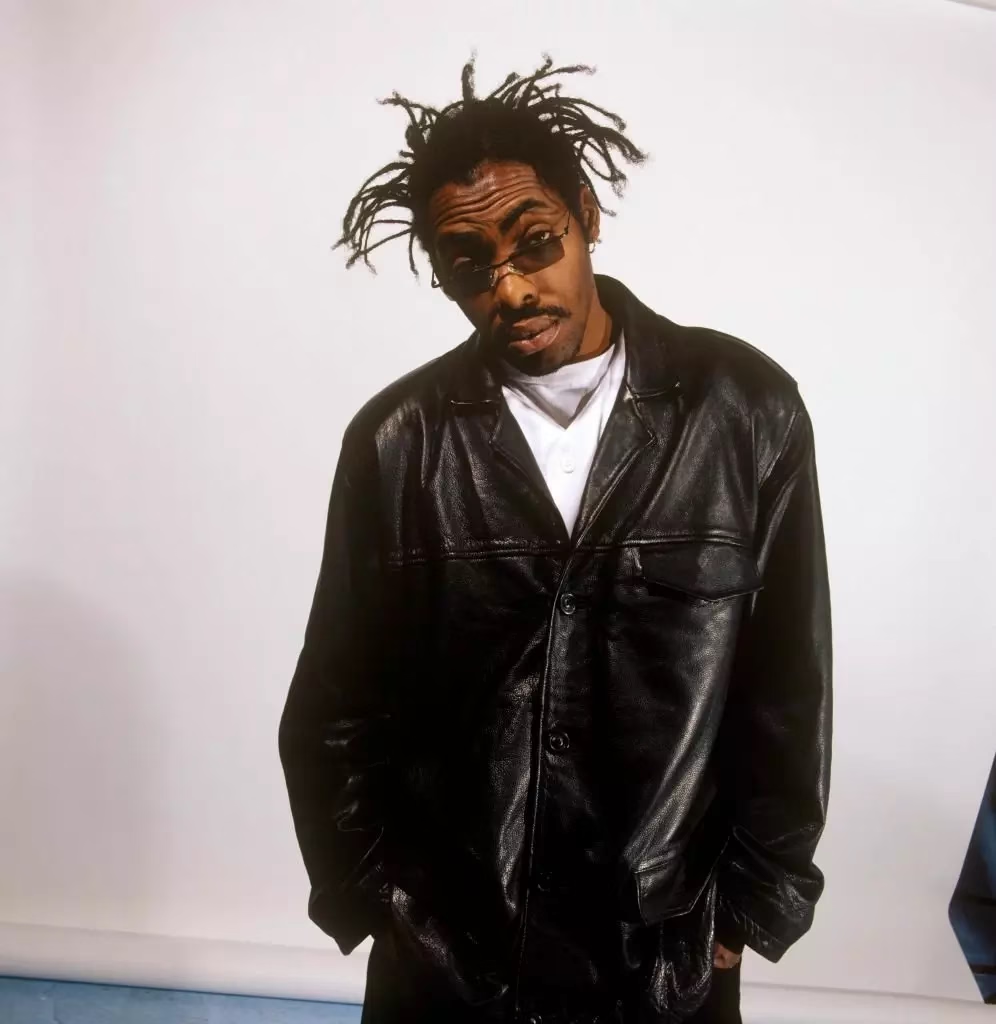
"My first thought when I listened back to the demo of ‘Gangsta’s Paradise’ was ‘Man, the hood’s gonna love this shit,'" recollects Coolio. "I was so excited about sharing it with everybody."
To be clear, the "everybody" Coolio was initially thinking of was just his record label and his friends—"My day ones and my homies that I trusted to give me a real opinion," he states. However, soon enough that "everybody" he was excited to share his new song with would substantially grow to include millions and millions of music fans around the world, as "Gangsta’s Paradise" became a chart-topping, multi-platinum global hit throughout the fall/winter of 1995 and well into the summer of 1996.
More than just a flash-in-the-pan genre hit, "Gangsta’s Paradise" hit No. 1 on the Billboard Hot 100 pop charts, became the best-selling single of 1995 across all genres, and helped to mainstream hip-hop in previously uncharted ways. Both albums it appeared on—first the Dangerous Minds soundtrack and then his own sophomore album Gangsta’s Paradise—were quickly certified multi-platinum, while the single itself sold over three million copies on its own. The song took off with international audiences as well, reaching No. 1 in the United Kingdom, Ireland, France, Germany, Italy, Sweden, Austria, Netherlands, Norway, Switzerland, Australia, New Zealand, Scotland and Zimbabwe, just to name a few.
To celebrate the monumental milestone and acknowledge the song's expansive legacy, Coolio’s Gangsta’s Paradise album is getting a special 25th Anniversary vinyl reissue for Record Store Day this Saturday (Sept. 26). While Record Store Day has typically taken place on a single day in April every year since its inception in 2008, this year’s event has been spread across three separate dates in August, September and October due to the COVID-19 pandemic. The special RSD edition of Gangsta’s Paradise has been remastered, pressed across two heavyweight 180g red vinyl records, and features some previously unreleased bonus material on the flipside of its second disc.
GRAMMY.com recently interviewed Coolio to get the story behind the creation of his signature song, his recollections about the globe-trotting rollercoaster ride the song took him (and hip-hop itself) on, how he views his place in hip-hop and what he is working on these days.
<style>.embed-container { position: relative; padding-bottom: 56.25%; height: 0; overflow: hidden; max-width: 100%; } .embed-container iframe, .embed-container object, .embed-container embed { position: absolute; top: 0; left: 0; width: 100%; height: 100%; }</style><div class='embed-container'><iframe src='https://www.youtube.com/embed/fPO76Jlnz6c' frameborder='0' allowfullscreen></iframe></div>
Coolio: Honestly, my memories are still so clear of exactly how "Gangsta's Paradise" came to be. I had gone over to my manager’s house to sign for a check. He had this nice little house at the beginning of the Hollywood Hills and he had an office and a little recording studio there. That day, a producer named Doug Rasheed was working on some stuff and when I walked past the studio, I heard the beginning of the track start playing. Now, the crazy thing is, I am a huge Stevie Wonder fan—one of the very first records I ever bought in my life was Stevie Wonder’s "Superwoman" single—but for some reason, I don’t remember ever hearing "Pastime Paradise." Anyway, I heard the music playing, so I went in to see what was happening. L.V. was there and he was already working on the hook; not recording, just riffing with it. When the music stopped, I said to Doug, "Wow, that’s kind of dope. Whose track is this?" He told me it was just something he was working on, so I said "Really? It’s mine now."
He was excited about that, rewound the track, and I started freestyling over it. The first line just came right out: "As I walk through the valley of the shadow of death, I take a look at my life and realize there’s nothing left." As soon as I said that, I sat down and wrote the whole thing without even having to think about it. I’m telling you, my head stayed down the whole time and I never even picked up the pen. That’s the only song I’ve ever had that experience with. I say I didn’t write "Gangsta’s Paradise"; it was already there and just chose me as a vessel to come through.
I should say though, about two or three years ago, L.V. started telling some made-up new story about "Gangsta’s Paradise" and it’s such bullshit. He said that he was trying to get me on the song for a couple weeks before I finally showed up. When I heard him say that, I’m not going to lie, I was ready to get funky. I was ready to start some shit with L.V., but I didn’t because if we would’ve started something, neither one of us would’ve gotten hurt but one of our children or friends could’ve gotten hurt. That’s where it would’ve went. So, I left it alone for that reason. He was trying to bait me to get some recognition or something, but I wasn’t going to go there.
After finishing up a rough demo of the song that same day, Coolio sent a copy to his record label, Tommy Boy. However, although Coolio was extremely excited about his new song, the lukewarm response he got back from the label surprised him. The general consensus around the office was that it would make a good album cut, but they didn’t hear it as a potential hit. Undeterred, Coolio found another avenue for the song’s release with an equally excited business partner.
Coolio: At the time, I had also met with Kathy Nelson who did song acquisitions for movies. She heard "Gangsta’s Paradise" and went absolutely crazy for it. She told me she knew exactly what she wanted to do with it. She mentioned this Michelle Pfeiffer movie that they were trying to get ready for a full nation-wide release that wasn’t scoring well with test audiences. She was like, "I love it; I have to have this song for that movie.” My manager sent her a rough copy and they put it in the movie for the next round of test audiences. It changed the dynamic of the movie so much and they got the emotional response from the audience that they were looking for. I called Tommy Boy to make sure they thought it was still just an album cut and then said, "So I guess you don’t mind if I use it on a soundtrack." They were fine with it, so I went back to Kathy and worked up a deal. They paid me as much for that one song as most rappers were getting to record a full album back then. That’s how much they wanted it for the movie and the soundtrack.
<style>.embed-container { position: relative; padding-bottom: 56.25%; height: 0; overflow: hidden; max-width: 100%; } .embed-container iframe, .embed-container object, .embed-container embed { position: absolute; top: 0; left: 0; width: 100%; height: 100%; }</style><div class='embed-container'><iframe src='https://www.youtube.com/embed/gA-5nLQCmW8' frameborder='0' allowfullscreen></iframe></div>
The Pfieffer-fronted Dangerous Minds opened in the late summer of 1995 and became an instant box office hit. It grossed almost $180 million worldwide and even spun off into a television series. Pfieffer also appeared with Coolio in the heavy rotation "Gangsta’s Paradise" music video, which won Best Video from a Film and Best Rap Video at the 1996 MTV Video Music Awards. However, as inextricably linked as the song and movie were, Coolio wasn’t exactly a big fan of the film’s "white savior" theme.
Coolio: I didn’t like the movie that much because it was another one of those where the almighty white teacher comes in and saves the little minority kids because she’s so good at her job. That happens rarely, if ever, and it never happens the way she did it. That’s some bullshit.
At the same time though, it was a huge movie. I’ve had three or four generations of families come to my shows and tell me that they first got into my music from seeing that movie.
With the movie still in theaters, "Gangsta’s Paradise" was released as the lead single from the Dangerous Minds soundtrack and simultaneously held the No. 1 spot for three straight weeks on their respective Billboard Hot 100 and Billboard 200 charts. Both the single and the soundtrack would go on to each be certified triple-platinum. Coolio’s own Gangsta’s Paradise album would be released that November and would also be certified multi-platinum itself by the following April. Globally, the song achieved the same level of multi-platinum, chart-topping successes in an impressively long list of countries—some of which had little-to-no prior engagement with American hip-hop.
Coolio: That song seriously went worldwide! They gave me this big plaque that has about 50 different flags representing countries were "Gangsta’s Paradise" became a hit. That song took me places I would’ve otherwise never gotten to see and it took hip-hop places it had never been. There was something like 10 different countries where I was the very first hip-hop artist to ever play a show there: Pakistan, Azerbaijan, Kosovo. I did a concert, I think it was in Romania, maybe, where they only had like three television stations and they broadcast my concert on all three channels.
The song’s sweeping success meant Coolio had a pretty eventful ’95-’96 awards season as well. Not only did he take home a GRAMMY for Best Rap Solo Performance and an American Music Award for Favorite Rap/Hip-Hop Artist (with a variety of other nominations), but he also turned in a couple standout awards show performances—including an unforgettable version of "Gangsta’s Paradise" with Stevie Wonder at the 1995 Billboard Music Awards. However, by the time Coolio’s third album, My Soul, came out in 1997, the shine on Coolio’s rising star seemed to have significantly cooled. Though according to the rapper, that had more to do with his record label than the record itself.
Coolio: As a full body of work, song-for-song, My Soul was a better album. That shit was straight fire. Lyrically, I had stepped it up. The only MCs writing shit like "Can U Dig It" and "Knight Fall" was Pac and Nas and maybe Scarface. Ice Cube wasn’t even writing like that at the time. My label released "Ooh La La" as the single but that should’ve never happened because it’s not who I am. That’s not what people wanted to hear from me at that time.
Tommy Boy f**ked up with that one and personally, I think they did it on purpose. They had a pattern. Tommy Boy had this in-house lawyer who was an idiot. He did everybody’s contracts pretty much the same. Basically, if your first album went platinum, you got a bonus and a boost on your royalty percentage. Same thing if your second album went Platinum, just bigger. If your third album went Platinum, they had to pay you even more in a bigger jump. Tommy Boy didn’t want to give up that kind of money. I honestly think they sabotaged all of their artists' third albums on purpose so that they didn’t have to make those big payouts.
<style>.embed-container { position: relative; padding-bottom: 56.25%; height: 0; overflow: hidden; max-width: 100%; } .embed-container iframe, .embed-container object, .embed-container embed { position: absolute; top: 0; left: 0; width: 100%; height: 100%; }</style><div class='embed-container'><iframe src='https://www.youtube.com/embed/nGYcgqUbVMQ' frameborder='0' allowfullscreen></iframe></div>
Seriously, just look back at Tommy Boy’s roster. Naughty by Nature: first album, Platinum. Second album, Platinum. But their third album didn’t really blow up. Digital Underground: “Doowutchyalike” and “The Humpty Dance” on the first album, “Kiss You Back” on the second album, where was the big single from the third album? De La Soul or House of Pain, can you name their third albums? Queen Latifah only got two albums on Tommy Boy. Don’t that sound like a pattern to you?
While sales figures and chart performance are one way to gauge an artist’s impact and legacy, it’s also important to look at what happened to other artists and the genre in the wake of those successes: What doors were opened for other artists? How did the genre grow? What boundaries were pushed? What bars were raised? For "Gangsta’s Paradise," one of the more notable markers of its importance can be seen by looking at the Billboard Hot 100 chart-toppers before and after the hip-hop classic became a global smash. In the early ‘90s, the only hip-hop-adjacent songs that went to No. 1 had more of a pop-polished sheen to them; songs like Kris Kross’s “Jump” or Sir Mix-a-Lot’s “Baby Got Back,” for example. The year after Coolio took the more authentically gritty "Gangsta’s Paradise" to the top, songs by Bone Thugs-n-Harmony, Tupac, Dr. Dre, and Blackstreet all became No. 1 hits on the Billboard Hot 100.
Coolio: "Tha Crossroads" is a great song, no doubt, but I don’t think it would’ve been as big as it was if it weren’t for "Gangsta’s Paradise." "Gangsta’s Paradise" really opened the door for that style of hip-hop to be at the top. I feel like I don’t get the proper recognition for stuff like that, from the industry at least. When people start doing these best MCs, best rappers lists, I’m never on any of them. It doesn’t bother me so much anymore, but when I was younger it didn’t really sit right with me. But now I know where I sit and what my value and contribution to hip-hop is. I know how much work and dedication I’ve given to it and the lengths I’ve gone to make it. When people hear me rap or see me live, they know it’s real hip-hop. They feel the spirit, like they’re in church or something. If you get it from the people, that’s when you know it really means something anyways.
Some of the rap music that makes it on those lists, I know that they’re not on my level, so it makes me laugh. Especially now, being 57 years old, I know my skills and my ability to adapt my style. Having a versatility of styles and being clever with your words, for some reason, that’s not valued as much anymore. A lot of MCs that get recognition for being the best, I don’t really get it because many of them rap the same on every single song. They say the same things in the same way over and over and over. It’s the same cadence, the same style of words. To me that shouldn’t put you in league with the greats, because what have you really done? Being able to mix it up is what makes you great.
Coolio and L.V. at the the 36th GRAMMY Awards in 1996
Photo by Ron Galella, Ltd./Ron Galella Collection via Getty Images
Not to disrespect anybody, but take someone like Jay-Z. He’s known for being one of the best lyricists of all time, but I disagree with that. I’ll admit, he can switch his style up every now and then, like with “99 Problems” or “Empire State of Mind.” But like, the style that he used way back on “Hard Knock Life,” he still uses that style constantly as his main go-to style. I’m not a huge Jay-Z fan but I do give him credit for what he’s done on the business side of things. Being able to become a billionaire, coming from nothing. I will give all things due him for that. But as far as being one of the greats, to me, he’s not on the same level as Nas as a lyricist. That battle they had, Nas won that, no question.
Even with his biggest hit celebrating its 25th anniversary, Coolio is showing no signs of slowing down any time soon. In fact, after sporadic periods of his music taking a backseat to various other creative projects over the years—cooking shows, reality TV appearances—he’s back to writing, recording and collaborating on a wealth of new material. Though, as a seasoned veteran looking to make his mark again in an ever-evolving musical landscape, he’s still trying to determine the best way to get his new songs out when they’re ready.
Coolio: I’m working on a new collection of songs right now and I feel like I could write about anything. My writer’s block is finally broken and I feel like I’m in my 20s again, lyrically and style-wise. I just did a song with Too Short and Spice 1. I got another one called "We Got the Power" featuring Treach from Naughty by Nature. I’m supposed to do something with Obie Trice when he gets out of prison. I’m also going to try and get a feature from Eminem as well. The way he works is swapping features: he does one of yours, you do one of his, and no money is exchanged.
<style>.embed-container { position: relative; padding-bottom: 56.25%; height: 0; overflow: hidden; max-width: 100%; } .embed-container iframe, .embed-container object, .embed-container embed { position: absolute; top: 0; left: 0; width: 100%; height: 100%; }</style><div class='embed-container'><iframe src='https://www.youtube.com/embed/poWXLuGjPd0' frameborder='0' allowfullscreen></iframe></div>
We’re probably going to start dropping some singles next month; do them one at a time until we run out of material. Unless you’re someone like Kendrick Lamar or Drake, it doesn’t really make sense to put out traditional albums anymore. But who knows, I might take a chance and do an old-school album with interludes and skits and everything. For a while, music wasn’t any fun for me. I had a period where I think I went through a depression without really knowing it. There were a number of years where I didn’t write very much. But I’m having fun doing music again.