Next time you watch an artist's press cycle roll out, know this: In many instances, they're sick of the record before it's time to promote it. "I certainly have gone through periods of 'I hate this. I don't even want to put it out,'" Gary Louris tells GRAMMY.com over the phone from Hamilton, Ontario. "Or, 'I absolutely love this.'" Back in 2020, with his band the Jayhawks' album XOXO taking priority, Louris waited—and waited—to put out his solo record, Jump for Joy, as well.
While this may seem like a recipe for hating your own creation, the 66-year-old kept Jump for Joy at something of a distance, not overthinking or smothering it. As a result, Louris is elated to put out a record that feels refreshingly weird and untouched yet with his fingerprints all over it. "In this case, it's worked because of COVID and I'm excited to have something I like coming out," he adds. "And I've also made the decision that I'm not going to wait for the record company anymore."
<style>.embed-container { position: relative; padding-bottom: 56.25%; height: 0; overflow: hidden; max-width: 100%; } .embed-container iframe, .embed-container object, .embed-container embed { position: absolute; top: 0; left: 0; width: 100%; height: 100%; }</style><div class='embed-container'><iframe src='https://www.youtube.com/embed//R54IpVpxHT4' frameborder='0' allowfullscreen></iframe></div>
Jump for Joy, which arrived June 4 on Sham/Thirty Tigers, is Louris' first solo album in 13 years. (He last released Vagabonds in 2008.) But while enjoying the intimate, homespun pop songs within, like "New Normal," "Mr. Updike" and "Follow," know that you're not going to have to wait two-and-a-half presidential terms for the next one. A newlywed hitting a new seam of creativity, Louris plans to keep self-producing songs and putting out the results on his website and Bandcamp.
The new album isn't the only thing on Louris' docket: He's been covering the Beatles' White Album in full on his Patreon page; goofing off with his son, Henry, on his music-filled YouTube show, "The S**t Show"; and jamming wild prog records like Yes' Tales from Topographic Oceans. The interior feeling of Jump for Joy sums him up right now: Touring and hitting the studio may not be big priorities, but he's got a wellspring of ideas percolating inside.
GRAMMY.com gave Gary Louris a ring to discuss the long gestation of Jump for Joy, why the next one won't take so long, and which song on the album stemmed from a rejected AT&T jingle.
This interview has been edited and condensed for clarity.
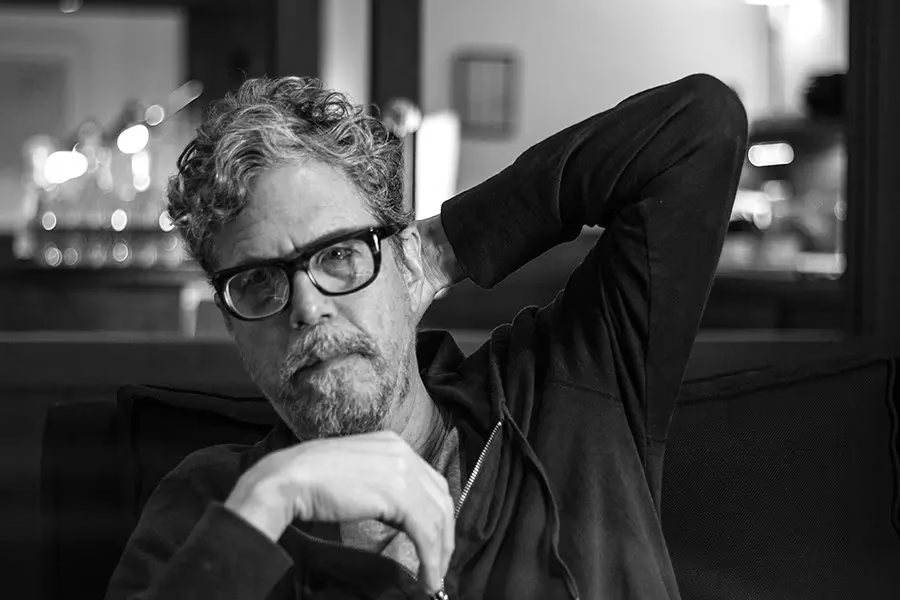
Gary Louris | Photo: Tim Geaney
While listening to this album, I didn't have a single thought of, "That song sounds like Hollywood Town Hall" or "That part sounds like Tomorrow the Green Grass." I just thought, "That sounds like the Kinks. That sounds like Yes." Is there a faction of your fan base that just wants you to make those two records over and over?
There's definitely a schism we created when we did Smile, even Sound of Lies a little bit. Some people abandoned ship. They didn't like it. Bob Ezrin produced Smile, and I remember that he kept telling me, "Gary, you don't have to be reverential to your audience. Lead, don't follow them."
I grew up listening to pop music and prog rock. Everything English was what I listened to. I didn't grow up in South Carolina listening to Appalachian music. I didn't have brothers or parents who played Crosby, Stills and Nash records. I fell in love with British music. I wanted to be British. I wanted to be in the Who or the Kinks or the Beatles. And then prog rock, hard rock, English punk rock, everything.
I didn't really discover Americana until the '80s. I was like, "This is new, this is cool. I'm not British, and I can take certain things—the soulfulness of that." But underlying everything is always a big, heady dose of British music. English, Anglophile prog and pop, for me. That's what I listen to more than [anything]. I don't listen to roots rock much.
While watching your cover songs on "The S**t Show" and checking out your White Album project, I was thinking that you have a versatile voice, one that can handle all those different songbooks and canons. Where do you want to go with the canon in the future?
Well, it's funny. As you called, I was uploading my latest White Album song I did today to my Patreon page. I did "I'm So Tired."
Originally, I thought, "I want to do something where [it's not] my own music." So I picked the White Album because it's one of my favorites. I recently thought, "Why didn't I do something like Yes' Tales from Topographic Oceans or something really bizarre?" I'll tell you why: Because people would think it's a pompous and difficult prog-rock album to play. But I love that kind of stuff.
My focus is always on writing my own music. However, during the pandemic, I just kind of embraced learning cover songs, which I never really did that much. It teaches you something. It inspires you. And if you're asking what I want to explore as far as covering?
I meant more along the lines of what might infect your own work. Like if you'll make your own super-prog album or British folk album someday.
This is kind of where I ended up, which is kind of prog with a sort of classic pop structure. It still has a sense of American folkiness, which I can't help because I'm American, I guess.
There's always some kind of weird mixture that makes me happy, that seems to balance what I do. And I can do things that I don't do with the Jayhawks, because not everybody likes exactly what I like in the band. I can't force people to play some synthesizers they don't feel like playing. So, I get to explore a little bit more on my own.
I know "New Normal" is an older recording, and the Jump for Joy press release says the songs span decades. I'm curious, though; do the recordings span decades as well?
That's the only one, although I have other recordings I'm finding. Honestly, I'm ashamed of how long it took me between solo records. Life happened and s**t happened and I still have a band going. I want to put out more, much more often if I'm able. But I'm finding other things I like from the old days. "New Normal" is the only one from 2009 or something like that.
All the rest were recorded in the last two and a half years, but they have been around and finished since 2003. The business being what it was, with the Jayhawks putting out a record, it felt it was better to just wait. And now, I'm kind of glad I did. I grumbled, going like, "I want my record out. It's been sitting here."
But now it's kind of new to me ... Because the Jayhawks aren't really getting together to write in the near future, it's like, "Wow, I have something coming out." I'm learning how to play them again. So, it turned out to be good timing. Almost all the songs were just recorded in a little room.
It's kind of stripped down with a lot of buzzy, fuzzy things going on. Were you inspired by the arrangement palette of any particular record from the past?
No, I just love electronica. If I listen to music, I prefer to listen to something electronic. I listen to a lot of things that are not as song-based as you would think because I'm not thinking about how somebody wrote a song. It's just repetitive, electronic stuff.
I knew I wanted to include that because it's very satisfying for me to program things and get them to be in sync with each other, because most of the music I've made with the band has a soulful sloppiness to it that's fun. But, sometimes, I want to go in the other direction.
<style>.embed-container { position: relative; padding-bottom: 56.25%; height: 0; overflow: hidden; max-width: 100%; } .embed-container iframe, .embed-container object, .embed-container embed { position: absolute; top: 0; left: 0; width: 100%; height: 100%; }</style><div class='embed-container'><iframe src='https://www.youtube.com/embed//fxqMjljRSpA' frameborder='0' allowfullscreen></iframe></div>
Something about "Almost Home" makes me feel like it was plucked from your memories. What's going on in that song?
It started as a commercial and then evolved into another commercial. I'm not very good at this commercial work because I write too much of a song, where they really want [something smaller]. And I don't do it very often; it's not something I wholly seek out so much as it comes up once in a while. I think, "Well, nobody's buying records anymore anyway." If I have to write something for a commercial, I'm not going to apologize for it.
I did a song, I think, for AT&T. It was "Almost Home." It's about calling and being far away from home and hearing somebody's voice. I just had that little chorus, and they didn't use it. Years later, it sat around, and a friend of mine who worked for an agency said, "This other company's looking for something." I played him different things and he said, "I love that." I worked on it, and of course, too many people got involved and it got diluted and they didn't use it.
But it always stuck in my head: "This is a really catchy song. I should make it into a real song." Because it didn't have a verse; it was just a little riff-y thing. I decided to write something unusual for me, which is more of a story song—less imagery and muddled. It's an ode to my wife.
How about "Living in Between"?
I like songs that are really simple. I like both—I like songs with 20 parts, too—but writing a song with two or three chords with a verse and chorus that share the same progression, I always find that something to aspire to. There [are] a lot of songs I write that I notice are questioning—the meaning of life or what we're doing here or being in the moment.
That song is certainly a question of why I am the age I am and when somebody asks me what I believe, I'm not sure what I would say. I've been seeking and looking and I still don't know.
What can you tell me about "White Squirrel"?
"White Squirrel" is another song that's three chords, I think. Thematically, it's about people who don't fit in. I think it started when I read about a young trans person feeling trapped inside a body that wasn't their own—getting to know more about trans people and expanding to people who always feel out of place, out of sorts, out of sync, not really comfortable in this world.
I guess it's just saying, "You're not alone," and hoping that might help somebody.
In your public school days, did you feel like the odd man out?
Well, it was a private school. It was an all-male, Jesuit, coat-and-tie thing. I think I certainly had some of that in me, yeah. I think that's why people pick on musicians.
We already touched on "New Normal," and I feel like you've talked about that one a lot, so let's skip over to "Mr. Updike."
I'm just a fan [of John Updike]. He wrote about rich, quotidian events. Everyday, kind of small things. I just fell in love with his writing. I'm currently in touch with the family as I might make a video, which is my favorite thing to do now. I discovered iMovie, and my wife and I are making videos for all these songs.
It's just an ode to the writer's life. The thought that creating an idea from nothing and making it artistically happen makes a lot of things in life pale. It's like a high you chase because it gives you purpose and power and it's something unique you can keep going to.
<style>.embed-container { position: relative; padding-bottom: 56.25%; height: 0; overflow: hidden; max-width: 100%; } .embed-container iframe, .embed-container object, .embed-container embed { position: absolute; top: 0; left: 0; width: 100%; height: 100%; }</style><div class='embed-container'><iframe src='https://www.youtube.com/embed//sJBtTBa_doQ' frameborder='0' allowfullscreen></iframe></div>
What about the song "Follow"?
It's just a straight-up love song. It's become a song for my wife, but I originally wrote it for my niece and her husband as a kind of wedding gift. I played it at their wedding. Then, I rewrote it and it's kind of for my wife and I.
And how about "Too Late the Key"?
That one's a little older. Now, that one's a slightly older recording also. It's another questioning, longing song. "Have I made too many mistakes? Have I made too many wrong turns? Am I broken? Will I be able to walk through that door if it opens again? Or am I just too jaded and broken to be open anymore if there's something going on?"
You play a lot of guitar on "One Way Conversation"!
Yeah, I got a little Steely Dan thing in the little break in the middle. I don't remember the thematic [content]. That became more about production than, "I know what that song's about." I write things a lot where I don't know exactly what they mean.
What can you share about the title track, "Jump for Joy"?
Um … dark. It's got a weird, suicidal kind of [feel]. I like the play on words. Not that I was feeling suicidal, but it's got this juxtaposition of words and delivery, or multiple meanings. It's sung in a dark way, but I'm thinking of something ecstatic.
When you think of jumping for joy, you're all excited, but it's also a phrase, to me, that could allude to suicide. Jumping off a ledge to alleviate the pain and the resulting freedom. I certainly don't encourage that, but it's the hypnotic, underwater, dark beauty.
Then, finally, we have "Dead Man's Burden."
[Proudly, brightly] "Dead Man's Burden" is one of my favorite things I've ever written, and I don't know if anybody else will ever like it. My wife loves it. Not too many people have heard it yet. It's stream of consciousness. I could never write anything like it again. It's the bookend. It's the opposite of what I was talking about earlier—two or three chords. The song has about eight parts and maybe one repeats.
And yet, when I tried to edit it and make it more concise, it didn't work at all. It was like a house of cards. You take one card out and the whole thing falls apart. So, I embraced it, and [it's] just an epic—for me—production with strings. It's got multiple movements. I love it. I have no idea if anyone else will, but it's like, "How did I write that?"