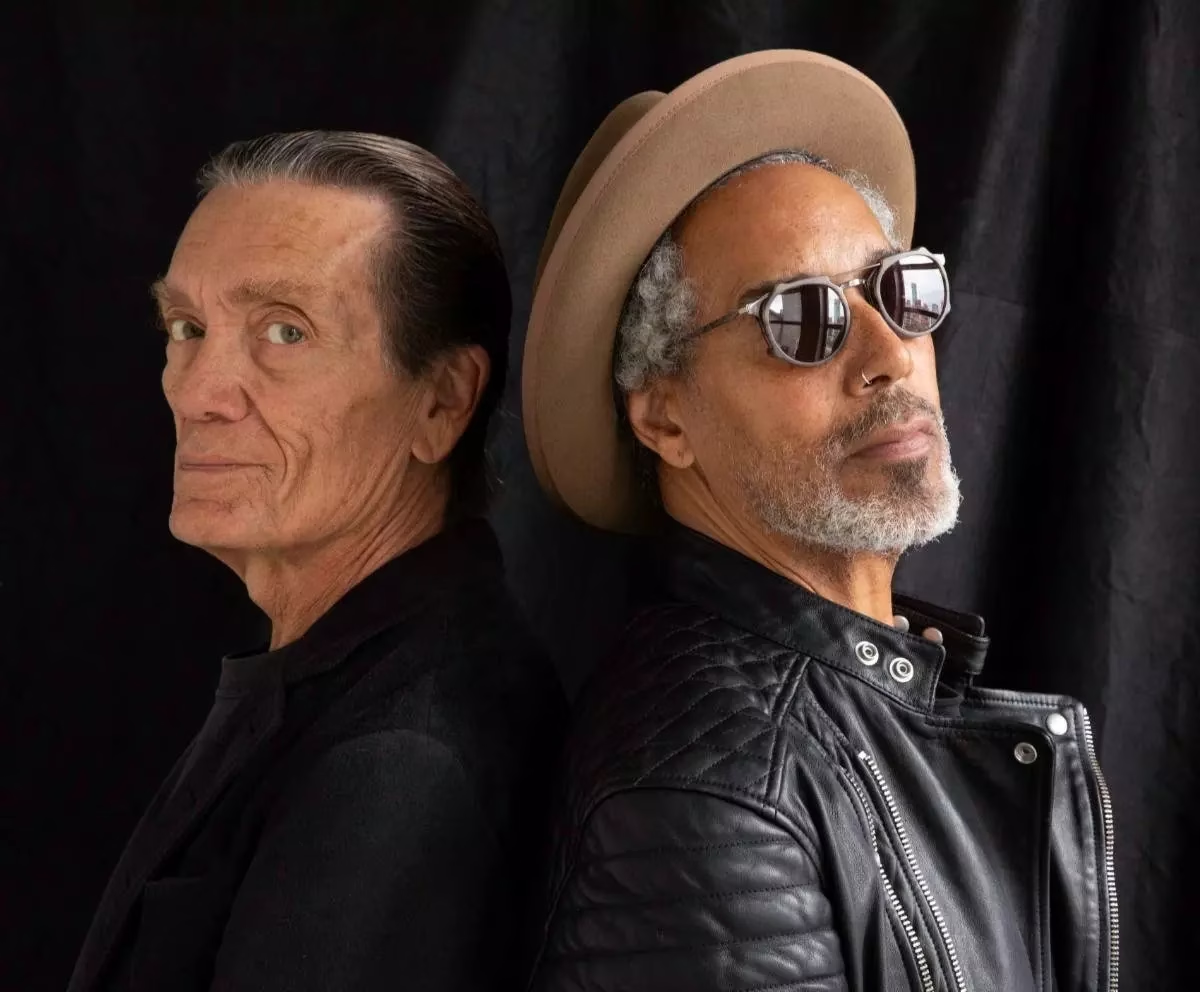
Even before this challenging year, singer-songwriter LeRoy Bell was getting tired of the negative grind of daily news. He couldn't understand how the United States allowed migrant children to be separated from their families.
His frustration spawned the song "America," which appears on Stony Hill, his new debut collaborative album with veteran guitarist G.E. Smith, out Friday (Aug. 28). In the song, Bell sings, "God only knows how I miss those days / She only knows how I miss the way we were."
"I just thought that we would be so much farther along as a nation, as a country," Bell tells GRAMMY.com during a recent interview. "And in the last couple of years, it just seemed like it was going to hell in a handbasket. I just wanted to write a song, and it was a healing process for me, and I just thought that a lot of other people can relate to it."
<style>.embed-container { position: relative; padding-bottom: 56.25%; height: 0; overflow: hidden; max-width: 100%; } .embed-container iframe, .embed-container object, .embed-container embed { position: absolute; top: 0; left: 0; width: 100%; height: 100%; }</style><div class='embed-container'><iframe src='https://www.youtube.com/embed//PIN8YW7f0Rk' frameborder='0' allowfullscreen></iframe></div>
After Bell showed the song to Smith, the two started working on what would amount to a politically charged album full of like-minded songs. Stony Hill is a contemplative and honest look at where American democracy stands today. Rather than angrily pointing fingers, the duo instead offers constructive criticism in a nonpartisan way aimed at finding a more perfect union.
Smith and Bell use the wisdom and experiences they've gained through their long and wide-ranging careers in music to inform Stony Hill.
Best known as the former ponytailed musical director for "Saturday Night Live," Smith is a one-time member of Hall & Oates and a sideman to musicians such as David Bowie, Mick Jagger and Tina Turner.
Bell has written hit songs for a variety of artists, including Elton John, Jennifer Lopez, Teddy Pendergrass and The Three Degrees. A finalist for "The X Factor" in 2011, Bell has also made a name for himself via his work as a solo artist and with his former soul duo, Bell and James, alongside Casey James.
For Smith and Bell, their newly formed duo welcomes a pairing that's long been in the works.
"I'd been looking for a great singer for 30 years," Smith says. "And I've been looking for just the right voice. And [my wife] said to me, 'Hey, listen to this guy. This is the voice.' And I heard it. I said, 'Yep, that's him.'"
GRAMMY.com caught up with G.E. Smith & LeRoy Bell to talk about how their timely debut album, Stony Hill, offers a nonpartisan, universal perspective on today's societal issues and how their rich individual careers inform their latest project.
<style>.embed-container { position: relative; padding-bottom: 56.25%; height: 0; overflow: hidden; max-width: 100%; } .embed-container iframe, .embed-container object, .embed-container embed { position: absolute; top: 0; left: 0; width: 100%; height: 100%; }</style><div class='embed-container'><iframe src='https://www.youtube.com/embed/Alx7wnkw6NA' frameborder='0' allowfullscreen></iframe></div>
The songs on your new album, Stony Hill, feel like they were written for this moment in time.
Smith: Well, we recorded the record in 2019. We had it finished up by the early fall and then did the postproduction. And it just happened that a lot of the songs that LeRoy had written are very relevant to what's going on now; songs like "America," "Under These Skies," "Let The Sunshine In." It just speaks to this present time as things worked out.
Bell: I don't think this happened overnight, and so a situation we're finding ourselves in, it's not like I predicted anything and saw it coming. I think it was just a feeling that was going on in the last couple of years, the way things were turning. But I had no idea that it was going to end up like it is now and we'd be in this position with the pandemic and the civil unrest that we have at this point. But I think some of the signs were there.
What's the story behind the album's title, Stony Hill?
Smith: We were looking for a band name; there [have] been so many bands at this point, it's really hard to come up with a name. [My family and I] happen to live on Stony Hill Road. And so there that was, and then that image of pushing the rock up the hill just fit right in. That seems like what we're all doing now.
While writing the album, you made a point to make songs such as "America" nonpartisan and from a more universal place. Why was that important?
Bell: I think politics go back and forth, and, depending on who's in power, people use politics as a tool to control other people. And that's why I used those lyrics that way. I think you can interpret it how you want, but I think it speaks to the times that we have right now. But I think it's also a political stigma that can speak to any time, because a lot of it is general, although some of it is specific to this time.
What was the inspiration behind "America"?
Bell: I was kind of down and watching too much news on TV, which I finally just got rid of because it was just messing with my emotions. I saw this one thing where they were separating kids from their parents and putting kids in cages, and I just kind of balled up. This is not where I thought we would be in 2019. I just thought that we would be so much farther along as a nation, as a country. And in the last couple of years, it just seemed like it was going to hell in a handbasket. I just wanted to write a song, and it was a healing process for me, and I just thought that a lot of other people can relate to it.
<style>.embed-container { position: relative; padding-bottom: 56.25%; height: 0; overflow: hidden; max-width: 100%; } .embed-container iframe, .embed-container object, .embed-container embed { position: absolute; top: 0; left: 0; width: 100%; height: 100%; }</style><div class='embed-container'><iframe src='https://www.youtube.com/embed/r-DGrckPfRs' frameborder='0' allowfullscreen></iframe></div>
"Black Is The Color" is a rocking modern take on the traditional folk ballad. Why did it feel like a good time to revisit the song?
Smith: I've always loved that song. I've been playing that song for 40 years at least. And most of the versions that you hear of that song are slow and beautiful. Nina Simone is the famous one that comes to mind. But in the early '60s, a lot of what they called folk artists—Joan Baez, people like that—everybody was doing that song, and everybody did it slow. But I'm kind of a rocker, bar band, guitar-player guy, so I wanted to rock it up. I love the lyrics and I really thought I'd fit in with the rest of the material that we were doing. I've always really enjoyed rearranging traditional songs like that, taking a more modern approach to them, because the lyrics are great in a lot of that traditional stuff. The stories are universal. The stories are timeless.
"Under the Skies" talks about the hopes and fears people have in this country. There's a lyric about the longing for finding the way home. Why was that an appealing metaphor?
Bell: A metaphor to finding the way home to peace and love—that's what I mean by that. Finding a way back home to reconciliation, to getting along, to where we're supposed to be as humans with each other. Like we just got so far off-track of where we should be. I think this is … just about as far away from where we should be that I can remember [in my life].
How did the two of you originally meet?
Smith: Taylor Barton, my wife, was listening to LeRoy. I think she found him on Spotify, or one of those places, and I'd been looking for a great singer for 30 years. And I've been looking for just the right voice. And she said to me, "Hey, listen to this guy. This is the voice." And I heard it. I said, "Yep, that's him."
So Taylor got a hold of LeRoy, and he lives in Seattle. We're on the extreme East Coast, out on Long Island [in New York], and we invited him out January of 2019. And he came and we sat down with our guitars and started playing, and we just had a great time. He had recently written "America." He showed it to me, and within two days, we were in the studio.
Did it feel like a good pairing?
Bell: We're fans of a lot of the same music—that would be old-school music. We played in a lot of different bands that had a lot in common, and we were close to the same age and grew up in the same era. Once we started playing together, we just hit it off. It just felt very comfortable.
Smith: You never know, when you get together with people, everybody can be really talented, but it doesn't always click. Thankfully, this time it did. We got along right away, musically, because, as LeRoy said, we had grown up listening to the same records at the same time— we were [just] in different rooms. You've got to be able to like the people and hang out with them and spend time with them. So that all was very easy and comfortable right away—thankfully.
<style>.embed-container { position: relative; padding-bottom: 56.25%; height: 0; overflow: hidden; max-width: 100%; } .embed-container iframe, .embed-container object, .embed-container embed { position: absolute; top: 0; left: 0; width: 100%; height: 100%; }</style><div class='embed-container'><iframe src='https://www.youtube.com/embed/Mq4SP3Uz4h8' frameborder='0' allowfullscreen></iframe></div>
Each of you has histories of collaborating with others. How have these lessons and experiences carried over to this project?
Bell: I think when you've been collaborating with other people, you learn to listen and pay attention to what that other person has. Music is cool, but you don't want to just play it by yourself all the time; you want to be able to enjoy playing with other people. And so, collaborating with somebody else that's giving you ideas and cool things to work off of is a joy, especially if you get along personally. It's fun. It's creative.
Smith: You don't dismiss your own ego, but you've got to put your own ego aside a little bit and work with the artist, the person that day you're supporting. As a guitar player, sideman, you work with them and you try to make the idea that they have shine. You try to make it good. So LeRoy comes with these songs and then I like the songs, and then I could hear right away what I want it to sound like; it was just a great experience to be able to do it. We're looking forward to recording the next album.
Are you planning to tour together whenever things get back to normal after the pandemic?
Bell: Yeah. We were already planning on touring and then the COVID-19 [pandemic] hit, and then that just pulled the rug out from under us. But we would love to get out there and get to the people and bring them music. There's nothing better than playing in front of live audiences.
Smith: In the middle of March, when this COVID thing really took off, we were supposed to go to South By Southwest [SXSW], play two or three shows while we were there, introduce the band and the recording. They were going to release "America" right there. But of course, that got canceled, along with everything else.
On "America," you talk about not standing idly by. Have you been involved in the community beyond music?
Bell: Not so much. My main way of being involved is through my music. I'm not out there in the streets, physically, but I try to lend my voice and my time to the causes. Somebody needs me to be there, phone lines or vocally or any way that I can that way with my support; I try to do that. But physically, as far as being out in the streets, I don't really do that. Mainly, it's just through my music and what I can bring that way.
Smith: For me, I've never been political at all. It never seemed to make much difference to me, as a musician, who was president or governor or anything. It was the same for me when Reagan was president or when Clinton was president or Obama.
But Trump, he came along and just ... To me, he's very wrong on so many things. I hate the way that he's encouraged the white nationalist people. And he seems to thrive on this chaos; he likes it. He thinks it makes him look good to his people, I guess. I've never voted in my life, but I'll tell you what. I'm registered now. And I'm going to vote in November. I'm not going to vote for Trump—you know that.
This interview has been edited for clarity and brevity.