
There's never been a day online like #BlackoutTuesday this past summer, a cacophony of black squares and soapbox proclamations in reaction to the killing of George Floyd. But six months after the nationwide protests that ensued, you'd be hard-pressed to find much of anything about police killings of Black people: a black square, an infographic, a hashtag. According to Google Trends, searches for "George Floyd," "Breonna Taylor" and "Elijah McClain" have flatlined in recent months.
Even if the online movement is past its shelf life, this didn't deter Ethan Sultry. For the Los Angeles producer, reducing the extinguishment of Black lives to a meme is repulsive in the first place. His new track, "Say Their Names," fully encompasses his anger toward the whole situation.
"I certainly was not concerned about timing [the release of the song] with some moment. People have told me, 'Oh, that's over.' It's unbelievable. 'It's not relevant anymore.' I've been told that!" Sultry incredulously tells GRAMMY.com. "As far as music goes, it's not relevant for what? For sale? What, it doesn't time with the death of someone? It makes me so angry that that is even in the picture. This is the truth, this is the horror. This is the racism that we live in, and it's not going away. Within the art world that we live in, where are we going wrong that that's even a question? That shouldn't even be on the table. We are artists."
Today (Dec. 11), Sultry unveils a visceral, new jazz track, "Say Their Names," six months after we called on our peers to post — or, in many cases, not post — a black square on Instagram. The song features numerous session cats, most of whom live in the L.A. area: vocalists Cedric Myton and Maiya Sykes, saxophonist Katisse Buckingham, pianist Ruslan Sirota, bassist Benjamin Shepherd and percussionist Diego Álvarez Muñoz.
Stream "Say Their Names" below and donate to MyGood, a charity benefiting families who have lost loved ones to police violence.
<iframe width="100%" height="300" scrolling="no" frameborder="no" allow="autoplay" src="https://w.soundcloud.com/player/?url=https%3A//api.soundcloud.com/tracks/930394867%3Fsecret_token%3Ds-wETe9Ca7mqI&color=%23ff5500&auto_play=false&hide_related=false&show_comments=true&show_user=true&show_reposts=false&show_teaser=true&visual=true"></iframe><div style="font-size: 10px; color: #cccccc;line-break: anywhere;word-break: normal;overflow: hidden;white-space: nowrap;text-overflow: ellipsis; font-family: Interstate,Lucida Grande,Lucida Sans Unicode,Lucida Sans,Garuda,Verdana,Tahoma,sans-serif;font-weight: 100;"><a href="https://soundcloud.com/margolismusic" title="Sir Sultry Music" target="_blank" style="color: #cccccc; text-decoration: none;">Sir Sultry Music</a> · <a href="https://soundcloud.com/margolismusic/01-say-their-names/s-wETe9Ca7mqI" title="01 Say Their Names" target="_blank" style="color: #cccccc; text-decoration: none;">01 Say Their Names</a></div>
"I'm usually someone who avoids all slogans and clichés in my writing, but for this instance, it felt like there should be no other title than 'Say Their Names,'" Sultry explains. "No matter how many artists did a song called 'Say Their Names,' 'Say Her Name,' 'Say His Name,' whatever it was, everyone needs to be yelling it at the same time—loud, loud, loud."
The lightbulb moment to write "Say Their Names" came a day after Sultry marched in downtown L.A. Initially, he felt too old to participate in the protests.
"I just said, 'You know what? If you were 25, 30, you'd be doing this. So what? You're 40, so do it anyway,'" Sultry says. "It's always good to go, even when sometimes you don't know why exactly. I mean, I knew why I was going, but sometimes you just have to go because something else happens. I got in it, and sure enough, it inspired this piece."
Sultry, who lived with and learned from Gypsy musicians for more than a decade, didn't start by picking up an acoustic guitar. Instead, he established the pulse by way of clapping, mapping out drum patterns on Logic Pro X and beatboxing into a microphone.
Due to COVID-19 restrictions, Sultry assembled the rest of the song in a piecemeal fashion, drawing from tracks recorded at five different studios. First, Muñoz, a revered cajón player and multiple Latin GRAMMY nominee, swung by the studio and replaced Sultry's makeshift grid with his percussion.
"It was an amazing experience because everything came from his mind," Muñoz tells GRAMMY.com. "When we started to record, I didn't understand what he wanted. I was just following his direction because I didn't have a song or tune or something to follow. He just pre-produced everything beforehand. And when we started to build instrument by instrument, step by step, at the end of the session, I was like, 'My goodness!' It was a wall of percussion."
Diego Alvarez | Photo: Sari Makki
Sultry included a Venezuelan percussionist because of the context and lineage of Muñoz's art form. For example, "It has a clave in it," Sultry says of the percussion arrangement. "The clave is so much more important than we give it credit for, because clave is one of the main rhythms that the slaves and their descendants were playing in all of the islands. Then it becomes different things over time. So it becomes protest music and a rebellious beat later."
While dictating Shepherd's bass part, Sultry combed through the language of flamenco, a musical form of which he's intimately familiar. "The bass combines jazz walking with my instruction to follow a bunch of push-patterns that would be similar to flamenco," the producer explains. "By not identifying the harmony on the bass real clear and by the accents not always falling where you would anticipate, that creates a floating vibe out of the song. In my opinion, it makes it easier for someone to hear it and know it's not a normal song. It's a spiritual, ethereal thing."
For the woodwinds, Sultry tapped Katisse Buckingham, who plays in his quintet. Buckingham is best known for recording the music in the famous "jazz flute" scene in the 2004 comedy, Anchorman: The Legend Of Ron Burgundy, and for playing on Dr. Dre's 1992 classic, The Chronic. From his home studio, Buckingham recorded alto, tenor and baritone saxophone, and alto, bass and standard flute. For added emotional impact, Sultry gave him a jarring instruction for how to approach his solo.
"For the first saxophone solo, he was like, 'Imagine you're an African woman during the slave trade, and your husband is being pulled away from you,'" Buckingham tells GRAMMY.com. "He would paint that picture. Hopefully, he brought out those types of images."
Read: Aminé Talks New Album 'Limbo,' Portland Protests And Black Lives Matter
Sultry recruited Cedric Myton, a Rastafarian singer, for the first vocal part. "Cedric has been in the fight against systemic racism his entire life, so there's your truth right there," Sultry explains. "This is not someone who jumped on the boat this year. He's been doing it his entire life, and his entire message has been against systemic racism."
For a supplemental vocal part, Sultry went with Maiya Sykes. As with his other casting calls, this was the result of weighty consideration, not just a flight of fancy. "There's a real purpose behind the calls that I make," Sultry says. "I go through a very purposeful process. I'm very sensitive about who I might go about doing this with. It has nothing to do with fame or name recognition. The power of a name has nothing to do with the process for me."
Sultry went with Sykes, with whom he's recorded for years, for her facility as a jazz singer and her lifelong commitment to social justice. "Maiya worked amazingly in the song," he says. "She not only embodied the female aspect of it, but bridged a little bit of the space left between Cedric and the instrumentation. The way I led Maiya's session in the song was to try to make it all kind of make sense with what Cedric had done."
(L-R): Ethan Sultry and Maiya Sykes | Photo: Sari Makki
As activists go, Sykes is the real deal. Her mother was on the frontlines against apartheid, and to hear her tell it, she's been attending rallies and protests since she was in diapers. "My relationship with Black Lives Matter is quite simple: I'm Black," she tells GRAMMY.com. "I have no choice but to say, 'I need you to recognize me and see me equally—not just me, but my counterparts.'
"What the Black Lives Matter movement is to me is not just inclusion, but the recognition that Black people, like every other group of people, are not a monolith," Sykes continues. To that end, she had passed on a litany of protest songs that she saw as propagandistic pablum. "I turned down a lot of them because I felt it was a bunch of sign-waving or phrases or mantras I've heard before," she says. "One reason I liked this song was that it presented itself differently. It's the same idea presented with some intricacies and some simple things. The juxtaposition of those two things stands out for me. You almost have to go for the obvious title to grab someone's attention, but upon listening, you realize it's a more intricate presentation of this idea, which is what drew me to it."
Read: Want To Support Protesters And Black Lives Matter Groups? Here's How
For piano, Sultry went with Ruslan Sirota for his edgy comping abilities. His crossover-jazz Rolodex is more impressive than most. "I think when I'm old, I'm going to think about this a lot: how I found myself in that intersection with folks like Thundercat, Seamus Blake, a lot of the guys on the wave right now," Sirota tells GRAMMY.com. "I'm so happy to have run into these people more than a decade ago when we were all wet behind the ears, running around with our gear, trying to get a gig. Now, what do you know? These are the folks that reflect the culture back at itself."
Sirota considers the simplicity of the song's title versus its teeming, multifarious music. "It might be wise to consider that there's a whole world behind the meme as well," he says. "Everything's as deep as you are, right? Everything is as profound as you're willing to go. A conclusion is often the point where one got tired of thinking. There's more to most things—and certainly to an issue as contentious and consequential as this—than might meet the eye. But sometimes, just as memes are a good vessel to communicate profound ideas to people quickly, so, too, is a song title. It can set a little bit of a framework and context for people to bite into more than they otherwise would."
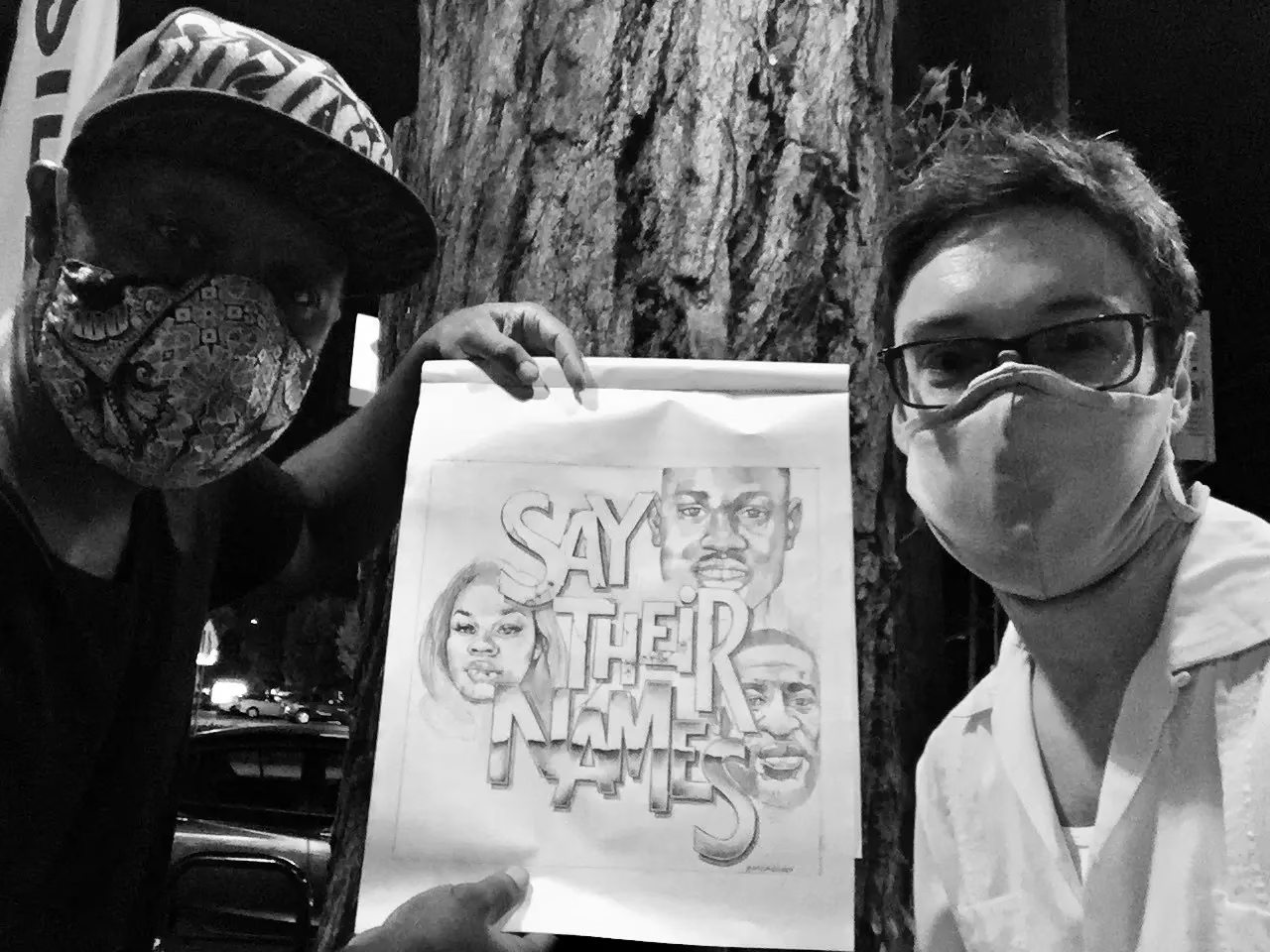
"Say Their Names" Artwork
Toons One, a multimedia artist in the graffiti and hip-hop realms, conceptualized and painted the cover for "Say Their Names." The image features the faces of George Floyd, Breonna Taylor and Ahmaud Arbery as well as industrial-style typography riddled with bullet holes.
"For me, lettering has been a powerful way of getting my message across through the art that I do," Toons tells GRAMMY.com. "Trying to come up with something that would be timeless is very important to me."
GRAMMY winner Dave O'Donnell, who's famous for working with James Taylor, Keith Richards and John Mayer, mixed the track; Paul Blakemore, the senior mastering engineer at Concord Jazz, mastered the track.
Can a song genuinely change the world in a practical, boots-on-the-ground sense? What happens between a song about police brutality appearing on the planet and a police officer not extrajudicially killing a Black citizen?
"The practical step, I think, is amplifying a social conversation," Sirota says. "Because whenever you see an outcome of the sort that you mentioned, where there's an actual, practical implementation of police reform, it's always the result of multiple causes. The endgame is to amplify social conversation to where things are being prioritized to be looked at, which only ever happens through social pressure of sorts."
What if that social pressure goes too far? "I think we ought to be cautious that it's not turned into a religion, which it could easily be," Sirota continues. "Because this is when it stops being taken seriously, ironically. Because then we're not scholars with numbers on our sides; we're just a bunch of people projecting our high school issues on our political grievances. That's the one thing about which we ought to be careful. This needs to have a tangible side of more than slogans, of numbers and statistics and concessions when we went overboard in our enthusiasm. Otherwise, it just becomes something where the politicians say, 'Oh yeah, they had TikTok, now they have BLM.'"
Sultry says donating to MyGood, which Macy Gray founded last summer, is a practical step toward making a difference. "I like the clarity and the honesty of what I see about MyGood. It's just very clear," he says. "'If you donate, the money goes to the victims' families, and here are some of the ways.' What better way to donate than to say, 'What do these families need?' This happened to them in their household. This is their son, their brother, their sister, their mother. What do they think? I want to hear what they say, their opinions. I want them to have the microphone."
Ruslan Sirota | Photo Courtesy of Artist
The musicians on "Say Their Names" are not an ideological monolith or mouthpieces for an organization. From their backgrounds to their life experiences to their views, they're utterly diverse. The bottom line is that they meet on one key issue: police killings of Black Americans must end today. If these musicians had sweated insignificant rhetorical differences, they might have never completed the song.
"I hope, if nothing else, it sparks some conversation," Sykes says. "To me, that's the essence of democracy. What we're lacking is political discourse. Political discourse means you and I can get into a room and talk about ideas. We might disagree, but we can talk about them cogently and with respect and, in the end, feel like everyone is satisfied. We've lost that completely, and that's disheartening."
"The small actions of millions change things," she continues. "Yeah, you can get frustrated and feel fed up and think, 'I can't do much.' But if a million of us do some tiny action, that means we take one big step forward. That's all we can do every day: some small thing. You can be very pie-in-the-sky about this in an esoteric conversation, but I do realize that whole changes got made because one person was like, 'Listen, I've got a big-ass idea, but I need 20 of y'all to help me carry this through.'"
This involves not dropping the mantle of Black lives when one gets tired of it, but playing, rapping and singing about Black victims of police brutality into 2021, 2022, 2023 and beyond. Instead of brooding on the edges of our beds or dragging would-be allies on Twitter, Sykes asks that we shake off the self-pity, get out of our heads and engage with this topic in any way we can, which may start with a simple conversation.
"There's this intense disheartening that's coupled with shame. 'Why didn't I see this? Why didn't I act?'" Sykes says. "That's not helpful. We have to get into a dialogue where if we're going to move forward, let's be progressive about it in our inclusion. I'm not asking you to be ashamed about it. I'm asking you to be proactive."
In the spirit of patience and understanding, casting away infighting and misplaced aggression, we'll say their names until there are no more names to be said.
Amid Black Lives Matter Conversations, Black Latinx Artists Urge Non-Black Latinx To Do Better
