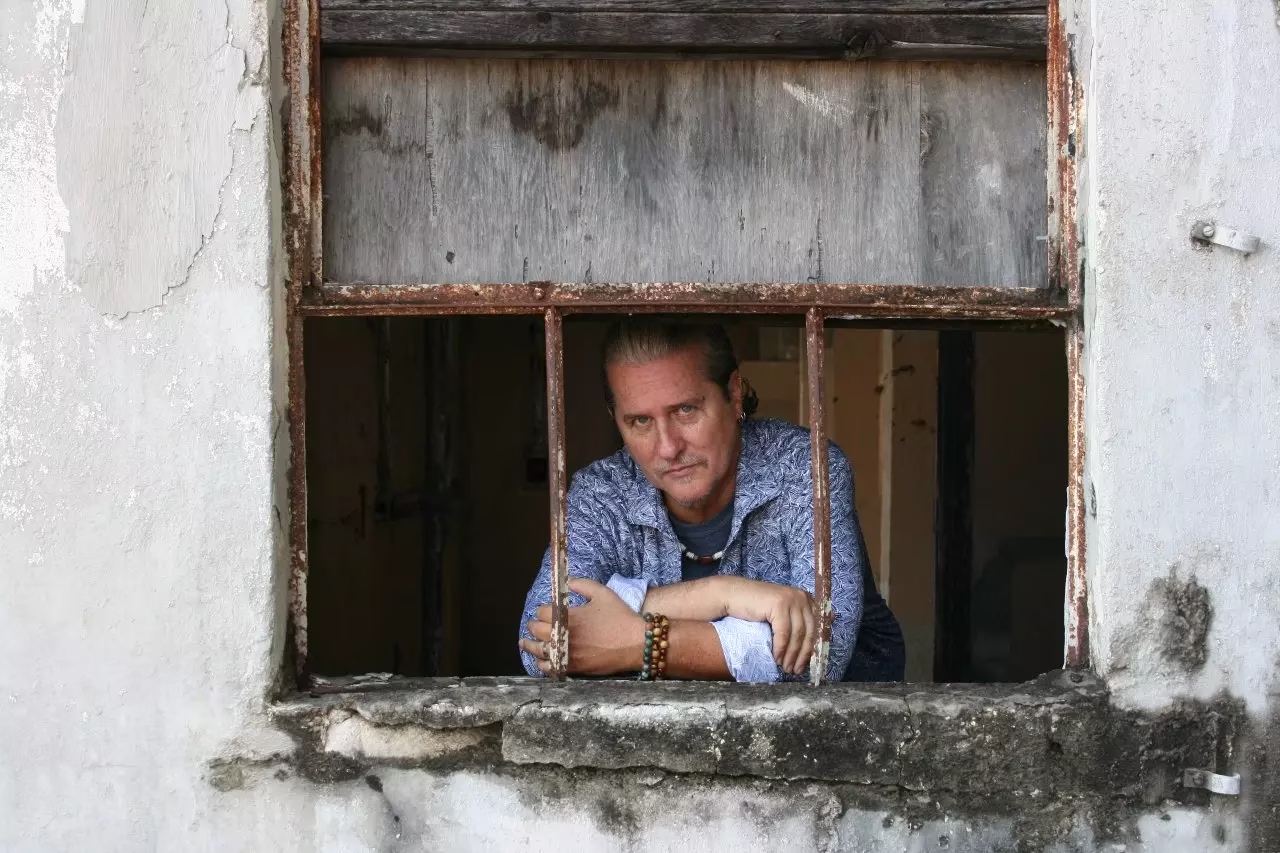
North, south, east and west on the interstates of a pandemic-gripped America, Gerry Gibbs drove 15,000 miles to make some music. In the evenings, he and his wife, Kyeshie, camped out in the car and dozed off to DVDs of Kojak, Starsky and Hutch and The Mod Squad. They were too apprehensive about COVID-19 to board a flight or sleep in a hotel. So, with his record label's financial assistance, they drove and drove and drove.
"I'm not touring. I'm not working. I just sit at home every day wondering what's going to happen," Gibbs told GRAMMY.com back in 2020 while driving through the middle of the desert. "Everything I ever had doesn't exist anymore." So he hurtled between New York, California, Texas and Florida throughout the first wave. "All to make this stupid record," Gibbs says in 2021, cheekily and modestly. Because what he and his associates made is a doozy.
He was driving all over creation to make Songs From My Father (released August 6), a homage to the songbook of his dad, the pioneering vibraphonist and bebop luminary Terry Gibbs. It features four permutations of his Thrasher Dream Trio, drawing from a Rolodex of cream-of-the-crop musicians: bassists Ron Carter, Christian McBride and Buster Williams, and pianists Chick Corea, Kenny Barron, Patrice Rushen, Geoff Keezer and Larry Goldings.
By now, in music, the anecdotes about recording in lockdown are starting to bleed together. Plus, jazz is a Möbius strip of lineages, so a son paying tribute to his father is as natural as can be. That said, Songs From My Father stands out for multiple reasons.
First, it sheds light on Terry, an underappreciated architect of America's music. Second, it’s a testament to Gerry's indefatigable creativity. And—perhaps most enticingly—it contains the final recordings of the late pianistic legend and 25-time GRAMMY winner Chick Corea.
Terry Gibbs with bassist Eddie Safranski and the 1953 Metronome All-Stars. Photo: PoPsie Randolph/Michael Ochs Archives/Getty Images.
The Swinging Mastery Of Terry Gibbs
At almost 97, Terry is a hilarious fount of stories, and his 2003 memoir, Good Vibes: A Life in Jazz, is a treasure trove of Brooklynite musings. The man born Julius Gubenko in 1924 had a front-row seat to bebop and big band at their peaks, playing with Benny Goodman, Buddy Rich, Ella Fitzgerald, Charlie Parker, Bud Powell, Dizzy Gillespie and scores of other household names.
Gerry was born in 1964, and his father didn’t steer him toward becoming a musician at all. "He's had his own mind since he was a kid," Terry tells GRAMMY.com. "I never told him what to like. He went from liking Buddy Rich to liking Elvin Jones, and that's a big jump going from straight-ahead to a guy who was playing pretty far out. But he liked it. That's where his head was."
Terry and Gerry Gibbs. Photo courtesy of Gerry Gibbs.
Read More: 10 Essential Cuts From Jazz Piano Great McCoy Tyner
Gerry became a music obsessive by his own volition. "You remember those blue-jean-colored folders you put all your manilla folders in when you were in class?" Gerry asks GRAMMY.com. "On the front, I would just put 'Chick Corea. Ron Carter. Freddie Hubbard. Miles Davis. John Coltrane. Kenny Barron.' And I would just stare at the names on the books and say, 'These are my heroes. These are the people I want to play with one day.'"
Terry didn't just play with the titans of bebop; he provided a platform for brilliant Black female pianists. One, Alice Coltrane (née McLeod), is experiencing an overdue reappraisal. Another, Terry Pollard—an equal talent on vibraphone who performed alongside him in swinging mallet contests—remains bizarrely obscure given her considerable skills.
About Alice Coltrane, "Before everything she had done with John, she was a swinging bebopper, playing in all these Detroit bands and in Terry Gibbs' band," saxophonist Jeff Lederer told GRAMMY.com in 2020. "She was a great, great bebopper." As for Pollard, "I feel like it's really important to acknowledge her when talking about this music," Geoff Keezer tells GRAMMY.com.
Terry Gibbs and Terry Pollard. Photo courtesy of Gerry Gibbs.
Read More: 'Ptah, The El Daoud' At 50: How Alice Coltrane Straddled Heaven And Earth
Terry played from age 12 until his retirement at 92. In that time, he made more than 90 solo recordings and was the musical director on "The Steve Allen Show" for more than 20 years. However, he's mysteriously still not an NEA Jazz Master, despite many musicians far younger than him—and with fewer bona fides—receiving the honor.
Plus, his infectious compositions, like "Kick Those Feet," "Bopstacle Course" and "Pretty Blue Eyes," aren't as widely known as they should be in the 21st century. That is, unless Gerry has something to say about it.
The Creative Whirlwind Of Gerry Gibbs
The apple doesn't fall far from the tree: Gerry Gibbs is as loquacious and driven as his father. Moreover, time is elastic on Planet Gibbs: What would typically be a half-hour conversation might stretch to more than three times that length.
"When he's explaining stuff, his mind is going 20,000 miles an hour," Patrice Rushen tells GRAMMY.com. "He might skip a lot of information that it would be of value for you to try to keep up with where he's going." For example: "'There's no bass player in this session.' [Pauses.] OK. 'Well, you'll be playing with [pianist] Larry Goldings.' [Pauses even longer.] OK? 'Larry's going to play the organ.' OK, got it. Now I'm piecing it together."
Put a man like this in pandemic house arrest, and he'll do something like write and record an entire song every day in an 18-day spree while playing all the instruments. And that's what Gerry did. He sent the resulting album, Emotional Pandemic, to 500 people on his email list. One of them happened to be Corea, who he'd been friendly with before but never worked with.
Corea took to Gerry immediately and emailed him, eager to learn about his creative process. "I was pretty freaked out," Gerry admits. "Friends of mine hadn't had time to listen to it, and here's Chick, who's so busy, and he listened to it numerous times." Gerry sent Corea his phone number; they talked for two hours and became fast friends.
"One time, at almost 3:00 in the morning, the phone rang, and it was Chick," Gerry says. "My wife sees the phone and I say, 'He must have butt-dialed me.' I answer the phone, and he says [loudly] 'Guess whooo!' I don't care. Chick could have woken me up every night, and it would be fine. It's Chick."
After Corea listened to Journey to Parts Unknown, another album Gerry made during lockdown—this one comprised of solo piano compositions—he inquired about adapting the tunes to include bass and drums.
"Then I realized, 'My label can't afford him,'" Gerry says. He offered to put his people in touch with Corea's people; Corea waved it away. "He was just like, 'No, no, no. Don't worry about that. I don't care about that. Let's just do it.'"
There was another potential wrinkle: Gerry's compositions are incredibly elaborate, so much so that Corea requested advance time with the charts. Plus, with COVID as a factor, lengthy rehearsals weren't possible. So rather than composing streamlined, improv-friendly music, Gerry decided to play his father's music instead.
"It's a tribute to my dad, but it's not a tribute because he's my dad," he says. "His music was some of the most important music for me growing up. It was my way to put my take on something that I grew up with that had a huge influence on me." While on a stroll through his neighborhood, he called everyone who ultimately would be involved with the record. They were in.
Gibbs told Corea he was going to change direction and play his father's music instead. Corea took to the idea enthusiastically, even asking to write an original song for the record: "Tango for Terry."
"All of us had so much faith in his judgment and his ability to work out the situations that were beyond everyone's expectations and experience." —Ron Carter
When it came time to track the music in various locations, none of the musicians were rusty after being housebound for months. "I was a little apprehensive about going into the studio, but I needed to play," Keezer says. "I was very happy that he called me for the project, especially with Christian on bass."
Gerry's curatorial and leaderly acumen struck all the musicians involved. "All of us had so much faith in his judgment and his ability to work out the situations that were beyond everyone's expectations and experience," Ron Carter tells GRAMMY.com. Barron adds, "Gerry is very creative in terms of coming up with different kinds of projects. It's not always the same thing, which I love about him."
For "Chick's Tune," a spin on Terry's "Hey Jim" with nine out of 10 of the musicians taking a solo, Gerry matched the tempo to a 1961 recording of his father and spliced his vibraphone solo to the music. "Gerry's very good at [working with] pre-recorded elements to play to, as far as the production side," Larry Goldings tells GRAMMY.com. "Gerry's very clever at editing."
Notably absent from his namesake song, however, was Corea.
The Final Musical Fires Of Chick Corea
By all accounts, Corea was strong and upbeat during the sessions. However, when it came time to tackle "Hey Jim," "Chick called me and said, 'I can't play on it because I'm not feeling good. I've got a pain in my ribs. Can we postpone this for three or four weeks?'" Gerry recalls. "I said, 'Of course, Chick.'"
"And then I spoke to his management," he says. "Chick was gone."
In a massive shock to the global jazz community, Corea passed away on February 9, 2021, from a rare form of cancer. He embodied energetic creativity for a musician in his autumn years; the internet was full of his recent videos and masterclasses. With about a month left, Corea got his affairs in order and wrote a statement to the world.
"I want to thank all of those along my journey who have helped keep the music fires burning bright," he said. "It is my hope that those who have an inkling to play, write, perform or otherwise, do so. If not for yourself then for the rest of us. It's not only that the world needs more artists, it's also just a lot of fun."
"My dad always said, 'People remember the very beginning, and they always remember the end. They don't always remember everything in the middle'... That's what I try to remember: What are the bookends? Are they really memorable?" —Gerry Gibbs
"I was so hurt and disappointed that, finally, I got to hook up with Chick and that we were going to get together and play after COVID," Gerry says. "It's a little eerie. When you're a little kid, you don't think, 'One day I'll play with Chick and when it happens, it'll be the last thing he'll ever do.'"
Gerry suggested they repurpose the track to be a tribute to their fallen friend. Terry agreed and proposed a new title—"Hey Chick." The music sounds as radiant, eager and playful as its namesake.
"My dad always said, 'People remember the very beginning, and they always remember the end. They don't always remember everything in the middle,'" Gerry says. "That always struck me as very important with a lot of music that I love. That's what I try to remember: What are the bookends? Are they really memorable?"
Terry and Gerry Gibbs. Photo courtesy of Gerry Gibbs.
A Father's Verdict
One critical question remains: What did Terry think of the final product?
"There's nothing greater than to hear someone play a song you wrote and interpret it their own way," he marvels. "You're talking about the heavyweights of heavyweights. Everyone is a bandleader."
"When he told me about all these guys he tried to get, I thought the COVID got to him or he was completely out of his bird!" he exclaims. "How did he get those guys, especially with this disease going around?"
Buster Williams has an answer: Despite the extraordinary circumstances, there was a "business as usual" vibe among the musicians. "We do record dates all the time, you know? You never know what's going to be the result of a record date," he tells GRAMMY.com. "You're sort of like, 'This is what I do.' But I was very pleased when I heard the complete record that they put together."
"When he told me about all these guys he tried to get, I thought the COVID got to him or he was completely out of his bird!" —Terry Gibbs
In a period of frustration over the perceived NEA Jazz Master snub, Songs From My Father proved to be a balm for the family. "[My father] said 'This is better than getting an award,'" Gerry says proudly. "He was really excited."
And while this ultimate act of paternal respect touches Terry deeply as he approaches a century on this planet, he's not going to let his son off that easily.
"I used to be a boxer," he clarifies. "I can still beat the heck out of him if I want to."
In Remembrance: Chick Corea Played In More Ways Than One