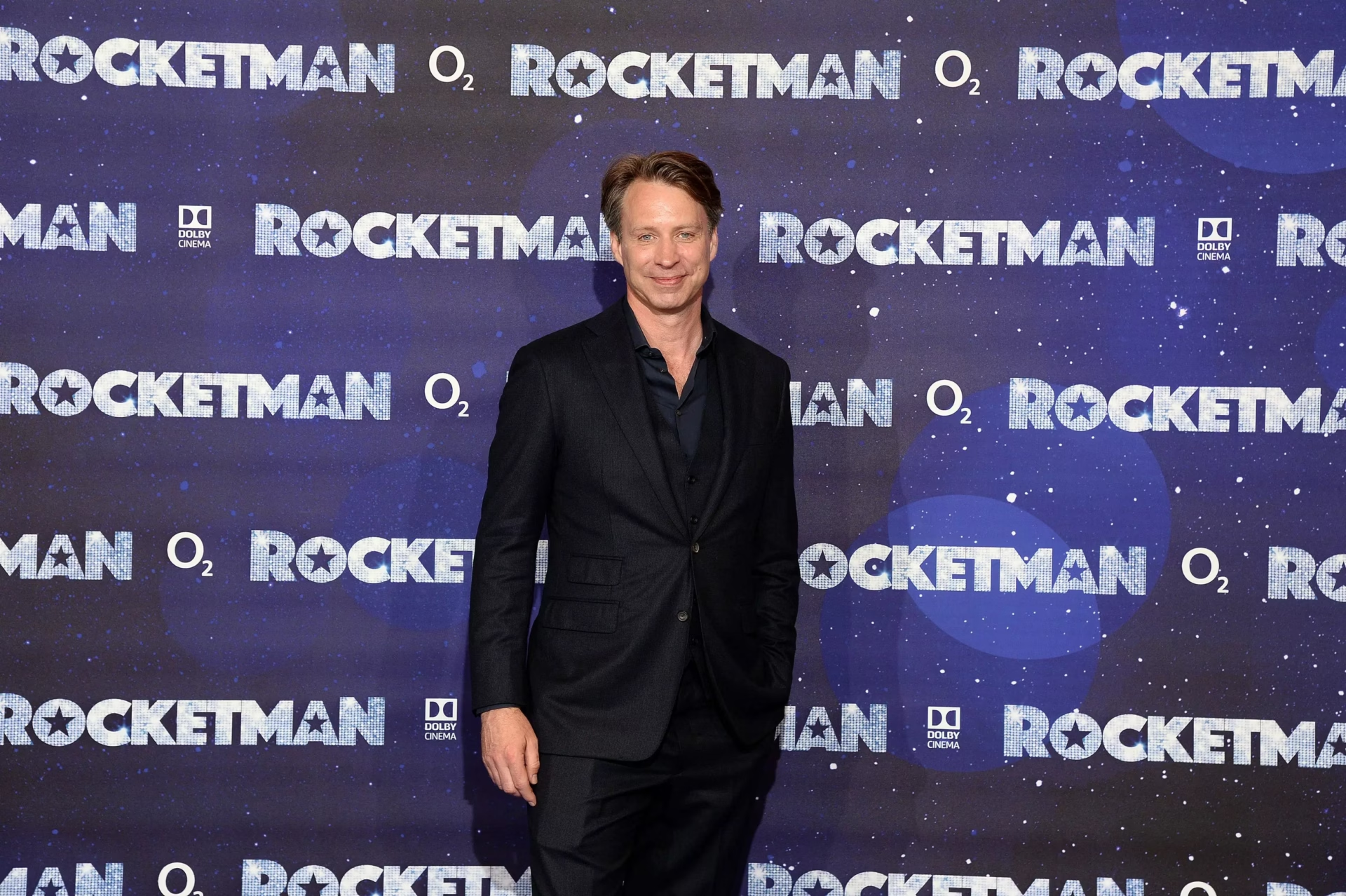
Giles Martin is no stranger to the pressure of reimagining timeless classics. The GRAMMY winner and son of Beatles producer George Martin has remixed and rearranged the Fab Four's work a number of times throughout his career—perhaps most notably for Cirque du Soleil's production of Love. But that pressure to get it right and do the original recordings justice never disappears when he dives into a beloved artist's catalog, especially when the artist is Elton John.
As the musical director of John's new biopic, Rocketman, Martin was given free rein to interpret the legendary singer's work as he saw fit. John remained hands-off throughout the whole process, entrusting Martin and star Taron Egerton with the task of telling his story through the music.
"It was huge pressure," Martin says with a laugh. "It's a bit like you've got a top chef and they give you a bunch of ingredients and go, 'I completely trust you to make an amazing meal,' and you go, 'Oh, right, okay.' At the same time, I guess it's better than the other way around. It's better than someone saying 'I don't trust you at all.' I was delighted when he actually liked it by the end."
<iframe width="620" height="349" src="https://www.youtube.com/embed/S3vO8E2e6G0" frameborder="0" allow="accelerometer; autoplay; encrypted-media; gyroscope; picture-in-picture" allowfullscreen></iframe>
The endorsement from John came this past January in the form of an unexpected phone call from an L.A. number Martin didn't recognize.
"Elton doesn't have a mobile, so I haven't got a number saved for him," he explains. "He was like 'Giles? This is Elton John.' And I don't think I'd spoken to Elton at all for about four months, and I was like 'Oh god.' I always think I'm gonna get fired for some reason. But he goes, 'I've listened to the music, and I love it. I just wanted to phone you and tell you I've been watching the rushes, and I think what you've done is an amazing job, and I just wanted to say thank you very much, and I've phoned Taron as well.' And I think I nearly cried. It was a relief. Because you know, it is his music, and it's his life, and you just want to make sure that you do right by him. But you have to change things around because it has to suit the film."
Those changes instantly noticeable in the movie, whether they come in the form of John's family performing "I Want Love" to illustrate his troubled childhood, a slowed-down "Crocodile Rock" intro during his star-making set at the Troubadour or a version of "Rocketman" that draws inspiration from Pink Floyd's "Great Gig in the Sky" during a scene that begins with John underwater in a pool and follows him all the way to his Dodger Stadium performance. But the change Martin struggled with the most was his decision to swap "Tiny Dancer"'s iconic piano intro for guitar.
"I did a lot of iterations of 'Tiny Dancer,'" he says. "'Tiny Dancer' was the one that I kept on changing. I did [at one point] have the piano starting, and do you know what? It didn't suit the mood. It was a really tough thing because it comes from a very quiet place, 'Tiny Dancer' in the movie. And it's at Mama Cass's party, and it's sort of quite folky, and I did it on 12-string acoustic guitar and that was a bit too strong. I then tried the piano because I really missed the piano riff. You know, who am I to get rid of that iconic riff? And I ended up with just doing it on acoustic guitar, and it worked better for the scene. It seemed to drift in better."
<blockquote class="twitter-tweet" data-lang="en"><p lang="en" dir="ltr">ICYMI: The soundtrack to <a href="https://twitter.com/eltonofficial?ref_src=twsrc%5Etfw">@EltonOfficial</a> biopic <a href="https://twitter.com/rocketmanmovie?ref_src=twsrc%5Etfw">@RocketmanMovie</a> is out now. Produced by Giles Martin (<a href="https://twitter.com/mashupmartin?ref_src=twsrc%5Etfw">@mashupmartin</a>), using Studio One, Three, Penthouse and Mix Stage.<br><br>Listen to songs from the soundtrack on our playlists: <a href="https://t.co/xCSTeJ2mRb">https://t.co/xCSTeJ2mRb</a> | <a href="https://t.co/5Tb5Rt2v1h">https://t.co/5Tb5Rt2v1h</a> <a href="https://t.co/ccJaxPnZEx">pic.twitter.com/ccJaxPnZEx</a></p>— Abbey Road Studios (@AbbeyRoad) <a href="https://twitter.com/AbbeyRoad/status/1134134916432748546?ref_src=twsrc%5Etfw">May 30, 2019</a></blockquote><script async src="https://platform.twitter.com/widgets.js" charset="utf-8"></script>
"In all honesty, it's as simple as you watch the movie and listen to the song, you think, "Does this sound too like, 'Here comes the song!'?" he continues. "Sometimes you need that, but in that moment in the movie, I didn't. It's funny, you can have strings—people don't mind having strings coming from anywhere, but if you're using a piano, you kind of want to see it [onscreen] to a certain degree. So that was the reason why. It didn't feel right having the piano starting it."
Despite those changes, several of the songs on the soundtrack remain deeply rooted in the source material—"Your Song" even features harpist Skaila Kanga, who played on John's original recording of the hit song half a century ago.
"Not on purpose, she's just the best harp player there is," Martin clarifies with a laugh. "She's great. She's brilliant. I mean, she's the harp player I get for all the sessions. There's a couple songs in the movie where we did takedowns of the originals, and 'Your Song' was one of them. And I forgot there was harp on it. And so I said, 'Oh god, there's harp, I better get a harpist in.' So we phoned up Skaila, and she goes, 'I played on the original of this.' We transcribed the part from the record, and she went and checked it because she'd done the original part. She was at the Royal Academy of Music with Elton when they were 15 or so, so she's known Elton that long...It was pretty amazing. I didn't realize that 'Your Song' was in 1969. So this is 50 years on that she's playing the same song."
Martin and Egerton were careful to match John's phrasing on the songs they were attempting to do loyal recreations of—as Martin notes, "Elton has the most amazing phrasing"—but they were careful to avoid mimicking him too closely, instead allowing Egerton to put his own spin on the tracks.
"I didn't really want him doing an impersonation of Elton," Martin explains. "Just because he's using his voice in the film. He's doing Elton's voice to a certain degree, but it's more of an interpretation than it is an imitation. Because it's gotta have the right soul. It's gotta have the right feel. You have to sing from within your heart. You can't sing from someone else's heart. And for me, that's why Taron's performance in the movie is really good, because he does that. It comes from within himself. He interprets Elton in the right way as opposed to just being a pastiche."
The most surreal moment for Martin, who was in the studio with John and his father in 1997 when they recorded "Candle in the Wind" after Princess Diana's funeral, was watching the singer join forces with Egerton for "(I'm Gonna) Love Me Again," the new song that plays over Rocketman's end credits.
<blockquote class="twitter-tweet" data-lang="en"><p lang="en" dir="ltr">I've recorded a new song with <a href="https://twitter.com/TaronEgerton?ref_src=twsrc%5Etfw">@TaronEgerton</a> for the <a href="https://twitter.com/hashtag/Rocketman?src=hash&ref_src=twsrc%5Etfw">#Rocketman</a> movie soundtrack and you can hear it now! It’s called ‘(I’m Gonna) Love Me Again’ and I hope you enjoy it! Elton xo <br><br>Listen: <a href="https://t.co/CzUr2kAPAN">https://t.co/CzUr2kAPAN</a> <a href="https://t.co/MaOyinYDx0">pic.twitter.com/MaOyinYDx0</a></p>— Elton John (@eltonofficial) <a href="https://twitter.com/eltonofficial/status/1128929325305278464?ref_src=twsrc%5Etfw">May 16, 2019</a></blockquote><script async src="https://platform.twitter.com/widgets.js" charset="utf-8"></script>
"It was funny having Taron and Elton in the studios because I'd spent a year working with Taron doing Elton, and then I had Elton," he says. "It was kind of strange for both of us...With myself and Taron, we have a close work relationship, we really dig in and he works really hard at getting it right, and Elton just goes and does it in one take. And then I started recording Taron and he goes, 'Is this gonna take long?' I said to Elton, 'Give him a break. He only sang it once.' He goes, 'Well, I only sang it once.' I said, 'Yeah, but you've been doing it for longer than he has.'" He laughs. "But the good thing about Elton is he's so open-minded about it. He really is. He's open for any ideas. He just loves music. That's what he thinks about, and that's what makes my life easier."
That love of music is abundantly clear in John's work—and in Rocketman—and it ultimately led to the soundtrack ballooning from the 13 songs originally called for in the script to the 26 that made the final cut. ("I think I ended up doing three times more work than I thought I was going to on this movie," Martin says with a laugh.)
"We realized that having music that wasn't Elton's in the film didn't make any sense, and we ended up using more and more songs as background," he explains. "We realized that the more music of his we had in the movie, the more we got of his life."
Out In Entertainment: Powerful Conversations On Representation, Intersectionality & Action
