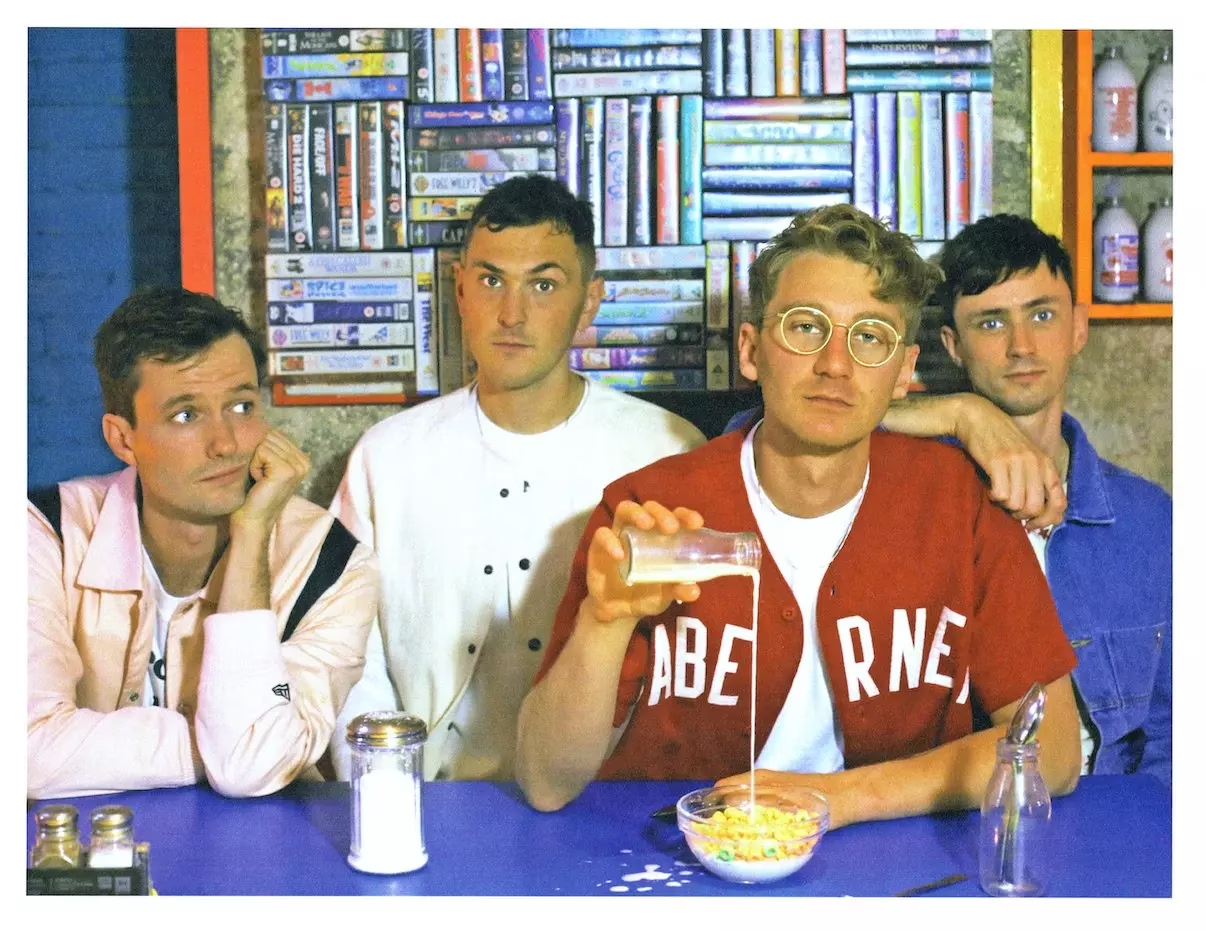
After more than a decade as a band, Glass Animals are having the biggest moment of their career — with a song that came out two years ago.
"Heat Waves," the British indie rock group's infectious, thumping single, hit No. 1 on the Billboard Hot 100 this week. The song's 59-week ascent set a record for the longest run to the top, having first entered the chart in January 2021, seven months after its June 2020 release.
Glass Animals' rise arguably feels most unprecedented to frontman Dave Bayley, who inadvertently started the band with his childhood pals Joe Seaward, Ed Irwin-Singer and Drew MacFarlane in 2010. He has almost single-handedly written and produced every song in the group's catalog, including "Heat Waves," which he has referred to as "the most personal song I've ever written."
Though it's not their first taste of success (their trippy single "Gooey" was a rock radio hit in 2014), "Heat Waves" has certainly created a different kind of experience for the Oxford, England-born band. Along with topping the Hot 100, the song also saw multi-week reigns on several radio charts, further solidifying its place as a crossover smash — and, subsequently, making Glass Animals bigger than ever.
With their newfound prominence, the foursome earned a Best New Artist nomination for the 2022 GRAMMY Awards. Prior to "Heat Waves" reaching No. 1 on the Hot 100, GRAMMY.com caught up with Bayley about what it means to receive recognition more than a decade in, why the song is so special, and how his band is "still a bunch of 12-year-olds."
Congratulations on your GRAMMY nomination! I'm sure that being a band for more than 10 years, that's probably a pretty surreal thing to celebrate.
It's amazing. I feel very lucky to have even gotten to make a third album. A lot of people don't even get that lucky. I felt lucky when that happened, and then this is just an absolute 'nother level.
We're always trying, with every album, to basically be a new artist every time, and try to make something that sounds like a huge step forward. Take a couple of big risks. So yeah, it means a lot.
Did you ever envision your career getting to where it is now when you started?
No! Honestly, when we started, we started just for fun. We were friends, we listened to music together, and we used to hang out on the weekends and go see shows. I started writing songs late at night — I was actually DJing for like, 50 bucks on the weekend, doing the opening slot at this club in London. I'd get back and not be able to sleep, so I just started making music on a really rubbish computer that only had like, two recording tracks. They were all very simple.
I showed them to the guys, and they were like, "You should put them on SoundCloud." And then someone asked us to do a live show. Basically, it all just kind of slowly spiraled out of control. Slowly, and sort of by accident. Like, "Alright, let's do a show. Alright, let's sign a deal for an EP. Alright, let's go to America." And it just built until we're here.
Sometimes me and Joe, our drummer, look at each other on stage and we're like, "How did this happen? There's a lot of people out there!"
You had your first taste of success with "Gooey" in 2014. That didn't have quite the impact that "Heat Waves" has, but how does what you experienced with "Gooey" compare to what you've been experiencing in the past couple of years?
There are a lot of similarities, just that it's been a very slow progression. And kind of so slow that you don't realize it's happening.
Similarly with "Gooey," it was quite unexpected. This came from us just making something that we liked, and we never expected anything from it. We just tried to do something that we felt was cool.
It completely caught us off guard. After "Gooey," we released the album [2014's Zaba], and it sold a couple of copies in the UK. We thought we were gonna probably go back to our day jobs. I think we were in a slightly similar position with "Heat Waves" and Dreamland, the album.
It was a very tough world to release an album into. People were listening to music that they grew up with, and looking for comfort in that, and here we were with this bunch of new, quite experimental music. It just didn't seem like the right climate.
We also had Joe's [biking] accident as well. So there were a couple points along the way where we thought, "We're going back to our day jobs again."
You even thought that when you were making Dreamland?
No, not necessarily. Just before making Dreamland. We didn't know if the band was going to be able to go on. Joe was in a really terrible accident. Miraculously he's recovered now, and he's drumming as well as he ever was.
It was one of those moments where we had to cancel absolutely everything and make sure he was okay. Luckily he was, he learned to walk and talk again, and it wasn't the end.
We went into making this album with this whole new vigor and electricity, and... pandemic! We were like, "Oh my god, it's over again!"
You were not alone in that. I know a lot of people who were just getting ready for something big to happen, and then March 2020 hit, and it was like, just kidding.
Huge, huge credit to anyone who put anything out over the last 18 months. It's quite anxiety-inducing enough just putting a song out at all. Anyone who stuck with it and did it deserves some kind of metal. Or a giant, delicious cake.
In your post about your GRAMMY nomination, you wrote, "To be on the list feels wonderful after thinking we might have lost it all." I figure that pertains to the pandemic, but also Joe's accident?
I think it was the accident. It was more likely than not that [Joe] wouldn't recover from that. It was an actual miracle.
The surgeon who did that surgery came to the show that we did in Dublin [in November]. I'm getting a bit emotional again thinking about it. That guy saved Joe and saved this band. When he was there, watching Joe do his thing, it was too much for my heart to take!
[The accident] was one moment, and then the pandemic happened, and I had conversations with people — friends, managers — saying, "Look, this is probably not going to go very well."
And then everything became unbelievably huge — the total opposite of what anyone expected.
Absolutely the opposite of what I expected. The label believed in it and saw something in it that I often didn't, and were incredibly encouraging through all of it. So did everyone who has been with us since the beginning. Those were the people pushing me to get up in the morning and put this out.
It seems like your mom had a lot of faith in you, too — you captioned the GRAMMY post, "Thanks for manifesting mom."
She was the first person I called. I was like, "Mom, we've been nominated for a GRAMMY!" She was like, "Yeah, I know. I found out last week." I was like, "You didn't find out last week, it was announced today." And she was like, "What? No, I heard last week!" and I was like, "No, you didn't!"
Maybe that meant she was living it. Walking around thinking, "Yeah, he's got it."
It sounds like you weren't always confident in Dreamland as a whole, but did you think "Heat Waves" had a chance to be big?
I didn't have any faith in any particular one of them. But I did love "Heat Waves." "Heat Waves" was definitely one of the most personal ones on the record. I remember making it and just feeling incredibly nostalgic. Makes my heart a bit fuzzy. Got some butterflies. I think that's a sign of a good song — when you're making it, you get a little shiver.
You have to hold on to that feeling. Because it does go away quite quickly, and you start to forget about what that song meant to you at the beginning. We produce and write everything. It's very easy to get caught up in the details. You just have to hold on to that initial feeling, that initial rush that you got.
Then there's another side to it, which is like, it's a very sad song for me. Performing that every single day is quite tricky as well.
It's one of those songs that's a sad lyrical piece, but it doesn't feel like it, so you can kind of lose yourself in the energy of it. You don't realize how sad the lyrics are, because you're just dancing too much.
I do like songs like that. The thing that's kind of gotten me through performing it so many times is that there's a sprinkle of optimism [in it]. You just hold on to that for dear life.
I can imagine the first performance of it was pretty crazy, since you couldn't tour right after it started blowing up.
Playing it for the first time was absolutely insane. The first time it really sank in as we were playing was New York. I've never felt anything quite like that. I had a little cry on stage for that.
After the emotional roller coaster that the band had gone through prior to this album, it's probably nice to cry happy tears — and like, only happy tears.
It really was. It was amazing. The thing that triggers me is watching someone in the front row. As soon as their lip starts quivering, I'm like, "No, no, no, no… You got me."
Since Dreamland is the most vulnerable record that you've put out, do you feel like that's why you're now having the most success of your career? Or is there something else that feels like the contributor to the reaction that you've had?
That is a huge part of it. It felt very risky. I'm quite a shy person, so writing such a vulnerable chunk of music was really hard.
It came at a time when everyone was feeling incredibly vulnerable themselves. There was this strange alignment in the world. Everyone I knew was feeling vulnerable — feeling a bit scared, a bit nervous, and kind of going back into their heads thinking about the past.
People were eating the foods that they grew up with, watching the movies they grew up with, and here was this record that was about how it's okay to be vulnerable. And it's about watching those movies and eating that food to try and make yourself feel better.
Has the reaction to it changed the way that you'll approach your next projects, because you did open up a different side of you, and it paid off?
I'm a bit more comfortable being vulnerable and very, very honest. But we've tried not to recreate what we've done before. Like, [we] almost try to point in the absolute opposite direction, and try something new and interesting. I definitely don't think we'll talk about all that same stuff again. I'm not gonna do another record about memories.
I'm sure you've had some crazy career moments before these past couple of years. But considering how big things have become for you, what have been some of the most surreal, crazy things that have happened?
My goodness. All of them? Absolutely all of them.
All of that stuff that happened on the internet — that creative response, artwork and 3D animations that people have made for the song and the album. All of those amazing online community moments absolutely blew me away. That was my highlight.
I actually have a whole folder on my phone [of] pictures or screen grabs. Some of them are memes. Some of them are text messages. Some of them are little snippets, like someone's NPR interview that someone sent me. That started evolving into my mum sending me all sorts of crazy things, like text messages from her friends who are all, like, 85.
One of them has to be a psychic and said something about a GRAMMY nomination.
I bet it was Beatrice.
That checks out.
Beatrice would send my mom a recording of her in the gas station, recording "Heat Waves." There were loads of Instagram stories that people were posting of the song living in the real world. That meant so much to me, because we weren't able to go out and experience that ourselves.
Someone in Australia sent me a video of their teenage kids' end-of-year school disco, and there's like, 100 kids just screaming — absolutely belting — one of our songs, "Tangerine." It was surreal. I was just saving all of those moments.
What has it been like to be able to relish in all of this stuff with guys you grew up with? It's so cool that the bandmates are still the same, and it's the guys that you were just buddies with before anything took off.
We've been through so many moments where we just look at each other and we don't know what to say, because we never expected it. But we'll be like, "That's incredible."
We'll talk about whatever has happened, like that video of the kids screaming in Australia at their school disco. Inevitably, Joe [was] like, "Do you remember when we were at our school disco, and we got super stoned within the first five minutes, and just had to go sit outside and we missed the whole thing?"
We always end up going back to memories like that. Like Ed accidentally setting his house on fire. Crazy s*** as a bunch of kids.
What a span of experiences you guys have had together.
So crazy. We don't know how to express that to each other [Laughs].
We just act like we're 12. We're still a bunch of 12-year-olds that have absolutely no idea what we're doing. We're still, and will always be, idiots.