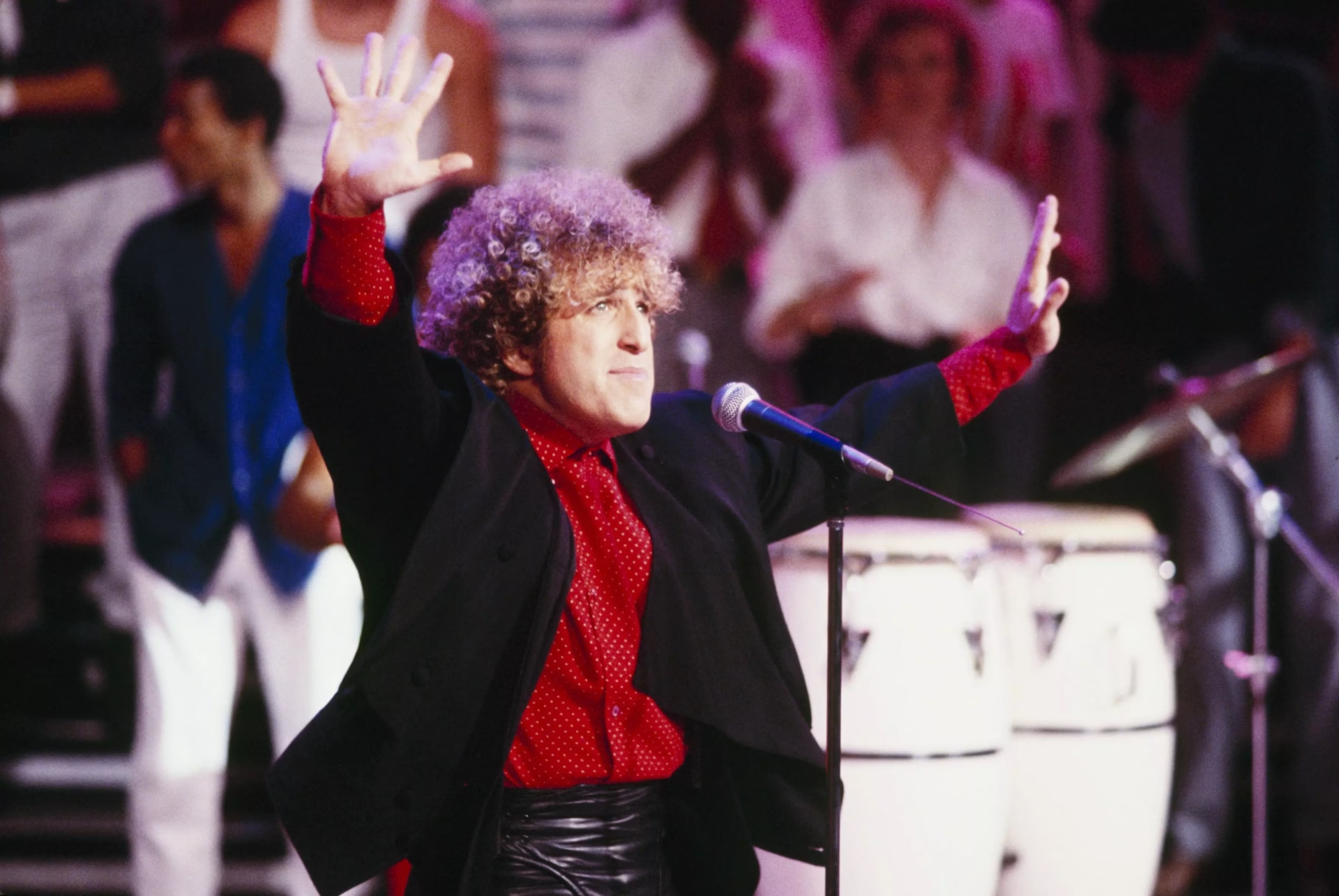
When Matthew Wilder first wrote his early '80s synth-pop smash "Break My Stride," he wasn't, as the lyrics suggest, in the greatest headspace. "I was under contract to Arista Records and I had been two years deep into that relationship and things were not going my way," he tells the Recording Academy. "I was quite frustrated... And 'Stride' was a culmination of that feeling of being incredibly frustrated, and I'm hitting a wall, and the song poured out of me in probably a matter of 30 minutes."
"Stride"—a jaunty tune about perseverance in the face of great odds—eventually went on to hit number five on the Billboard Hot 100 and has been remixed multiple times. And now, in 2020, it's found new life on TikTok, where, in the #BreakMyStrideChallenge, users would text their friends the lyrics of the song, prompting Wilder to post an official lyric video featuring text messages of the song's lyrics.
<style>.embed-container { position: relative; padding-bottom: 56.25%; height: 0; overflow: hidden; max-width: 100%; } .embed-container iframe, .embed-container object, .embed-container embed { position: absolute; top: 0; left: 0; width: 100%; height: 100%; }</style><div class='embed-container'><iframe src='https://www.youtube.com/embed/kZ5h0KUowKk' frameborder='0' allowfullscreen></iframe></div>
Though “Stride” could accurately be called Wilder’s one hit as an artist, his career has boomed behind the scenes in subsequent decades: He's found huge success as a songwriter and producer, famously working on No Doubt's Tragic Kingdom and Return Of Saturn, among others. As a composer, Wilder's been heavily involved in writing the music to some of your favorite animated Disney films—Mulan, in particular. And soon his music will be featured in the forthcoming live-action Mulan remake, arriving in theaters on March 27.
For now, though, Wilder is still in awe over the recent viral resurgence of "Break My Stride," which has since earned a spot on Spotify's Viral 50 playlist and landed on Apple Music's Top 100 chart in more than 20 countries. We recently called up Wilder to talk about the surprise comeback of his new wave classic and why that "got-to-keep-on-moving" ethos is still so relevant today.
First off, congrats on the renewed interest in "Break My Stride"! What do you tell people—and interviewers like myself—when they ask you about the TikTok #BreakMyStride challenge?
We talk about the fact that it came out of nowhere. I was aware of the TikTok platform, but it wasn't a part of my life in any way, shape or form. So I think it was my brother that sent me a Google alert or something along that line that was pointing the way to this thing that was starting to unfold. And I kind of shrugged it off. And then little by little I was contacted by several different people and this thing kind of snowballed. And then by the time I was off on my trip to Europe, this thing was full-blown. So it took me by surprise. I had no idea that this was percolating.
<blockquote class="tiktok-embed" cite="https://www.tiktok.com/@peytoncoffee/video/6783063315934383366" data-video-id="6783063315934383366" style="max-width: 605px;min-width: 325px;" > <section> <a target="_blank" title="@peytoncoffee" href="https://www.tiktok.com/@peytoncoffee">@peytoncoffee</a> <p>Might Post His REACTION...</p> <a target="_blank" title="♬ Break My Stride - Matthew Wilder" href="https://www.tiktok.com/music/Break-My-Stride-6780351840790792966">♬ Break My Stride - Matthew Wilder</a> </section> </blockquote> <script async src="https://www.tiktok.com/embed.js"></script>
I actually saw this as a fun opportunity to revisit the song itself and talk about its genesis. Can you share what you were thinking when you originally wrote "Break My Stride"?
At the time that I wrote the song, I was under contract to Arista Records and I had been two years deep into that relationship and things were not going my way. I was quite frustrated. There were other things happening personally at that point in time. And "Stride" was a culmination of that feeling of being incredibly frustrated, and I'm hitting a wall, and the song poured out of me in probably a matter of 30 minutes.
But what was happening culturally around that period of time was the new wave movement with Culture Club and Men At Work. So it was the confluence of all of these influences that was happening musically at the time. I'd been on one particular path stylistically and kept trying to write and record music in a particular vein. And then once the new wave movement took hold, it opened up a whole bunch of possibilities.
Stylistically the synthesizer became a lot more prominent. Attitudes were different. And so the song itself was, was a confluence of events where I'm taking that frustration lyrically, I'm getting into nonsensical lyrics to afford myself the opportunity to sing a chorus like "Break My Stride" and musically being strongly influenced by what was happening around me culturally. So we went off at that point, my relationship with the label was such where the producers and I went off and made the record. We didn't know it was the record at the time. In the wee hours of the graveyard shift at Pasha studios in Hollywood and called our friends in and so on, put this thing together with basically shoestring. And then went back to the label and played this new odd little creature and they didn't connect with it at all.
And when the word came down from on high that they didn't really believe in this particular song amidst everything else that I'd given them. My gut response was to request that they let me go, which they did and I was free to take the record with me because it had not been financed by the label.
It wasn't long after that I got signed to a new record label and the song became a worldwide hit about six months later.
When you think about the message of the tune and the events that were happening around it and then the realization at the end of this whole little vignette that I'm describing to you, the song sort of was a self-fulfilling prophecy if you will.
<style>.embed-container { position: relative; padding-bottom: 56.25%; height: 0; overflow: hidden; max-width: 100%; } .embed-container iframe, .embed-container object, .embed-container embed { position: absolute; top: 0; left: 0; width: 100%; height: 100%; }</style><div class='embed-container'><iframe src='https://www.youtube.com/embed/cy46iOwWQiE' frameborder='0' allowfullscreen></iframe></div>
You mentioned that the sound of “Stride” was primarily born of the new wave movement. What musical style had you leaned toward previously?
Well, I've been a working musician since I was 16 years old. So you have to really turn back the clock stylistically to understand what was happening back in those days when I was first starting out, which was more of the folk singer/songwriter movement. And I like many other musicians in the pop vein are a reflection of what's happening in our time.
So, back when I was first starting out a James Taylor and Carole King and Seals And Crofts, I mean I'm just grabbing names off the top of my head but that's what was driving popular music at the time. So my music was somewhat reflective of that. And then as you know, the decades tick by and styles changed, so did my music and my influences.
So it's not to say that I was a musical ambulance chaser. I wasn't going after chasing the sound of the minute. But you can't help but be influenced by what's happening with you culturally, around with what surrounds you. So my music did change stylistically over the years, but I grew up on the Beatles and the Stones like everybody else. And that was really the catalyst to what informed my approach to writing pop music.
Since then, you’ve done so much prominent songwriting and production work in the pop music and film worlds. What are you up to currently?
Yeah, it's changed. I mean, now my work is a lot more eclectic. It's not necessarily as pop-centric as it used to be, scoring films and I'm working with younger artists. I still function in a multifaceted capacity depending upon the job description, if you will. I'm still involved in pop music or contemporary music, why don't we use that word. There's a new artist that we just completed producing an album for that we're hoping is going to become well known in the next year named Oscar O. She's quite extraordinary, she's 20 years old so that keeps a foot in that world. And I'm just about to finish scoring a political feature animation called "True North," which is about North Korea. There's the obvious big event on the horizon with "Mulan 2020."
So I'm happy to say I've been fortunate enough to be able to dip my toe into a number of different genres and styles and be able to use the extent of my musical knowledge. It's not just relegated to one particular style of writing.
Read More: Lil Nas X's No. 1 Run Began With TikTok, Now The Music Industry Is Taking Notice
Yeah, it seems that the best way to survive as a working musician is to be able to do a little bit of everything.
Yeah. And I think the way that the music businesses evolved to the point that we're at right now, younger musicians that are starting out at this point in time, it's a very different industry to quote the obvious. And I think in my humble opinion, the more you bring to your artistry, in other words, if you have the ability to function in different capacities, the greater the chances that you're going to have a long career. It's a lot more difficult if you're focused on one thing and one thing only.
Sometimes if it hits like that, if you're lucky enough you can ride that wave for a considerable amount of time. I mean, look at me, I've got a song now is what, 35 years old that is come back full circle and has stood the test of time, not by any grand design on my part. That's luck. And that also is part of the DNA of the song that is able to sustain over three-plus decades. So, that's great but you can't plan on that.
I could be reading too much into it, but we're living in such extraordinary times, and the music and pop culture that we consume is often reflective of current events. I wonder if the resurgence of "Stride" on TikTok is a glance at young people dealing with frustration over current events via dancing to a song about overcoming the odds no matter what?
I like the way that you frame that and I can't take credit for it. And you know, once a song is released to the world, people take it and they interpret it and apply it to their lives, particular to what their needs are. But when you have, as you said, when you have a moment like this and the times in which we live, a song of this nature of defiance and spirit I think is... I was talking to, I'm sorry I'm interrupting myself and my thought, but I had an interview last week with a woman from the BBC who is telling me that every time she broke up with a boyfriend, that this was the song that she would play. This was her rallying cry. It makes me smile and laugh but the song also is applicable to far more, not to diminish what this woman was equating the song to mean for her.
But I've heard so many people over the years talking about very, very challenging personal events in their lives where this tune played a big part in helping them get through. And I know that sounds a bit cliche, but it's true. I mean these are stories that have circled back to me that make me feel that that really was the essence of what, why the tune came to be in the first place. It wasn't that I was specifically writing about Arista, although there are moments in the lyric that I could point to that were a bit specific, but it was a culmination of a feeling at that moment where that was the catalyst for and the impetus for writing the song. So it's a long way of saying, I agree with you. I think that the times now in which we live could not be a better time to have a song like this in the zeitgeists that are helping people to get by.
I think also sometimes the simplest phrasing is also the most powerful.
Yeah. Pop music was, if you think back to the era that I would, to which I was referring earlier, there was a time where music really played a massive role in changing culture and having an influence on the political arc of what was happening at that point in time. These are during the Vietnam war, all the protest that was going on, music was reflective of that. I'd love to see more of that now myself, but things do recycle and I think in the case of Stride, this is its time again. And for whatever reason, whether it's just for fun, lark of TikTok with people digging deeper, so be it. I mean, I couldn't be happier about that.