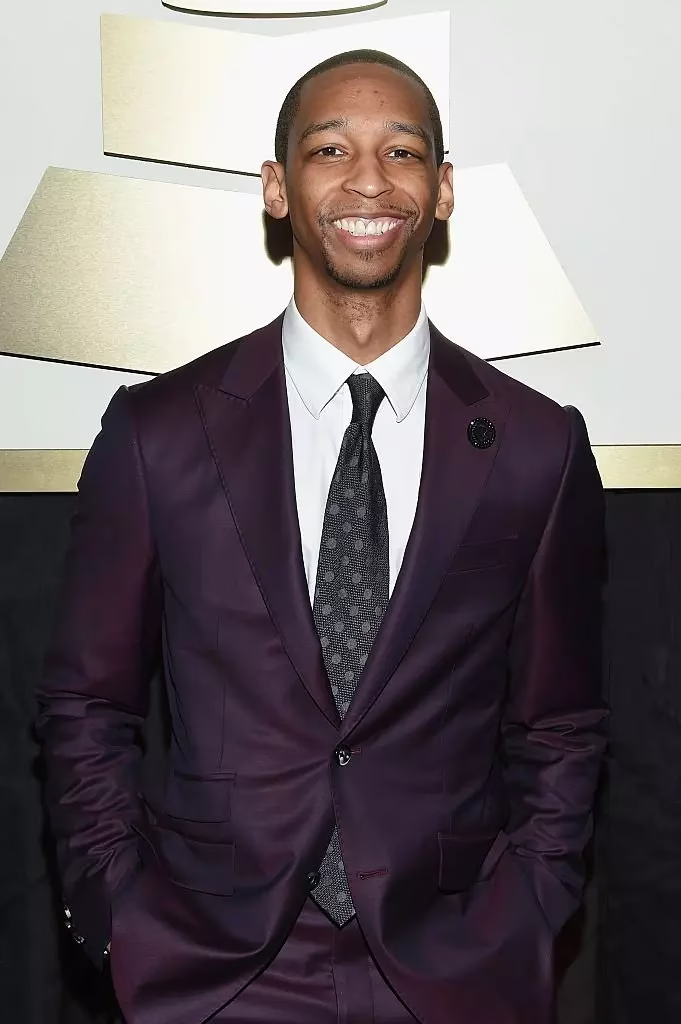
Armand Hutton is a man of many, many talents: Not only is he a GRAMMY-nominated bass vocalist, arranger, composer and voice actor, but he is a newly elected Nashville Chapter Board member.
With Black Lives Matter protests being staged across the nation in response to the deaths of George Floyd, Breonna Taylor, David McAtee and many other Black people at the hands of police, GRAMMY.com checked in with Hutton to get his perspective on the current situation, what change looks like and how the music industry at large can contribute.
How would you describe our current situation?
In regards to social unrest and injustice, I would liken our current situation as a country to a pot overflowing with boiling water. The water was always there in the pot before the heat was applied. In order for the water to boil, heat had to have been applied for an extended amount of time. The water didn’t start to boil as soon as the heat was applied. But if you keep the heat on long enough, not only will the water boil, but it will start to spill over the pot. Social unrest and racial injustice is built into the very fabric of American history. It’s always been there. There hasn’t been a time in this country’s existence (perhaps before the first English settlers arrived) where social unrest and racial injustice didn’t exist. This is also not the first time in our country’s existence where the "boiling water" that is racial injustice hasn’t overflowed. But we are at an all-time high in our country’s history when it comes to the awareness of racial injustice and the desire to fight it by non-POCs.
How do feel we got to the current state of affairs in our country?
Answering this question would take up as much time as a few semesters of American History. Our country was built on the pillars of white supremacy. Because these ideologies went unchallenged and accepted for centuries, it led to the systemic racism we face today. There have been uprisings, revolts, protests, riots and resolutions since slavery. Out of these actions things did and will progress. Laws were passed or amended. Acts were written and set in place. Unfortunately there was no law or act that sought to amend the issue of hatred born within the heart of man. Racism maintained its stronghold on our country through the form of designed systems that give privilege to white people on the social, political and economic level.
So, how do I feel we got to the current state of affairs in our country? To a POC, it has always been this way. The only difference is that now it’s on non-POC's radar more than ever before.
Read More: Torae Talks Fighting For Change & Overhauling The Music Industry's Business Model
How can the music community at large contribute to creating change?
The arts have always done an excellent job of telling the story of the times. If you ever wanted to study a certain time in history, listen to the music of that time and you’d be painted a pretty accurate picture. The same thing has to be done today. Musicians and songwriters must not shy away from detailing the horrific scenes of systemic racism that exist in the 21st century. We must tell the story of now. We must educate others and ourselves on the issues of not just the world at large but our individual regions and communities. We also must be at the forefront of not only hearing and creating these new stories and perspectives, but also by embracing them. What gave America the illusion of greatness was the kaleidoscope of cultures and differing ideas blending, working and living together to create harmony. "Harmony" is often used as a word that means togetherness. But we know that it is a basic musical term. So we must once again make the word "ours" by leading the charge against division, and doing our best to embrace each other's differences.
What are you doing to activate/advocate?
Along with living my life as an advocate for equality, I volunteer as a songwriting teacher for middle school-aged kids at a black school here in Nashville. Teaching children goes beyond grades and a curriculum. I now have the duty to instill self-awareness, confidence, empathy, compassion, history, pride and all of the tools necessary to advocate for change. By being involved in their lives, I can reach and teach kids who are developing their ideas of the world. I can help shape and mold who they ultimately become.
How are you coping?
I cry from time to time at the injustice I see, and especially knowing that any of these unwarranted actions of hate could be done against me simply because of the color of my skin. But I find refuge in friends, family and in the peace that God gives. I’ve lived my whole life as a Black man, so I’ve had time to build up an immunity against hate. Every now and then, the darts sneak past the shield I’ve built up. But I talk about them. I don’t hold them in, because my story could be what prevents someone else’s story from ever happening.
In your opinion, what should non-Black people be doing to support the Black community?
Read and understand the history of this country. Take the time to analyze your own prejudices and seek to find the origin. Understand that change takes time, but be eager to make that change. Speak up when you see or hear something that could offend someone else. Decide if job security, friends, family members or social status matters more than defending and seeking justice for the oppressed and abused.
Regarding the COVID-19/coronavirus pandemic and its affect on the music industry as a whole, how has that affected you personally?
I no longer tour or travel as much as a performer as I used to. However, the few shows that I had were canceled. Studio sessions were canceled. Productions were halted as I sought to collaborate with musicians around the world.
What has this moment taught you?
I am extremely blessed that no one I know personally contracted or died from the virus. And because I was blessed enough to be spared from it, I found myself spending more time with my family. I found myself spending more time working on projects that I never had time to work on. As an introvert, I realized just how much I love staying home. I also realized how much time and money was spent on doing things and going places that I really didn’t need to do or go to. So this moment has taught me how to prioritize the things that really matter. My gift of music and my craft does not define who I am as an individual. Music is what I love, and it's what I do, but it’s not who I am. It’s a large part of me, but not the whole. Taking time to look inward has helped me realize that.
Moments like this can be a springboard for creativity or innovation—has that been your experience?
Because I’m an introvert, I have always set aside time to be alone with my thoughts and creativity. I haven't grown musically as a result of COVID, but I have been forced to be innovative when it comes to how to collaborate with friends and other musicians. I’ve had to rely on technology and focus on the importance of the individual when it comes to how my music relates to fans.
Want To Support Protesters And Black Lives Matter Groups? Here’s How