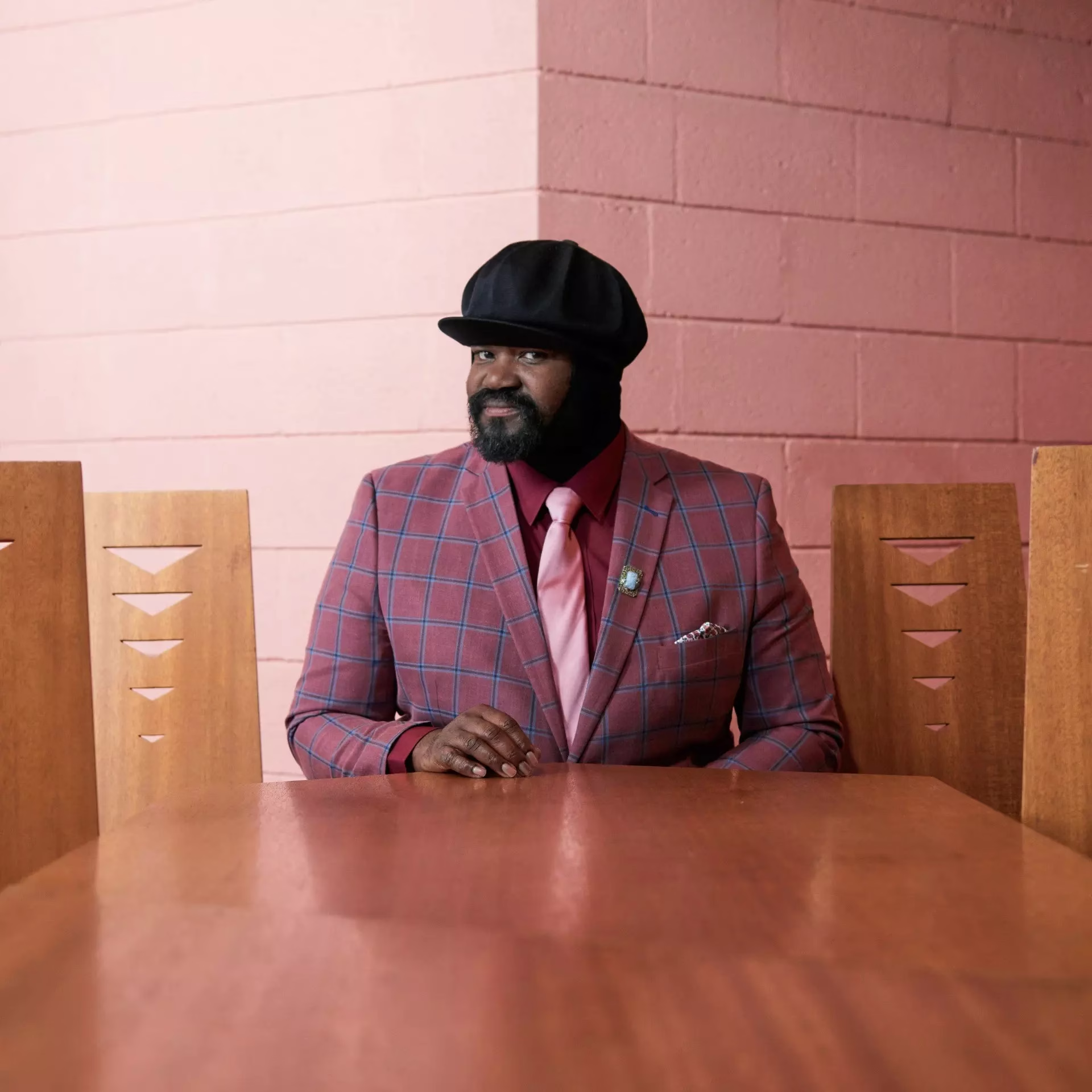
Gregory Porter recently sang "America the Beautiful" from his living room to send off the Mars 2020 Perseverance Rover in style. He's far less concerned about the Red Planet than ours. "This could go a whole bunch of ways," the two-time GRAMMY winner and five-time nominee tells GRAMMY.com about the COVID-19 pandemic. "The anguish, the poverty and the food insecurity [the pandemic] could potentially create could be the beginning of World War III."
And if we come out of this without triggering Armageddon? "I think we'll be stronger, better and more loving," he says. "This is my desire."
<style>.embed-container { position: relative; padding-bottom: 56.25%; height: 0; overflow: hidden; max-width: 100%; } .embed-container iframe, .embed-container object, .embed-container embed { position: absolute; top: 0; left: 0; width: 100%; height: 100%; }</style><div class='embed-container'><iframe src='https://www.youtube.com/embed/JIB3JbIIbPU' frameborder='0' allowfullscreen></iframe></div>
Sure, "love is the answer" is the mother of all platitudes. Who cares, Porter asks, given what's on our plate in 2020? Police brutality, a pandemic, the USPS teetering on the precipice of needing a GoFundMe—taking stock of these issues through the lens of love is the best policy we've got. "I'm trying to shake the shyness of people to [coax them to] perfect love and just call it what it is," Porter says. "I'm constantly trying to express the irrepressible and optimistic view of love."
His latest plea for peace, love and understanding is his new album All Rise, which is due Aug. 28 on Blue Note. Featuring an orchestra, a 10-piece choir and vibrant production redolent of upscale cologne, it could have been recorded this year, 50 years ago, or during the Truman administration. Same goes for the writing—on "Revival," "Faith in Love" and "If Love is Overrated," Porter probes spiritual themes that recall those of Donny Hathaway, Curtis Mayfield and Stevie Wonder.
Porter was raised in Bakersfield, California, which is the home of Buck Owens' Crystal Palace and not a hotbed of jazz. The oil town does have a history of gospel, which figures heavily in his sound. More than that, he embodies the genre's message of tolerance and humility—which, in our sanctimonious, Twitter-addicted era, has largely been shouted out of the room. Whether singing or conversing, Porter exudes warmth that can thaw a cynical heart—even as he admits our worst days may lie ahead.
GRAMMY.com caught up with Porter about the making of All Rise as well as fusing Bakersfield and New York sounds, writing for an orchestra and how his father gave him the gift of a golden voice—and nothing else.
<style>.embed-container { position: relative; padding-bottom: 56.25%; height: 0; overflow: hidden; max-width: 100%; } .embed-container iframe, .embed-container object, .embed-container embed { position: absolute; top: 0; left: 0; width: 100%; height: 100%; }</style><div class='embed-container'><iframe src='https://www.youtube.com/embed//jvIb__axcDI' frameborder='0' allowfullscreen></iframe></div>
This interview has been edited and condensed for clarity.
There's a history of country music in Bakersfield—jazz, not so much. So it seems like you sprouted like a flower through concrete.
You know, there's a pocket, there's a pocket. There's a jam session that happens [at Bakersfield Jazz Workshop] and there’s a jazz festival that happens at Cal State Bakersfield. There's smooth-jazz bands, but a pocket of straight-ahead and contemporary jazz artists here as well. Terrace Martin has a [family] connection to Bakersfield and he spends a lot of time here.
Country music is big here, but also gospel music. Black gospel music is strong here. So that's the roots of my connection to music. What I'm doing and have been doing is bringing the two together in my way. So it's Bakersfield and Brooklyn, Bakersfield and Harlem coming together to do what it is I'm doing.
You've said you always write from voice and piano as a foundation. So how did you decide these songs asked for strings and a 10-piece choir?
Any song that I've done becomes something bigger than what I thought it could be. They all start with just a voice, you know. You always have to imagine them at first with piano, bass and drums. The orchestra and even the choir is a further expounding on that original idea. So it's not difficult mentally for me to hear how any of these songs could go small or big.
Quite frankly, in live performances, they may be smaller. It may just be my rhythm section with horn players or organ players. I definitely can't take the London Symphony Orchestra or anything equivalent along with me. We will do it with full orchestra and choirs in some locations. But it's a larger sound than [typically] would be played live, so I have to hear it in bigger and smaller ways.
The fact that I'm just coming off an orchestral record, [2017’s twice-nominated] Nat King Cole & Me, encouraged me to use my original sound—my vocal sound, the way my band plays, my original writing—and combine that with a beautiful orchestra that has a sensitivity to that kind of music and an eagerness to play it. A leaning-in spirit in terms of playing different types of music outside the classical rubric.
I think, in a way, adding orchestrations and adding more to a song can be as simple or as complex as adding more voices to the congregation of things that are already happening. It’s like more background singing, but the background singing happens to be violins or oboes or cellos, you understand?
I love the way All Rise was recorded. I don't know if it was the way everything was miked or not, but there's a rich, dark sound to it. Walk us through the recording process.
My producer Troy Miller and I took our time with the sound. We recorded some parts—maybe three or four songs—at Capitol Studios in Los Angeles. But the meat of the project was recorded in Paris in a small studio. Troy's quite a wizard in terms of capturing the music the way it should be captured and getting all the information we need.
It's really an organic and old-school process of [crafting] this rich sound, mixing the orchestra with the vocals in a tasty way.
In "Dad Gone Thing," you explain that your mostly absent father taught you to sing and little else. What do you remember about his musical abilities?
Nothing. This is the thing: I never heard him sing. In all our interactions, I never heard him sing. I heard him preach. In the Black American style, it's a sing-songy way of preaching. It's kind of like singing the blues but with gospel lyrics. I heard him do that—maybe about 15 seconds of it—but live, hearing him sing, I never heard him.
But many people said at his funeral that he was a great singer. So in the song, what I'm saying is that he gave me my singing voice. But no fishing, no tie-tying, no fatherly wisdom, just nothing. I inherited his voice. That’s the way I've been trying to reconcile our relationship and find positivity and beauty in it in some way.
<style>.embed-container { position: relative; padding-bottom: 56.25%; height: 0; overflow: hidden; max-width: 100%; } .embed-container iframe, .embed-container object, .embed-container embed { position: absolute; top: 0; left: 0; width: 100%; height: 100%; }</style><div class='embed-container'><iframe src='https://www.youtube.com/embed/UcJ_sP1nShQ' frameborder='0' allowfullscreen></iframe></div>
Let's talk about "If Love is Overrated." Are love, humility and mercy overrated right now? I feel like there’s more value assigned to intentionally misunderstanding and demonizing our neighbor.
Well, you know, sensitivity, tenderness, kindness—including current leadership in this conversation—all those things can be considered weaknesses. In a way, if you're taking the song romantically, it's an embellishment on the idea of "No Love Dying" or "When Love Was King." The idea that If love is cliché, I’m still OK with it. If you consider love and kindness to be signs of weakness: OK, put that stamp on it, but still give me love.
To my ears, there's DNA of Marvin Gaye's What’s Going On and Stevie Wonder's Songs in the Key of Life in this album. What records were swimming through your mind while you made All Rise?
Without question, What's Going On. The way that Stevie Wonder, Marvin Gaye, Donny Hathaway, Curtis Mayfield, Abbey Lincoln and Nina Simone played with their visions and blurred the lines of heaven and earth—the way they immersed themselves in the secular and the spiritual—is genius and soulful. It's something I've tried to incorporate in my career. It's definitely something I've been steeped in.
Spiritual inspirations are what I'm writing for and writing from. I survey what I see and what I've gone through in the past and I try to take all that information and come up with songs that speak to who I am as an artist and where I’d love to see us go as a people.
In "Revival," I'm talking about our ability to strengthen our inner core, that self-doubt that comes our way or can come our way any day. What do we do [in response] and how do we find a way to be stronger? I'm thinking of all these things—quite spiritual things—when I'm writing songs.
At the same time, there's protest and a bit of justice in there, and it's subtle. You have to listen. You have to see where I'm placing the lyrics and when I’m saying it. You have to go back to the first verse and see what I said and go "OK, it's a song about race, it’s not a song about teenage love."
Speaking of a song like "Mister Holland," it's relevant and present to some of the protests that have been going on in the country and worldwide. I'm telling Mr. Holland, "Thank you for treating me like an ordinary Joe." I'm telling him, "Thank you for not making an issue of the color of my skin."
The last verse of "Mister Holland" is "Mama used to fear for me / When you walk out in the world, you'll see / Some people will fear your face and name / But Mr. Holland don’t play that game." I’m suggesting that conversation happened to me and all eight of my brothers and sisters. She was worried about us coming home and somehow being abused in the streets because people were judging us on who they thought we were.
You're right in capturing that; it is coming from a spiritual place. And all those artists I mentioned, with the inclusion of an artist like Bill Withers, speak to me in my writing.
If COVID-19 had never happened, you'd be coming off a run of theater and festival gigs right now. In the midst of our various lockdowns and reopenings, how are you trying to get the word out about All Rise?
Well, I'm doing Skype and Zoom meetings and interviews, and a few European television shows happened and are coming. Obviously, the combining of my interests with the NASA launch to Mars, that was exciting. You know, we just continue on.
It is unusual for me to be talking about a new record from home. Normally I'm on the road and I'm just waking up in my hotel room fielding interviews like this. Normally I’m traveling—over 250 shows a year. And normally I’m working songs from the album into my show as we go. So it is unusual and difficult.
But the interesting thing is, in our slow immersion in this nightmare, I think this music can be solace or a balm to somebody. I think there is an optimism here and a desire to get over some of these issues, whether it be race or even a feeling of depression — the depths of our emotions that can come from being on lockdown for months.
So, yeah, "Revival" is present. "Mister Holland," that message is relevant before and after the protests. There are some songs on this record that are timely, no question.
The title, you've said, connotes that "we are all exalted and lifted up by love." It's safe to say we don’t feel very exalted right now—economically, emotionally, spiritually. Do you think we'll come out of the pandemic as a better human race?
[Wincing inhale] I… am hoping so. I don't want to give too much power to leadership, but I think there definitely should be a change in many ways. I think there’s opportunity for optimism because I think people will live a little bit truer.
It’s like that cliché of "I almost lost my life and my whole life flashed before me." Now, the entire world’s life is being threatened. I think we'll live [more openly] and appreciate everything. I can’t wait to taste real Italian pasta. I can't wait to eat a croissant in Paris. I'm sure I’ll appreciate everything a bit more because it's been taken away from us.