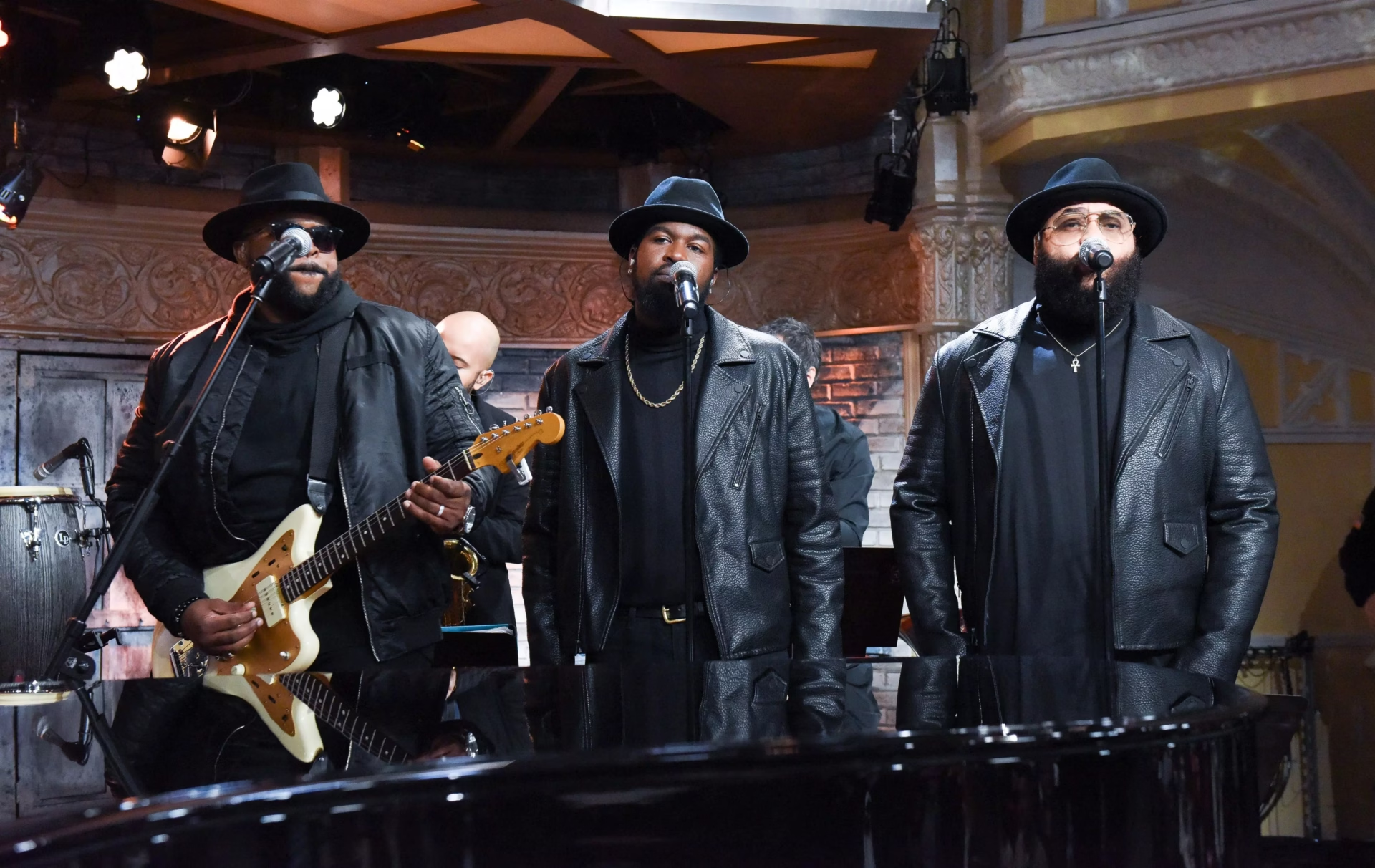
The Hamiltones genuinely want you to listen.
The North Carolina R&B trio's latest album 1964 began as one song for Juneteenth but soon developed into an 11-track LP reflecting their thoughts around police brutality, racism and Blackness in the United States.
<style>.embed-container { position: relative; padding-bottom: 56.25%; height: 0; overflow: hidden; max-width: 100%; } .embed-container iframe, .embed-container object, .embed-container embed { position: absolute; top: 0; left: 0; width: 100%; height: 100%; }</style><div class='embed-container'><iframe src='https://www.youtube.com/embed/un36uMYvVyA' frameborder='0' allowfullscreen></iframe></div>
Their follow-up to a series of EPs, 2020's Watch The Tones (The B Side) and 2019's Watch The Ton3s, has them shifting from their usual upbeat R&B rhythms and lyrics to a more serious vibe. J. Vito, 2E and Tony Lelo, all who once were Anthony Hamilton's back-up singers, take you into their world with 1964, their first full-length album, and ask those not familiar with the Black experience to pull out a chair and hear them out. Tracks like "My Life Matters," a song with a catchy chorus that proclaims the phrase inspired by the Black Lives Matter movement and "The Warning" featuring Petey Pablo and Ricco Barrino touch on experiences Black people have had with police, a topic that has increasingly gotten more attention nation-wide.
"We just wanted to give an audiobook of Blackness, in a sense, to all of the people out there that may not know what's going on, don't sympathize with what's going on and don't understand," Tony Lelo shares via Zoom. "It's time to focus on us because we've been catching the bad end of the stick for a long time. So when do we get our justice?"
The talented group spoke to GRAMMY.com about the making of the album, producing an album themselves for the first time, their targeted audience, their journey as an R&B group in world in which they are essentially non-existent, and more.
What inspired this album?
2E: Lelo actually came up with a song for Juneteenth and it was a great song. It was such a great song that it actually inspired me and a friend of mine to just doing an album, or just putting some songs together and just making it a thing, not just a song, but a whole project.
You created this project during the pandemic. How was that?
J. Vito: It was a bit challenging. If I may, it was a bit challenging. We had a scare. We had to stay isolated from each other for a while. But in the midst of all of that, it didn't take our efforts away of trying to put this piece of work together. We treated it like any other day that we were in the studio working, but we used the proper safety precautions that we needed to take to maintain the safe environment for us all.
I'm glad you got it done because it's an awesome album. Why did you decide to name it 1964?
2E: We went with 1964 because of everything that was going on back in [the] timeframe [we recorded it]. On top of that, the Civil Rights Act got signed in 1964 and when you fast-forward today, we still have the same issues that they were dealing with back then. So that is the biggest part of naming it that.
You have delivered inspirational music before, but this felt very different. What did you want your audience to take from this album?
Tony Lelo: Well, the beautiful part about us is we have a very wide variety of people that support us, which we are appreciative of. What we wanted to do was identify to a community that may not understand what the Black community is protesting, or may not understand why the Black community is reacting in the many different ways that we are reacting. Some people want to protest, which is completely fine by me. Some people create music as we have done. Some people have pushed to the government to try to make a change. We just wanted to give an audiobook of Blackness, in a sense, to all of the people out there that may not know what's going on, don't sympathize with what's going on and don't understand. The beautiful part about the project is not only did we put music there, but we also put some excerpts of significant people who are within our culture, like Congressman John Lewis, Nina Simone, and a couple of more on there that meant something to us that we felt would be significant in this album, and beautiful with the whole total process of creating the album.
You've decided to speak primarily to an audience that is not the Black community. What inspired you to do that?
J. Vito: It was more of a need, I would say. There are a lot of artists choosing to stay quiet. Nowadays we feel we have to be politically correct and we have to watch what we say and how we say it, but [then] you have some people that are just very forward with what they say. But we, our message was more of a peaceful message, but we did it through the arts, the art of music, a world language. It's a language. It's just the language that communicates to so many other people. I feel like God blessed us enough to have the talent to reach the masses and different cultures. I'm hoping that people would want to hear the message and received the message in the right way.
You mentioned that some musicians aren't taking a moment to speak up. What would you say to them about the importance of speaking up at this moment?
2E: I would say to all the people who have a voice that have a platform that agree with what we're fighting for, you should definitely take advantage of your platform. That would be me. Every night, everybody's willing to do that. But if you have a platform and you agree, I would most definitely encourage you to take the stand and speak out.
<style>.embed-container { position: relative; padding-bottom: 56.25%; height: 0; overflow: hidden; max-width: 100%; } .embed-container iframe, .embed-container object, .embed-container embed { position: absolute; top: 0; left: 0; width: 100%; height: 100%; }</style><div class='embed-container'><iframe src='https://www.youtube.com/embed/90cFpDv2v9Y' frameborder='0' allowfullscreen></iframe></div>
One of the songs that really stuck out to me on the album is "My Love Matters." Was that inspired by BLM?
Tony Lelo: Yeah, that was actually the song that I initially had finished with the guys. "My Life Matters" really just equated to my community. Obviously, you could see now I'm African-American. Basically, that's the way that we wanted to say that our lives matter. Everybody has, I don't know, their thing that they're putting on it, Black Lives Matter, Our Lives Matter, Blue Lives Matter, whatever the case. Well, we said, "My life matters." And that's to anybody who feels like their lives matter, but specifically, we're talking about the Black community and who we are. Obviously, that's what we're a part of. It doesn't just single it to the Black community. Anybody that feels like they're giving a disservice within the world right now, anybody that supports the movement right now, my life matters. And we just kind of wanted to have our own direction on what we felt about everything that's going on right now. [We wanted it to] be titled "My life" instead of "Black lives," "blue lives" or whatever the case, my life.
You also have a song called "The Warning," which is a special message to young people. Why did you want to reach out to them?
2E: Well, that's the youth. That's the future. So if I could guide anyone, it doesn't even have to be the youth, if I could guide anyone of any age in the path of being right and being safe and being aware of your surroundings, then that message goes to everyone. You know what I'm saying? So I won't even say specifically to the youth, but to everybody. Everybody. If I can help, I'm going to help. That song is a warning to anybody who needs to be warned and you know who you are.
Some of the songs on the album are named after significant Black figures in the community. Did you pick them specifically for a reason?
2E: We went with those people who are almost like the unsung heroes of Black history. You don't really hear too many people talk about James Baldwin or Nina Simone or John Lewis, you don't really hear those names. So we wanted to dig into the creative unsung heroes and bring more awareness to other people who in a certain time were fighting for the things that we're fighting for today.
Some of the themes that come up on the album are police brutality and racism. A lot of the songs are just humanizing the Black community. Talk to me more about that.
J. Vito: Well, our message wasn't, "Rah, rah, rah, black power. Rah, rah, rah, Black power." I think that was the thing that we all were thinking about, but at the same time, bringing awareness to that culture. And the song speaks for itself. I believe in the message. How can you sleep and be unbothered when you see tragedy on the news? That's the real thing. Because each day of our lives, we live in our houses. You scroll up and down on Instagram, or we look at world news or CNN or however we get our news. And a lot of times, if it don't really apply in our household, or if it's not affecting us immediately, sometimes we just look past it. It's just news, and you just go, "Oh, that's bad. That's sad." But this music is to make you do more than that. You can't just listen at this album and just be, "Well, that's nice." When you listen to this album, we try to create it to where it can be more than just, "Oh, it's okay." It's like, "Wow, I'm listening. You have my attention. Okay. Let me dig into this. Let me dig more into this and see." And then you'll look on the news and you'll see, we're thinking about this because our Black brothers and sisters are being murdered for senseless reasons. So it was real. It calls for us to make this kind of music. But like I said, it is peaceful, but it's not, "Rah, rah, I'm black." Yes, I'm black. I'm proud to be black, but it also takes a look at our culture. Take a walk in our shoes for a second. Live in our shoes. And how do you feel if you had to live like us? That's just the message of 1964. And like my brother said before, the things were going through back then was still going through now. Now, what are we going to do to change it?
Tony Lelo: I would like to add onto the end of that as well, just to piggyback on what my brother said. There are multiple messages in this album. So you can go to "The Warning" that is speaking on police brutality and a bit of racism. You can go to "My Life Matters," which is speaking on what we feel as a culture. But then you can also go to" Imagine" and it says, "Imagine a world where we all can live together. No matter the decree, no matter the race, no matter what you choose to do on your personal life, imagine the world will be all can live together." So I just want to piggyback on what he said. This isn't just like a, "Rah, rah, rah, rah." We tried to really attach ourselves to every particular emotion to show people we're not just trying to tell you the bad side of things because we do evoke and love to love. And that's what the world ultimately needs more of. It's just a whole lot of love.
I'm wondering how you all felt during the process of the making of this album, because I know for me, as a woman, as a Latina, it can be sometimes so draining to explain my identity to people who can't relate.
2E: Well, the album, we actually condensed six months of work into a month's worth of time. So it was a lot of back and forth between our homes and the studio and our personal studios, a lot of the back and forth between our personal hubs and the studio, trying to get it done in a timely fashion because it was really time-sensitive. We really want to make an impact on the moment. You know what I'm saying? And the moment is now. So we are trying to operate in the now and be as impactful in the now as possible.
<style>.embed-container { position: relative; padding-bottom: 56.25%; height: 0; overflow: hidden; max-width: 100%; } .embed-container iframe, .embed-container object, .embed-container embed { position: absolute; top: 0; left: 0; width: 100%; height: 100%; }</style><div class='embed-container'><iframe src='https://www.youtube.com/embed/HKRYbtEjEQQ' frameborder='0' allowfullscreen></iframe></div>
I want to go back quickly to something Tony mentioned. You didn't want it to be like, "rah, rah, rah, rah." I'm assuming, you mean you didn't want to come off angry. Do you think if a person or a musician comes off that way people won't listen?
Tony Lelo: Yeah. And I was piggybacking off of my brother J. Vito. So I want him to be able to answer the question as well. He was definitely the person that was speaking on [that]. But me, personally, I want to say, t's like a relationship, right? So when you're talking to someone, I don't think it has to be so hard and harsh. We have to gain an understanding and the best way to gain an understanding is to respectfully speak to each other. So then that way we can have an understanding that it won't be so defensive and sometimes the aggressive, "rah, rah, rah" way can totally turn a person off because they're not even hearing what you're saying, but they're looking more to the actions of what you're putting into what you're saying and what you're saying is totally going past their head now. So I don't want to discredit any way or anybody in any way that they want to get their message across. Hey, whatever you decide to do is what you decide to do. But as for us, not only did we not want to attack it in that way, but we wanted to try to attack every angle that we could think of that our culture is feeling right now. ... But please, Vito, piggyback.
J. Vito: No, brother, I completely agree. What I would say is we got a lot of white friends. Some guys that we work with and tour on the road with, they are not Black. And we're sleeping in houses with these guys. So at some point, we have to have a line of respect for each other and we do. We have respect for everybody. We were always brought up to just treat people the way you want to be treated. And that's our message.
Tony Lelo: Exactly. Exactly.
J. Vito: That's just what it is. My brother, he summed it up, but that's how it is. For us, well, we try not to worry about those types of things because we treat people nicely. We treat people with respect and I think that's how people receive us in the light that they do. So it's easy for us to get messages out like that because we never came trying to be, say "Black power this, Black power that." None of that. It's just we're peaceful people. It's a peaceful message.
Tony Lelo: And I also want to stay too on behalf of me and my brothers, it's not that we aren't saying that everybody doesn't matter. Everybody does matter. But right now, man, we receive enough of bad side the stick. So it's about us right now. You know what I mean? That's really what The Hamiltones are saying. Yeah, everybody does matter. No matter what race you are, no matter what you choose, yeah, you do matter. We all matter as people. But right now, it's time to focus on us because we've been catching the bad end of the stick for a long time. So when do we get our justice?
I noticed that you end the album on a lighter note. You end with "Celebrate." Was that intentional?
2E: Yeah, that was. If you really listen to the album, like really, really listening to it, you could see where we started off kind of, I guess, aggressive in the beginning. And then as you go through the outro, you could see in transitions from aggression to a more lighter, "Let's celebrate. It's like we have to talk. We got all that at the way. I love you. So now we can party together." It's like your parents. Your parents give you a whooping, but then they hug you out. So it's like that. You get that whooping, but then you're going to get some love at the end we're going to rub you on the back and say, "It's going to be okay."
Production-wise, who did you work with? Did you all make the beats?
J. Vito: The one proud fact about this album is its self-produced. It was written and co-written between the Hamiltones and a friend of ours, Keith Matt. 2E, Tony Lelo and Keith; We all just came together. It was like piecing it together to bring it out. And that's what happened and 1964 came to be.
Tony Lelo: Vito, as well. Don't leave yourself out, Vito.
J. Vito: I said everybody.
Tony Lelo: Vito played his part as well.
J. Vito: We all get like a team, like the Lakers. You had Shaq. You had Derek Fisher. You had Kobe. Then you have Robert Horry on that side. We came together. Now we got these friends today.
When you were making it, you were going into it with a very specific theme. Did that at all affect the beats and rhythms that you wanted to choose?
Tony Lelo: I think most of these productions were based on what we thought at the time that accompanied the song in the right way. So I don't think it was much of a choice. It was what God gave us. So he gave us those words. And by the grace of God, most of the time, he gives us the bop to it as well. And we just got together to be able to create. So like "My Life Matters," the way that I orchestrated it, I generally come up with a beat first and then after that, I say what I want to say on top of the beat, I'm not exactly sure what the thought process is for Keith, but I know for one song "Message to America" he sent me the words and then asked me what did we feel about it? He sent it to the guys, the guys liked the words. We just wanted to present it in our way. So but then from there, when he sent me, I took my thought process and applied to the music to it. So 2E, I'm not exactly sure how 2E created his part. I'm sure we'll be interested in hearing that. 2E?
2E: I had an idea and then I did my parts and sent it to my bro, because they added their thoughts to it. And that just how it went. Same thing with Keith, he had an idea and just brought it to the table. We did our necessary parts to make each individual song, and that song will work and our own individual with it, whatever the vibe was.
There are not many R&B groups nowadays. Is that a positive for you?
J. Vito: I'd like to say all the time that we're reminders that there's still great music and there's still a group of people that know how to sing together. That's been the beauty of us being together all this time. We know how to sing with each other, and learn... Anything with each other, we learn with each other. So it transitioned in the pieces of like 1964, in Watch The Ton3s, and Watch The Tones (The B Side). We're learning each other and learning how to produce with each other because a lot about music has been self-produced with a lot of... We work with other people. But for the most part, we really try to do a lot in-house. Not that we try to cut off anybody else's opportunities, but most of our inspiration, we draw from each other. So it's really easy for us to come up with a lot hence, put some respect on it. And all the little funny videos that you saw, we know how to sing with each other. We know how to act with each other. So that just gives you who The Hamiltones are. It's just how it works for us. And it goes to show you that people can't come in here and try to be a Hamiltone. It takes three, me, Tony Lelo and 2E.
What do you enjoy most about working together?
Tony Lelo: I like the learning process and I like the intensity of learning with these guys ... You might have those days where we may get another debate, I wouldn't call them argument, but the debate about maybe the direction that we wish to go. Even this particular album, if we would be truthfully honest, we were kind of nervous. You know what I mean? Because you're stepping into grounds that you're going to lose people that support you. You want to gain people that support you. You kind of put yourself in harm's way in a sense, because it's crazy people out here now. So just because they hear one of your products and the way that you feel about a scenario, if they don't agree, you put your life on the line. Think about Malcolm X Think about Bob Marley. Think about Martin Luther King. So we really, really had to have an in-depth conversation, but that's the beautiful thing about going with my brothers. So I enjoyed the learning process, learning and being around these guys because they've helped me grow up into a man, but that's just me personally.
Tony mentioned something that's really real about not knowing how people are going to take a project like this that focuses on race. Nowadays, you don't know what might get you a death threat. I'm wondering how your fans have received the new music?
2E: I was about to say, I don't even think our music would either draw that type of energy. That project doesn't need to have that type of energy in it. So I couldn't see anybody playing that album and being scared of something to that extent. That album doesn't even put out that type of energy.
Jekalyn Carr Speaks To The Unifying "Power Of Love" | Positive Vibes Only