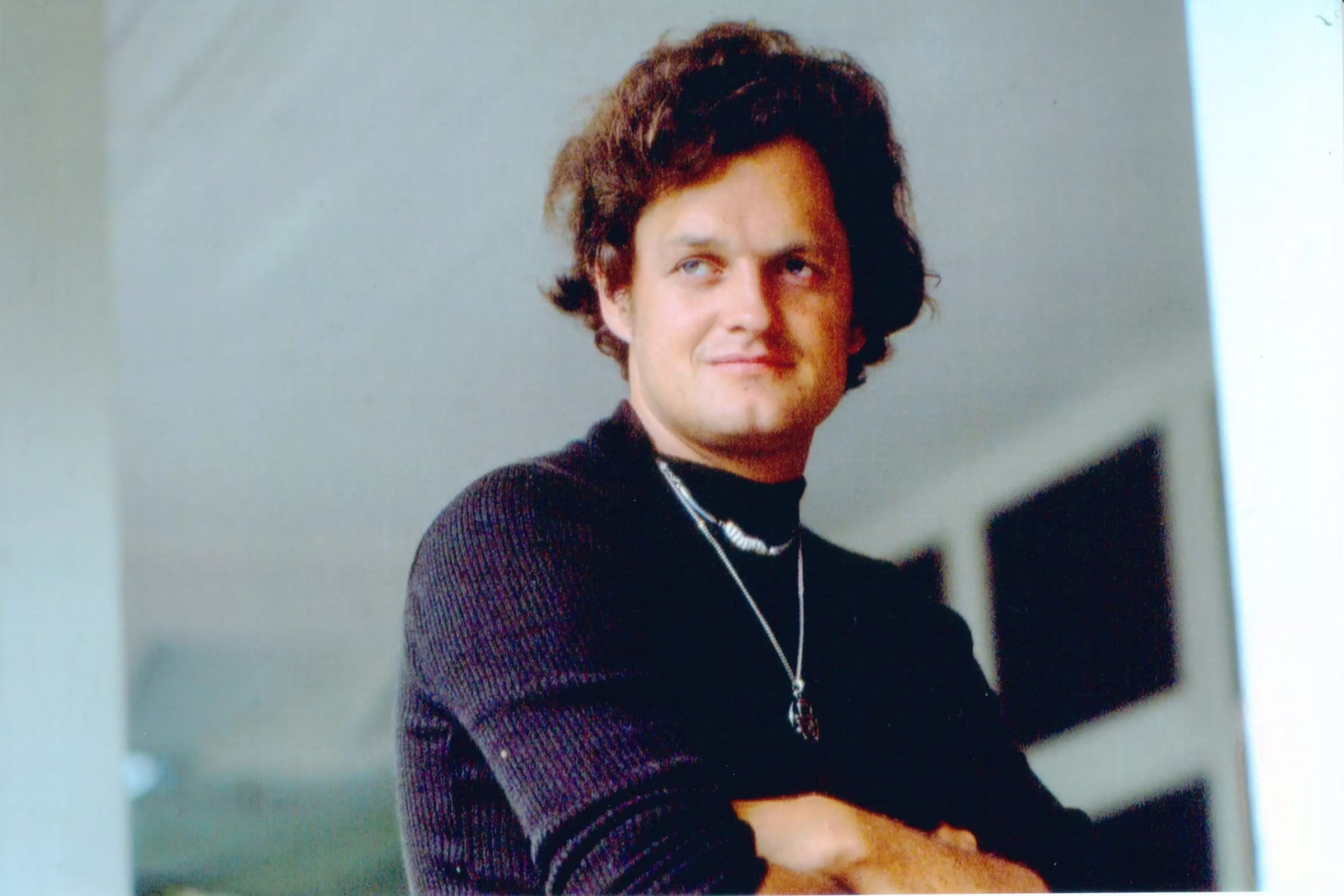
In 1972, not long after signing to Elektra, a 29-year-old folk singer/songwriter named Harry Chapin released his debut album, Heads & Tales, spawning the hit single "Taxi." Later that year, he'd release his sophomore album, Sniper & Other Love Songs, and receive his first GRAMMY nomination, for Best New Artist at the 15th GRAMMY Awards.
Just two years later, in 1974, the Brooklynite released his fourth album, Verities & Balderdash, along with his most well-known song and only No. 1, the deeply moving "Cat's in the Cradle." The memorable track also brought his second GRAMMY nomination, for Best Male Pop Vocal Performance at the 17th GRAMMY Awards.
Almost as quickly as Chapin rose to global fame, he began using his platform to make a difference in the world. With nudging and support from his wife Sandy Chapin, he and radio DJ Bill Ayers founded WhyHunger in 1975 to address the root causes of food insecurity and poverty. The "Shooting Star" singer, who died at just 38 in car accident, would spend the rest of his time on earth hosting and playing benefit concerts, mentoring rising artists, advocating in D.C. and raising money and awareness to fight hunger.
Now, with the release of Harry Chapin: When In Doubt, Do Something on Oct. 16, World Food Day, viewers get a deep dive into the inspirational man behind the music, along with the message that one person really can move make a difference when they put their mind to it. We recently spoke to the documentary's director, Rick Korn, and co-producer/Harry Chapin's stepson, Jason Chapin, about the film, what the great folk artist's legacy means to them and much more.
Watch: History Of: The World-Famous Troubadour In West Hollywood
Harry Chapin, When In Doubt, Do Something comes out soon, on October 16. What messages do you hope viewers will get from watching it?
Korn: Well, there are two messages with Harry's story. The most important thing is about his activism, his music, his way to really inspire generations of music artists, of people like myself. I think the most important thing for people to get out of this is it's a break from the craziness of what's going on in the world around us, it's a 93-minute escape into Harry's world, which is just so entertaining and inspiring. I hope that people look at it from that perspective. I know people that have seen the film have walked away from it thoroughly entertained and thoroughly inspired. That's what we hope people get out of the film.
Chapin: I'll add that my father's been gone for a long time, but over his 10-year career, he accomplished a lot musically. His music continues to be listened to by younger generations, which is great, but the humanitarian side, starting WhyHunger in 1975 and Long Island Cares in 1980 and being involved in a lot of other important causes and organizations, is also big. It's amazing that those organizations have grown so much and continue to help, literally, hundreds of thousands of people each year. If you think about today, hunger and poverty is a much bigger issue now, but, fortunately, because of my father's work and many organizations fighting against it, there's a lot being done.
The takeaway, I'm hoping, for those that see the movie, is that it's one individual who was motivated to do something, who inspired many others to continue to support what he did, but they also are doing great things on their own. It's really inspirational to know that one person can make a difference.
Related: Darius Rucker To Receive Harry Chapin Humanitarian Award At Music Biz 2019
I feel like that answers this question a bit, but I still want to ask it this way. Why did you decide to make a documentary about Harry Chapin?
Korn: Harry was unique in a lot of different ways, and if this was a story about another music artist that focused on their vices and the destruction of their lives, we would not have been interested in making the film. What interests us about Harry is his prolific creativity and his ability to literally move people, to save people. What really blew our minds when we did our research on Harry was he was so incredibly effective in fighting for the underdog.
He could write a protest song and you can do a benefit concert, but Harry was more than that. He literally got his hands dirty doing the work, and figured out what the root causes of hunger and poverty are and attacked them in every way. He spent a good portion of the most vital 10 years of his life just trying to help people, and that is unique in the world, particularly in the world today. That's why we made the film. We made the film because I think the world needs a little bit of Harry today.
Chapin: One thing I'll add, maybe it's not known to a lot of people, but my father was a successful filmmaker before he became a successful musician. I think film helped him really understand stories better and made him a much better songwriter. It's also just amazing, so many years later, when Rick and S.A. Baron [who co-produced the film with Korn and Chapin] asked if we would be interested in a documentary, it was special to me because there had never been interest in a film about him. They saw a different subject matter that others didn't.
Also, it's just the right time, because there's so much going on that my father was passionate about and committed to, and, as Rick said, there's so much negativity out there, but this is the right film at the right time.
Why do you feel like it's so important to share this story and these messages now?
Korn: I don't want to say we rushed it because we didn't, but we really worked hard getting this film out now because of all the divisiveness in the world. Harry's story is unique from any other music artist because he really inspired a generation of music artists. You look at Bruce Springsteen and Billy Joel, Bob Geldof and Ken Kragen, all these people that created Live Aid and "We Are the World"/U.S.A for Africa and Hands Across America. Harry inspired these people in that way, and his music, on top of that, was just so moving and so incredible.
I want to follow up on something that Jason said about him being a filmmaker. One of the things that surprised me when we did our research, was that he was a filmmaker, and not only that, but an Academy Award-nominated filmmaker and documentarian, but we learned that was the way Harry wrote songs. It's very similar to the way a director writes a film. His songs are these mini movies. His storytelling feels like you're the character, one of those two people in the taxi in the song, "Taxi." And you always feel like the parent in "Cat's in the Cradle." He and Sandy just had a way of making songs that you find yourself in, and that's the brilliant part of his songwriting.
Explore: It's The One: 45 Years Of Bruce Springsteen's 'Born To Run'
Do you have a favorite story or anecdote from any of the artists you talked to while making the film?
Chapin: I was at the Billy Joel interview and he told us a lot of things that I didn't know. I learned that he opened for my father and years later, my father opened for him, and they had a nice friendship, and supported each other. And Billy Joel started talking about how people would think that "Piano Man" was written by my father, and he really loved the way my father wrote songs, and he was describing how much he loved the song "Taxi" and how it gave him goosebumps. And then he was talking about my father as a humanitarian, and he called him a saint. I think that was probably my favorite experience with this whole project.
Korn: Yeah, the Billy Joel interview was certainly a great one because I didn't realize how close Billy and Harry were, just on a human level. The reason for that, I think, was the fact that Harry treated everyone like your kid brother. The fact that he would support Billy, which was so rare in the music business then, and even now, it just broke down whatever barrier or competition they normally would have with each other. That surprised me.
My favorite interview—there's so many, because after each interview, you love everybody that you interviewed because they loved Harry. You can't make a movie just with that one interview, but the two that stand out for me is DMC [a.k.a. Darryl McDaniels of Run-DMC], because he taught us something we didn't know about, how he did "Cat's in the Cradle" [on 2006's "Just Like Me" with Sarah McLachlan] and they were one of the first rap groups. The fact that Harry was considered cool in the early days of hip-hop music blew my mind. He's a great guy. He's done so much for WhyHunger over the years, and he's just a really genuine guy, so I really loved that interview.
I have to say that the most entertaining interview for me that maybe I've ever done was Sir Bob Geldof, which ended up being a two-and-a-half-hour interview when my average interview is about 45 minutes. I literally asked two questions in the entire interview. He just went on and on and on. He would come back and say something about Harry, but then he would go on.
They all loved Harry. Harry changed their lives, just as he did mine. Harry came to my high school in 1974. Everyone in the school, teachers, coaches, janitor, everyone came into the auditorium, and he came running in and played for two and a half hours and talked about hunger and poverty, and it was the greatest lecture you ever went to in your life. It was inspirational.
What does his legacy mean to you?
Chapin: When I think of his legacy, I think of all the people that my father looked up to, and one of them was Pete Seeger, and I think he saw that Pete was doing great things over many years. He was completely selfless and hugely impactful. As I look at my father's legacy, it's the fact that so many fans can tell stories about meeting him after a concert in the lobby, so many fans talk about how they shared his music with their kids, and now grandkids, and the fact that he started these organizations and that continued to grow and help more people each year.
I think the overall, in terms of his legacy—he even says in the film that he wanted to matter. That's another way of saying he didn't want to be forgotten. The fact that people are still talking about him, people are still inspired by him is just amazing.
Korn: I'd like to tag on to that. When I think of Harry's legacy, obviously he was a great songwriter. Music is important, and his music is important, but when I think of Harry's legacy, I think of what is going on right now with this pandemic and the fact that what he and [N.Y.C. radio DJ] Bill Ayres and Sandy Chapin created in 1975—and Sandy and Bill are still at it—is still saving lives today. That is a legacy that is larger than life.
Can you talk a little more about WhyHunger's work and why specifically the issue of access to healthy food was so important to Harry?
Chapin: I think what's important to understand is that it was my mother who really nudged my father and said, "You should get involved in more things, not just do music." My father was interviewed by Bill Ayres on his radio show, "On This Rock," and they had instant chemistry. They started talking, with my mother at some of their meetings, they decided that they wanted to focus on something that would really have a big impact on a lot of people. They did a lot of research. They talked to a lot of experts, and they realized hunger and poverty was at the root of all of our issues, and if they tackled that, that could solve so many of our problems. They continued to educate themselves and talk to experts. They spent a lot of time down in D.C. talking to legislators, and they were really committed to being knowledgeable and informed and getting other people to understand.
I think what my father knew is that if you tackle hunger and poverty, you're also tackling social injustice, you're tackling women's issues, you're tackling racial issues, you're tackling so many root issues, and so I think it was very insightful for them to talk about that. It wasn't just about giving people food.
My father was very into being self-sufficient, so he wanted people to have access to education and work to become self-sufficient. At the same time, I think he wanted people to understand that people don't choose to be hungry or poor, that there were certain policies that were put upon them that created a lot of the problems, a lot of the barriers that they faced.
I think it's also important to say that the fact that we still have a problem doesn't mean that we're losing the war. It just means that there are more people that need to get involved in order to solve the problem. WhyHunger's job is not to solve the problem, it's to help other people it, so it's a very grassroots focus. They do a lot of work with groups around the country and internationally to help support what they're doing and connect them to other organizations so that they can realize their potential and do even more great work.
What do you each see as the connection between art and service?
Korn: Art is service in a certain way. We have a livestream docu-concert coming out called Do Something and there's an artist participating by the name of Raye Zaragoza. Raye is a young artist/activist. She's Native American and she's all about the environment and has devoted her life to it. She doesn't just write the songs. An artist/activist is someone, in my opinion, who doesn't just write and perform great music, but as Harry taught us, they get their hands dirty.
If you care about the pipeline going through South Dakota and the reservations, you're going to go to protests. You're in Washington. You're writing motivational songs. It doesn't mean you have to write motivational songs, because Harry didn't have many protest songs, but he understood his nature and human feelings and empathy, and he had tremendous empathy. I think that's the connection, that's what makes an artist an artist/activist.
Chapin: Yeah, and my father and my uncle Tom [Chapin] did a lot of benefit concerts, and I know they had a lot of conversations. My father was always fascinated with Pete Seeger's philosophy about being an activist, getting involved, and he said it was because he got to work with great people, people who were very passionate and committed. My father and Pete Seeger and others, I think they were getting more out of the experience than they were giving to the experience, and it made their lives richer.
My father, he spent a lot of time in high schools, middle schools and colleges talking to young people. He always felt that young people were the future, and he wanted to know what they cared about, what they were interested in doing, and to encourage them to get involved. It didn't have to be hunger and poverty, but just get involved, to commit to something. It was all about letting them know that they could make a difference.
Lastly, a lot of musicians, I think, tend to be a little bit self-centered, but my father was very generous when it came to other musicians. He used to do these songwriting workshops where he would spend time with a group of up-and-coming musicians, those who wanted to learn more about songwriting and composing music. My father had these regular meetings with different musicians on Long Island. I think the musicians who attended really enjoyed the experience of learning from my father, but my father also enjoyed the experience of hearing what they were thinking and collaborating with them. I think that was also very rewarding for him.
It becomes so much more than the artist saying, "I care about this, you should too." When it's like, "I really care about this. What do you care about?" it feels different.
Chapin: Yeah. I think it's a beautiful community when musicians collaborate and they do things together. I think that really attracted my father's interest, he just loved other communities, whether it was other artists or not. He was really into a lot of intellectual stuff. He did a lot of reading. He was intellectually very curious, and I think he also liked learning from other people and finding out what motivated them and what inspired them. I think that gave him a lot of, I don't know, excitement just to be around people who were very eager and action-oriented.
Do you think art can change the world?
Korn: You know, I think that music is, by its very nature, a healer. I'm not saying it can cure cancer, but it can help cure cancer. Maybe that's an overstatement. I just mean it that it's got that power. People get moved by music. I was working with a gentleman by the name of Carl Perkins, who wrote the song, "Blue Suede Shoes." We were flying over to London [in 1997] to do a benefit concert with Paul McCartney and Eric Clapton and a bunch of people, and for the island of Montserrat after a volcano eruption. I asked, "Why is it that it seems like music artists are always the first ones to jump in and do benefit concerts?"
Carl's response was, "Did you ever meet a great songwriter that didn't grow up poor or have some sort of difficulties in their life? They just tend to be more empathetic towards the common man. They write about it." From that standpoint, I don't know if they can save the world, but I think Harry in a lot of ways has saved lives, and I guess that's your answer. [Chuckles.]
Chapin: Yeah, that was well said, Rick. I can't think of anything else that brings people together more than music. It's a universal thing, and once you bring people together and there's somebody who plants a seed as to something they should all work toward or work on together, then anything is possible. We know, going back decades, whether it was Bob Dylan, Pete Seeger, the Beatles and their Concert for Bangladesh, or Live Aid or "We Are the World," we know when groups come together, anything is possible. They may not be solving all the world's problems, but they can certainly make a huge difference.
It's so true. I have to share, my dad grew up in Brooklyn Heights and went to Grace Church, so he knew all the Chapins. The first concert I ever went to was Tom Chapin—my dad took us to his shows all the time when we were kids.
Chapin: I'm so glad you shared that because that's where everything happened, at Grace Church. That's where my uncles Tom and Steve were in the choir. My father was a little older, so he wasn't as involved, but that's also where they met Robert Lamm from Chicago. John Wallace was also a member of the choir, and he ended up being a key part of my father's band. That was such a magical time back then, because there were so many musicians and they would all go into Manhattan and play at the different clubs and community events. Everybody wanted to be a musician or go listen to musicians. Brooklyn now is still—that's the hot borough in New York City. That's where the musicians want to live, and that's where they want to perform. It's a fabulous tradition.
Great to hear that you've been to some of my uncle Tom's shows. I don't know if you're aware, but my father had two GRAMMY nominations, but Tom won three GRAMMYs, so that's fun family history.
Beat By Beat: How "Song Exploder" Unlocks The Intimacy Of Music And Creativity