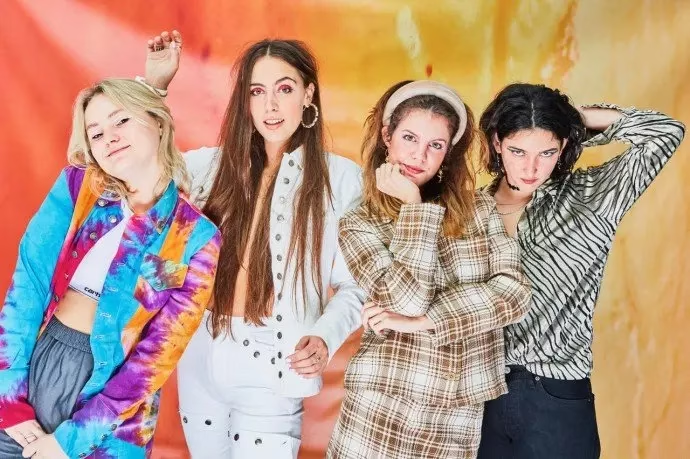
Sitting in Carlotta Cosials' room via Skype feels a lot like listening to her band Hinds’ new album. For their third LP, The Prettiest Curse, the Spanish indie rockers took time to crack open their world and define themselves—retaining the strident energy of their first albums yet refusing to be reined in by the world’s definition of them. That same ease and freedom flows from Cosials, an inviting warmth that draws you in far enough to discover new rules to the game, the new rubric for understanding Hinds. "When you’re creating something that doesn’t exist, you feel more free," the guitarist/vocalist says. By stopping people from defining Hinds, Cosials and her bandmates found time to slow down the pace and explain themselves on their own terms.
Hinds built their reputation for constant touring and raucous live shows. But rather than continue to chase that energy on record, the quartet spent time in both Madrid and New York City with producer Jennifer Decilveo to capture a reality beyond the four walls of a concert hall. They imagined themselves explaining their reality to children, to streamline exactly who they are and what they do—without the filter of outside expectation or the romanticism of rock and roll.
The Prettiest Curse crystallizes that experience. Over a rubbery rhythm section, "Just Like Kids (Miau)" catalogs the inane comments leveled at Hinds in a nasally mockery, the band channeling their mania through indie pop as smoothly as garage rock. The euphoric "Good Bad Times" churns with ‘80s energy, wrapping heartbreak, anger, sadness and misunderstanding into a glossy ball. To compound the dizzying appeal, the lyrics alternate between English and Spanish, exemplifying the album’s ability to draw every listener into its "us against the world" embrace.
Cosials spoke with the Recording Academy about facing misogyny head-on, turning time into creativity, and the depths of studio experimentation on The Prettiest Curse.
<style>.embed-container { position: relative; padding-bottom: 56.25%; height: 0; overflow: hidden; max-width: 100%; } .embed-container iframe, .embed-container object, .embed-container embed { position: absolute; top: 0; left: 0; width: 100%; height: 100%; }</style><div class='embed-container'><iframe src='https://www.youtube.com/embed/m_N93cxyg8Q' frameborder='0' allowfullscreen></iframe></div>
This album is such a journey sonically, and I’m sure it must have been to record as well.
You are so right. We had so many songs! For the first time in Hinds, we wanted to create something with a background that is not necessarily just what you hear and what you see. We wanted something behind the Hinds world, something kind of magical. And for that we had to explore new sounds, which has been such an amazing journey. For the first two albums, it was only two guitars, bass, and drums. So suddenly we were like, "Oh my God, let's use this instrument over here, and oh look at this old piano that sounds like this!" It was just super cool.
What other instruments did you experiment with?
I don't even know how many there are! So many synths, so many pianos, so much space echo vocals. We really had fun at the studio. When you're creating something that doesn't exist, you feel more free. So it was like, "Let's look for the sound that sounds like morning." We would look for sounds that make you feel like it's the morning, waking up and stuff. That was the kind of exploration we were doing—anything, literally anything. Suddenly, production was the priority, and then we would think about the live show, instead of the other way. The other albums were more like turning a live show into a record.
I really hear that. I was struck by the freedom in this record thematically, as well. There's this constant motion, and it deals very openly with the struggles of being a musician on the road, away from the people you love—but without being overly sentimental. What ignited that freer feeling?
We've finally reached the point where we assume that we're going to be musicians forever and that this is our life. We wanted to share the reality of that, and how the reality is tough sometimes. Reality is not as beautiful as what you think of when you think about musicians. Being a musician isn’t just all parties and laughs and claps. We wanted to tell this reality through a story you could tell to a child—saying something that is completely real and not necessarily easy, but you put it in a way that you can swallow it better. It's not hiding it, it's not running away from it, it's not trying to avoid it, or not looking at it. I can go through it, I can face it, and I'm going to put it in a more poetic way because that's what I do. What I do is music. It's my pleasure to talk about the realities of being a touring musician.
What emotional bank, if you can call it that, did you need and pull from in order to make that change and be that open?
This is going to sound silly, but one of the most important things is that when we were recording in New York City, the studio was exactly 45 minutes away walking from the Airbnb we had rented. I have the best ideas when I'm walking or when I can't sleep. So each day, an hour and a half, 45 minutes each way, was the perfect amount of time to listen to an album. It really refreshed my mind and I arrived at the studio with a fresh brain and not full of stress.
The other albums have been always in between tours, and in a rush. I'm not saying that the songs were worse, but when you have more time you just enjoy the process more. There were still some moments of doubt. Like, "Are we going with too many instruments or too many sounds? Is there too much going on, too many layers in a song?" But then at the same time, I don't want to become a guardian of rock or something, the police of rock and roll. So, we just went for it.
<style>.embed-container { position: relative; padding-bottom: 56.25%; height: 0; overflow: hidden; max-width: 100%; } .embed-container iframe, .embed-container object, .embed-container embed { position: absolute; top: 0; left: 0; width: 100%; height: 100%; }</style><div class='embed-container'><iframe src='https://www.youtube.com/embed/XVdJUy5KCJY' frameborder='0' allowfullscreen></iframe></div>
It’s incredible how time and freedom can turn into the perfect recipe for creativity. Was there anything from your past records that you wanted to get rid of? Were there things that you didn't want to repeat?
In a more philosophical way, I wanted to get rid of all those fears. We used to be actually proud of only having used four instruments in a whole album. We felt pressure to tap ourselves into rock and roll because that's what we wanted to be: a rock and roll band. Us being girls and stuff, sometimes it's confusing for people. "Why are you here? What the hell are you doing? Are the songs good enough?" So certainly for us it was a relief to be a rock and roll band because I think rock and roll is free of gender. And we felt better if we were established as a rock band. But suddenly with this third album, we're older and wiser. [Laughs.] We just don't care that much about what people think.
So what were the albums that you were listening to when you were walking to the studio every day?
During those walks, I listened a lot to Jesus and Mary Chain. To me, the songs on their first two albums, Psychocandy and Darklands, are pop songs. They're in disguise, but it's actually pop lyrics with pop guitar riffs. And they're the darkest thing you could imagine. You would never think they were cheesy. So if they can do it, we can do it too. Just because we smile more or have fun, that doesn't change the music we do. So, let's go for it.
And then during this year, I'm re-discovering Spanish-singing rock and pop music. I've been studying each album from Los Punsetes, Mujeres' Un Sentimiento Importante, Sen Senra's Sensaciones and Carolina Durante's self-titled album. I've been really enjoying that journey.
Your new album really does mix Spanish and English lyrics in a natural yet urgent way. Was that a conscious decision to do that here?
Yeah, definitely. Ana [Perrote, vocals/guitar] and I wanted to speak more Spanish in the songs. We even tried to write a whole song in Spanish, but it didn't make it to the album. It wasn't good enough. [Laughs.] But I'm really happy how it turned out.
We used to get asked why we sing in English all the time, but it was really never a decision. You accidentally write songs. You know what I mean? You're not actually looking for something. You write songs that sound similar to the music you listen to. At that moment, we were listening to a lot of garage music, and all of it was in English, so it was pretty automatic. And suddenly when we were getting that question so many times, it was like, "Whoa, is this a big deal?" We didn't know it was going to be a big deal.
But now that you're singing more in Spanish, did those lyrics hit harder when you were recording?
One hundred percent. When we write in English, it requires more attention from us because it's not our first language. We think kind of in Spanglish I guess, and we talk to each other in Spanish. And then suddenly when you're translating it into poetry, onto the paper, it's in English. That process is natural for us now. Sometimes I think I speak my feelings better in English than I do in Spanish—but then I realize that's not actually true. When we're singing in Spanish, I have a million possibilities because I think I know all the words in the dictionary. [Laughs.]
Sometimes limiting yourself allows you to explore the meaning of the word even more. So because you don't know "all the words" in the English language—but also, no one does—it limits you to find the words that mean the most to you.
Exactly! This is a super silly comparison, but do you remember season one of Stranger Things? The little girl doesn't know how to speak and she just learned little sentences, like "Friends don't lie." Those are the only things she knows and are the reasons why she does certain things. When you don't have all of the instruments, you're constantly finding the way to express and to communicate. Every kind of art in the end is communication between human beings. I really don't care if I'm speaking another language. I just think we should get rid of those barriers, of accents, of lack of knowledge, and of feeling embarrassed.
And your instruments become their own language. There's a real density to that language on the record. It's just so meaty. The production sounds full and warm, and the harmonies and shout-along passages feel really passionate. Why did these specific songs need that fullness and that warmth?
Sometimes it just flows. For example, during the summer, I was listening to Manu Chao's Clandestino. Throughout the album, a lot of radio sounds come in and out, other sounds are repeated in each song. There's a motif through the whole album. I was also listening to Bestia Bebé's self-titled album, and that one is surrounded by soccer, basically. I was thinking, "This album has to have a concept, something that holds the songs together. It has to be meaningful." And that's how we came to the idea of explaining reality to kids and how this magical world is nowhere and everywhere for us at the same time. The cover of the album is a house, a venue, and backstage. It's nowhere. It's a strange place. We all wanted to sound clearer and not too distorted. It's just evolution.
There's also this youthfulness to the vocals. I'm thinking particularly of the half-buried shouting on "Boy."
Yeah. Another album I was listening to a lot during the recording was Molotov's ¿Dónde Jugarán las Niñas?. There are five or six men in that band, and they're super aggressive, and they shout. Hearing that in a feminine voice, I didn't know if it was going to be cool enough. And then I thought, "What the hell? Am I being sexist against myself?" [Laughs.] "So let's have girls screaming. Hell yeah!" When we were listening to the demos that we had, we felt like they couldn't go lo-fi. It really had to be bold and fat and big and round, or else it would sound weak or broken.
<style>.embed-container { position: relative; padding-bottom: 56.25%; height: 0; overflow: hidden; max-width: 100%; } .embed-container iframe, .embed-container object, .embed-container embed { position: absolute; top: 0; left: 0; width: 100%; height: 100%; }</style><div class='embed-container'><iframe src='https://www.youtube.com/embed/sQGViicdVI8' frameborder='0' allowfullscreen></iframe></div>
I want to thank you for "Just Like Kids", which is such a powerful anthem for women in the music industry—and really any industry, honestly. Often artists will speak out against sexism, but it's an extra step to bring it into your art. Have you gotten mail from other women who've shared that experience?
Those lyrics, no doubt, are the ones that we're most proud of on the whole album. We've been meeting with people and speaking about the industry, like in panels in New York and Madrid, and we've gone on the radio to speak about this stuff. It's still important to give visibility to the reality of being a girl in a job full of men. I like the way we chose to take it because sometimes I get tired of complaining. That can be exhausting. Taking it in a funny way, of already being over it—like, "Alright, tell me ... tell me your f**king advice. Tell me what I'm not good enough to do. Tell me that I'm not pretty enough or that I am too pretty or that I am sucking dicks everywhere. Whatever, all right." [Laughs.] We just don't care anymore.
What do you feel needs to change first? Obviously the first step is what you guys have just done, putting a song out like that. Facing misogyny head on. How did you get to a point that you can write a song like this, and you're not just sitting in a closed-off corner overwhelmed by how awful the industry can be?
It really depends on the day. It sucks sometimes, but sometimes you feel strong enough. Even right now, I play this song to myself. I had to meet with someone the other day and I put it on in my headphones before going into the room to feel stronger, to feel good about myself.
It's not easy to expose yourself constantly. It's not easy to feel great about yourself constantly. Everybody has a f**king opinion of you, and more if you're a woman. But at the same time, I agree a lot with the English writer Caitlin Moran and her book How To Be A Woman. She says that actually what we need is time. We need time to feel this freedom, to feel free to jam with guitars, to feel free to sing good or bad, to feel free to do interviews, to feel free to appear on TV, to do anything. They haven't let us have our time before, so it's impossible to achieve a level of greatness in only 30 years.
Ana and me, we met through our ex-boyfriends because they both were in a band. We never took up guitar at the time we were with them, and both of them were guitar players. We never had the idea of taking up guitar because we thought we were going to be a waste of time. You don't want to be last in the class. We're very hard workers. So we started when Ana and I were alone together in a room, where we weren't going to judge each other or criticize each other. We really didn't care whether we were good or bad. When you feel happy and free, you can actually create something. If you feel stressed or pressured, you're not gonna come out with something genuine. So to the haters, leave us alone. [Laughs.] Leave us alone for a while, and we'll start to feel chill and create amazing stuff. We need time and we need to relax. People need to stop telling us what to do or what not to do. We need time.
Why did you choose music as your expression?
Because it's the best one! [Laughs.] I used to be an actress. I also write sometimes. But music is the best one because I'm a very social person. I believe in people, and I think people supporting people is one of the best things you can have in this world. Music, or at least rock and roll, you can't do it on your own. You need to coordinate four little brains and make them agree. And that is one of the biggest things you can ever imagine. Making these four little girls agree on something sometimes is hard. [Laughs.] Group coordination and group support, I just love it. If it could be a representation of the whole world, it would be amazing because you build up your empathy and you stop thinking just about yourself.
Naeem Talks New Album 'Startisha,' Creativity In Quarantine And The Need For Change In America