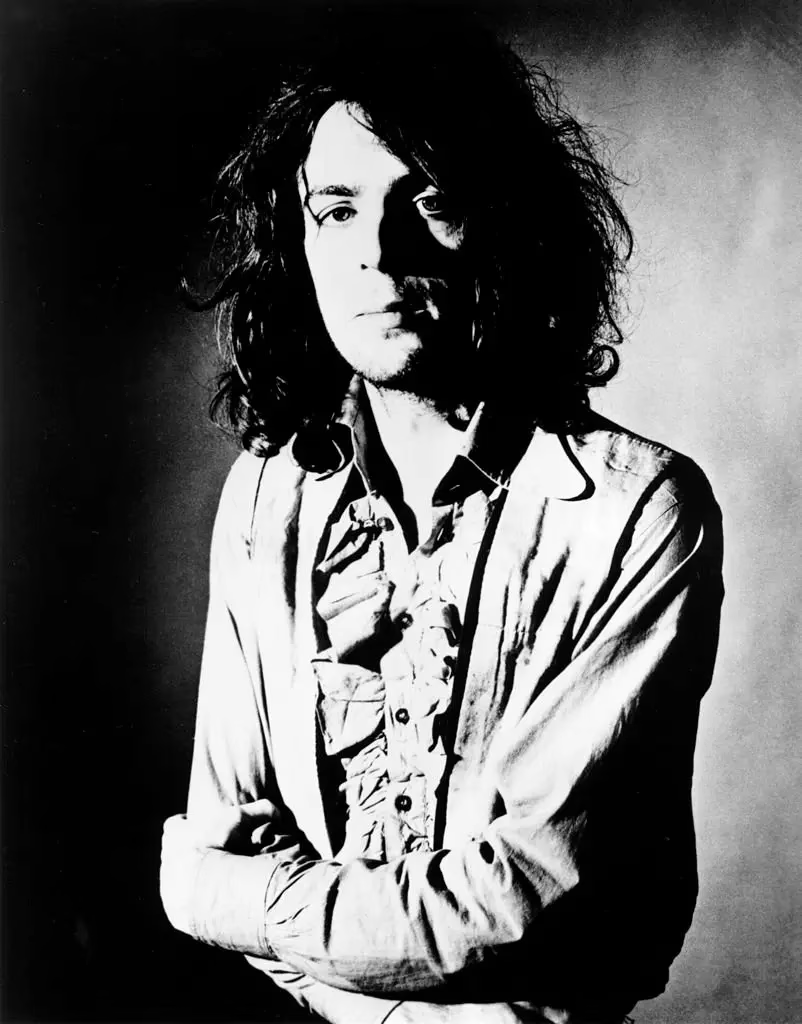
After 1969 symbolically brought the decade to a frightful close, with the escalation of war in Vietnam, the Manson murders and Brian Jones's death kicking off a series of untimely losses for Pop, 1970 arrived as a slap in the face, designed to wake counterculture up from its fantasist dream for good. As the Beatles made their separation official and irrevocable through the uncomfortable psychodrama that was Let It Be, a whole generation either grew discouraged by the inexplicable resilience of the establishment, or simply escaped altogether.
Syd Barrett had been escaping for a long time, though. After having been sacked by his own band colleagues two years prior amidst the predictable personal and societal confusion the Spring of 1968 had precipitated, a block seemed to emerge between his stubborn, ever-flowing geniality and a saddening inability to pour it out in a comprehensible way—a dichotomy embodied by the backwards solo in Barrett's "Dominoes," which remains a striking testimony of the way he was perceiving and performing his psyche. But Syd was probably "bored, as well as ill," according to biographer Tim Willis, and definitely not as insane as most media would later portray him. Although he was painfully aware of his deteriorating mental condition, some of his public antics were likely more a product of his eternal provocateur persona than of an irreversibly mentally disturbed individual—a behavior whose inadequacy psychiatrist R.D. Laing would often defend as deriving from society's normalized notion of "sanity" and not from a sick mind itself. Rumor has it Laing even paid a visit to Barrett in 1970, although the circumstances and eventual results remain fuzzy.
<style>.embed-container { position: relative; padding-bottom: 56.25%; height: 0; overflow: hidden; max-width: 100%; } .embed-container iframe, .embed-container object, .embed-container embed { position: absolute; top: 0; left: 0; width: 100%; height: 100%; }</style><div class='embed-container'><iframe src='https://www.youtube.com/embed/jvu9q2QIiJ4' frameborder='0' allowfullscreen></iframe></div>
Nevertheless, and however harsh Syd's own personal reality might have been at the time, 1970 was ironically his year. Aided by former Pink Floyd colleagues (albeit some critics find their work on Syd's solo material to be little more than patronization fueled by a sentiment of profound guilt for having fired their band's founder), Syd put out two albums that would prove fundamental not only for his enduring legacy but also as unquestionable references for many artists that followed: The Madcap Laughs was released in January, three days before his 24th birthday; Barrett came out in November.
While a somewhat more cohesive, Madcap may conceal a process filled with false starts that included several changes in approach and personnel (following Peter Jenner's departure, producer Malcolm Jones would too be replaced by Gilmour and Waters), Barrett is unapologetically more scattered, portraying Syd's frustration with a certain dead end he was encountering in both his career and personal life: "I made sure they were closed sessions," EMI engineer Pete Bown later recalled of the recording process. "Because if anyone had seen Syd, that would have been it." His erratic behavior is perhaps best illustrated by the often evoked anecdote of housemate Duggie Fields once arriving home to find Syd lying on the floor, static, stating that this stillness granted him every option in the world, while a decision would make all but one disappear. The problem is, of course, that no option is real unless action is taken towards it, and both Madcap and Barrett often seem like abstract attempts of an action whose results didn't quite satisfy Syd the way he expected them to.
Yet it is perhaps fairer to say that, by then, Syd bore little to no expectations at all. Barrett is a profound reflection on loneliness and sadness, and Syd's mental engagement with it seems much more fickle when compared to a relative vivacity present in its predecessor. This is, of course, something he was very much aware of: "[The songs of the album] are very pure, you know; [but sometimes] I feel I'm jabbering," he confessed during a conversation with music journalist Michael Watts at the time of the album's release. Containing few tracks that actually feel finished and an aura of despair coronating the ensemble, Barrett augured a premature ending to Syd's offerings.
<style>.embed-container { position: relative; padding-bottom: 56.25%; height: 0; overflow: hidden; max-width: 100%; } .embed-container iframe, .embed-container object, .embed-container embed { position: absolute; top: 0; left: 0; width: 100%; height: 100%; }</style><div class='embed-container'><iframe src='https://www.youtube.com/embed/qPRO-XFh8g8' frameborder='0' allowfullscreen></iframe></div>
But the album also represented an announced return to his Cambridge hometown, be it in its themes, its compositions ("Wined and Dined," for example, had been written there), and even the cover art, which was based on one of the many drawings Syd had made some years earlier. Darker and arguably heavier than Madcap, Barrett showcased how Syd had become increasingly desperate for a reencounter with the simple life and with himself: "I've always thought of going back to a place where you can drink tea and sit on the carpet," he would later say. Having grown disenchanted with the life the swingingest capital of the swinging world had provided him with, Syd mutely acknowledged the end of a volatile excitement that had only revealed to be shallow and deprived of the creative richness it had once remotely promised.
Barrett is Syd's very own Pastoral. His return to the country as a respite, a celebration, or even a ritual, might have come about not in the fairest of circumstances, and even a tad too late if we consider his mental state at the time; but the universes he had been bringing about since the early Floyd days kept inhabiting (haunting?) him until he was left with no other choice but letting himself be absorbed by them, both inside and out. After going back and forth for another decade, in 1982 he walked all the way from London to Cambridge never to return. The peregrination suited him as his own Via Dolorosa, towards freedom and distance from earthly sins; but as Syd turned his back on a mess he didn't ask for or even related to, he remained oblivious to the fact that he would carry a part of it with him forever.
Pink Floyd's 'The Wall': For The Record
