In 1983, San Francisco blues-rock outfit Huey Lewis & The News released their third album, one the world would never forget, Sports. They hit it out of the park with six of the nine tracks landing as hits, including classic jams "The Heart Of Rock And Roll," "If This It," "Heart And Soul" and "I Want a New Drug."
Now, 37 years later, the GRAMMY-winning band has released their 10th studio album, Weather, on Feb. 14. The seven-track project is made up of jubilant songs they finished recording before Lewis suffered an intense episode of Ménière's disease—an inner-ear disorder that affects hearing and balance in varying intensity—in 2018. Because of this heath issue, Lewis hasn't been able to perform, record or even listen to music since—but he is hopeful things may improve in the future, and is grateful for his many rockin' memories.
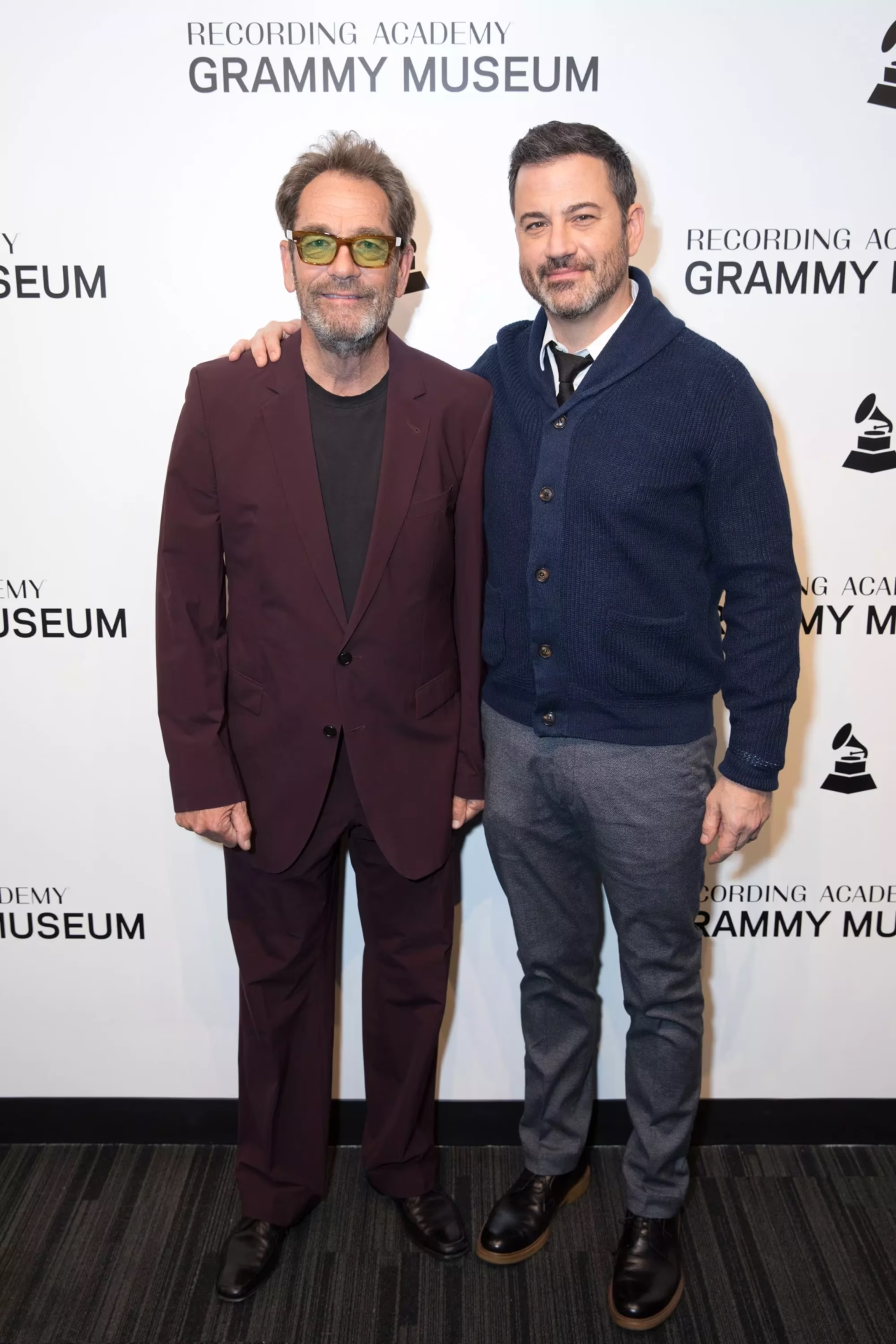
Ahead of Weather's release, the "Hip To Be Square" singer treated GRAMMY Museum guests to a heartwarming and enlightening conversation with his celeb bestie, Jimmy Kimmel. The dynamic pair dove deep into Lewis' long musical career (all the way back to busking around Europe with his harmonica at age 16), living with hearing loss, Weather and the new "The Heart of Rock & Roll" musical.
The GRAMMY Museum event opened with a special early preview of the star-studded "Her Love Is Killin' Me" music video (which you can watch above), featuring Kimmel, S.F. Giants' former manager Bruce Bochy, legendary S.F. 49ers quarterback Joe Montana, Andy Garcia, Brandon Flowers, June Lockhart, Topher Grace, Brad Paisley and many more. During the chat, Kimmel shared his excitement about finally fulfilling his dreams of staring in one of their videos, while Lewis revealed that his original idea for the video was for Kimmel to lip-sync the whole song.
Before Lewis and Kimmel's conversation, Huey graciously spoke to the Recording Academy about Weather, the legacy of Sports, living with hearing loss and where the heart of rock and roll is still beating (hint: it's in Ohio).
The band's first album of new music in almost 20 years, Weather, is coming out soon. How are you feeling?
Yes. Friday, Valentine's Day. I'm very excited. I honestly think it's among our best work. I have these hearing woes, so I probably shouldn't be trying to do interviews and stuff, but I've tried to give the songs a nice sendoff. We're very proud of the record, and we're trying to make some noise with it.
"I honestly think [Weather] is among our best work…We're very proud of the record, and we're trying to make some noise with it."
Can you talk a little bit about the message behind "While We're Young"?
Yeah. It's written from the point of view of someone who's not that young, but not dead yet either. I think that's the idea. [Grins.] It's how do you handle middle age, let's say.
"We'll take a nap in the afternoon." That's just part of the fun.
I love that lyric.
So much of youth is wasted on the young.
I was just having that conversation with my coworker today—what should we be doing now that we're going to be mad we didn't do when we're 50?
See? [Grins.]
Can you talk a little about your experience living with hearing loss?
Yeah. It's something I've lived with for a long time. I lost my right ear 35 years ago, or 80 percent of it. [Points to left ear.] This just happened two years ago. Unfortunately, the left ear fluctuates. When my hearing's good—I wear hearing aids—I'm okay. I can hear speech and everything, and I might even be able to hear music enough to sing. But I haven't been able to find that out because I'm never good long enough to book a rehearsal. My hearing turns crappy again like it is now. When it's bad like this, I can't hear anything, I can barely hear the phone. I can hear you when you're 24 inches away, that's about it.
Has it been hard emotionally for you? Do you just take it day by day?
In the beginning, it was very, very hard. I spent my first two months in bed really, just fasting and taking steroids and trying everything, hydrating galore. I lost 18 pounds, but my hearing never got better. I was really depressed.
My kids are great and helped me through this all. It turns out you can kind of get used to almost anything. I have to realize that there are lots of people worse off than I am. I have to be grateful for what I have. It's hard sometimes, but it's only right. That's what I try to do, try to look on the bright side.
That's important.
Not always easy, but I try.
"Our dream is to play music for a living, period. That was it, to be able to do nothing else but play music. And so, Sports was the record that proved to us that we could do that."
What did the success of Sports feel like to you at the time?
Well, it was a relief for us because our dream is to play music for a living, period. That was it, to be able to do nothing else but play music. And so, Sports was the record that proved to us that we could do that.
But it's an interesting record because it was a record of its time, it came out in 1983, but we recorded it in '82. If you think back to that time, it was completely a radio world, Contemporary Hit Radio ran the whole show. Even MTV, which had just started, its playlist exactly mirrored radio's playlist. And so, our job was to make a hit single. If you didn't have a hit single, you didn't exist.
This was our third album, and if we didn't have a hit with it, it was going to be all over. So we insisted on producing the record ourselves because if we're going to make those commercial decisions, we wanted to make them ourselves. Because you've got to live with that stuff. So our manager went to bat for us. Our label was in London, so they couldn't really control us. We were 6,000 miles away, so they allowed us to produce it ourselves.
We aimed pretty much almost all the songs at radio because we knew we needed a hit. We didn't know we were going to have six of them. Each with different styles—one was kind of a ballad, one was a rocker, one was kind of a bluesy thing, one was R&B-based, not knowing which one would work. Now, when I look back at the Sports album, I see it as a record of its time, a collection of singles because it was a singles world back then.
As the group came together in San Francisco back in the '70s, do you feel like '70s S.F. had an influence on your music or career as a musician?
It was a great time for music. Even before that, live music was abundant when we grew up. That was the entertainment of its day. There were four or five clubs in Marin County, which had live music all the time. And so, it was a great, great place to learn your craft. I was in a band called Clover that played five nights a week for years.
And then this band, we played clubs and concerts. We've played thousands of shows probably, certainly more than a thousand. A lot of groups today don't get to do that. In fact, it's a mistake if you do. It's better to make a nice video or screen time thing, and let that work and don't go out there and blow it. And so, it was just a different time then.
In our day, the way you broke a record was you released it and then you go play the country. You started in Seattle, go to Portland, go to San Francisco, go to L.A., go to San Diego, cross Tucson, Phoenix, then Texas. And in each town, you invite the radio stations and the newspapers, and hopefully, when you leave, you get a nice review and the radio stations will be playing your song. You do that all across the country, about 50 shows. When you get to New York at the end, hopefully, the whole country is playing your record. But even if they aren't, you've just done 50 or 60 shows. So that's how we learned our craft. It was very much a live performance thing. I think today it's less of that.
A lot of cutting your teeth, hustling that music.
Yeah, a lot of cutting your teeth. We weren't playing with machines, so we're ad-libbing more. It was a different deal.
Where do you think now the heart of rock and roll lives now?
Well, it's probably still beating in Cleveland. Cleveland is a cool place. I wrote that song because we had played a gig there and, you know, we're from San Francisco, and we'd always heard that Cleveland is a great rock and roll town. I thought to myself, "How could Cleveland be a great [city]—we're from San Francisco!" We had the Grateful Dead, Jefferson Airplane, Sly & the Family Stone. [Jimi] Hendrix played the Fillmore [West]. Then we played the gig and it was amazing. The audience was amazing. It was really one of our best gigs when we were first coming up.
Driving out of town on the bus, somebody had a T-shirt on with the smoky skyline of Cleveland that said, "Cleveland, you got to be tough," or something. I looked at the shirt and, mindful of the great gig, I said to the guys, "Hey, you know what fellas? The heart of rock and roll really is in Cleveland." I said, "Wow that could be a song." And the guys went, "The heart of rock and roll is in Cleveland? I'm sorry, that's not very good." I changed it to make "the heart of rock and roll is still beating," but that was the inspiration.
I think it's probably still beating in Cleveland. It's beating in a lot of places, but just not as loudly as it once was.
What gives you the most hope right now?
Wow. My kids, my family. [Grins.] My kids are so positive. I get notes from my daughter, like just now [points to phone], she says, "Love you dad, and I know you're looking at an upturn any minute." They're just so positive and so wonderful. It's really wonderful to have a great family.