
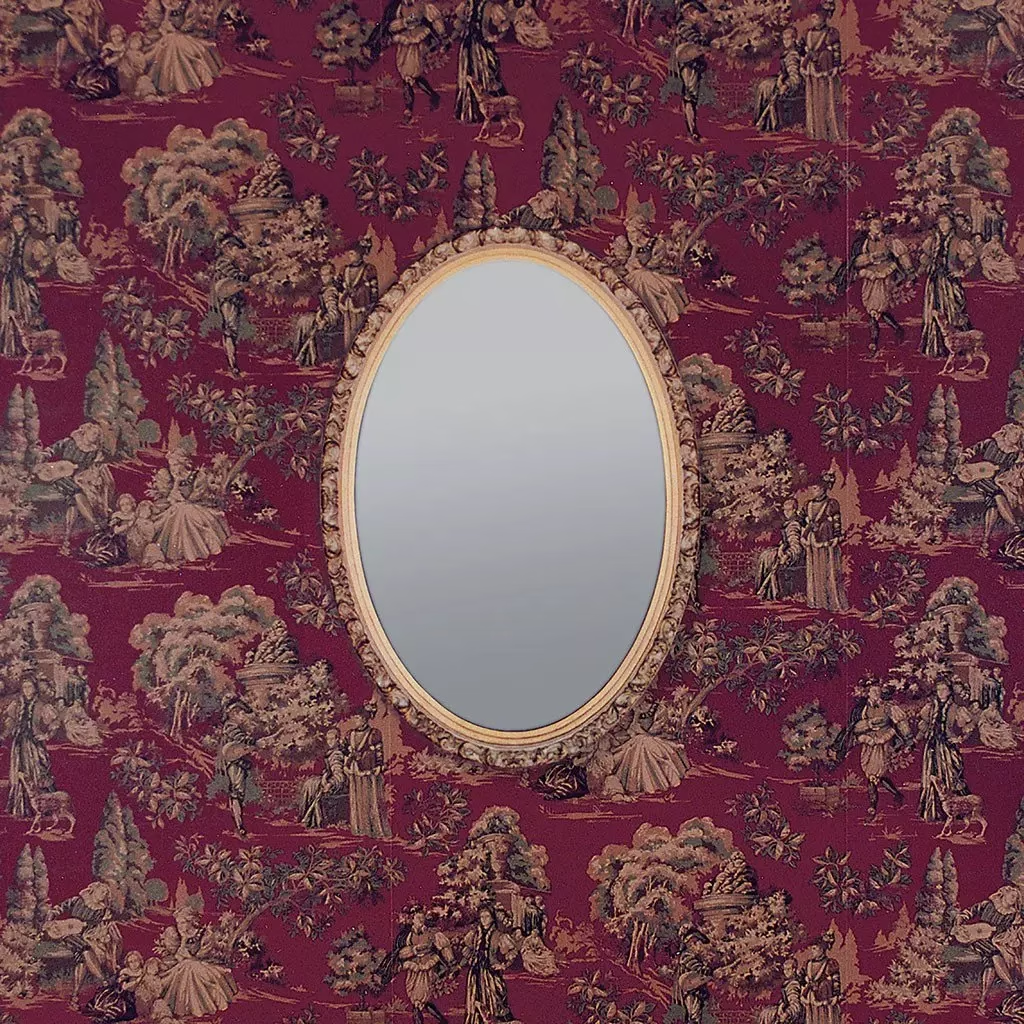
A child’s voice opens up Fevers And Mirrors—the third studio album by Bright Eyes—unconfidently reading the words: "So long, everything!"
There is not a better way to set up the tragedy to come in the following 11 tracks. In Nebraska in 1999, the indie three-piece recorded the folksy-emo masterwork with the help of many others on unorthodox instruments such as the accordion, flute, tambourine and organ.
Released 20 years ago this week, Conor Oberst's now-revered Saddle Creek touchstone has the frontman's lofty ambition and creative quirk on full display. As influential to the indie genre as Neutral Milk Hotel’s thematically rich In The Aeroplane Over the Sea, Fevers And Mirrors featured inventiveness like the eccentric sampling of Johnny Cash’s "You Are My Sunshine” in the warbling love song "The Calendar Hung Itself…" The Jeff Mangum inspiration is evident, but it’s far less subtle about its darkness, and it seems to, in a way, predict the emo ballads to arrive in the following years—from Brand New’s "The Boy Who Blocked His Own Shot" to My Chemical Romance’s "Helena." Oberst is not making a rock opera, but he sure is theatrical. Love manifests in sinister ways—in this case, through jealousy and obsession. He sings: “Does he kiss your eyelids in the morning / When you start to raise your head? / And does he sing to you incessantly / From the space between your bed and wall? / Does he walk around all day at school / With his feet inside your shoes / Looking down every few steps / To pretend he walks with you?"
<style>.embed-container { position: relative; padding-bottom: 56.25%; height: 0; overflow: hidden; max-width: 100%; } .embed-container iframe, .embed-container object, .embed-container embed { position: absolute; top: 0; left: 0; width: 100%; height: 100%; }</style><div class='embed-container'><iframe src='https://www.youtube.com/embed/dGwR5h7L1zA' frameborder='0' allowfullscreen></iframe></div>
This third track is one of the most popular Bright Eyes songs, and it’s not hard to see why. Oberst’s brilliant songwriting is striking, along with his theatrical delivery; he comes through as the listener's emotionally vulnerable friend as he persists with a trembling 19-year-old voice: "Does he lay awake listening to your breath / Worried you smoke too many cigarettes?"
Even as deranged as Oberst gets on this record, there are moments where he morphs into the voice of reason—and even of wisdom. His insights are sprinkled throughout, an important one sitting at the beginning of the beautiful "Something Vague": “Now and again it seems worse than it is, / But mostly the view is accurate.” Oberst is aware of his own dramatized perspective, aware that his own youth can exacerbate his problems and his emotions. The tangled mess of adolescence is captured; he knows that he is not a reliable narrator, because no 19-year-old is.
On the second half of "An Attempt To Tip The Scales" is a fake interview, in which Todd Fink of fellow Saddle Creekers The Faint is impersonating Oberst and giving tongue-in-cheek answers to Oberst’s friend Matt Silcock of Lullaby For The Working Class. When asked about the symbolism in the record, Fink earnestly says, "Well, the fever is basically whatever ails you or oppresses you, it could be anything. In my case, it’s my neurosis, my depression, but I don’t want to be limited to that."
<style>.embed-container { position: relative; padding-bottom: 56.25%; height: 0; overflow: hidden; max-width: 100%; } .embed-container iframe, .embed-container object, .embed-container embed { position: absolute; top: 0; left: 0; width: 100%; height: 100%; }</style><div class='embed-container'><iframe src='https://www.youtube.com/embed/mhCwYWKAtFw' frameborder='0' allowfullscreen></iframe></div>
Oberst is clearly in a depressive mindset on the nightmarish 10th track "Sunrise, Sunset." His view of life is awfully cyclic and gloomy for a teenager: "You wake up, then you undress / It always is the same." This revelation resembles something of a midlife crisis, but it becomes palpable through Oberst’s work that he is constantly in a state of crisis. Whether it be brought on by existential wonders or romantic turmoil, it all leads him into a seemingly endless spiral of despair.
When the album was unveiled in 2000, emo was on the brink of change. Brand New would join the scene with the passionately petty Your Favorite Weapon; My Chemical Romance would explode with the extravagant I Brought You My Bullets, You Brought Me Your Love; Thursday would unleash the violently anarchic Full Collapse. Emo was evolving from one-dimensional to a living thing that contained multitudes. It became more operatic; it became more empathetic; it became more violent; it became more existential; it became more poetic. Fewer dudes were just spitting out misogynistic clichés; emo was evolving to be more inquisitive, with Fevers And Mirrors arguably catalyzing the revolution. It’s not conventionally emo, but it’s not conventionally anything. It expanded the meaning of emo and left more space for bands to experiment.
Oberst was never an emo figure prior to Fevers And Mirrors. When people describe Bright Eyes, mostly the genres "indie" and "folk" are used, but "emo" can't help but sneak in there with the record's central themes of heartbreak and crippling depression. The eighth track "Haligh, Haligh, A Lie, Haligh"—a jangly breakup anthem that showcases Oberst at his most broken down—is the epitome of the genre. After getting a phone call from someone breaking the news ("No, it’s just some guy she’s been hanging out with / I don’t know, the past couple weeks I guess"), Oberst begins planning a funeral. His pain pours out in great poetry, metaphors and simple epiphanies—he realizes that people make promises they can’t keep, that plans are made to fall apart with time, that love can make you lose sight of yourself. All of these realizations build up to his proclamation: "And I sing and sing of awful things / The pleasure that my sadness brings." It feels like a confession, like Oberst is admitting that amidst the madness he is having a good time. There is a sense of belonging in the chaos, as it enlivens him and causes him to make revelations about life.
<style>.embed-container { position: relative; padding-bottom: 56.25%; height: 0; overflow: hidden; max-width: 100%; } .embed-container iframe, .embed-container object, .embed-container embed { position: absolute; top: 0; left: 0; width: 100%; height: 100%; }</style><div class='embed-container'><iframe src='https://www.youtube.com/embed/9_kWPTAETUU' frameborder='0' allowfullscreen></iframe></div>
This is essentially the whole point of emo as a movement: sadness provokes thought, inquiry and ultimately epiphany. Oberst’s misery may ring childish at points, but in reality that dispair caused him to age much faster than his counterparts, both emotionally and mentally. A line on Bright Eyes' later critically acclaimed album I’m Wide Awake, It’s Morning echoes the same idea: "Now I’m drunk as hell on a piano bench / And when I press the keys, it all gets reversed / The sound of loneliness makes me happier." Solitude is where Oberst makes his greatest discoveries and conceives his best art. Fevers And Mirrors finds Oberst at his lowest, and from rock bottom he transcends upward.
Nicole Atkins Explores Muscle Shoals & Jersey Shore Nostalgia On 'Italian Ice'
