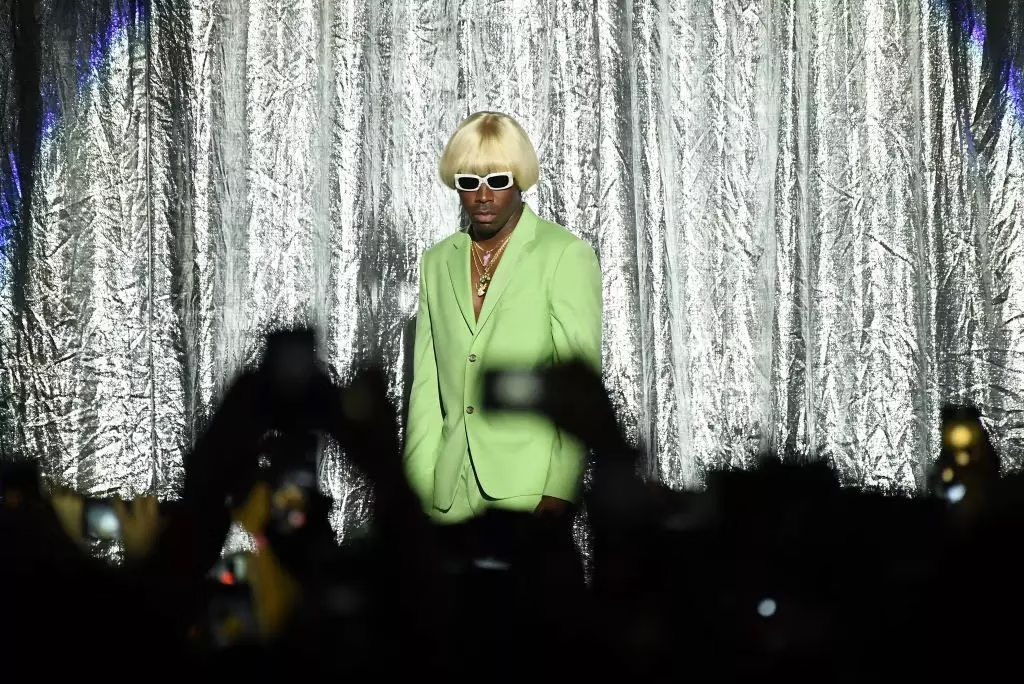
Tyler, The Creator lives up to his facetious moniker on just about every one of his albums and multimedia projects. Since Bastard, his 2009 debut mixtape, Tyler, the meticulous creator he is, has always been exceptionally scrupulous in his artistic craftsmanship, working on minute details of production, lyrics, song-sequencing, album art, aesthetics and video direction.
So much of what defined his previous work was artistic provocation, painting chaotic, vulgar, absurdist portraits about his tumultuous life experiences and identity conflicts. On "Yonkers," the lead single off Tyler's 2011 debut album, Goblin, he waxed poetic, "I'm a f**king' walkin' paradox / No, I'm not." The song and its provoking lyrics submerged listeners into a provocative yet cathartic deep dive into his psyche, one loaded with suicidal thoughts and perceptions of homosexuality in a heteronormative culture. The track's music video, archetypal of Tyler's youthful, creative radicalism, showed Tyler toying with a bulky cockroach in his hands. He then eats the insect, causing him to immediately vomit violently. The effect of the revolting image was clear: to provoke and challenge the world's perceptions of comfort and beauty.
<style>.embed-container { position: relative; padding-bottom: 56.25%; height: 0; overflow: hidden; max-width: 100%; } .embed-container iframe, .embed-container object, .embed-container embed { position: absolute; top: 0; left: 0; width: 100%; height: 100%; }</style><div class='embed-container'><iframe src='https://www.youtube.com/embed//XSbZidsgMfw' frameborder='0' allowfullscreen></iframe></div>
Tyler's 2017 high-concept album, Flower Boy, was his first compelling body of work, which incorporated sunny, shimmering melodies and saw the rapper shifting away from his incendiary histrionics.
Flower Boy, like a bloomed flower, was Tyler's first head-on confrontation with his sexuality and insecurities. Employing dense, layered tracks like "Garden Shed" and "911 / Mr. Lonely," the latter featuring Frank Ocean and Steve Lacy, Tyler rigorously explored his boredom, loneliness and sexual identity across the album. After progressing through a musical journey toward self-acceptance, on the album's antepenultimate track, "November," Tyler leaves a voicemail to his crush in which he bravely confesses his love.
The following track, "Glitter," a euphoric outburst, ends with a voicemail system saying, "We didn't get your message, either because you were not speaking or because of a bad connection." All of Tyler's emotional battles preceding his audacious confession fell on deaf ears. This bittersweet conclusion left many narrative questions unanswered: Who was Tyler's crush? Will he further pursue him? Was the love interest mutual?
Two years later, in May 2019, Tyler dropped Igor. Like a movie sequel, the album continues the loose threads and romantic themes from Flower Boy, examining Tyler's love interest in vivid detail.
<style>.embed-container { position: relative; padding-bottom: 56.25%; height: 0; overflow: hidden; max-width: 100%; } .embed-container iframe, .embed-container object, .embed-container embed { position: absolute; top: 0; left: 0; width: 100%; height: 100%; }</style><div class='embed-container'><iframe src='https://www.youtube.com/embed//HmAsUQEFYGI' frameborder='0' allowfullscreen></iframe></div>
On Igor, Tyler is at his creative vertex, crafting a body of work with both alchemical precision and abstract beauty while openly facing and exposing his emotions like never before. Abandoning pretentious hip-hop bravado, he adopts delicious soul hooks, luscious synth-pop tunes and impressionistic lyrics. The album continues the thematic nuances of its predecessor, Flower Boy, orchestrating a multilayered, musically complex vision. It also happens to be one of the best breakup albums of the last decade.
Igor follows a breakup story centered on a love triangle between Tyler, his male crush and his crush's female love interest. The narrative cycles through different stages of this complex, dynamic conflict, which finds Tyler at his happiest and most hostile, sometimes all at once.
As narrative art expert Chris Lambert exhaustively dissected in a long-form analysis in Forbes, Tyler structured the album's storyline in two phases: part 1 ("Falling In Love": tracks 1-7), wherein Tyler chases after his love interest; and part 2 ("Moving On": tracks 8-12), wherein he crucially realizes his relationship is volatile and a platonic friendship between the ex-lovers is, perhaps, the only alternative. The narrative shift between the two conflicting halves is truly remarkable: Uplifting tracks like "Earfquake," Tyler's self-critical plea to his lover—"Don't leave it's my fault"—spiral downward to the cold-blooded, grating screams of "I Don't Love You Anymore." Igor's notable character development aligns with Tyler's passionate, chameleonic vocal performances.
The storyline becomes as riveting as a "Harry Potter" audiobook when a convoluted love triangle is presented on "New Magic Wand," in which Tyler competes with his lover's paramour for attention and love atop the track's jolting, abrasive bassline and vampiric guffaws. By way of a magic wand, a romanticized version of a gun, Tyler wishes to "Get her out of the picture" "like magic." Later in the track, he portends, "She's gonna be dead," amplifying the album's Shakespearean melodrama to 10. Engrossing moments like these, harmonized by Tyler's grandiose musical architecture, elevate Igor from a concept album to an immersive, multidimensional experience.
<style>.embed-container { position: relative; padding-bottom: 56.25%; height: 0; overflow: hidden; max-width: 100%; } .embed-container iframe, .embed-container object, .embed-container embed { position: absolute; top: 0; left: 0; width: 100%; height: 100%; }</style><div class='embed-container'><iframe src='https://www.youtube.com/embed/9JQDPjpfiGw' frameborder='0' allowfullscreen></iframe></div>
While he served as the sole producer and arranger on Igor, Tyler, ever the masterful collagist, pulled from his influences brightly and loudly, expertly weaving together his diverse musical inspirations into his singular vision. The futuristic pop production of Pharrell Williams, one of Tyler's idols and a guest on the album, runs through gorgeous, gleaming compositions like "What's Good" and "I Think," while the iridescent dreamscapes of Tame Impala's Currents bear influence on Igor. Kanye West, a featured guest on "Puppet," is both physically and spiritually present across the album, too. His signature soul samples directly influenced tracks like "A Boy Is A Gun," which features a gorgeously knitted sample of “Bound" by Ponderosa Twins Plus One, a track also sampled on "Bound 2," the finale of West's 2013 opus, Yeezus.
Aesthetically, Tyler fleshed out the titular Igor character into a full-on persona via theatrical, dazzling live performances and a custom costume consisting of a psychedelic-colored suit and a now-iconic blonde wig. In his interview with Beats 1's Zane Lowe, Tyler discussed his meticulous process of engineering the musical and visual identity of Igor. "I've been drawing that character for three years now," he explained, justifying his radical ambitiousness with, "This is the first album where I didn't want to be cool."
The breakout success of Igor—in the U.S., the album topped the Billboard 200, his first No. 1 entry on the chart—earned Tyler high status and top accolades. Last November, Tyler won The Wall Street Journal's 2019 Music Innovator Award, which encompassed his work across music, TV and fashion.
Igor's most monumental moment came at the 2020 GRAMMYs this past January, where Tyler delivered one of the most memorable, melodramatic performances of the night. He opened with "Earfquake," assisted by legendary R&B crooner Charlie Wilson, later transitioning to an explosive, vehement performance of "New Magic Wand." Tyler performed in full Igor character, complete with an ornate, colorful set filled with houses in flames, which symbolized the album's romantic turmoil.
Read: Tyler, The Creator Gives A Fiery Performance Of "NEW MAGIC WAND" At The 2020 GRAMMYs
Later that night, Tyler won the GRAMMY for Best Rap Album, his first-ever career GRAMMY win. In a revealing and touching acceptance speech, he expressed gratitude toward his family, fans and managers for trusting his "crazy ideas." "I never fully felt accepted in rap," he said, delivering words straight from the heart. "So for y'all to always stand by me and get me here, I really appreciate that."
Tyler's radicalism, those same "crazy ideas," have been largely unwelcomed and misconstrued by the pop mainstream. But with Igor, his craziest idea yet, Tyler took his biggest shot—conceptually, artistically and musically—and won.
Chika Confronts Music 'Industry Games' With Candor & Confidence On Her Major-Label Debut