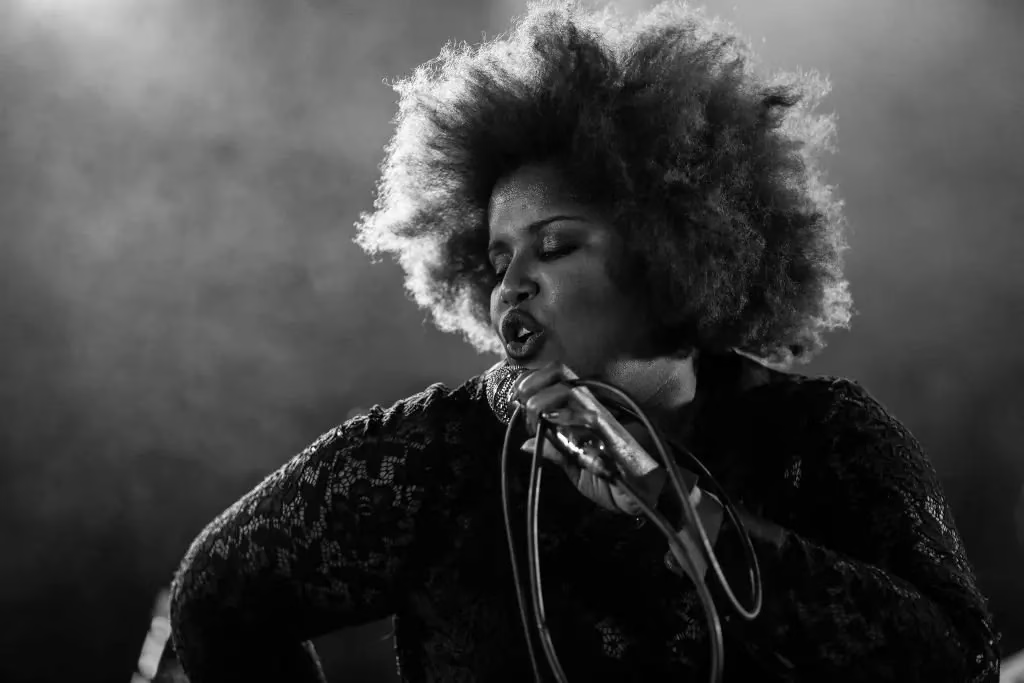
With recent social unrest in response to racial injustice against the Black community, people throughout the nation have risen up and unified together en masse to demonstrate and publicly protest in support of the fight for justice and equality. To help facilitate the conversation and bring light to efforts in impacting change one step at a time, the Recording Academy’s Texas Chapter brought some of the music industry’s most influential members from the state’s Black music community together for a conversation centered on effective ways to drive change specifically within the music industry, artistic communities and beyond through advocacy and creativity.
The conversation led by Texas Chapter Executive Director Christee Albino also featured notable key players including GRAMMY-nominated rappers Paul Wall and Texas Chapter Vice President Bun B, alongside GRAMMY-winning gospel singer and Trustee Yolanda Adams. Additionally included in the event were Texas Chapter President Carlos Alvarez, Secretary Heather Wagner Reed, and board members including Dallas-based attorney Tamara Bennet, Houston-based PR and Marketing Manager Arnaecia Alridge, producer Lisa Morales, recording artist Kam Franklin, GRAMMY-nominated gospel artist Brian Courtney Wilson and GRAMMY-winning producer Symbolyc One “S1”.
To begin the discussion, Albino referenced a quote recently shared by Rolling Stone from a 1982 Billboard interview with Bill Haywood, Senior Vice President of Black Music Marketing at PolyGram Records at the time. He stated, “Black music is the backbone of the music industry in the U.S. today. It seems to be less affected by variables in the economy than any other forms of music.” He continued, “The major problem is the lack of broad open acceptance by all segments of society based on feelings that are racist in their nature.”
While 38 years removed, according to Bun B, the statement in many ways still holds true today. “If you look at communities of color with respect to the music industry, they’ve been able to achieve so much with so little,” he said, explaining that because of this, in terms of lack of access to studios, labels or other music industry personnel, that many Black and brown artists are forced to operate outside of the industry and attain creative mobility by their own faculties.
“You look at the music charts today and some of the most impactful, successful music available to be consumed in the industry and in the market right now is being created by people of color. Rappers are no longer regulated to rap and hip-hop charts, they’re on the Billboard top 100, they’re on the 200 for album debuts. They are making incredible impact in our industry and world today,” he said.
Unfortunately, this fact of their impact does not absolve them of suffering from many forms of systemic racism that plague the industry in all of its facets. “People are still fighting to be seen, to be heard, to be recognized and to be acknowledged,” added Bun B.
Similarly, Franklin offered her own testimony of facing hurdles of prejudice and racism as a touring artist throughout her career. For five years now Franklin has been writing openly about these struggles while also touring full time.
“During that time it was always independent, DIY, learn from every mistake. A lot of that industry polish and guidance that you would get from a major label, I had no experience with, so I was out asking questions,” she explained. “For a while, one of my favorite things to do was find where the Black people were at these festivals. My average was about 40 festivals a summer and for a long time I would see maybe one other Black act. There were consistencies… you would see one Black act per day with 50 white artists.” She says that when she began asking about these inequities, she was often met with opposition in the form of micro-aggressions and oftentimes overt racism.
Corroborating Franklin’s commentary, Wall spoke on the importance of allowing artists to ask these necessary questions and speak up for themselves without the threat of being barred or penalized. “I think it’s important not to tokenize people. It’s disgusting to see the hypocrisy of promoters or festivals who will tokenize artists, individuals, and then promote that they’re being diverse,” he said. “It’s very important that we include people, and not just speak for them, allow them to speak. We can’t tokenize, regardless of the genre it’s about being inclusive.”
With members across the nation tuning in, the panelists took the opportunity to focus on issues involving racism and inequality within the music industry as artists, producers, songwriters, managers and executives. Each panelist noted their own feelings about the current fight for justice and equality, but also touched on various other topics like discussing societal issues with the next generation and how these often complex dynamics will evolve over time. They also highlighted their ideas about ways that artists and industry personnel can directly impact others with their platforms and contribute to the wider movement through expression to create longterm changes within our world.
Furthermore, the panel also focused in large part on the Academy’s efforts to bolster diversity and inclusion internally and outwardly amongst the industry. These efforts include but are not limited to the recent announcement of a new partnership with Color of Change, the nation’s largest online racial injustice organization to promote positive social change within music, a $1 million donation to the organization for sustaining their work, a full-fledged plan to host a series of live and digital programs to promote black music and shine light on racial injustice, an upcoming launch of an inclusion rider to be implemented at the Academy as well as throughout the music industry, the recent appointment of the Academy's first Chief Diversity and Inclusion Officer Valeisha Butterfield Jones and also an appeal to major labels by the Academy to appoint diversity and inclusion positions in-house as well.
With this, the panelists also discussed changes to the Recording Academy’s awards and membership beyond the aforementioned inclusion and diversity initiatives, such as ways Academy members can get involved anc enact change within their regional chapters as well as on a national membership scale, and strategies for recruiting more diverse members into the Academy and more.
Be sure to follow the Recording Academy and keep up with GRAMMY.com for more information about future live events and panels.
The Recording Academy & Color of Change Team Up To Promote Positive Change In The Music Industry