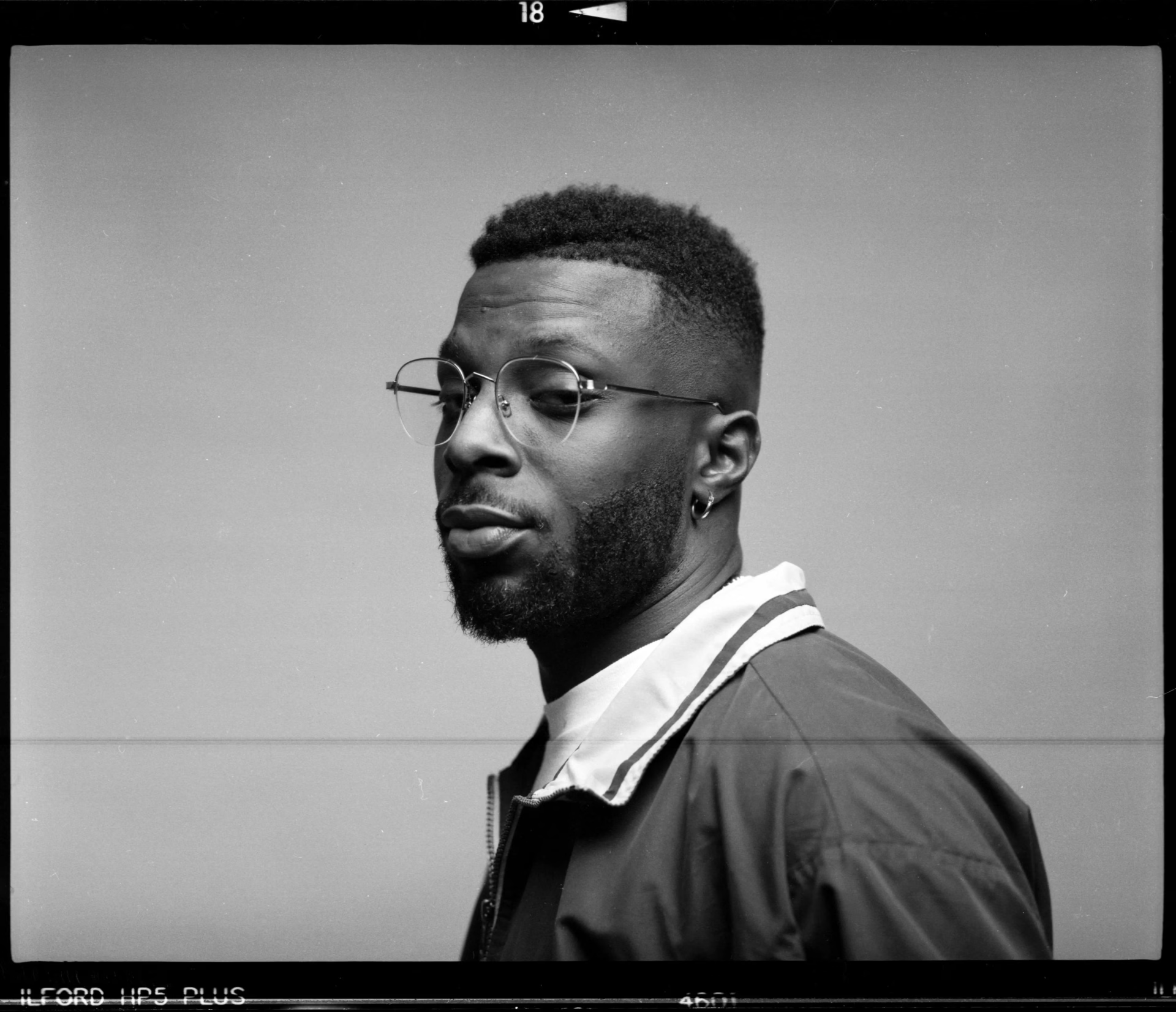
All it took was a five-year intermission for Isaiah Rashad to reconnect with his Southern origins. Now a Los Angeles transplant, the 30-year-old Tennessee native envisioned his new album, The House Is Burning, as a homecoming, complete with atmospheric, laid-back production, interpolations of Three 6 Mafia, and introducing new acts like Duke Deuce ("Lay Wit Ya") and YGTUT ("Chad"). With a set intention, Rashad executed his album with refinement, aligning a cast of wide-ranging features from Smino to Lil Uzi Vert and luring production from Kal Banx, Kenny Beats, Devin Malik and more.
As the follow-up to his 2016 album The Sun's Tirade, Rashad's return was long-awaited, but expectations for his third album were held in limbo as fans witnessed the TDE rapper vent frustrations against label owner Top Dawg on social media. Later eschewing the alleged "beef" with his label, the rapper also underwent a brief period in rehab, where he faced his struggles with alcoholism and substance-dependency, leaving with a new outlook on his career purpose, family and self-reflection.
Ultimately, the path to acceptance led Rashad back home, even if that meant he had to burn it down in order to rebuild. The rapper recently spoke with GRAMMY.com about his approach to The House Is Burning, his idea for an eventual comic book series and how sobriety improved his focus.
Congratulations on The House Is Burning. How do you plan on celebrating your first album in five years?
Getting a steak with my mom, maybe smoke with my mom.
Where do you go for steak?
Ruth's Chris sometimes, STK [Los Angeles], BOA [Steakhouse] sometimes—I like Nobu a lot, though. I might take her to Nobu.
You started working on the initial stages of The House Is Burning last year. Did quarantine change the narrative of the album?
I'm a hermit and I only come outside when I have something to do. So, I was blessed that [there were] less people interrupting in the studio.
Did that give you more time to concentrate?
Way more time, it was way easier for me. I was one of those people who thrived during the pandemic.
Did you do any reading? I know you're a fan of Stephen King.
I read a lot, I'm constantly reading. I can honestly say that nothing really upped [for me] during the pandemic except me concentrating. I realized that stuff was slowing down for everybody else, so it gave me more time to catch up on the shit I wanted to do.
I read "The Bazaar of Bad Dreams" by Stephen King again. I've been reading stuff by Ta-Nehisi Coates—I usually read on my iPad. I'm reading Frank Herbert's "Dune" since that movie's coming out and I know that shit's old. [I read] "Empire of the Sun" and it's about Native Americans. I've been reading "The Dead Zone" by Stephen King, "Talking to Strangers" by Malcolm Gladwell and watching hella documentaries. I actually read comics more than I do actual books—I would consider them books but I wouldn't throw them out there like that.
You're a comic book fan and the first track of your album is titled "Darkseid." When you ultimately have your own comic book, would you want the protagonist to begin as a hero or villain?
I've been trying to figure out whether I'm gonna inspire the villain or the hero, or whether I'm gonna project, so I don't even know. I know that the villain's usually the most interesting part of a story, [so the protagonist] would definitely remain the villain. I'd probably try to get somewhere in my mind where I'm making it make sense for their motivations to continue being the villain.
Historically, [there's] old sh*t like Dr. Doom or certain villains, like when they introduced Kang the Conqueror the other week on "Loki." Those are characters that have motivations that don't really change too much and it's not too maniacal to not make sense. When you have one of them, it's a good base character to juxtaposition the protagonist off of.
"Loki" was a good show, but I think I liked "WandaVision" more.
We shot the last video [for "THIB"] where they did the finale of "WandaVision," I didn't even know until we were about to leave. I was looking around like, "This is where they fought, this is kind of crazy."
Is there anything that you discovered about yourself during your hiatus?
I definitely realized—or came to accept—that I'm capable of things that I want to do. The only thing that's held me back is the limitations I've put on myself. I'm not really one of those big, sit back and think about it myself type of [person], I'm really in the moment. I'd say I'm a problem-solver more than anything else, so the pandemic and all the time I had to do anything, I just took it to work.
There was a lot less self-examination. I feel like I spent a lot of time in my early twenties thinking about myself, the moves I wanted to make and being okay with tripping and bombing sometimes instead of trying to avoid it from the jump.
You were 25-years-old when The Sun's Tirade came out. How do you feel like your mindset has changed?
Yeah, now I'm Dirty 30. I believe what my mom used to say about women's brains developing at 24 or 25 in their cerebral cortex. She said that I'm not gonna make sound decisions until I was 29 and it makes sense, I get it now. I'm lucky to be here when I think of it like that.
<style>.embed-container { position: relative; padding-bottom: 56.25%; height: 0; overflow: hidden; max-width: 100%; } .embed-container iframe, .embed-container object, .embed-container embed { position: absolute; top: 0; left: 0; width: 100%; height: 100%; }</style><div class='embed-container'><iframe src='https://www.youtube.com/embed/1NMZ0MpaEuY' frameborder='0' allowfullscreen></iframe></div>
You've been vocal about spending a month in rehab, even referencing it in the "Headshots" video. How has sobriety changed your creative headspace?
Initially, when you are living an unhealthy lifestyle for so long, you tend to assume that it was only unhealthy at the end of it. So I had to kind of relearn and realize that my creative process was greater than the substances and drinking that I'd put in my body.
Regaining that confidence was probably the hardest thing, because it's easy to get drunk and say some sh*t in the studio. To have precise words and a precise message—or a lack thereof a message on purpose—is harder to do when you're [focused], but it's also more rewarding when you get it done. Making a song on purpose is way better than one [by] accident.
Did you have feelings of self-doubt while making The House Is Burning?
Nah, I'm a Taurus so I'm used to repetition. Even if it's an unhealthy schedule, I'm used to doing things a certain way. When I remove certain elements of my day, it goes back to me thinking like, "Well, can I recreate or do something as good as I used to if I'm not doing it the exact same way?" So, one of the more important parts of this project was saying "Okay, I can do anything I want. I don't need anything to do anything."
To an extent, I've had to not have certain friends [anymore] or our lives went in different directions. Even coming to that understanding, like, I don't necessarily need a specific person or thing to make me go to the studio—I do what I want to do if I want to do it.
<style>.embed-container { position: relative; padding-bottom: 56.25%; height: 0; overflow: hidden; max-width: 100%; } .embed-container iframe, .embed-container object, .embed-container embed { position: absolute; top: 0; left: 0; width: 100%; height: 100%; }</style><div class='embed-container'><iframe src='https://www.youtube.com/embed/RLecv6aZiEk' frameborder='0' allowfullscreen></iframe></div>
Do you feel like your routine changed? Have you adopted any holistic methods instead of drinking?
I just went to college, man. I think a lot of people didn't go to college and pick up their lifestyle—I went to college out of town, I was with my friends and I was doing stuff that I knew a lot of people were doing. I just looked at it as a problem and other people don't.
I wouldn't say I [adopted] a holistic thing, but I'm pretty spiritual. I do a lot of meditation, take a lot of natural supplements. I don't take anything for anxiety, I practice breathing more than anything else when I'm stretching or even when I'm getting vitamin D in the sun and sh*t. But I don't even think of stuff like that—step one is just cleaning my room in the morning. If I clean my room in the morning, my day can only go so bad.
The production throughout the album is heavily Southern-oriented. How has Tennessee rap defined your sound?
Man, that's all me. I grew up surrounded by everything Southern—Southern rap, but also Southern R&B, my favorite singers are from the South. Erykah Badu is from Dallas, Anthony Hamilton is from Georgia—even Ray Charles, he's more of the old school ones. Most of my influences are from the South.
I've been in L.A. for so long, this was the decision time that I needed to make music that sonically reminded me of where I was from versus just being inspired by it. The previous two projects were more inspired by where I'm from, [while The House Is Burning] is like recreating the element, recreating the vibe.
Do you feel like there's any pressure to maintain the interest of new fans since music has entered the TikTok age?
Nah, not really. I think I'm a part of that era anyway, you just don't see me posting TikToks. I wake up in the morning and look at that sh*t, I'm a part of the same generation of people. I'm just fortunate to be able to have fans that are open enough for me to expand my music and my sound to gain new fans, so I don't think there's any pressure behind it.
It seems like they want me to do sh*t, versus fearing that I'm staying a certain way. If you listen to the B-sides of my early projects, it's been there from the jump, I've been making this type of stuff. It's been such a greater gap of time since [then] that it better be something different than before. That gives me more of an opportunity to be myself than somebody who wants to hear "Shot You Down" or "Heavenly Father" a thousand times. Respect to those songs, but—[Laughs.]
Is the current climate of hip-hop making you feel more competitive or observant?
More at home, neither of the two. I feel more comfortable in it, I think it fits me right now [more] than the other eras. Music feels like TV channels versus TV shows, so if I want to go check out this type of sh*t, that sh*t exists, or if you want to come check out this sh*t, it exists too.
Before, I feel like things were trying to compete on the same wavelength, but now with playlists and streaming—even with how much YouTube [has grown]—you can go listen to what you wanna find when you wanna find it. I think I benefit from that.
Vince Staples Talks New Self-Titled Album, Teases Upcoming Netflix Show & Graphic Novel