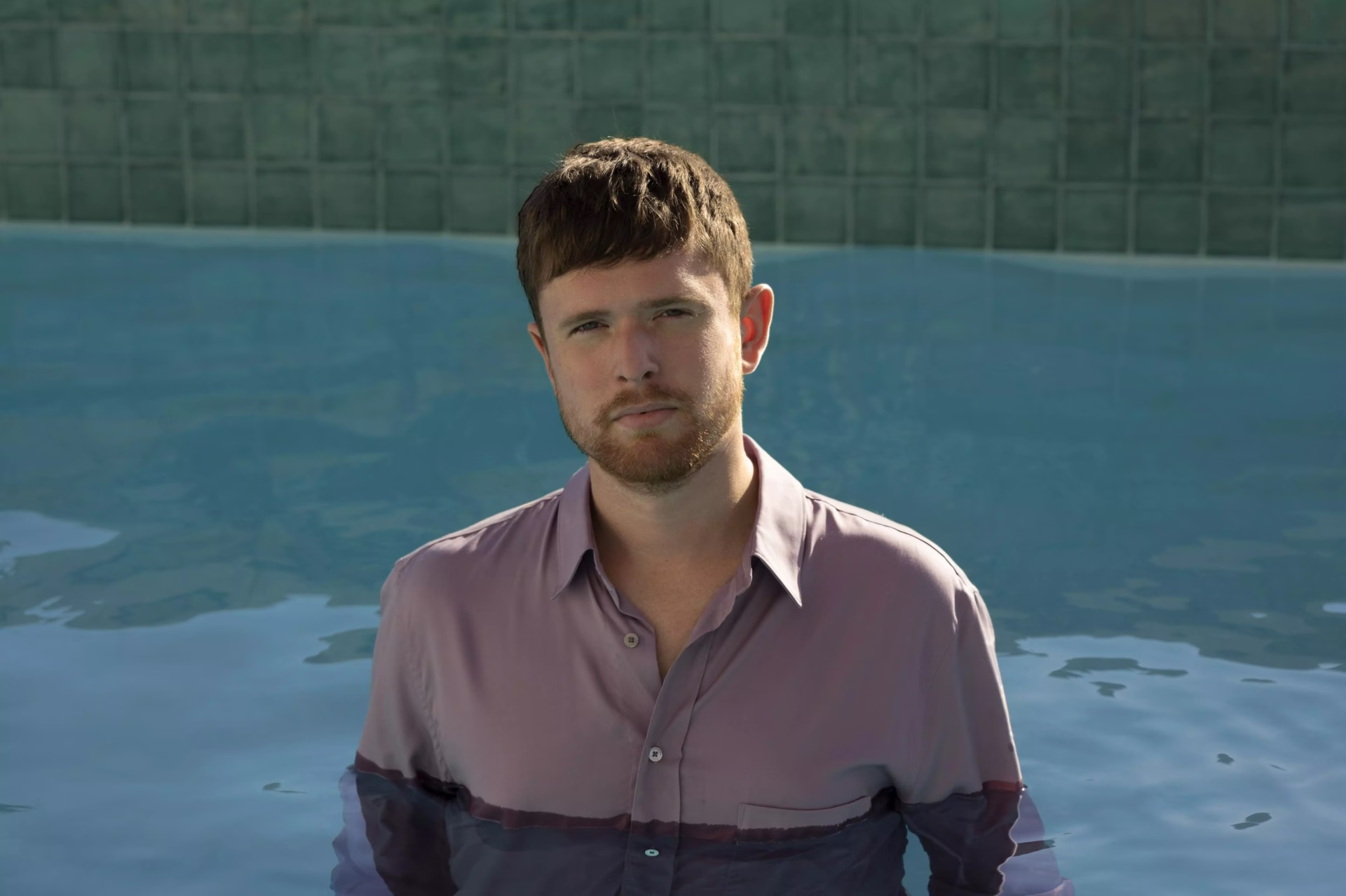
At 9:36 a.m. on a typically sunny Los Angeles day, James Blake apologizes for being "roughly six minutes late" to his Zoom with GRAMMY.com. It's September and the multi-hyphenate musician is looking relaxed in a short-sleeve floral print shirt and grown-out lockdown beard.
Only days before, Blake announced his latest album, Friends That Break Your Heart, was moving from its scheduled Sep. 10 release date to Oct. 8, due to COVID-19-related delays at vinyl pressing plants. As Blake explained on social media, he wanted his growing contingent of vinyl-buying fans to get the album on the day it hits digital platforms.
While not ideal, the delay allowed the native Londoner to focus on rehearsals with longtime friends and bandmates Rob McAndrews and Ben Assiter for a fall tour of the U.S. "In a little way, I'm relieved," Blake tells GRAMMY.com. "It can be quite stressful when everything happens at once."
Friends That Break Your Heart is Blake's fifth album, following 2019's pre-pandemic GRAMMY-nominated outing, Assume Form. On that album, the singer and studio whiz explored new variations on hip-hop and R&B production, working with guests Rosalía, Travis Scott, Moses Sumney, Metro Boomin and one his musical heroes, André 3000. Blake was feeling out a new album at New York's storied Electric Lady Studios when the pandemic hit. As a result, he made much of Friends That Break Your Heart in lockdown at his home in Los Angeles.
Despite his focus on the next LP, Blake had a prolific 2020, releasing the club-tinged Before EP and collaborating with Kehlani, Jay Electronica and slowthai, the latter whose “feel away” also features Blake's contemporaries Mount Kimbie. Each collaboration bears Blake's unmistakable imprint, from the ghostly presence of his backing vocals to the warmth and clarity of his production. To round out the year, Blake released the Covers EP, featuring aching interpretations of songs by Frank Ocean, Billie Eilish, Stevie Wonderand Roberta Flack.
<style>.embed-container { position: relative; padding-bottom: 56.25%; height: 0; overflow: hidden; max-width: 100%; } .embed-container iframe, .embed-container object, .embed-container embed { position: absolute; top: 0; left: 0; width: 100%; height: 100%; }</style><div class='embed-container'><iframe src='https://www.youtube.com/embed//X5j-40Y5-p8' frameborder='0' allowfullscreen></iframe></div>
James Blake first earned international attention with the release of his self-titled debut album in 2011. A clear standout of that year, James Blake introduced the singer's rich and pliable voice, which he manipulated into surprising shapes using a variety of vocal effects. The album typified the “post-dubstep” sound, which Blake championed as a DJ and via his party-turned-label 1-800 Dinosaur, together with the soul searching of an indie singer/songwriter.
Blake's next two albums, 2013's polished Overgrown and 2016's long and winding The Colour In Anything, took his songcraft to a wider audience outside the leftfield electronic world. In the decade since James Blake, its creator has carved out a secondary career as a collaborator, working with three of the biggest acts in music, Beyoncé, Jay-Z and Frank Ocean, through to next-in-line talent like Mustafa and JPEGMAFIA.
Blake has adapted to his new visibility as a public figure, particularly as a result of his relationship with actor and activist Jameela Jamil. Since 2018, he has used his Twitter platform to defend Jamil against online criticism and to challenge the “sad boy” tag that stigmatizes "men expressing themselves emotionally." As he tells GRAMMY.com, he's worked hard to become a better communicator outside the default outlet of his music.
Friends That Break Your Heart feels like the accumulation of all Blake's work up to now. As the striking cover art by Miles Johnston suggests, the album is an exercise in emotional openness and nuance. The message of self-acceptance in lead single “Say What You Will” was emphasized in a comedic music video that imagines Blake feuding with FINNEAS, including comparing his one GRAMMY statue to his faux-rival's armful of five. The following singles—”Life Is Not The Same,” co-produced with trap hitmakers Take A Daytrip, and the gently pulsing “Famous Last Words”—add to the complexity of emotions that make up the album.
While largely a one-man show, Friends That Break Your Heart also features SZA on “Coming Back,” Atlanta rappers J.I.D and SwaVay on “Frozen” and Monica Martin (who Blake calls "a generational talent") on “Show Me.” Here, electronic music's Renaissance man tells GRAMMY.com how it all came together.
<style>.embed-container { position: relative; padding-bottom: 56.25%; height: 0; overflow: hidden; max-width: 100%; } .embed-container iframe, .embed-container object, .embed-container embed { position: absolute; top: 0; left: 0; width: 100%; height: 100%; }</style><div class='embed-container'><iframe src='https://www.youtube.com/embed/JRUjtalz_1k' frameborder='0' allowfullscreen></iframe></div>
Has the album's release date moving back changed how you're approaching these fall live shows?
We've had to restrict what we can play slightly. We didn't ever want to play everything from the album. If you're going to see someone live and you've only had about a day with the record, you haven't had as much time to develop associations with the songs. It's nice to play a few off the new record though.
We're rehearsing every day in the [San Fernando] Valley and it's been great reconnecting with the band. They've been in England and I haven't seen them for months and months. And also just getting my hands on this gear that I play with live and into that headspace--it's one of those moments where it's like, “Oh yeah, I remember what I do now.”
When did you last play a live show?
God, I don't know. Christmas 2019?
Where were you in the world when everything changed last year?
I was in New York. Something about New York, maybe because it's the home of so many disaster movies, felt so spooky. We were posted up at Electric Lady Studios [in Greenwich Village] at the time. It was like being in a bunker. We were there for two months, every day and night. So, slight cabin fever was setting in and then this fear about what was going on outside.
What shape was the album in at that stage?
Well, that was around the time I did the Before EP, and I did several tracks off this album as well while we were there. It was where this album took its initial shape.
<style>.embed-container { position: relative; padding-bottom: 56.25%; height: 0; overflow: hidden; max-width: 100%; } .embed-container iframe, .embed-container object, .embed-container embed { position: absolute; top: 0; left: 0; width: 100%; height: 100%; }</style><div class='embed-container'><iframe src='https://www.youtube.com/embed/xbUvNFUrkpc' frameborder='0' allowfullscreen></iframe></div>
I'd have to assume there was some influence on the songs from the past year, or were they quite set in your mind?
I'd like to say there wasn't an effect, because you don't want to look back on an album and think, “Oh, that was the COVID album.” But at the same time, all of our headspaces changed dramatically because of the lockdown.
It has had a huge effect on music overall, as an industry and as an artform. Everybody has been chucked in another direction. I'm not sure whether the course we were on was necessarily good overall, or maybe that's not even relevant. But I do think we'll never know what music would've sounded like if this thing hadn't happened.
I'm noticing the writing process has changed, because for a year we weren't able to be in rooms with many people. So you're hearing a more isolatory experience.
You mentioned your Before EP, and you were very active with standalone releases in 2020. Did that more piecemeal approach feel right for the time?
It did. And also it felt ironic to release dance music. It was an outlet at a time with no clubs and no communal anything. It was almost like a little weird joke.
Have you missed DJing over this time?
I have actually. I don't miss extremely late nights. I'd often be put on at four or five in the morning. At that point, you've got to make a choice if you want to also live a normal life. Am I going to wake up at four and play the show, or am I going to stay up to four, play the show, then sleep?
It can be quite disruptive, especially if you're touring and also want to play live shows. I have the double-edged sword of wanting to sing really well, but also wanting to go out and DJ until six in the morning. They can't really coexist that easily.
<style>.embed-container { position: relative; padding-bottom: 56.25%; height: 0; overflow: hidden; max-width: 100%; } .embed-container iframe, .embed-container object, .embed-container embed { position: absolute; top: 0; left: 0; width: 100%; height: 100%; }</style><div class='embed-container'><iframe src='https://www.youtube.com/embed/umnjNOjqlcg' frameborder='0' allowfullscreen></iframe></div>
The new album has a very intentional flow to it. How did you structure the tracklist to create that momentum?
I think every album is like a DJ set, really. It needs a contour. In my DJ sets, I often start with something a little heavy but slower; something with a little bit of shock value but that doesn't give up all the energy straight away. Then I bring in a bit more energy before pulling it back in a chillout moment, so people can adjust before I ramp it all the way up again. Then it's about slowing down to allow for the landing.
In a four-hour DJ set, at some point people need to go get a drink. It can't just be slappers the whole time. If you really want to lock people into one set, you need the peaks and troughs. My favorite DJs do that, and my favorite albums have these journeys too. I think we as listeners find it hard to stay at one vibe for too long without wanting to switch it.
“Famous Last Words” is a very striking way to open the album sonically. I found the sound of it a little surprising, and that fits with what you're saying.
Yeah, grabbing the attention sonically, but not with an uptempo slap in the face. I'm hopefully just drawing you in. The song itself has a climax, but it's not heavy yet. The album gets heavier towards the middle, and then you get “Funeral,” which is a chance to take a breather and just appreciate a song.
<style>.embed-container { position: relative; padding-bottom: 56.25%; height: 0; overflow: hidden; max-width: 100%; } .embed-container iframe, .embed-container object, .embed-container embed { position: absolute; top: 0; left: 0; width: 100%; height: 100%; }</style><div class='embed-container'><iframe src='https://www.youtube.com/embed/O-W-tiQ3UwU' frameborder='0' allowfullscreen></iframe></div>
Was the album all made in New York?
No, the majority was at home in Los Angeles, because I was in lockdown. We were in New York for two months before the lockdown hit and when we left it was either get on a plane or be stuck in New York for the rest of the quarantine.
So the process went from collaborative to solitary?
Yes. It started very collaborative and became very solitary. Then it became more collaborative again as things started to open up.
How did you coordinate the collaboration with SZA on “Coming Back”?
That actually got started before quarantine. Starrah and I were working together. I absolutely love working with Starrah—she's brilliant. She and I were listening to a bunch of music and she said, "Oh, I'm going to invite my friend Solána." I said, "Oh cool, Solána's welcome." And Starrah was like, "Y'know...SZA?" And I was like, "Oh, that'd be lovely." [Laughs.]
So then SZA turns up. I've always loved her music and we just got on immediately. She wanted to know what I was making and I started banging through stuff.
The instrumental for “Coming Back” was the thing she immediately resonated with. So her and Starrah ended up working on a verse and that's what I had, a little bit of me singing, and a little bit of SZA singing, these two verses over one static piece of music, which were basically the opening chords. It took me about a year to do the rest and make a whole new instrumental for the switch. SZA is on the switch, and when the beat comes in, that was all new. It took me a while to figure it out.
I was curious as well about how you used your voice on this album. For example, “Life Is Not The Same” reminded me of the vocal techniques on your first album, whereas I didn't immediately recognize your voice on “Say What You Will,” so there's this interesting contrast going on.
It's different moods. Those two songs are probably written six months apart, so they're from different mindsets. Also I think there's something very storytelling-like about, [Singing, from “Say What You Will”], "Well, I've been normal, I've been ostracized, I've watched through a window..." It's in my speaking register. And I think the power of that is you feel like I'm speaking to you, rather than singing to you.
Over the course of “Say What You Will,” it's getting incrementally higher and higher until I deliver that big long note, and that's the feeling of acceptance, of not needing to compare myself to everyone.
The use of the voice might not always be intentional, but it does usually serve the song. It's word painting. With “Say What You Will,” I was in a sort of a Leonard Cohen-y mood, and then it turned into something else. That was one of those rare songs where I basically wrote the whole poem out and then just sang it. It doesn't always happen that way.
<style>.embed-container { position: relative; padding-bottom: 56.25%; height: 0; overflow: hidden; max-width: 100%; } .embed-container iframe, .embed-container object, .embed-container embed { position: absolute; top: 0; left: 0; width: 100%; height: 100%; }</style><div class='embed-container'><iframe src='https://www.youtube.com/embed/a3qRD0mYtPs' frameborder='0' allowfullscreen></iframe></div>
Do you see your albums in conversation with each other, or do you need to enforce a clean break between each one?
Some things you didn't use on the last record end up on the new record, if they fit the theme. I don't need to call it a break, because usually I'm just not in that headspace anymore. There's a lot of music on my hard drive that will never come out, and before I die, I will have them burned. [Laughs.]
The themes of your albums can often be described in quite reductive ways—for example, Assume Form was described as the in love album.
Yes, it's the happily in love album.
But with this one there's an ambivalence or wariness that carries through the songs that's not so easily condensed to one sentence. I'm thinking of the lyrics on “Show Me” as one example.
That happened naturally. It's what I was going through. I know not all music has to be about what you're going through at that time, but I've found that maybe that's my purpose. To experience emotions in a quite visceral, slightly over-the-top way, which is not to say I'm not feeling them.
It's an artist-wide thing, to be highly empathetic and to feel things strongly at the surface. Then, because you're overwhelmed, you need an outlet to put that into, otherwise you just boil over and feel crazy all the time. In a way, music sometimes isn't enough of an outlet, which is why I had to develop my actual communication as a person.
But I think maybe that's my job, to offer listeners a perspective, whether it's on heartbreak or anxiety or depression, or even happiness. To offer a perspective that says, “I also feel this.” I think that's maybe my raison d'être really, because I find when I do it, I resonate. And if I'm not doing that, I'm just making music.
“I know not all music has to be about what you're going through at that time, but I've found that maybe that's my purpose.”
Did you have to work hard on being a better communicator outside of your music?
Oh, yeah. In my experience, musicians are not the best communicators. I think we use music as a primary method of communication, and the secondary method might be our actual language in person. That's because that primary method of communication, especially for people who've been rewarded financially for it, [offers] an almost Pavlovian reward.
We're not being rewarded for standing up for ourselves in person or being vocal about what we feel. Those things can actually be discouraged. I was discouraged from being emotionally open and from saying what I think. When I offered that, people very often reacted negatively, so I stopped doing that and kept emoting with my music.
People started paying me to come on stage and do it and eventually praising me for it. In fact, since I can remember, people were praising me for making music. And so, if you're in that situation, any human being chooses the path of least resistance. You become a good communicator that way, and not necessarily the other.
That's how a lot of musicians are vulnerable to mental health [issues], because we're never really letting off that steam effectively. Real communication is better than music for actually getting things off your chest.
Something that I think gets missed is your sense of humor. There's a YouTube comment on the “Say What You Will” music video that jumped out to me: “This is the funniest and saddest thing I've ever seen."
[Laughs.] My favorite comedy does exactly that.
Your debut album, James Blake, came out 10 years ago. How has your relationship to those songs changed over the past decade, particularly as you keep revisiting them live?
They go through cycles. When you first do the song, it's raw, and you're thinking about everything it's about. Then after a while you become numb to those stories, and you want to get away from them if anything.
Eventually, you start reapplying those stories to things in your life now. With some of those songs, I remember the people I wrote them about and I can reminisce, as if they're little diary entries. It's nice. It's historically documenting what I've been through—the relationships, the good times, the bad times. Some people have Facebook—I have my songs from 10 years ago.
Meet The First-Time GRAMMY Nominee: Arca Is Expanding Latin Music On Her Terms With Electronic Album KiCK i