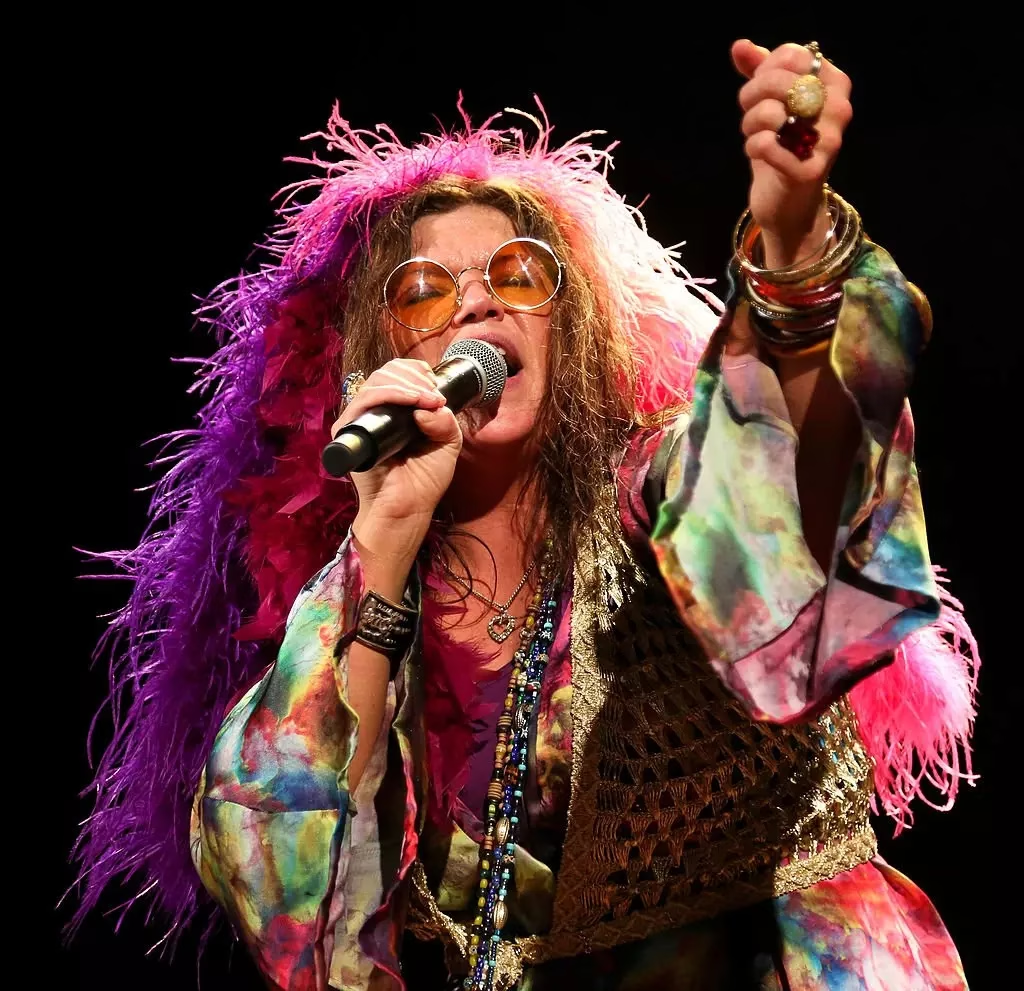
Mary Bridget Davies has been living the musical life of Janis Joplin, singing her songs and bringing her music to her original fans as well as younger generations. What began as a regional theater gig in 2006 led the lifelong vocalist to touring with Joplin's original band, Big Brother and the Holding Company and then starring in the Broadway musical, "A Night With Janis Joplin," that extended into national touring. She even has the blessing and approval of the iconic rocker's siblings Laura and Michael Joplin.
<iframe width="620" height="349" src="https://www.youtube.com/embed/xIiabXQ6-zw" frameborder="0" allow="accelerometer; autoplay; encrypted-media; gyroscope; picture-in-picture" allowfullscreen></iframe>
Now Davie's exuberant performance in "A Night With Janis Joplin" has been captured for posterity and is being screened in theaters across the country between Nov. 5 and Nov. 11. CineLife Entertainment is releasing the film with BroadwayHD (showing and ticket info available here) of a performance that was recorded at the La Mirada Theatre for the Performing Arts in California in September 2018.
Originally staged on the Great White Way from October 2013 to February 2014, "A Night With Janis Joplin" has toured the country regularly since with Davies still in the lead role. The show landed her a Tony nomination for Best Performance By An Actress In A Leading Role In A Musical, and upon watching this two-hour concert style event, it is easy to see why. Davies commands the stage with her powerhouse pipes and also charms during the contemplative monologues between numbers that flesh out parts of Joplin's remarkable life story.
This show is not simply a Janis musical revue with a live band (who, by the way, have chops to spare). Interspersed throughout hits like "Tell Mama," "Piece Of My Heart," and the post-bow encore of "Mercedes Benz" are songs by four women who were major influences in Janis' life: Etta James, Nina Simone, Bessie Smith, and Odetta, plus an Act One ending fantasy duet with her peer Aretha Franklin, which never happened in real life. The show creates a bridge and a dialogue between Janis and her female inspirations (in real life, Janis did sing with Tina Turner and Mavis Staples).
Davies explains that the show began as an off-Broadway production called "One Night With Janis Joplin," and only one female singer inhabited all the African-American singer roles. But the ensemble was later enhanced. The renamed "A Night With Janis Joplin" emerged in the summer 2012 in Davies' hometown of Cleveland, Ohio, went to the Arena Stage in Washington, D.C., and the Pasadena Playhouse, before landing on Broadway in spring 2013. "It was a very quick process," says Davies.
While the Joplin siblings were involved in the casting for "A Night With Janis Joplin," Michael recalled Davies from her role in a previous off-Broadway show called "Love, Janis," and knew that she had toured with Big Brother and the Holding Company. "There were a lot of women that could sing insanely well, but not a lot that could pull a Janis thing off," Michael explains. "I didn't realize that until we were auditioning."
They saw hundreds of women with plenty of theatrical experience, but Davies had the wow factor. "Mary comes from performance, and that's a real different skill set especially [in] rowdy bars," Michael says. "You learn a real different set on how to grab a bar." And a theatre audience.
"When you play Janis Joplin, you don't play her politely" -Mary Bridget Davies
When "A Night With Janis Joplin" first emerged on Broadway, there were some criticisms that it did not delve deeply into the tragic side of her story and stayed upbeat throughout the show. However, "Love, Janis," staged in NYC in 2001, handled that aspect and was inspired by the best-selling book written by Laura Joplin. Davies joined the touring company in 2006. Singers who tackled the role prior included Cathy Richardson, Andra Mitrovich, Beth Hart, Laura Branigan, and Sass Jordan, among others. (Interestingly enough, for whatever reason, many did not last that long in the part.)
"That was far more dark," Davies says of "Love, Janis." "It was telling her story chronologically from her beginnings in Austin, Texas, and hitchhiking to San Francisco, meeting Big Brother, all of that up until her untimely passing [in 1970]. It was pretty maudlin. We played the actual coroner's report. She shot up in scenes. It was heavy, but it was accurate, and that's what I loved about it. People just think rock stars are these happy go lucky bobbleheads, and that they're just living the dream. That show really proved that it's not all it's cracked up to be."
By contrast, "A Night With..." serves a different function, as if Janis were coming from Heaven and throwing her ultimate concert, one which Davies likens to the 1987 concert and TV special "B.B. King and Friends," which featured the rock icon performing with the likes of Albert King, Stevie Ray Vaughan, Eric Clapton, Phil Collins, Chaka Khan, Etta James, and Gladys Knight. In this case, Janis is paying tribute, "To the women who shaped her sound and who she looked up to so much," says Davies.
The newer Janis musical is ultimately uplifting. "I wanted to have a fun night," says Michael. "I realized that I don't pay to go see movies that depress me anymore. I just don't care. I could do that just reading the paper. I want to be entertained. That was our goal from the get go, to have an entertaining evening that you felt good about. You might learn something, and there might be some tears, but there's gonna be a lot of joy."
Both "A Night With..." and "Love, Janis" have used direct quotes from Janis' life rather than fictionalize her story.
"People had done that enough already, even in their own stories about her," notes Michael. "Even in some aspects, Janis fictionalized herself. She was a really good salesman. She wanted to get stuff in print. She was 25 – what the hell, go for it."
Janis once addressed the idea that while she did not yet have the life experience of her idols, she had the strength and was hoping to reach a higher level as a performer. "I've always admired that," says Michael. "I thought that was extremely aware, and I've always applauded that forward thinking in her."
Michael praises "A Night With..." book writer Randy Johnson in tracing his sister's musical evolution and how her influences (blues, soul, Broadway, psychedelic rock, and later, a little country) guided her. The Joplin siblings grew up with classical and Broadway music being played at home.
<iframe width="620" height="349" src="https://www.youtube.com/embed/DMN7d70WTzQ" frameborder="0" allow="accelerometer; autoplay; encrypted-media; gyroscope; picture-in-picture" allowfullscreen></iframe>
Davies notes that many fans do not know that "Summertime," which was recorded by Big Brother and the Holding Company, came from the African-American folk opera "Porgy & Bess" which debuted on Broadway in 1935. Appropriately enough, this production's version begins with another singer tackling the original version before segueing into the Big Brother rendition. "I love watching the audience's reaction," says Michael. "They're in awe of both. That's so fun to watch."
While some in the media tried to paint Joplin as manic depressive or dour, her brother Michael has stated before that she actually was having a good time and enjoying her life. It showed on stage.
"Janis was such a different take," says Micheal. "All the women before were pretty straightforward and singing nicely. Grace Slick was a wonderful rock performer, but she was definitely singing that kind of theater voice versus the Janis rock thing. It just took everybody by surprise, so their automatic distrust of something new was going to be there. That's a human nature thing. It wasn't Janis' intent to break down any doors. She just did what she did. Big Brother was an intense garage band."
Michael says he and his family saw Janis perform three times with Big Brother (although not with the Kosmic Blues Band or the Full Tilt Boogie Band). "That was pretty insane," he recalls of the experience. "That was pretty cool. My parents were a little bit shocked by all of it. I can't see how they wouldn't be actually." The singer's appearance on The Ed Sullivan Show cemented her legitimacy with her parents.
"As a parent, you've got to watch that and hope for the best," says Michael. "They had a lot of fears, and well-founded now in hindsight, but they were still incredibly proud of her and her drive and ability. But terrified all at the same time. As a parent now, I can completely understand that. You just pray that they get through it."
While there is no way to truly replace Janis, Davies has been doing an admirable and acclaimed job. Following "Love, Janis," she landed a gig singing with Joplin's original group, Big Brother and the Holding Company, on and off between the summers of 2006 and 2012.
<iframe width="620" height="349" src="https://www.youtube.com/embed/0Z0jOfG7itE" frameborder="0" allow="accelerometer; autoplay; encrypted-media; gyroscope; picture-in-picture" allowfullscreen></iframe>
"I was lucky enough to tour Europe with them a few times, see the world with them, and really get to know Janis from their point-of-view," says Davies. "They were all just like best friends. Just getting those background stories that you can't get except from the source was a lot of fun too. They still knew how to throw down. They were fun in their advanced age, if you will. The remaining members that are still alive are the rhythm section, Dave Getz the drummer and Peter Albin on bass, are still out there touring and doing their thing."
Davies has soldiered on with her chosen role in "A Night With Janis Joplin," dazzling fans old and new. "People who were there the first time remember it and feel young," she remarks. "My favorite moment is when you look out and see someone walk in with a walker or a cane, and by the end of Act One, they've got that cane in the air and they're standing on their own two feet and they're feeling that adrenaline like they did when they were kids. Then I've done my job. Then you see younger kids come up to you after the show and go, 'I had no idea who Bessie Smith was.' Or I'll get stage letters like, 'I saw your show last year, and I just want you to know that I did my social sciences diorama on women of the blues in the early Twenties.' That's cool."
According to Micheal, social media is likely the main way that younger fans find out about Janis and her music, although her multigenerational appeal means that younger people also discover the singer through older relatives. "We'd go to the play and watch grandmas taking their daughters with their granddaughters and they're all rocking," he says. "It's so cool to see that. Theater is definitely lending itself towards gray hair, but a lot of Janis' performances are not."
The distinct grittiness in Janis' voice is something that other singers have struggled with, and Davies certainly took time to transition into that vocal space. "I'll tell you as someone that's been doing it for a very long time, she had a lot of finesse under that," says Davies. "That banshee wail was a complete and very cool fabrication of her own singing voice. She created that." When Davies tried singing "Try (Just a Little Bit Harder)" for the first time with her cover band at age 21, she admittedly blew her voice out halfway through.
"It was literally navigating unchartered waters," says Davies. "It took me a couple of years to actually get it to where I wouldn't hurt myself, but I would still be able to really drop the hammer and go nuts."
<blockquote class="twitter-tweet"><p lang="en" dir="ltr">NEW YORK CITY! I am so excited to share that we will be performing the new album, Stay With Me, at le poisson rouge Saturday October 26th! Come down and hear this amazing new record and tell your friends! <a href="https://t.co/hIq1LTbCj5">https://t.co/hIq1LTbCj5</a></p>— Mary Bridget Davies (@marybdavies) <a href="https://twitter.com/marybdavies/status/1182731128295383040?ref_src=twsrc%5Etfw">October 11, 2019</a></blockquote> <script async src="https://platform.twitter.com/widgets.js" charset="utf-8"></script>
If one listens to the first single "The Right Of Way" from Davies' forthcoming solo album Stay With Me: The Reimagined Songs of Jerry Ragovoy, which is due out in January 2020, one can hear her natural singing voice. (Side note: Ragovoy co-wrote a few tunes that Janis sung.) Davies' normal voice is just as strong but without that extra layer of grit, and it showcases a different side of her singing. She has learned to walk a line between her voice and that of Janis.
"That's the other thing – when you play Janis Joplin, you don't play her politely," observes Davies. "That's counterproductive. I've found a way to harness that lightning, but it took a few years for me to get it to where I could control it. I love putting the grit on it. Now it's second nature to me. I live in a world between the two now."
GRAMMY.com contributor Bryan Reesman is the author of Bon Jovi: The Story and host of the podcast Side Jams.
Inside Tina Turner's Empowering Final Album, 1999's 'Twenty Four Seven,' 20 Years Later