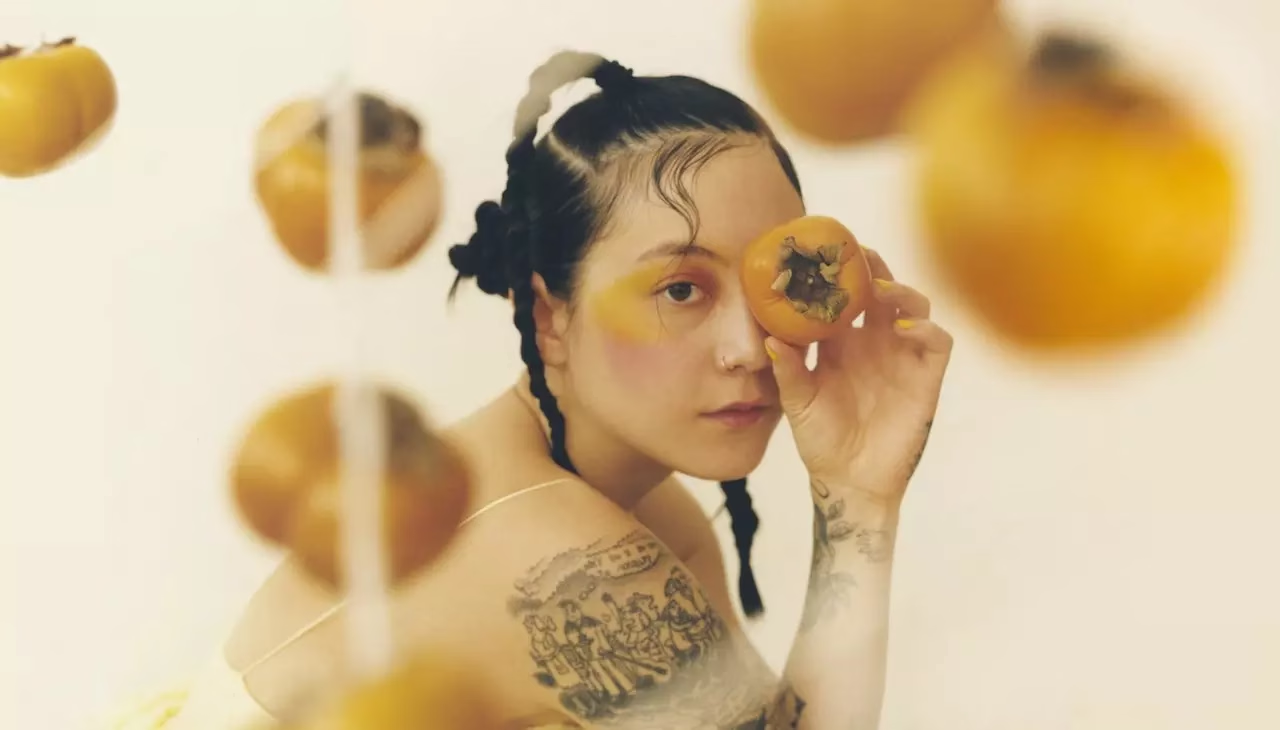
Up until now, Michelle Zauner's albums as Japanese Breakfast were mired in grief. It's more than understandable: They were written in the wake of her mother's death. But while Psychopomp (2016) and Soft Sounds from Another Planet (2017) mourned her mother's cancer and passing—both depicted in harrowing detail in Zauner's new memoir, Crying in H Mart, where she also reckons with her Korean identity—her upcoming third album, Jubilee, lets some light back in.
Of course, one can't emerge from grief by discarding it entirely; Zauner sits with the darker moments, too. On "In Hell," she describes keeping her mother's pain at bay near the end of her life: "I snowed you in / With hydrocodone / Layer by layer 'til you disappeared." Notably, that song is a former bonus track, reinvigorated for Jubilee. Why, then, does she put that track, and the similarly reimagined "Posing in Bondage," on her new, optimistic album? For Zauner, it's a "good reminder of where I've come from." Her mother passed six years ago, and she's processed that grief to the point where "time has healed a gaping wound, and it's something that I will live with forever, but it's less debilitating." Most importantly, she said, "I want to write about something else."
So on Jubilee, Zauner strives for joy. She said she feels "like I'm able to do things in my life now that aren't all clouded over with grief," and she wanted to explore that optimism in herself. From the bright, horn-heavy opener "Paprika" to gothic, dancey tracks, Zauner's Jubilee hinges on possibility and hope: She reminds herself that she's allowed to feel joy after this deep, consuming sadness.
GRAMMY.com caught up with Michelle Zauner to dive deep into Jubilee, which drops on Dead Oceans June 4.
<style>.embed-container { position: relative; padding-bottom: 56.25%; height: 0; overflow: hidden; max-width: 100%; } .embed-container iframe, .embed-container object, .embed-container embed { position: absolute; top: 0; left: 0; width: 100%; height: 100%; }</style><div class='embed-container'><iframe src='https://www.youtube.com/embed/2ZfcZEIo6Bw' frameborder='0' allowfullscreen></iframe></div>
I'm really curious about the timeline of working on the album and working on the memoir—did they overlap?
I was working on the book pretty intensely from probably 2017 to 2020. I sent out my first draft to my editor in October or September of 2019, so I kind of had this built-in break for three to five months where I just could not think about it, and it was in her hands, and I could go off and work on another big project. It was really time for us to start recording a new record, so I started writing and recording largely in 2019.
They are separate but, not to be cliche, they are interrelated in so many ways. Did you apportion certain ideas to one [project] or did they influence each other?
A good deal of the record has to do with my personal life in some ways, and a lot of it was the aftermath of where the book left off, [that] is actually the content of the songs. I think if anything, I wrote two albums that were largely focused on grief and then this whole book that really dove into that experience, [and then] I felt like I was actually really ready to fling myself to the other end of the spectrum and write about this other part of my life that is a bit more joyful.
<style>.embed-container { position: relative; padding-bottom: 56.25%; height: 0; overflow: hidden; max-width: 100%; } .embed-container iframe, .embed-container object, .embed-container embed { position: absolute; top: 0; left: 0; width: 100%; height: 100%; }</style><div class='embed-container'><iframe src='https://www.youtube.com/embed/q2pQIqR-m_w' frameborder='0' allowfullscreen></iframe></div>
That's actually what I was going to ask you about—this album is titled Jubilee, which means celebrating the passage of time. Was there a moment or catalyst, like "it's time to turn towards joy," or was it a slow realization?
I don't know if there was a catalyst, I think it was the slow processing of grief over the past six years, and it just made space for me—time has healed a gaping wound, and it's something that I will live with forever, but it's less debilitating, it's less of my primary focus. I feel like I'm able to do things in my life now that aren't all clouded over with grief.
It was definitely a conscious choice to be like, "OK, I've written two very dark albums and a whole book about grief, I want to write about something else," because I feel ready to do that and I'm interested in these other parts of my life and joy in particular. I think a lot of what I was going through was: "You're allowed to feel again, you're allowed to feel joy." A lot of the record is about struggling or figuring out how to do that or making decisions for myself that allow me to embrace that again.
I feel like "Paprika" really encapsulates everything you're trying to do on this record — it's very naturalistic, there's so much possibility. And then there are songs on the record like "Savage Good Boy" and "Kokomo, IN" which are more narrative and use personas. Why did you decide to do that?
It just happened organically. It's something that I've done before and I've always had a lot of fun with, and I think it's just like flexing this different type of muscle. I think I read something about billion-dollar bunkers in the news, and it inspired this whole narrative about a billionaire coaxing a young woman to live with him as the world burns around them.
"Kokomo, IN" happened because I was taking a lot of guitar lessons at the time and so of course I was learning a lot of Beatles songs, and adding all these sort of more interesting chord changes, a lot of major-7s and major-4s, these same type of very classic chord changes that made me write this very sweet, classic song of longing and teenage feeling. I just followed the natural narrative that the song created for itself.
You mention in your new memoir, Crying in H Mart, about being seen as a "bad girl" when you were a kid. The song "Slide Tackle" brings that up, too. Do you still think of yourself like that?
As a bad girl? [Laughs.] I'm so obsessed with striving to be a good person. My brain is very occupied, and I think a lot of my songs really boil down to "I want to be better, I want to be a better person." That song starts with "I want to be good / I want to navigate this hate in my heart / somewhere better." A lot of my songs are like that—I actually had to catch myself, because I'm like, "You can't start every song with 'I want.'" [Laughs.]
And "Diving Woman" [on Soft Sounds from Another Planet] also starts that way: "I want to be a woman of regimen." A lot of these are very simple ideas of "I want to be a more regimented person, I want to be in control of my emotions, I want to be kind to people," and I'm still a moody little f***er, but I try to get a better handle of that as I've gotten older and I definitely don't value that part of myself. I always want to be a better person.
You mentioned your guitar lessons, and I know you did a lot of work as a songwriter as you were creating this album.
I felt a little stuck and needed some brushing up. I've always been very willfully ignorant of music theory and thought it would hinder my natural songwriting ability, and I realized after years of touring and working professionally as a musician, I got to meet so many stunning musicians who have this incredible education that I've become quite envious of. I feel like that really inspired me to get back in and see what it could bring out in me that was new.
Did you like it?
I really liked it, actually. I was like, "This whole time there have been this many chords?" [Laughs.] I felt really stupid that I'd kept myself away from it for so long.
<style>.embed-container { position: relative; padding-bottom: 56.25%; height: 0; overflow: hidden; max-width: 100%; } .embed-container iframe, .embed-container object, .embed-container embed { position: absolute; top: 0; left: 0; width: 100%; height: 100%; }</style><div class='embed-container'><iframe src='https://www.youtube.com/embed/mcoC5ZgaFjY' frameborder='0' allowfullscreen></iframe></div>
Between "Posing in Bondage" and "Posing for Cars"—this might just be me being prosaic—I thought a lot about the word "posing," like posing for art, or even posturing. Those songs are so chilling and isolated.
["Posing in Bondage"] feels really fraught with tension and I think it's very delicate but also kind of industrial. The song was something that we put out with Polyvinyl on a 4-track series, and it was a very, very low-fi version of it that I don't feel like did the song justice and it's always been a song that I really liked. This was another song that I co-produced with Jack Tatum of the band Wild Nothing. He is just a real sonic wizard, he's a real tinkerer of tone, and he found this perfect balance of tension and these really unique sounds that give it this very fragile, vulnerable feeling. I really was happy to get it where it needed to be, and there's this almost Enya-esque vocals at the end.
Can you tell me a little about how "In Hell" came together?
That was actually a bonus song for Soft Sounds, for the Japanese deluxe edition. It was just one of those songs that stuck around and has haunted me for a very long time. I think it's a very beautiful and intense song and some of the greatest lyric writing I've done. It's very melodic and pleasant…I just felt like it didn't deserve to die as an exclusive bonus track, I really wanted more people to hear it. I think it's almost more devastating because it's on a record that's about joy, with a lot of warmer songs. I think it finds a good place there, sonically it fits, and it's a good reminder of what I've endured and that it's possible to experience happiness after these two incredibly dark moments in my life and comparing them. That song's literally about euthanizing my dog and comparing it to snowing my mom under with drugs, and it's spun into a little pop number.
Even as we keep talking about grief and sadness, we go back to Jubilee as a tribute to joy. What, right now, brings you joy?
I have a really great life, honestly. I have the greatest job, and I value that so much. I was kind of a late bloomer in this industry and it's allowed me to be so grateful that I've won this lottery and get to be a creative person for a living. I'm so overjoyed that I've found love in my life that's incredibly stable and very fulfilling, just endlessly fulfilling. Those two things alone—I've just won the life lottery, in that sense.