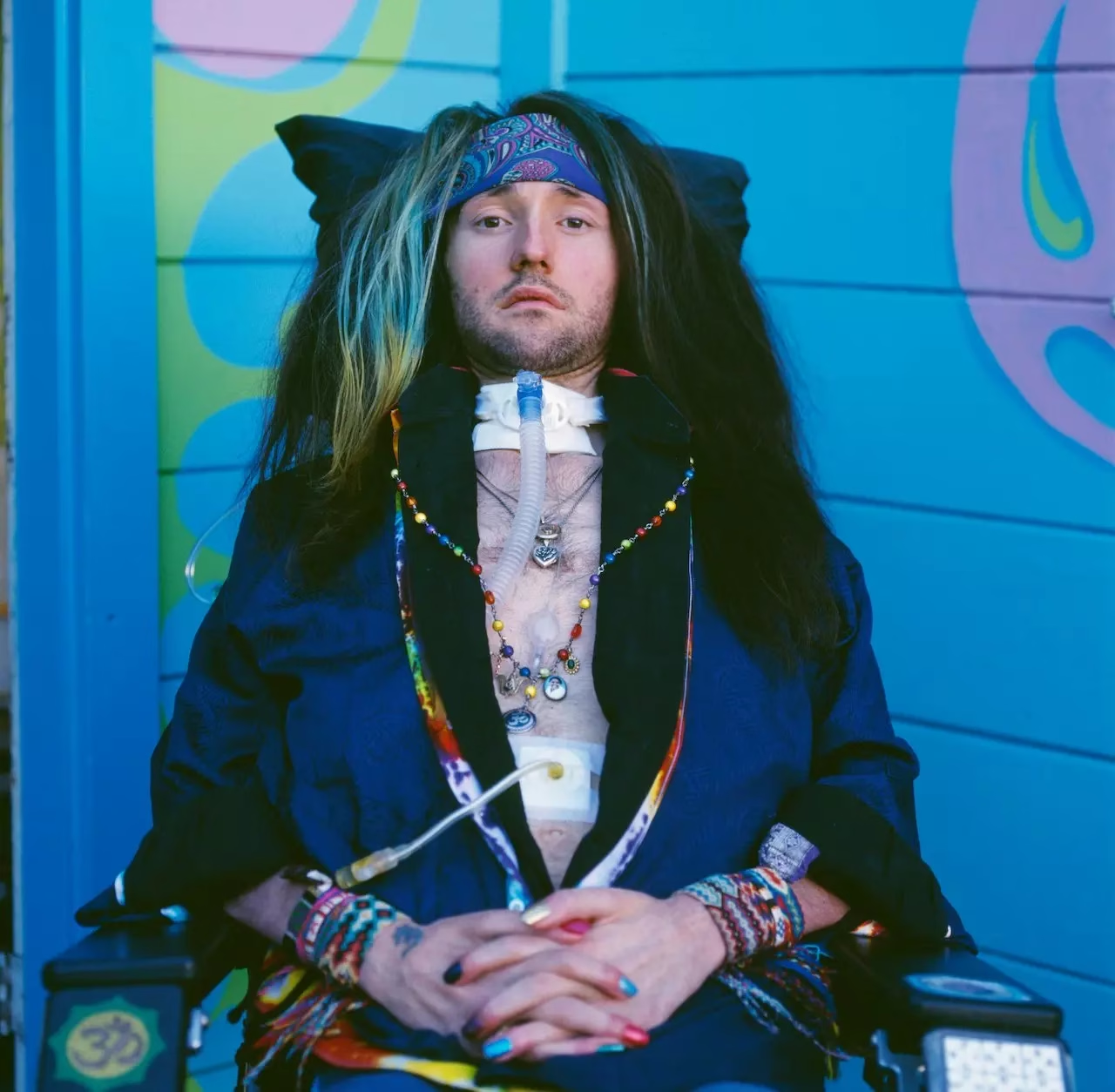
Jason Becker is no stranger to the Rock God World. He’s collaborated with the likes of Joe Satriani, David Lee Roth and Bob Dylan — just to name a few. Becker’s first band, Cacophony, a heavy metal duo with his pal Marty Friedman, was signed to the iconic Shrapnel Records when the pair were just teens. He then went on to land the coveted role of guitarist for Roth (following in the footsteps of guitar giants Eddie Van Halen and Stevie Vai). He had just finished recording Roth’s A Little Ain’t Enough when he was diagnosed with amyotrophic lateral sclerosis (ALS), also known as Lou Gehrig’s disease. Since his diagnosis, Becker has lost his ability to walk, talk and breathe on his own. While his life has drastically changed, he hasn’t lost his love and will to create music.
Using a unique eye movement system that allows him to communicate more thoroughly than most augmentative communication options, Becker went on to release several solo albums and compilations, broadening his scope from primarily metal and rock to genre-bending sounds encompassing R&B, pop, and more on his most recent 2018 release, Triumphant Hearts.
<style>.embed-container { position: relative; padding-bottom: 56.25%; height: 0; overflow: hidden; max-width: 100%; } .embed-container iframe, .embed-container object, .embed-container embed { position: absolute; top: 0; left: 0; width: 100%; height: 100%; }</style><div class='embed-container'><iframe src='https://www.youtube.com/embed/IXSR85mwRXw' frameborder='0' allowfullscreen></iframe></div>
Earlier this year Becker was hospitalized for a very serious bacterial infection that was affecting his heart rate and ability to breathe. After several months of treatment, Becker is back home and in recovery mode. His friend Herman Li of speed metal band DragonForce spearheaded fundraising efforts to help cover Becker’s ongoing medical costs. The #ShredForJasonBecker virtual fundraiser is auctioning off a bevy of prodigious guitars autographed by heavy hitters such as Metallica, Steve Lukather (Toto), Jeff Loomis (Nevermore), Zoltan Bathory (Five Finger Death Punch), amongst others. The auction is ongoing and has raised over $200,000. (Check out what’s still up for grabs in Becker’s guitar shop here.)
GRAMMY.com caught up with Becker to learn more about his present journey, musical works, and thoughts on where the music industry has room for improvement for those with accessibility needs.
You have been living with ALS for over 30 years, which smashes the average life expectancy rate of two to five years for those diagnosed with this nervous system disease. First and foremost, how are you doing? Second, what would you say have been the key elements in your life over the last few decades that have motivated you and inspired you to keep going?
Thank you for asking. It has actually been 32 years now, since Mother’s Day [1989.] I first felt painful cramps in my left calf [that day.] I am doing pretty well lately, after a long period of not feeling great. Mechanical ventilation has a lot of complications, and I had a bunch of these. Those things are exhausting and zap me of energy and strength and some of them can be pretty scary. I have spent a lot of time meditating and working on healing, and I can feel my strength and energy coming back. I am so grateful to be here, with the people I love, and I would say that is the thing that keeps me motivated and inspired to keep going. I have my moments of sadness and feeling like giving up, but I have gotten through so far, and I think it is all about love, including my love of life. Making music, feeling a sense of purpose, and the love and respect of my friends, fans, and peers, is also really motivating.
<style>.embed-container { position: relative; padding-bottom: 56.25%; height: 0; overflow: hidden; max-width: 100%; } .embed-container iframe, .embed-container object, .embed-container embed { position: absolute; top: 0; left: 0; width: 100%; height: 100%; }</style><div class='embed-container'><iframe src='https://www.youtube.com/embed/rThFDRYKKZE' frameborder='0' allowfullscreen></iframe></div>
For those who are not familiar with your journey, can you tell us about the eye movement system you developed with your father and how that allows you to communicate both conversationally and musically?
When I was in the hospital, getting my trach and stomach tube operation 24 years ago, my dad knew I was not going to be able to talk. It was already hard to understand what I was trying to say because my voice was so weak. A speech therapist brought in what they had in the way of communication, which was very complicated and impersonal. For instance, there were sentences like, "I am cold, I am angry, bring me some water" etc. It was based on shortcuts for standard needs and issues. My dad didn't think that would work and was a bit terrified about thinking I wouldn't be able to quickly communicate what it was I wanted to say — even if it was just to make a joke, or be part of a conversation. He went to his studio and devised a grid with the letters of the alphabet, divided into 6 squares. Each letter requires two eye movements. As we all got used to it, we could see that we could make our own shortcuts, like raised eyebrows for yes and lip up for no, and things like that. And, we all have memorized it now and we can all carry on conversations at a pretty fast speed. I can tell long stories, make jokes and be a part of the conversation. I have heard from others that they have tried the system and like it. At one of my movie screenings, I met a woman from Texas who said she was able to speak to her father for the last time, and she was very grateful. I still haven't found anything better for me, including computer systems; they just aren't personal or fast enough for me.
With music, it is fairly simple. I don't even need a musician when I am composing. I use LogicPro and I have a lot of great instrument samples. I direct my caregiver where to put notes. I rearrange the notes, instrument by instrument, and track by track. I usually know what I am going for and what harmonies and counterpoints will sound cool. I can adjust the velocity and volume of each note. I spell to my caregivers, for example: "Make the third note longer," or "Turn down the velocity." When recording musicians it is easy to explain what I want. I also had a great co-producer, Dan Alvarez, who gets what I say and can explain things with his voice and hum if necessary. Here is a link to how my eye communication works: Jason Becker – How Eye Communicate.
Wow! That is truly amazing. Your last album, Triumphant Hearts, came out in late 2018. There are a lot of amazing musicians featured on that album. Now that you primarily compose and write, how do you go about finding the right person to perform one of your pieces?
It is different with each piece. On "Valley of Fire," and both versions of "River of Longing," I just asked players who I loved. These songs were meant to be for my guitar player fans. I didn't write anyone's parts; they all just soloed over the pieces. "Valley of Fire" is kind of Ennio Morricone-inspired, and "River of Longing" is Bob Dylan-inspired.
For the vocal songs, I tried to get Peter Gabriel, Seal, Steve Perry, John Mayer and Steve Lukather, but for one reason or another, it didn't work out. Of course, I wanted Stevie Wonder for "We Are One." My friend, Dave Lopez, finally hooked me up with Steve Knight from Flipsyde, and Codany Holiday for "Hold on to Love." Both were perfect. Codany brought so much soul, he brought me to tears, and Steve brought the funk.
For the "Hold on to Love" guitar parts, I was trying to get Jeff Beck, but my friend Daniele Gottardo's mom asked me to find a place for him. It was perfect. For the intro solo, I used Andrew Jay, who was a fan of mine.
For the classical pieces, it sounds like I wrote them specifically for those players, but I didn't. It just worked perfectly to have Marty Friedman playing on "Triumphant Heart," Jake Shimabukuro, the ukulele great, playing with an orchestra on "Fantasy Weaver," and Uli Jon Roth and Chris Broderick on "Magic Woman." Great players can fit into anything, while still sounding like themselves.
Are you currently working on new music or any other projects?
At the moment, I am not working on anything, except in my head. I want to make videos for each song from my Triumphant Hearts album because I think many beautiful songs got overlooked. And, I am thinking about releasing some more recorded stuff of my guitar playing from back in the day. It has been a dry spell for me because of so much physical and mental stuff to deal with, but I can feel my strength and energy coming back and, with that, my brain starts to churn up ideas and the creative juices start flowing again, so we’ll see.
<style>.embed-container { position: relative; padding-bottom: 56.25%; height: 0; overflow: hidden; max-width: 100%; } .embed-container iframe, .embed-container object, .embed-container embed { position: absolute; top: 0; left: 0; width: 100%; height: 100%; }</style><div class='embed-container'><iframe src='https://www.youtube.com/embed/1gS5ibUPUvg' frameborder='0' allowfullscreen></iframe></div>
You had very notable successes in the 80s with your band Cacophony and the work you did on A Little Ain’t Enough with David Lee Roth before getting your ALS diagnosis. How has your experience in the music industry changed since becoming an artist with accessibility needs?
Well, I am lucky because the guitar community is the best and so many great guitarists have come forward for me and acted as my "paintbrushes" as Steve Vai has said. Mostly, when I have asked for help with playing guitar solos, they are happy to contribute, and I am so grateful for their love and support. As you say, I was somewhat established, so they know I am serious, and they like what they hear and most musicians are kind and giving and really seem to want to help and contribute to getting my music out there. It is overwhelming. So, other than having to be totally patient because I cannot go at the speed I would like as far as producing and mixing, not to mention composing, it is pretty much the same. Don't get me wrong, composing with eye movements, one note at a time, then doing all of the intricate details and additions takes years of hard work and major patience. I'm not sure anyone has done it. As far as the music industry changing, I only wish there was more exposure to my music. I feel like I write music for everyone, not just guitar players. It is weird; I haven't been a "shredder" since I was a teenager, but that is what people still call me. I write classical, pop, rock, funk, R&B, and all kinds of music. I wonder why only guitar publications knew about my album. I generally think the GRAMMYs do a great job trying to get many styles of music out there, but money speaks very loudly. I was really shocked that not one national TV show wanted to tell my story of creating this amazing album (if I do say so myself). Am I being too Kanye [West]? HA HA!
Did you find that the COVID-19 pandemic made the world of current music and events more accessible to you since the large majority of things moved online? Is there anything from lockdown that you would like to see carry over now that things are reopening that would help to continue to make shows, programs, etc. accessible to all?
Although I haven’t taken advantage of everything that can be streamed now, I know it has been great for many people for lots of reasons and I do hope it continues. The side benefit is it keeps people out of their cars a little bit, too.
Are there area(s) of the industry that you feel need the utmost attention in order to create an equal playing field for both consumers of music and those pursuing a career in music, who also have accessibility needs?
I definitely do, yes. I give myself as an example: I can’t tour, or even perform in any conventional sense, so the usual ways to promote music are closed to me. I believe my music would have a profound effect on a lot of people if it had even a little of the exposure given to popular music. What if the Recording Academy used its resources and reach to create a platform (web-based, maybe streaming) specifically for musicians with similar limitations where they can showcase their process and their music for a wide audience. The Academy could offer production support like videography, too. Accessibility is much more than ramps and wide doorways. If you can’t get to a venue or pick up an instrument, none of that matters. I really appreciate you asking, and thinking about this. It isn't easy to answer though because I think my music is as good as any other music. It would feel strange to be put in a "disabled" category, but with that said, any exposure is great, and if it inspires people, coolio!
What a great idea, Jason! What advice would you give to a younger musician who is struggling with a difficult health diagnosis and/or accessibility needs that may be impacting their ability to play or create music?
You know, there are ways, and for each person, the answer is probably different. I have heard from many musicians with disabilities out there, and one thing they always say is that they have to create; it's what they do and without it, they don't feel a reason to live, so that is quite a motivator. They tell me they are inspired by me and my music, but I feel the same about them. I think that creative drive brings about solutions to obstacles and it is always amazing to me to see what can be done.
For me, the most important thing is help and love from family, friends, caregivers and musicians. I couldn't do anything (literally) without help.
Donate directly to The Jason Becker Special Needs Trust here.
Meet Question, A Rapper/Producer Who Doesn't Want To Be Boxed In By Blindness