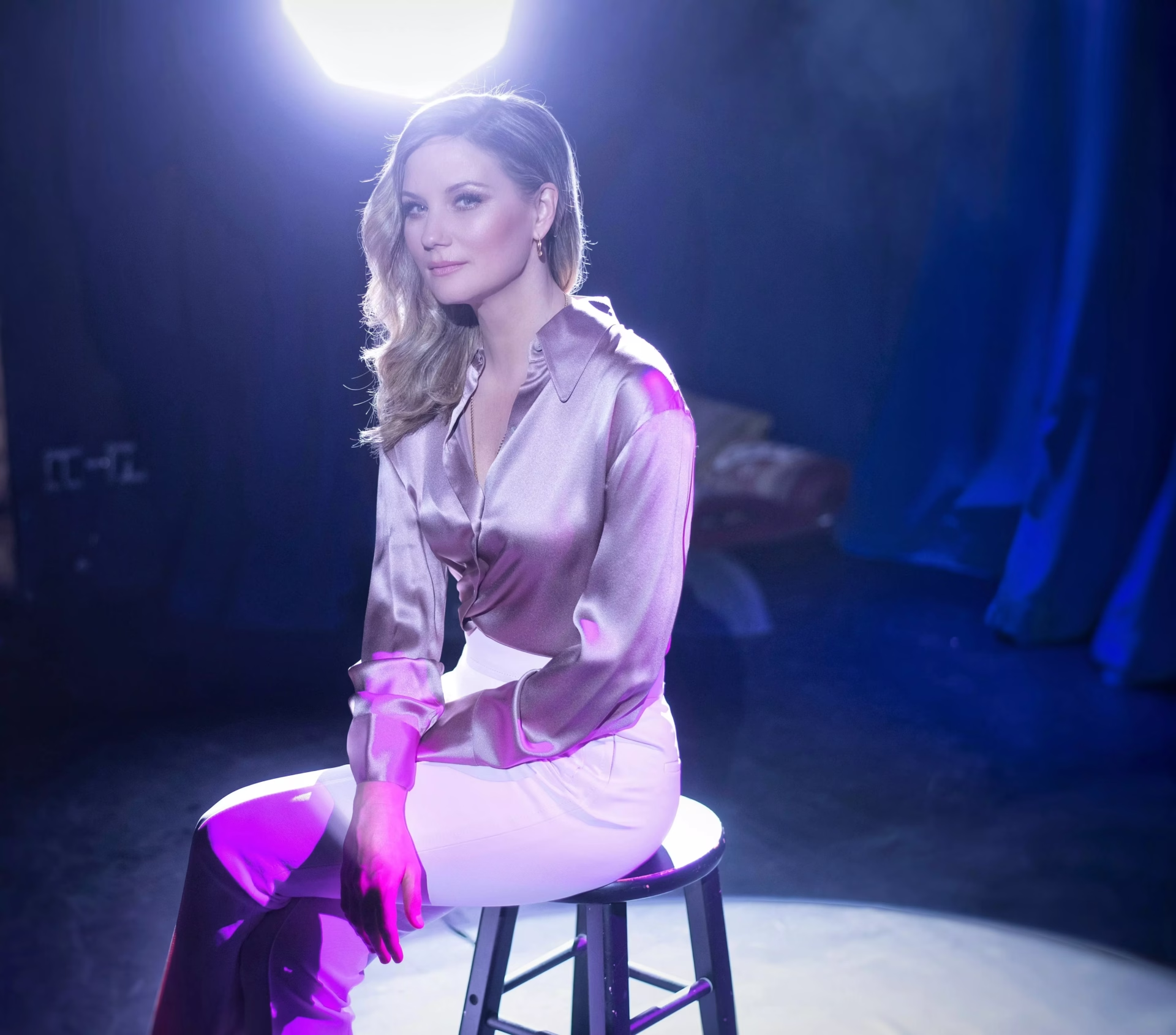
The first record Jennifer Nettles ever owned was the cast recording of "Annie." She might've missed the opportunity to play the red-haired orphan on Broadway, but she's bringing the Annie of her dreams to life in a significant way: Always Like New, her new album of American Songbook classics and contemporary musical theater songs, will feature “Tomorrow” from the popular musical and other songs sung on the Broadway stage.
Nettles may be best known as a multi-platinum and GRAMMY-winning country superstar, but she's no stranger to the theater world. In 2015, she made her Broadway debut playing Roxie Hart in "Chicago" and led "Mamma Mia!" at the Hollywood Bowl two years later.
<style>.embed-container { position: relative; padding-bottom: 56.25%; height: 0; overflow: hidden; max-width: 100%; } .embed-container iframe, .embed-container object, .embed-container embed { position: absolute; top: 0; left: 0; width: 100%; height: 100%; }</style><div class='embed-container'><iframe src='https://www.youtube.com/embed/7I_lWGG9Uas' frameborder='0' allowfullscreen></iframe></div>
These contrasting touchstones lend Nettles a palpable depth and enticing complexity in industries that prefer their women in tidy boxes. As she continues to widen her presence outside of country with her new album, she enlists multi GRAMMY-winning orchestrator, and musical director Alex Lacamoire ("Hamilton," "Dear Evan Hansen," "The Greatest Showman," "In the Heights"), and Broadway producer Adam Zotovich ("Dear Evan Hansen," "The Color Purple," "An American in Paris").
Always Like New is no doubt a lean into the future she's building for herself, a comfortable culmination of her musical theater and country instincts where she shrinks conventions and obliterates expectations for a new generation of listeners. And it's abundantly clear how important this album is to her. With Nettles, though, it's always about the music first; it's about much more than that, too. Always Like New tells a story of ambition and an unparalleled focus on her craft, her story, and her evolution.
In a conversation with GRAMMY.com, Nettles unpacks the album, her success in the country music industry, and crossing over from country to Broadway.
Let's talk about how you began conceptualizing Always Like New. Were there any songs in particular that you modeled the rest of your tracklist after?
"Wouldn't It Be Loverly" ["My Fair Lady"], "Oh, What A Beautiful Mornin'"
["Oklahoma!"], and "Sit Down You're Rockin' the Boat" ["Guys and Dolls"] were the anchors conceptually for this album. I love musical theater and these are songs I've long known, and sometimes just in my creative brain, I would play around with singing them in different ways. I shared "Wouldn't It Be Loverly" with Adam Zotovich, who is the executive producer on the record. At first, he was like, "Oh, my God, it sounds so different," and we started to explore the ideas of how these songs could be reimagined and reinterpreted. Some others that I had cooking already in my brain, so I was inspired to explore them further.
<style>.embed-container { position: relative; padding-bottom: 56.25%; height: 0; overflow: hidden; max-width: 100%; } .embed-container iframe, .embed-container object, .embed-container embed { position: absolute; top: 0; left: 0; width: 100%; height: 100%; }</style><div class='embed-container'><iframe src='https://www.youtube.com/embed/c2eRNccwdDU' frameborder='0' allowfullscreen></iframe></div>
How did your working relationship with Alex Lacamoire come about? You have such a great rapport!
We started recording the album in June 2019, and the last day was March 12, 2020, which was the day Broadway got the news that they were shutting down. It was a very sobering and poignant moment, so this album has been its symbol of not only what has happened over this time of the pandemic, but even more importantly, of where we're going as Broadway reopens. I love the Broadway community, and it was that love that inspired this record, and I'm proud to be a part of it and a flagbearer of sorts.
I'm a massive fan of Alex and Adam; whenever we discussed the creative part of the project, Adam said, "I'd love to connect you with Alex. He'd be amazing." We connected and it was like a house on fire. He was excited, interested and inspired! We had a couple of conversations, and I sent him voice notes with directions for those three songs. We just started a dialogue and got serious about it because this project has tons of meaning for us musically; to work together to explore what we could really reimagine in a way that was honoring the original songs but also allowed for a rediscovery of them.
The arrangements on this album feel so carefully crafted. You move away from straight country, but not that far. How did you strike that balance?
Some of it is inevitable for me in just what my artistic voice is. You'll hear a lot more vocally from me than you would from country because of the nature of musical theater and these arrangements. They're much broader, and country is very specific, but musical theater is much broader than this tracklist in terms of its musicality. You'll hear much more gospel even though you may have heard that influence in my performances and interpretations before. It will be more concentrated in this album "Oh, What A Beautiful Mornin’" is an example. Then you hear "There’s A Sucker Born Ev’ry Minute," ["Barnum"] which, even as it was performed originally, had the banjo and the fiddle already in it. When I interpreted it, we pushed it even further into that style. Some of it is who I am vocally, but there's something like "It All Fades Away" ["The Bridges of Madison County"] where you get to hear more of a singer/songwriter, folk, Irish vibe… you get to hear a lot of those elements. It’s not a disappearance or a departure vocally; it’s an expansion.
We often think of crossovers as something formulaic and definite that at times create rifts amongst fans. Shakira's crossover from Spanish to English with "Laundry Service" and Taylor Swift's venture from country to pop with "1989" immediately come to mind. Tell me about crossing over from country to musical theater and back, given their stark differences?
For most popular culture, if they know my work, they know it from what has been the most accessible, visible, and "successful" in terms of volume, and that would obviously be in the country genre. For me, it has always been about being an artist and that's why this expansion into musical theater is a celebration and continuation of my narrative of being an artist. I'm blessed and lucky to have had the success that I've had in country music. I'd been making country music for decades before people saw me in that way. I'll continue to do it for the rest of my life and will continue to tell stories in musicals and in front of the camera in TV and film because, as an artist, that, for me, is just a part of who I am. It may not be a part of what someone knew first, but I hope it's a way that I can be seen and allowed to explore more.
Brandi Carlile is the only featured vocalist on this album and "It All Fades Away" isn't originally a duet. That feels like a statement.
I've been a fan for so long of Brandi's work, voice and writing, and [of] her as an artist. I wanted to allow this album and the collaborations to be expansive. So it made much more sense for me to pull from musicians that were outside of musical theater and bring them in that way. As I was considering which song could be a beautiful collaboration, I thought of this gorgeous song. Jason Robert Brown, who wrote it, is a genius.
"The Bridges of Madison County" is such an underrated musical!
It is! Musicals are magical when the book matches the music and everything is on the same level. If they don't, you know, they can be completely underrated but still have a fantastic score. All that is to say that the song is such a beautiful, brilliant piece of musical theater, and I wanted to record it.
I thought this would be really great as a duet. Because of the organic nature of it and the singer/songwriter, Irish feeling to it. I immediately thought of Brandi and her voice and how it would bring richness to the song and record. To sing with her and harmonize with her and the choices we were each able to make… I love how that song manifested itself!
<style>.embed-container { position: relative; padding-bottom: 56.25%; height: 0; overflow: hidden; max-width: 100%; } .embed-container iframe, .embed-container object, .embed-container embed { position: absolute; top: 0; left: 0; width: 100%; height: 100%; }</style><div class='embed-container'><iframe src='https://www.youtube.com/embed/yGuxj2U4r3c' frameborder='0' allowfullscreen></iframe></div>
Speaking of "It All Fades Away" and the choices you made with Brandi and Alex, why did you decide to add a bigger string section?
That's a great observation and this is one of my favorite songs on the record. The world of musical theater is so well-considered in terms of how arrangements are made. Alex had a metaphorical chisel carving away at this arrangement and that level of attention shows in the quality and the changes in this arrangement. [laughs]
You've been working on a musical about Giulia Tofana, a 17th Century crusading poisoner who helped hundreds of women escape abusive marriages. How do you approach setting such dense text and topic when you are writing for a medium like theater, in which the audience presumably will only hear the song once? Cast recordings aren't always available when you see a show.
That's true, but there are so many similar things regardless of what it is you're writing, but then there are things that are very different in writing for a musical than it would be in writing for an album of popular music. They're different but in a good way. As singer/songwriters, we're playing around in that genre and format, but it's a lot more confessional. You're sharing your inner search to help someone else, the listener, on their inner search. In terms of a musical, you get to escape and while you can't help but write yourself into every song and every story, you get to escape into other characters and stories besides your own.
There is a power in being a musician who has a message and makes room to explore tensions concerning social justice and politics. You used your Christian Siriano pantsuit and cape at the 2019 CMAs to make a statement about gender disparity on the airwaves. What and who keeps moving you to use your platform in times of conflict?
My gift and obligation as an artist is to help people synthesize big emotions and feelings. Over the past year and a half, and in some ways for longer than that, we've found ourselves with many powerfully negative feelings and emotions, challenges and injustices that we've had to synthesize. I approach it in a way that comes from the heart. Don't get me wrong. There are so many moments when I want to answer comments on Instagram with a blowtorch because people can be gross with their cowardly words, but I want to respond to that [with] kindness. I try to shine a light from my heart on the truths of what I see, what it is to be a human in this world. It's very easy and human and very natural to want to scream back and allow ourselves to become so engrossed in what's political debate and discussion. Sometimes we even lose sight of what we're trying to accomplish within these policies, legislations, and changes that we want to make. Sometimes I do it with irreverence and humor, but that's always the intention, inspiration and motivation.
I always want to listen to people outside of my circle. Cynthia Erivo and Leslie Odom Jr. inspire me. As a white person, I want to ensure that I listen to people of color and direct attention to them, especially regarding racial injustices. It's essential that I raise my son in a kind, just world and if I see anything that doesn't align with that, I feel a responsibility to him and everyone around me to say something.
What is it about Broadway that speaks to you on an artistic level?
Right now, Broadway is like a litmus test when it comes to reopening live entertainment venues. The Broadway community is a prime example of resilience, focus, solidarity and it’s an incubator for talent. I hope this album introduces people who might have never seen a Broadway show to its magic and see what inspires me so much for themselves and feel inspired.
Miranda Lambert Talks 'The Marfa Tapes' And Why She's Drawn To Collaboration
