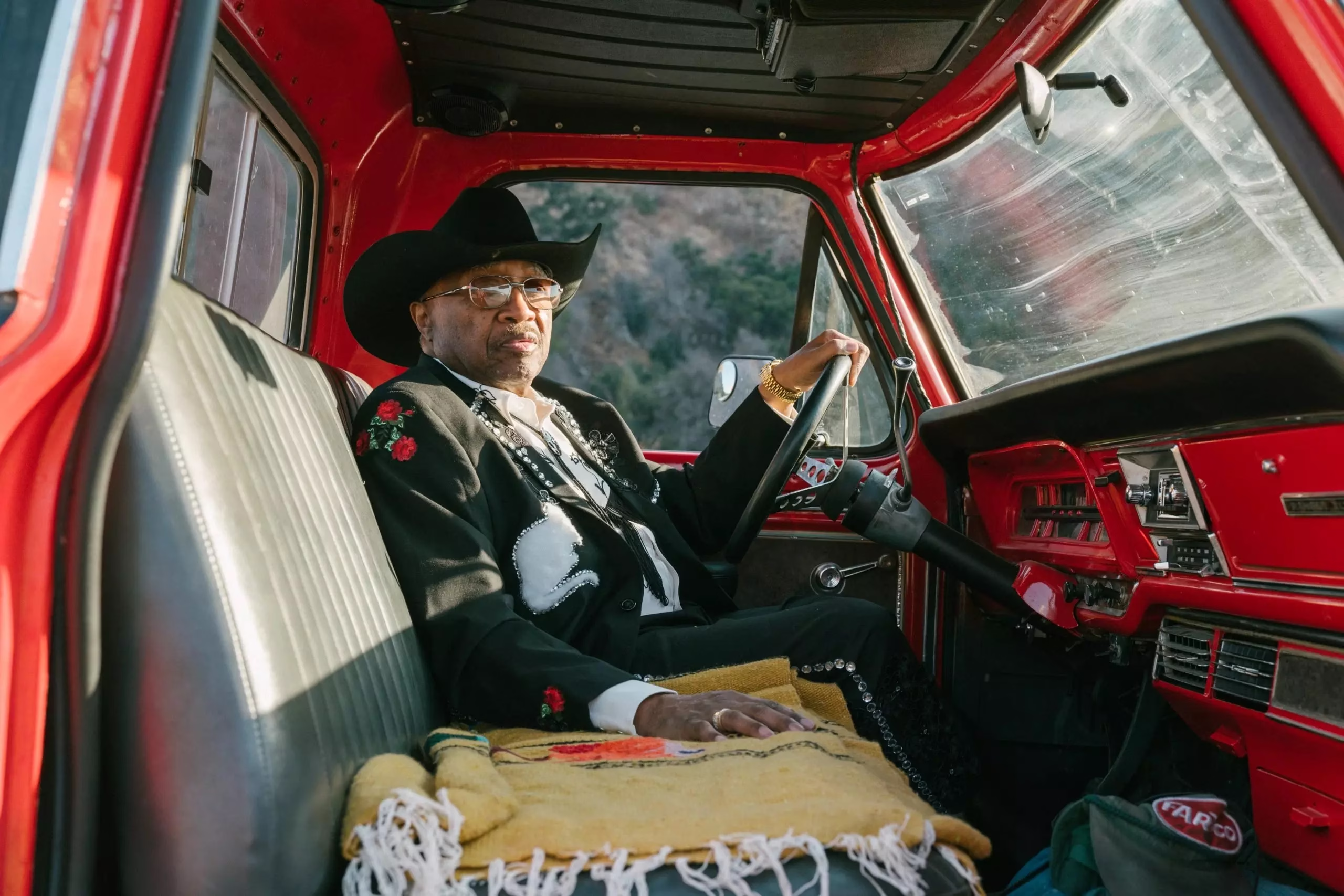
Jerry Williams, the 77-year-old soul legend otherwise known as Swamp Dogg, had a funny thing happen to him a couple of years back when he scored his first Billboard chart hit since 1971 with his 2018 LP Love, Loss and Auto-Tune.
"In fact, the album hit the chart with all kinds of numbers," Williams tells GRAMMY.com. "The greatest one was making the Heatseekers chart, where I came in at No. 7 [not to mention making the R&B chart that year as well, peaking at No. 28]. And I'm 77 years old!"
Yet it wasn't the success of Love, Loss and Auto-Tune that inspired Williams' latest Swamp Dogg classic as much as the hit that preceded it nearly 50 years ago; "She's All I Got," which Williams co-wrote with Gary U.S. Bonds that became a hit not only on the R&B chart for the singer Freddie North, but another version of the song by outlaw legend Johnny Paycheck peaked at No. 2 on the country music charts that year as well. A second country version of the song was also recorded by Conway Twitty in 1972. So when he saw his name back in Billboard, it got him thinking about the reception a hit country tune written by two black men had been received, which he recounts in the liner notes he penned on the back cover of his latest album, Sorry You Couldn't Make It.
"That's the greeting Gary U.S. Bonds and I received when we entered the Ryman Auditorium in Nashville, Tennessee for the Country Music Awards," Williams writes in regards to the album's title. "We were in the top five for a writer's award for the year 1972. My problem was... they never sent us an invitation to the dinner, that they were sorry we missed. I want to feel that we got overlooked because the mailroom people were incompetent, not because we were black. After all, Charley Pride and his wife were there."
But as Williams is quick to remind us, Pride did not get to that dinner table on his own.
"Bakersfield, California, was very, very responsible for pushing Charley Pride through," he tells GRAMMY.com. "Nobody was ready to push a Black country act, and I'm talking country. This sonofabitch talks country in everyday life. You'd think you were talking to a White country boy compared to what he used to sound like. And Buck Owens would take him on gigs with him, so if he's endorsing Charley Pride, they went with him. Had it not been for Buck Owens, I don't know where Charley Pride would be."
However, for Swamp Dogg, his first true taste of experiencing a black man sing country music was Modern Sounds in Country and Western by Ray Charles.
"At least once a year, I pull out my vinyl and listen to his country album," Williams explains. "He was country but it wasn't really country. He was singing those songs the Ray Charles way. Luckily, Ray did one of my songs. He did a version of 'Seems Like I Gotta Do Wrong', which was a big hit for The Whispers."
And following the success of Love, Loss and Auto-Tune, Swamp Dogg aimed to prove those stuffy un-inviters from 1972 wrong by releasing a country album in 2020 that will do just as well if not better than its predecessor. Being in a new music environment that champions such artists as Lil Nas X and RMR bringing a true hip-hop edge to country certainly played a role in the idea as well.
<style>.embed-container { position: relative; padding-bottom: 56.25%; height: 0; overflow: hidden; max-width: 100%; } .embed-container iframe, .embed-container object, .embed-container embed { position: absolute; top: 0; left: 0; width: 100%; height: 100%; }</style><div class='embed-container'><iframe src='https://www.youtube.com/embed//xMFTucgj8K4' frameborder='0' allowfullscreen></iframe></div>
"When rapping got started back in the late '60s with groups like The Last Poets and Watts Prophets, they rapped about what was going on in their lives, in their block, in their neighborhood," he says. "But that was as far as they could go. Now they are rapping about more things than just bitches and hoes; they got some subject matter. And I think its about time these cats came out with some decent product."
Yet for Sorry You Couldn't Make It, Swamp Dogg once again went with the …Auto-Tune tandem of Justin Vernon and Ryan Olson, trusting them to do what was right by the vision Williams had for this record. A difficult task, for sure, especially when you are considering a man who built a career writing songs and producing records for other people giving up creative control to an outside party.
"I let them produce the album, even pick the songs," Williams concedes. "And most of the songs that they picked, like 'Sleeping With You Is A Dragg', I wrote that sonofabitch in 1966! And they picked it out. They came out here and stayed at my house for two days while I was on the road. They went through all my lyrics and pulled out all these songs. When I got to Nashville to see what they had, I said to myself, 'Damn, I got better s**t than this!' But, again, they were producing and I didn't want to take them out of their thing to try and appease me. I hated when I'd produce other acts and the muthaf**kas keep f**kin' with me before I could even show them the results of the first step. I could have done that and I almost did a couple of times. But I just kept my mouth shut and ate another barbecue rib. They wanted to use all their electronics and s**t, and I just let them do what they were gonna do. And I loved what they did, and we're gonna do another one like this again real soon."
<style>.embed-container { position: relative; padding-bottom: 56.25%; height: 0; overflow: hidden; max-width: 100%; } .embed-container iframe, .embed-container object, .embed-container embed { position: absolute; top: 0; left: 0; width: 100%; height: 100%; }</style><div class='embed-container'><iframe src='https://www.youtube.com/embed//xyZzvWyRpSA' frameborder='0' allowfullscreen></iframe></div>
The absolute centerpieces of Sorry You Couldn't Make It, however, are "Memories" and "Please Let Me Go Round Again" featuring his longtime friend John Prine in what would be the folk legend's final recording session before he succumbed to complications from COVID-19 on April 7.
"John was signed to Atlantic when I was working there," Williams recalls. "He had cut his first album with 'Sam Stone' on it and they pressed it up. But they didn't push the record at all. I got a copy and I listened to that song. But I didn't know what I could do with it, but I loved it. I knew in my heart 'Sam Stone' was a great song. So when I turned into Swamp Dogg and got ready to cut my album Cuffed, Collared and Tagged, I wanted to get real serious with this one, because I had been writing about infidelity and all that kinda s**t before. So I did my own version of 'Sam Stone.'"
<style>.embed-container { position: relative; padding-bottom: 56.25%; height: 0; overflow: hidden; max-width: 100%; } .embed-container iframe, .embed-container object, .embed-container embed { position: absolute; top: 0; left: 0; width: 100%; height: 100%; }</style><div class='embed-container'><iframe src='https://www.youtube.com/embed//SY_1uBi7_68' frameborder='0' allowfullscreen></iframe></div>
For Williams, the chance to finally cut a session with his old friend is what makes Sorry You Couldn't Make It such a special album amidst his near-60 years of making music, both for himself and for others.
"I was listening to 'Memories' the other night," he says. "I don't know it just... he and I would talk about things we wanted to do together. And it shook me for a second because, hell, I'm older than John. Then I thought about all the stuff we wanted to get done that will never happen. He wanted me to go to Ireland with him so we could do some writing together. We had a good relationship. John Prine was a friend of mine, and I think about him just about every day."
Play That Again: Colorado Inmates Pour Heart, Hope & Faith Into 'Territorial' LP