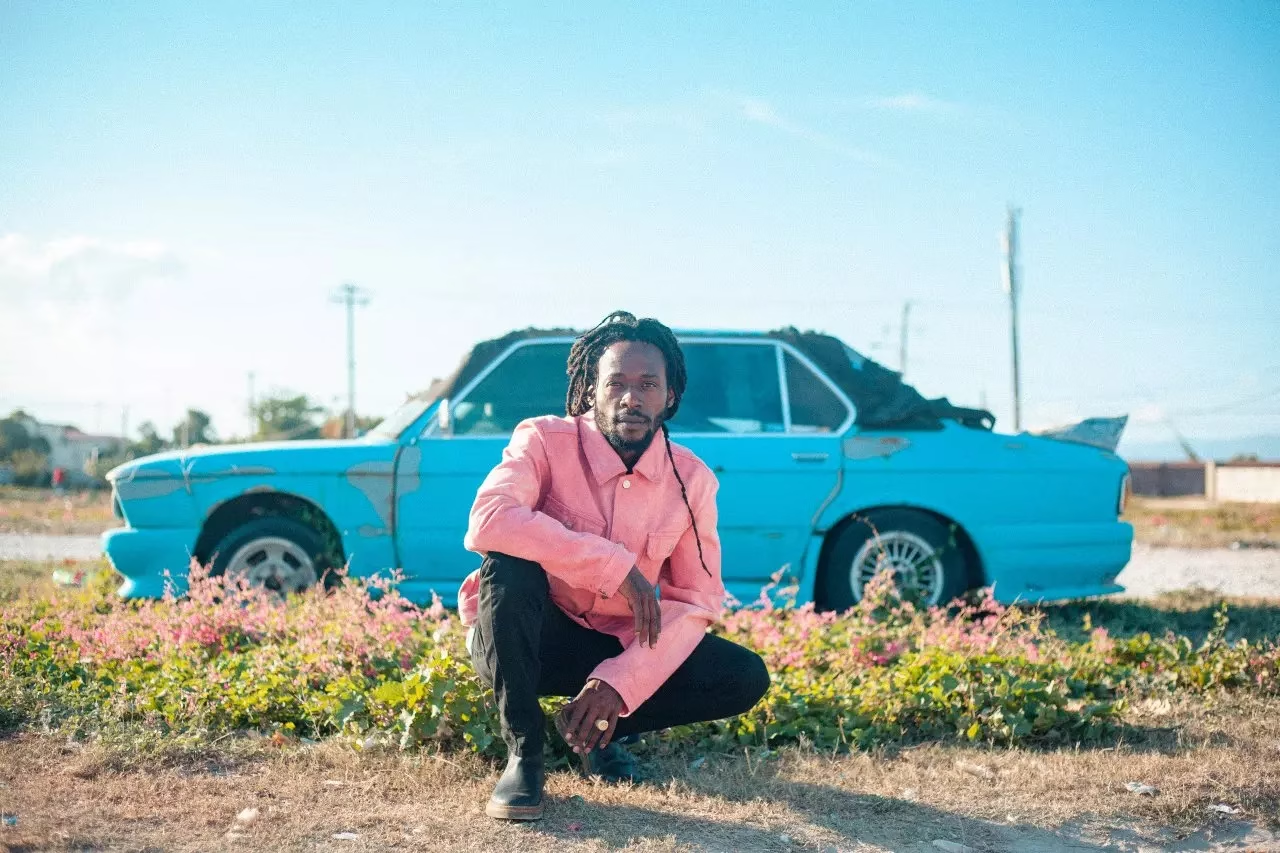
From Bob Marley encouraging the masses to "Get Up, Stand Up" to Peter Tosh exhorting the feds to "Legalize It," it's easy to think of reggae as a genre built to preach social consciousness—full stop. But to treat the genre as an ideological island isn't just unfair to its artists; it underestimates its ability to reflect the whole of the human condition. Take Jesse Royal, who recently took to music to work through the physical distance between himself and his daughter, who lives in Oslo, Norway.
"It's so far from Jamaica," Royal tells GRAMMY.com over Zoom. "During this pandemic, I haven't been able to get her to just be with me in Jamaica. So, it's been two years I haven't seen her. To the world, I'm Jesse Royal. But to her, I'm just daddy."
He addresses the feeling of missing his daughter in his song, "Home": "When daddy's not home and you feel alone/Don't get too lonely, 'cause Jah love surround."
<style>.embed-container { position: relative; padding-bottom: 56.25%; height: 0; overflow: hidden; max-width: 100%; } .embed-container iframe, .embed-container object, .embed-container embed { position: absolute; top: 0; left: 0; width: 100%; height: 100%; }</style><div class='embed-container'><iframe src='https://www.youtube.com/embed//OFvZ6K0SFrc' frameborder='0' allowfullscreen></iframe></div>
"Home" appears midway through the singer/songwriter's new album Royal, which dropped June 11 on Easy Star Records. With highlights like "High Tide or Low," "Rich Forever" and "Strongest Link (Do My Best)," the album makes a clear argument that reggae is an emotional Swiss Army Knife. "Reggae is a different tone, a different feeling, a different mood. It speaks to you in different ways," Royal explained in a press release about the album. "It is definitely royal music."
Speaking of regality: While some reggae may be heard as 4/4 upbeats and some sung obeisance, it's certainly not all that, and such a characterization belies the open-mindedness of its greatest artists. For Royal's part, he loves everyone from Drake to Dua Lipa. "People tend to think we stay in the hills and sit and just make music, but no," Royal contends. "We appreciate other people's perspectives on music."
GRAMMY.com caught up with Jesse Royal to discuss the infinite potential of reggae, his artistic intent behind Royal, and why he continually keeps his ears open to new inspirations.
This interview has been edited and condensed for clarity.
<style>.embed-container { position: relative; padding-bottom: 56.25%; height: 0; overflow: hidden; max-width: 100%; } .embed-container iframe, .embed-container object, .embed-container embed { position: absolute; top: 0; left: 0; width: 100%; height: 100%; }</style><div class='embed-container'><iframe src='https://www.youtube.com/embed//0ziEhk0jnZc' frameborder='0' allowfullscreen></iframe></div>
I love Bob Marley, Peter Tosh, Bunny Wailer, and all the other vanguards of this music. But where does reggae sit right now, artistically? What broader relevance does it maintain in 2021?
Reggae still has its roots. If you look around the world, reggae is literally the only genre whose message is dedicated to truth. If it's about love, it's about strife, it's about war, it's about spirituality, it's about reclaiming certain truths about our identity; that's what our genre is dedicated to. That will always be the root. The expression of it continues to grow. As we get exposed to other songs and other perspectives of music, we definitely incorporate that in our songs.
That's been going on since the beginning of time. I'm sure you've heard Bob Marley's covers. You've heard Alton Ellis cover so many greats. You've heard Ken Boothe cover Bread. "Everything I Own" is a classic in Jamaica that was a cover from Ken Boothe, but is an original song by Bread. "People Get Ready," [by] Curtis Mayfield, all these individuals—Otis Redding—had a heavy influence on Jamaica and Jamaican artists.
Read More: The Impressions' "People Get Ready" At 55
Before we had a real industry with certain radio stations in place, we were literally listening to what was offered. That definitely was part of Jamaica's expression of music. I don't think that has changed. People tend to think we stay in the hills and sit and just make music, but no. We appreciate other people's perspectives on music.
I still respect Bruno Mars as much as I respect Alton Ellis. I like Ziggy Marley, but Drake is also incredibly creative. I like Lila Iké and Protoje, but I also love Dua Lipa. She's incredible! I like to listen to other people and integrate ingredients from all music because I think it makes it more palatable for the broader world.
I feel like reggae is a conversation that needs to be held with all of the youth around the world, so it's our duty as distributors of this gold to ensure it's palatable enough for the youth and they can get it and digest it and it can be impactful in life.
All these artists you mentioned, yourself included, have big ears and big tastes. I remember reading that Bob Marley's Exodus was influenced by British rock.
Yeah, man. British rock and punk rock. Johnny Nash was also a big part of some of Bob's songs. Bob spent some time in England. A lot of Bob's songs were mastered and mixed in England. It's just being open to the world and understanding, as well as appreciating what everyone brings to the table. I like to tell people that it's too bad they closed the Bible because I feel like there are still prophets that are here.
Read More: For The Record: Bob Marley & The Wailers' Exodus
You've laid out many of the ingredients, as it were. So, for Royal, what did you choose for your figurative plate?
The album Royal is just a stripped-down version of me. It's literally my most vulnerable project to date, meaning that we just took experiences and put them in melodies. We took songs we were exposed to and found ways to integrate [them] in our own genre. We were using some melodies that I personally felt good singing, but you can tell there's a side of me I wasn't tapping into enough.
It was good to feel that. To not feel like I was going to the same source for every song. It was good to feel like there were songs that were forcing me to go into a different place. There [are] songs like "Home" that I wrote for my daughters that took me to a place I had never been. I was literally wiping tears listening to the playback in the booth just because of how honest a conversation it was.
<style>.embed-container { position: relative; padding-bottom: 56.25%; height: 0; overflow: hidden; max-width: 100%; } .embed-container iframe, .embed-container object, .embed-container embed { position: absolute; top: 0; left: 0; width: 100%; height: 100%; }</style><div class='embed-container'><iframe src='https://www.youtube.com/embed//bNke38kpxXc' frameborder='0' allowfullscreen></iframe></div>
I feel like when some people think of reggae, they think of messaging about the state of the world. But it sounds like you're more preoccupied with your internal world for this one.
It's [moreso] that we're more palatable and honest with the audience. Reggae has done what it's done and it's our time now to take it a little further. Let me put it this way: The fact that my sister Koffee sang "Toast" and celebrated life in such an honest way, it created such a real impact. I think people appreciate that, too, from reggae. We're giving thanks for blessings, yes, but I feel like we're dealing with some you-know-what.
We still have to be able to communicate with them because I don't care how intelligent or learned you are. For us, that is important, coming from the islands. The assurance that people understand the conversation. It's personal, but it's personal from the point of view that, "Yo, everybody's going through things like this!"
Read More: Popcaan Talks FIXTAPE, Working With Drake And The Globalization Of Dancehall And Reggae
Tell me about working with Protoje and Popcaan.
Popcaan is one of Jamaica's greatest dancehall artists. Very few people around the world don't know who Popcaan is. He's definitely waving the flag for Jamaican dancehall very high. He's also somebody who I consider a brother as well as a mentor, too. I definitely learned a lot from him, and he is humble enough to share experiences with me and a lot of other people.
Proto is my brother from another mother. He's definitely one of the realest individuals I've ever met in life, separate and apart from music. He is a very solid individual who is incredibly creative and caring about the genre as a whole. Protoje is somebody who wants the best for reggae music, not just for himself. It's a duty and a mission.
<style>.embed-container { position: relative; padding-bottom: 56.25%; height: 0; overflow: hidden; max-width: 100%; } .embed-container iframe, .embed-container object, .embed-container embed { position: absolute; top: 0; left: 0; width: 100%; height: 100%; }</style><div class='embed-container'><iframe src='https://www.youtube.com/embed//vf3LQTey_Yo' frameborder='0' allowfullscreen></iframe></div>
What do you hope listeners take away from Royal? What do you hope they learn about you?
What I hope people learn from me as an artist is that it's OK to be tough, but it's also OK to be honest. We have gone through a lot, but we're still here, standing. I say that as a people, not as an individual. There are songs like "Rich Forever" in which we are reminding people of their identity and ensuring they don't see themselves from a lower point, but understand they have a richer heritage than even I can describe.
We've given the world so much. The world has robbed so much—they've taken so much—and there's still so much left in Africa to give. We just be as real as it gets when it comes to the value of what our nation provides to the world. That in itself is one of the things we aim to achieve with this project in terms of reminding youths of our real place, our real position in the world.
Everybody's got to play their part for the team to work. You could have the best strikers on the field, but without a goalkeeper, you're still going to lose. You can have the best power forward and center forward on the court, but if you don't have a point guard to pass them the ball in the right place, things won't work right.
Just like that, in the bigger game of life, I feel like we as a nation have a role to play in the bigger picture of moving forward where the world is concerned. We need to get our s*** together so that we can be as beneficial to the bigger picture as possible.
The Women Essential To Reggae And Dancehall
