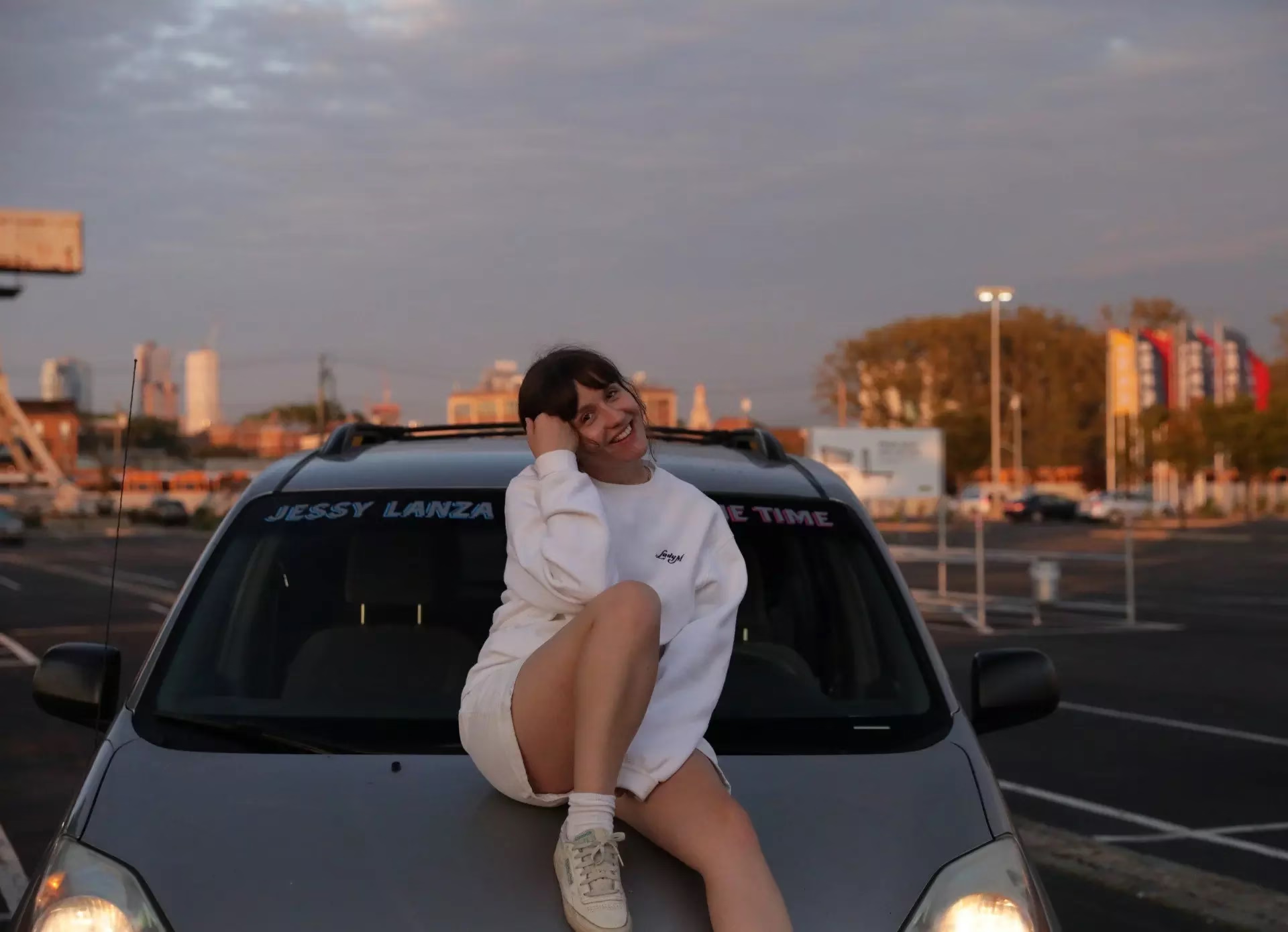
Jessy Lanza is far from home, specifically on the side of the road in Texas at a Jiffy Lube. The last few weeks have been a lot for the singer/songwriter. A cancelled tour, an unexpected relocation from New York to San Francisco with her partner after her landlord refused to extend their lease, and—of course—a global pandemic that colors almost every moment of the conversation.
It’s a lot, as Lanza readily admits. But the singer/songwriter has been trying to stay positive.
Unsurprisingly, music has been a lifelong support system. As a listener, she practices the kind of genre agnosticism that’s landed her the occasional radio DJ gig. But when it comes to her own work, first introduced widely with her 2014 debut album, Pull My Hair Back, the fascination manifests itself in a potent blend of breathy sing-speak and minimal beats, a mix that was further embellished on her sophomore album, Oh No. (The title was chosen to reflect her struggle with anxiety and dread—and yes, it feels prophetic now.)
Lanza's new album All the Time (out on July 24 via Hyperdub), is another upbeat, spartan mix, one that collages together 1990s R&B beats, disco and experimental pop tones. It’s also thoroughly optimistic dance party, the mood she needed to sustain her during a break-up, geographic relocation and learning how to make friends as an adult in a new city.
Ahead of the release of All the Time, Lanza spoke with GRAMMY.com about recovering from burnout, irrational anger, and forging a new creative connection with an old friend.
<style>.embed-container { position: relative; padding-bottom: 56.25%; height: 0; overflow: hidden; max-width: 100%; } .embed-container iframe, .embed-container object, .embed-container embed { position: absolute; top: 0; left: 0; width: 100%; height: 100%; }</style><div class='embed-container'><iframe src='https://www.youtube.com/embed/QrwrjMntR8o' frameborder='0' allowfullscreen></iframe></div>
How do you deal with anxiety when it emerges?
I have been in constant motion since this whole thing escalated. I've had objectives that I've had to achieve. I have been anxious, but it's just I'm kind of getting through every day. It's like, okay, we have to get to Albuquerque tomorrow. It's like, we need to get an oil change. So, I haven't really had time to sit and think about what's going on. I think by the time we get to San Francisco, I'll really have time to be super anxious. But yeah, I don't know. I guess I just try and try and remind myself how lucky I am. That we were able to leave and that I have a minivan that fits all my shit in it. Remembering how lucky I am to have mobility. That helps.
Are you as objective-driven when it comes to making music, or living day-to-day on tour?
I can be a really depressive person and I hate that about myself. So, it really is a challenge. Touring is a challenge for me. I don't want to just get in bed and pull the covers over my head even though I'm really tempted by that. But I think that that's why trying is a scary thing for me. But I think part of the reason I like it is because I do it despite myself and I think that gives me some confidence that I can do it even though it's not so natural.
When you are tempted to stay in bed, does having a schedule or knowing that you have to go make music help?
That's a tough question. Because sometimes I wonder, like, do I need to make music? It's the only thing that I've felt pretty much my entire life that I'm really any good at and the only thing that I've really been compelled to do. That's what drives me to do it. And yeah, sometimes that feels weird. I'm not a heart surgeon. It could be argued that that's the depression talking sometimes.
I feel like Maslow's Hierarchy of Needs, food, shelter, etc., should really have more branches for the nontangible things that feed us. Especially when it comes to something that has nurtured you for as long as it has.
It definitely has. I've come to terms with the fact I'm a real people pleaser. I've always wanted to make my parents happy. I always wanted to make other people feel good. And I think music is one way I know that I can do that. And so, I think that it gives me some sense of purpose in the world.
Well, in that case it sounds like a basic. It's in your pyramid.
Yeah, it's a weird road to go down where it's like, well, then why would you need to do anything?
When did All the Time start to take shape?
I started a long time after Oh No. Like, really right to the end of 2017. I was pretty burnt out by the end of that. 2018 when I knew I didn't have any tours, and I had time to spend at home and set studio [time] the way I wanted to. That's when I really started to write songs for All The Time. It took a long time for that record to get finished, because I was burnt out.
What helped you through that period of feeling burnt out?
I'd moved to New York from Hamilton, [Ontario] at the beginning of 2017. I really had this naive idea that like that leaving Hamilton and having a fresh start and a new relationship, and a new apartment, and a new city, I thought that that would make me feel better than I was feeling, and it didn't. And I think once I started that started to sink in—that the problem isn't the city, it's not the people around you, [but] the problem is me. That was the seed that started the whole album and a lot of the themes the album. I mean, I love living in New York, and I found that all this stuff was still following me around. A lot of the feelings that I thought would go away with a change of environment.
Was there a moment in all this with a song or like something that helped lead the way into this record?
The title track "All The Time" was the first song that Jeremy [Greenspan of Junior Boys], and I started working on. Our relationship was pretty weird at that point in time, because for the past five years had been dating, and we were broken up and we knew we still wanted to work on music. So, we were both navigating that situation and like weren't really sure that it was going to work out. And he sent me this really nice chord progression and drum pattern and he was like, I was working on this, maybe you could write something over it. And so yeah, I wrote the lyrics and the melody for that song "All the Time." And we both really loved it. And that kind of kicked things off. And it was a reassurance that we can still do this and we can still be friends and so have a musical relationship, even though it was it was pretty precarious for a while.
I love the way you rediscovered your shared language.
I think a huge part of our relationship was always working on music together. And so, that has just continued. And I feel really lucky that it has. Because I love working on music with Jeremy and I would have been really sad to have lost that.
What kind of angry emotions informed "Lick in Heaven?"
That song I wrote when I was really, really mad, and that's really about total frustration with other people. The seed of it was when you get to this point of anger and you just you just start seeing red. It's like the point of no return. You know, you can say things and do things that you don't mean or you're gonna regret later and it's like, that kind of detachment from reality. I think it was after I got in this like real banger of a fight with my partner, Winston, and just reflecting on how badly I acted. I was just so embarrassed with the things that I said.
<style>.embed-container { position: relative; padding-bottom: 56.25%; height: 0; overflow: hidden; max-width: 100%; } .embed-container iframe, .embed-container object, .embed-container embed { position: absolute; top: 0; left: 0; width: 100%; height: 100%; }</style><div class='embed-container'><iframe src='https://www.youtube.com/embed/V3D7EEpdlY4' frameborder='0' allowfullscreen></iframe></div>
When you've spent time working, and then sending ideas back to Jeremy and Hamilton, what do you do to help make you feel more connected either to the musical community or to the people around you?
I think DJing has been a really a really big part of me feeling like I'm relating to other people who make music. In New York, I didn't really know anybody when I first moved there and then I started DJing at this place called The Lot Radio. I have a monthly show there. I met people through that. DJing is such a nice way to get music from other people and share music and do edits of people's tracks. It opened up a whole social world for me that I really didn't have in Hamilton, just because that community just doesn't really exist.
Did listening to all this music affect the way you approached the new album?
I was listening to a lot of R&B music from 1980, music that was like 35 years old. I was listening to a lot of Alexander O'Neal and Pointer Sisters. I was taking a lot of time to actually learn the chord progressions. A lot of the songs on the album were started just from me figuring out the chords for a song and then writing my own song. It just turned into a track from there, so yes, I'm spending a lot of time in my studio, just kind of messing around and listening to music.
It seems like you're good at going with the creative flow. Even in trying times.
Yeah, that's something I've really tried to work on. Generally thinking positively. And like, you know, it's likely that something good will happen. It's not always something bad around the corner. Over the past couple years especially—just to try and relax and let things happen. Just think a bit more positively about it, because I'm pretty tired of thinking that everything's just going to go to shit you know? Even though sometimes it doesn't seem all that good. What else is there to do but [say] it's gonna be okay.
Since we started talking about basic needs, what would your superhero power be: flight or in visibility?
Oh, definitely flight. The ability to just get from one place to the next really fast and on your own terms. That'd be pretty awesome. I feel like invisibility would just bring out like the creep in me. Flight, you could still get a little bit of that, but I just feel like invisibility you would learn a lot of things that you probably don't need to know.
<style>.embed-container { position: relative; padding-bottom: 56.25%; height: 0; overflow: hidden; max-width: 100%; } .embed-container iframe, .embed-container object, .embed-container embed { position: absolute; top: 0; left: 0; width: 100%; height: 100%; }</style><div class='embed-container'><iframe src='https://www.youtube.com/embed/flh6HYEObp4' frameborder='0' allowfullscreen></iframe></div>
Wye Oak On Learning To Press Pause, Branching Out & Supporting Black Lives Matter