Even if you never get to Jim Lauderdale's thirty-somethingth album, he hopes you at least look at the cover. It's a serene, gently surreal painting by Maureen Hunter, the widow of Grateful Dead co-lyricist Robert Hunter. To him, even if record shoppers merely see that—with the word "Hope" in block letters above that—at least he'll have made a momentary impression on their hearts.
"We all need that, no matter who we are and what's going on," the songwriter's songwriter, who has won two GRAMMYs and had songs recorded by Elvis Costello, Patty Loveless, Gary Allan and others, tells GRAMMY.com. "This is as bleak as things have been for many of us in life. Some of us have seen worse, and much harder and more terrible times, but for a lot of us, this period has been pretty bad."
For his part, Lauderdale has been hanging in there, practicing tai chi, eating medicinal mushrooms to stay strong, and writing more than he ever has. This state of mind is refracted throughout Hope, which was released July 30 via Yep Roc Records. Its tunes, like "The Opportunity to Help Somebody Through It," "Breathe Real Slow" and "Joyful Noise," go beyond chord progressions and lyrics: They have legitimate therapeutic value.
'Hope' album art. Painting by Maureen Hunter.
And he had one of the most spine-tinglingly primeval lyricists on the case: the Grateful Dead's co-lyricist Robert Hunter, who wrote the words to classics like "Dark Star," "Ripple" and "China Cat Sunflower" before dying in 2019 at 78. He wrote more than a hundred songs with Lauderdale over the years; "Memory," included here," was one of the last.
"I really miss him very much and feel his presence every day and think about him every day," Lauderdale says of his old friend and collaborator. "I think he was the most interesting and intelligent guy I ever met." Read on for more expressions about Hunter, Hope and how Lauderdale keeps his bearings in an era of relentless disasters.
This interview has been edited and condensed for clarity.
Hey, Jim.
Hi! This is Jim Lauderdale. I'm sorry I can't get to your call right now, but please leave your name and number. It's really important to me, everybody. Each and every one of you. I promise I'll get back to you soon. Thanks. Beep! Your mailbox is full and cannot take messages at this time. [Breaks into giggles.]
Nah, I'm kidding. I love to do that to unsuspecting people.
Wow. I'm hundreds of interviews deep, but that's a first. What records are you checking out lately?
You know, there's a group from Louisiana called Feufollet. Really cool zydeco, country, rock—really diverse. My friend C.C. Adcock, who lives in Lafayette, just produced an album by a fellow, a staple down there called Tommy McLain. That's coming out in England, and I believe that Nick Lowe co-wrote a few things with Tommy, and Elvis Costello. They really love him. He's A1. I was really taken with that record.
I was also listening to some Donna the Buffalo stuff. Some Grateful Dead. Listening to some of their catalog always feels good. And a bluegrass group called High Fidelity that's got a new album. They're really, really terrific. You know, there's some good stuff out there.
That's encouraging to hear. Some people of a certain generation say, "There's been no good music since 1971."
Oh no, no. Gosh. There's plenty of stuff. Working on this radio show with Buddy Miller, the Buddy & Jim Show—outlaw country—Buddy keeps me on my toes. We need to make playlists occasionally, so I need to bring him things. Then, I'm discovering new things through him. He has a real encyclopedic musical mind. So, that's always good.
Back in the day—we're on hiatus now—but there was this show that I was working with called Music City Roots in Nashville. Usually, we had four different bands per night. We did that once a week. It's on some PBS TV station and it's a syndicated radio show, too. It's been great to hear new stuff—new artists, or even veteran artists that have new material.
There is no shortage of great music out there, new stuff. Constantly.
And the old guard is still great. People were calling Bob Dylan, Paul McCartney and the Rolling Stones old guys when I was a kid, but they remain potent forces today.
That's so good. I feel like over the last few years, too, I feel like I'm writing more than I ever have, really. At first, during this pandemic, I didn't want to do everything. That did slow me down for several months, but then I started writing again.
Read More: GRAMMY Rewind: Watch Bob Dylan Accept His GRAMMY Lifetime Achievement Award In 1991
What was the catalyst for that?
Well, it was such a depression and this uncertainty of tragedy going on all the time. I think it was when I started thinking in terms of grabbing some songs that didn't seem to fit on a country record I was working on. I was kind of recording whatever came out. Some of these songs weren't country. Then, I wanted to get something out there to help soothe people.
So, that kind of got me back on track writing again, because I realized I had some stuff that really spoke to the time we were going through—some of these non-country songs. Some new things just started coming out then. You know, it's interesting. I feel like a lot of times, I need the structure of a concept—of some kind of album—to get me going. Because that's one of my favorite things to do—to make records.
At the same time, sometimes it can be really daunting because I'll have very little or no material prepared when I go into the studio. As the studio date gets closer and closer, something comes out, either the day before or that morning. It's not always like that, and especially if I co-write with somebody, then that can be more random.
But that helped me start writing again: When I said, "Hey, I want to get something out there to people."
Tell me about your relationship with Robert Hunter. When I think of him, I think of how strong Grateful Dead tunes are at their core, partly thanks to him.
When I first started listening to the Grateful Dead, American Beauty and Workingman's Dead were my entry port for them. I was a junior in high school in North Carolina. There was this thread, musically—because I'd been loving country and rock and bluegrass—and they were so different-sounding, but synthesizing all these different styles in a way I hadn't heard.
And lyrically—of course Dylan had done some amazing things, and had his way—but it was just so different. I felt like Robert Hunter was touching on something that was in the back of my consciousness and subconsciousness. There was something in his descriptions of things I was thinking or feeling but couldn't put into words myself. Just kind of evoking different things I felt.
Some of the lyrics were about death and things like this, that you would hear in older bluegrass songs or folk music or whatnot. But you weren't hearing about those in a rock band. That marriage of Robert's lyrics and Jerry Garcia's [music] and other members of the band he co-wrote with, there was this perfection about it to me.
Let's talk about Hope, which exudes a sense of help, gentility and care. The worst thing about this era, to me, is how we treat each other.
It's funny: When you go to a movie, depending on the type of movie, when you get up out of your seat and you're walking up the aisle, whether you're watching some superhero [movie] or you walk away feeling scared or sad or whatnot—you either feel like you want to have an altered state of consciousness after you hear a song, or you want to party, or you feel angry. All these various things.
I think things have been so horrible that I figured it can't hurt to just have some good songs that make you want to get through. You want to get through these times and you want to help other people get through these times. There's some release, some kind of relief, a little bit, because we all need that.
Not that this record is some kind of a cure-all or anything like that, but I enjoy hearing something that makes me feel good, and I hope that's what this record will do.
Well, you don't even need to qualify it as not being a cure-all. It's a personal expression and artistic offering, not a product.
Yeah, absolutely. It's not an answer or anything like that.
The reason I decided to call it Hope: There's a song on there called "Here's to Hoping." [Perhaps] even if people don't listen to the record—even if they just see this beautiful painting that Robert Hunter's wife, Maureen, did as the cover, and see the word "Hope"—that it will trigger something and release some hope. We all need that, no matter who we are and what's going on.
This is as bleak as things have been for many of us in life. Some of us have seen worse, and much harder and more terrible times, but for a lot of us, this period has been pretty bad.
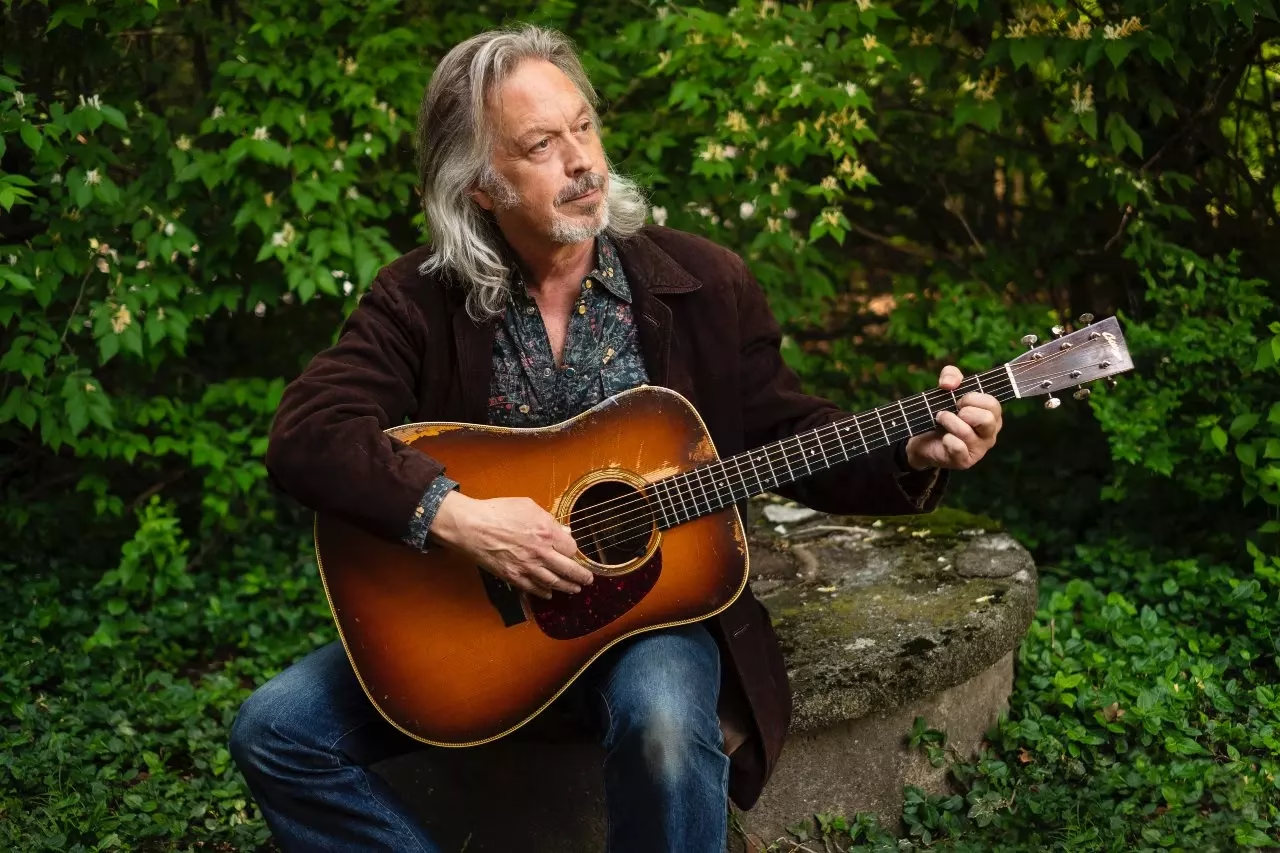
Jim Lauderdale. Photo: Scott Simontacchi
One of the worst parts is this sense of fetishizing the worst possible outcome. Optimism feels like a rebellion these days.
Definitely. It brought out the worst and the best of each one of us, in some way or another, during whatever time you were in—whatever phase of this you were going through. There were many phases for a lot of us. Reading about certain people who survived certain situations that were so dire, what many of the survivors said was, "How I got through was with hope. I didn't give up hope."
Sometimes, that really does seem impossible. Hope almost seems laughable, but we just have to have it. To keep going.
What else can you tell me about the essence of the record?
Let me see. Let me grab it here. [Pauses.] Well, these songs just really seem to fit together with this theme. I co-produced it with Jay Weaver, who's the bass player. He didn't do the last bluegrass album I did, but there were two other studio albums on Yep Roc that he co-produced with me.
We used this kind of crew of guys [that typically work together], with the exception of one or two guys. I just really feel like all these musicians played so great. It's just such a joy to work with them. So, it's nice to have that camaraderie. It's like a band. That was really uplifting for me to do all this stuff with these guys.
To wrap up the thing about Robert Hunter: We started working together, I believe it was in 1996, when I was going to do my first record with Ralph Stanley. That's how it started, and then he came to Nashville for a little while. We just hit it off, writing-wise. I'd go out there sometimes to California. Sometimes, I'd send him melodies or he'd send me lyrics.
I had recorded about six albums of just our collaborations, and then there were various tracks on other solo albums of mine. So, we recorded about 88 things that we wrote. We've written about 100 songs, and some of these haven't been released.
"Memory" was the last thing he heard that we wrote, and so I'm really glad he got to hear it. I really miss him very much and feel his presence every day and think about him every day. He's a big part of my musical life, and he was a wonderful guy. I think he was the most interesting and intelligent guy I ever met.