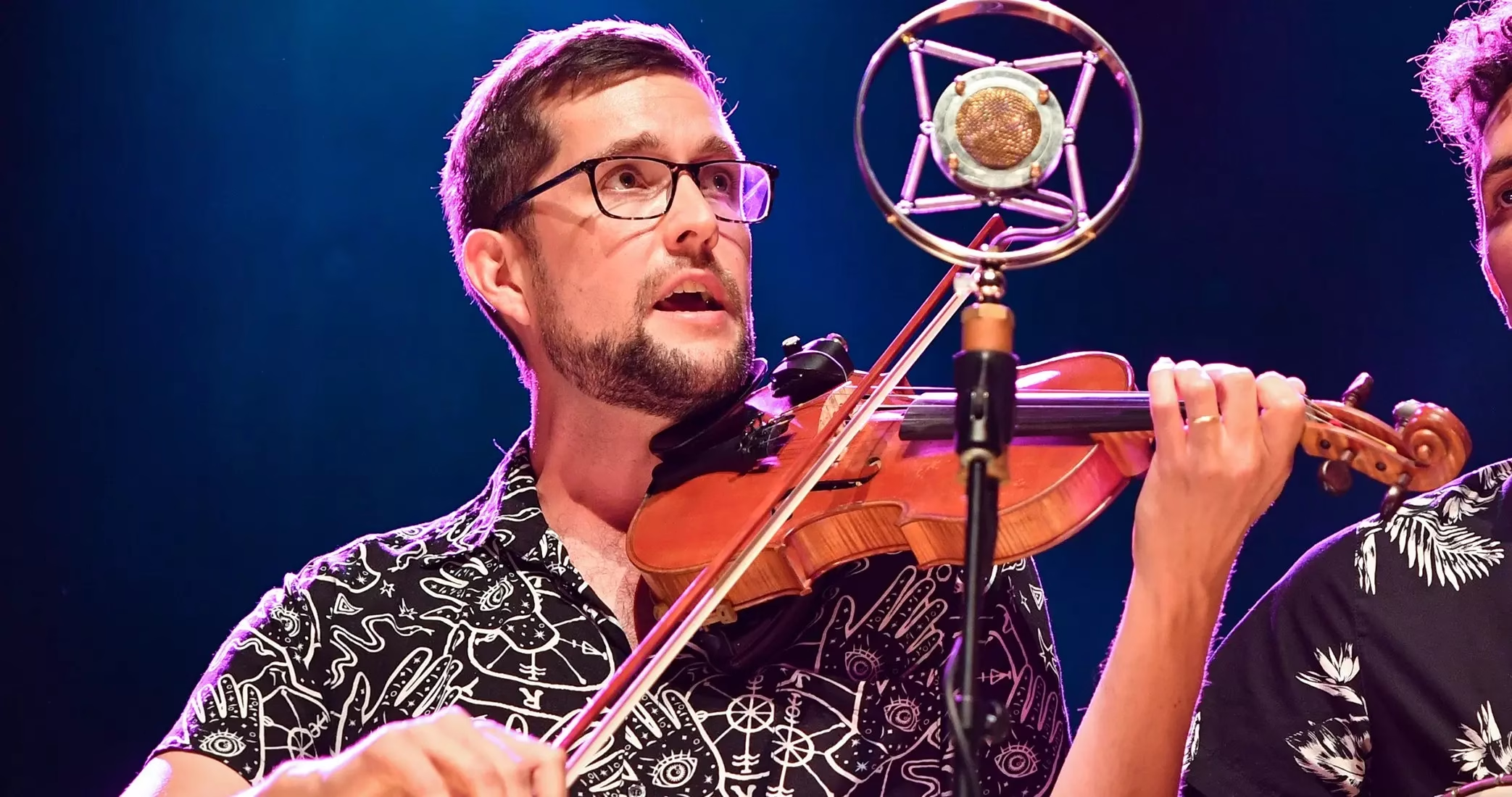
Joe Troop didn't plan on being in North Carolina right now.
For the past decade, the bluegrass artist has lived in Buenos Aires, Argentina, settling in the South American metropolis after years of traveling around the world and finding in his adopted home new audiences and other musicians eager to learn the ways of American traditional music. It's through Troop's work teaching bluegrass and old time music that his ensemble Che Apalache was born: the other three members of the group—banjo player Pau Barjau, guitarist Franco Martino and mandolin player Martin Bobrik—are all former students. With their help, Troop has expanded the bluegrass template to incorporate the rhythms and timbres of music from South America, Asia, and Africa. Their music has earned them famous fans like Béla Fleck, who produced Che Apalache's 2019 album Rearrange My Heart and earned them a GRAMMY nomination for Best Folk Album.
<style>.embed-container { position: relative; padding-bottom: 56.25%; height: 0; overflow: hidden; max-width: 100%; } .embed-container iframe, .embed-container object, .embed-container embed { position: absolute; top: 0; left: 0; width: 100%; height: 100%; }</style><div class='embed-container'><iframe src='https://www.youtube.com/embed//gQOUJ0w9UD4' frameborder='0' allowfullscreen></iframe></div>
But while Troop and his band were touring the U.S. earlier this year, the country quickly shut down as a result of the coronavirus pandemic, leaving Che Apalache somewhat stranded. The rest of the group decamped for their home countries (Argentina and Mexico) and Troop decided to return to the state where he was born and raised—and that he got away from as soon as he was able. Growing up in the foothills of the Appalachian mountains was great for inspiring his love of bluegrass and old time music, but incredibly challenging for a young gay man.
Troop has long since come to terms with what he had to endure in North Carolina and, now that he's going to be there a while, putting his energies into getting voters registered and energized to help flip the state in the upcoming election. (The state has voted for Republican presidential candidates in nine out of the last 10 elections.) As he succinctly puts it: "Given North Carolina's sway in the national elections, our votes can literally save the world this year."
<style>.embed-container { position: relative; padding-bottom: 56.25%; height: 0; overflow: hidden; max-width: 100%; } .embed-container iframe, .embed-container object, .embed-container embed { position: absolute; top: 0; left: 0; width: 100%; height: 100%; }</style><div class='embed-container'><iframe src='https://www.youtube.com/embed//mtGSdIgk1y8' frameborder='0' allowfullscreen></iframe></div>
Key to those efforts is his video series Pickin' For Progress. In each one, Troop sits down to talk or play music with a guest that can speak to what they see as the flawed political structures in North Carolina and put a face and a story behind some of the biggest issues facing the country. In a recent video, Troop spoke with Juana Luz Tabor Ortega, an immigrant from Guatemala who was facing deportation before she was allowed to live in sanctuary in St. Barnabas Episcopal Church in Greensboro. She's been separated from her family for three years and can't legally leave the grounds of the church. While Ortega is using her plight to spotlight the broken immigration policies of the current administration, the effects of this situation are clearly weighing heavy on her. When Troop plays a lovely ballad he wrote with her in mind, she listens with tears in her eyes.
GRAMMY.com caught up with Troop recently to talk about his music, his globetrotting ways, and how he developed his progressive politics, and the origins of Pickin' For Progress.
You've traveled all around the world, but you wound up staying in Argentina. Why did you pick that as your final destination?
I don't even know, honestly. I kind of go where the wind takes me. I met this really cool group of artists and creators and really cosmopolitan people in Spain who were immigrants from Argentina. The economy in that country collapsed in 2001, and there was a mass exodus for people who could afford to get out. I felt like I was brought into manhood in a sense by this really accepting group from Buenos Aires. After globetrotting for a bit and coming back to the United States and being in the hetero-dominant white bluegrass culture, something was not working for me. I took another trip to Spain and my friend said, "You should just move to Buenos Aires. You're going to love it." And I just did. I packed my suitcase, grabbed my banjo and my fiddle, and bought a plane ticket. I stayed for 10 years.
Are you going to head back there whenever the pandemic settles down and traveling is a lot safer?
I don't know. Everything is day by day. I have no expectations of anything. I think the world takes care of me. I feel like a lot of people are taking care of me. Like I woke up this morning and a neighbor left a bunch of vegetables on the porch. I'm lucky, clearly.
Since you've been back in North Carolina, you've been working on this Pickin' For Progress project. What is at stake in the state this election year that made you want to do this big push for voter turnout?
What's at stake is the well-being of a lot of people. There's a level of pervasive ignorance in some parts of this culture that's no different than Alabama in the 1960s. What's happening here is telling of what's happening in rural America. The whole concept of this initiative is to raise awareness of local issues. Things like ICE's involvement in the torture of the immigrant population, the carceral system, the cash bail system. How poor people have been abused by the system. The nature of this work is to show people the extent to which we need reform.
<style>.embed-container { position: relative; padding-bottom: 56.25%; height: 0; overflow: hidden; max-width: 100%; } .embed-container iframe, .embed-container object, .embed-container embed { position: absolute; top: 0; left: 0; width: 100%; height: 100%; }</style><div class='embed-container'><iframe src='https://www.youtube.com/embed//r9lzLv32cTU' frameborder='0' allowfullscreen></iframe></div>
Where did the idea of a video series come from?
I formulated the idea with my friend Matt [Hildreth], who is the executive director of RuralOrganizing.org. Matt and his team helped me mature in my political philosophy. He approached me with the idea of coalition building in North Carolina. We launched an initiative called VoteNC.org with four grassroots political organizations from North Carolina: Equality NC, Down Home NC, Poder NC Action, and Mijente. We built a coalition to get people to vote. And my videos play into that. The whole idea is to convince people that it is important that they vote. There's a lot of disengaged skeptics, especially young people, who really don't think that their vote matters—that don't consider what's on the line for African-Americans, for immigrants, for the regional health care system. There are so many people running for office that, if they knew about them, they'd sing a different song. These videos are trying to raise awareness for what's happening on the ground and for some of the people running for office.
How did you choose the people that you have highlighted in your videos so far?
It's a work in progress. We'll get suggestions from different organizations across North Carolina. The first video is the only one that I did alone. I just want to get things rolling. I thought it was very important to talk about the fact that, honestly, we shouldn't even be here in North Carolina. The whole history of the state begins with the forced removal of Native peoples. My friend Nokosee Fields—his ancestors are Cherokee—so I wanted him to play a song with me and testify. For the second video… Juana Tobar has been in sanctuary for three years at her church. And my band has actually played for her and the church a couple of years ago.
And you have a new video out this week. What can you tell us about that?
We did an interview yesterday with Dreama Caldwell who is running for county commissioner for Alamance County. She has one of the most harrowing stores I've ever heard that I think the whole world should know about. The whole premise of this is to illuminate leaders who have stories that would challenge people. I go back to the whole idea of contextualization. It takes time to understand who people are. You can't just read a paragraph and understand who someone is.
You grew up in rural North Carolina but you came out of that with a heart for progressive politics and causes. How do you account for that?
I'm a progressive because progressive politics are empathetic politics. I actively try to cultivate empathy. Progressive politics are basically putting yourself in someone else's shoes. If you're able to do that, you quickly see that injustice runs rampant. The problem, in the case of North Carolina, is that progressive voices are squashed by fascism. We are scared by the bullies that run our society. Here's an opportunity to put them in check. And I am a homosexual bluegrass musician, so there is something there. Being queer is a blessing. It's the best thing that ever happened to me.
<style>.embed-container { position: relative; padding-bottom: 56.25%; height: 0; overflow: hidden; max-width: 100%; } .embed-container iframe, .embed-container object, .embed-container embed { position: absolute; top: 0; left: 0; width: 100%; height: 100%; }</style><div class='embed-container'><iframe src='https://www.youtube.com/embed//b_uWDcfBKE4' frameborder='0' allowfullscreen></iframe></div>
What has it been like being a queer musician playing bluegrass music? Has that been the source of any friction among older musicians?
Yeah, but I have more to say artistically and am just a better player than a lot of the people who would raise any objections. I put them in their place through art and they shut the f**k up and sit their asses down. I can force them into cognitive dissonance and I watch their little heads explode.
One of the most interesting elements of your work with Che Apalache is how you've blended traditional bluegrass with elements of Latin music and Asian music and other sounds from around the world. Did that come naturally or did that take some work to get those worlds to play nicely together?
It comes naturally because I listen to music from all over the world, and I love it. And so do my bandmates. We all listen to crazy weird s**t from any corner of the world. I don't think that's uncommon. We are globalized millennials. The internet-wielding curious world music permeated young people of the new world. It feels natural.
Watch TRANScendent Sounds Fest 2020 In Full: MJ Rodriguez, Bob The Drag Queen, Monét X Change & More