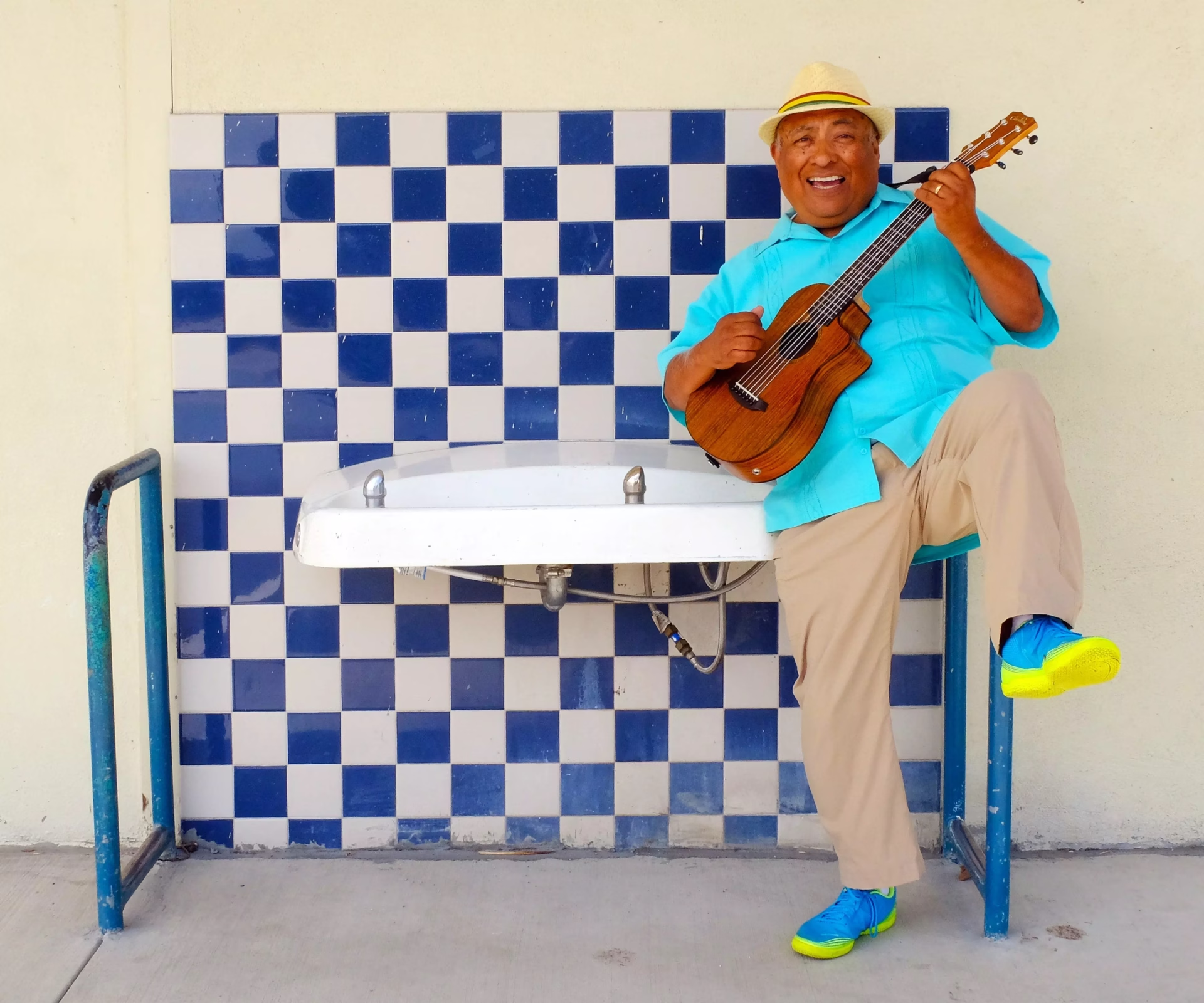
Emanating a jovial energy and infectiously positive outlook, it's hard to believe José-Luis Orozco has been in the music industry for 50 years. The Mexico City-born, Los Angeles-based bilingual musician has been crafting, recording and performing fun, educational children's music since 1970. While promoting multiculturalism and bilingual education for decades, he's been having fun and learning along the way.
<style>.embed-container { position: relative; padding-bottom: 56.25%; height: 0; overflow: hidden; max-width: 100%; } .embed-container iframe, .embed-container object, .embed-container embed { position: absolute; top: 0; left: 0; width: 100%; height: 100%; }</style><div class='embed-container'><iframe src='https://www.youtube.com/embed/HZNS3coMatU' frameborder='0' allowfullscreen></iframe></div>
We also discussed celebrating diversity, the power of the growing Spanish-speaking population in the U.S., and how to keep your kids happy and healthy during the COVID-19 quarantine (hint: his music and videos may help).
Your new album, ¡Muévete!: Songs For A Healthy Mind In A Healthy Body, comes out in a few weeks. Can you talk about your vision with this bilingual album and what you hope its young listeners will get from it?
Yes. Well, this is my last album of many albums, and it's also important to mention that I'm celebrating 50 years of promoting bilingual children's music.
This is a bilingual children's album to promote fitness. The title is Muévete, which means "Let's Move." These are songs for a healthy mind in a healthy body. The vision is to reach all the children—I actually have reached millions of people throughout the last 50 years—and the new parents and the newborn babies. And to celebrate multiculturalism, bilingualism and with this particular recording, to celebrate movement and to keep healthy, especially around these days of the Coronavirus epidemic.
That's awesome and congratulations on 50 years. Not a lot of people do something and do it well for 50 years.
Thank you so much. It's been very rewarding for me. I've touched more than three generations of families. In terms of school children, I would say it's like six generations if we count the children's generations; some of them already are grandparents.
<iframe width="100%" height="450" scrolling="no" frameborder="no" allow="autoplay" src="https://w.soundcloud.com/player/?url=https%3A//api.soundcloud.com/playlists/1009348753&color=%23ff5500&auto_play=false&hide_related=false&show_comments=true&show_user=true&show_reposts=false&show_teaser=true"></iframe>
The lead single for the project, "Arriba Abajo," is really fun—I'd love to hear from you about the story behind this song.
Right. This is a very simple song. When we make songs for children, repetition is very important. It has a lot of repetition, but also invites the children and the parents to move. It is a simple exercise of stretching their hands up high and then touching the ground down low; in Spanish, arriba arriba, abajo abajo. It's mainly that, with repetition of different movements.
So it's very simple, we have to make it simple for the kids; simple and fun. At the same time, they are learning, they're doing it in two languages. The English speakers are learning Spanish, because we have the songs in both languages, and the Spanish speakers are learning English.
You worked with [GRAMMY winner] Quetzal Flores and other L.A. artists on the album—I'd love to learn more about all the collaborators and what it was like working together.
Yes. Well, it is fun. Quetzal is the one that brought together the different talents. La Victoria, who are three girls, if you hear the violin or the guitarrón—the Mexican bass—and the guitar, those are them. Then there is Quetzal's son, Sandino and one of Quetzal's nieces. There are some others that helped with percussion, including Alberto Lopez. And, obviously with me singing and playing the guitar and also Quetzal playing some of the instruments.
Have you worked with them before on other albums? Or, how did you find them to bring on this one?
Well, Quetzal is mainly the source. Everybody knows him, especially in Los Angeles, so he's the one that gets the talent together. Sometimes some of them are in the studio recording and then I come later on and work with the background music that they have already recorded. It's fun.
We also released another album, ¡Come Bien! Eat Right!, to promote nutrition. There also we had some members from Ozomatli and some other well-known groups.
I'm sure it's always fun getting different people together especially for something like this that is just fun music.
Yeah. When we are in the studio it's like a playground. We all have fun, and we all feel good to be all together with great talent. That's good because then we transmit that good energy through the recording, through the sounds and to the children and the families and all the people that get the music.
Definitely. If you're not having fun doing it, something's wrong.
Right. It has to be fun otherwise why do we do it? And we are always learning, but I think we have mastered the things that we do. That's why it's fun. We are always exploring.
Due to the coronavirus crisis a lot of kids are home right now from school. What advice do you have for parents wanting to keep their young ones healthy and happy during these difficult times?
Well, there are so many things. Obviously, they have homework, but music is a friendly and important tool. In my case, I invite teachers, the parents, children to read my books and find my content the internet. I have more than 400 videos on YouTube. Some of the songs from Muévete are already on YouTube, Facebook, Instagram and everywhere. There are a lot of songs for them to move, to dance. Also, reading is very important, and if they are doing it in two languages, or three or four, it's better.
As you mentioned, you've been sharing music and stories with kids for a few decades now, five to be exact. What's the biggest thing that you've learned from the kids that you've met over the years?
Well, the most important thing is that they still remember. The generation from the 1970s, the people I run into, they remember the songs. This is very rewarding. They remember the songs and they tell me that they are passing it on to their children and to their grandchildren. I know now that my work has had impact with communities everywhere. I've gone to Puerto Rico and I hear that also in Hawaii and everywhere in the continental U.S., from Texas to the state of Washington and from New England and all the areas to California and in between, also on the Midwest. It is very rewarding.
Many, many teachers use my music in the classroom. I was traveling from Nevada to Tucson, Arizona and I stopped in the town of Bishop. Just to say hi and to give some information about the CD and my new book "Sing with Me / Canta Conmigo" and everybody was happy to see me. I didn't know and I didn't remember all of them, but we went into a classroom and the teacher said, "You know what? You were in this very same classroom 30 years ago singing for my students." He was very happy and so was I.
Sometimes the teachers have the children watch one of the videos of my songs where they move and everything. And they say to me, "Let's don't say anything. Just walk in and then we are going to turn off the monitor and then we're going to ask him to turn around to see you." It's beautiful. Again, in places faraway like Alaska and Hawaii and in many other places when they have bilingual English/Spanish programs, which are the ones that I visit the most. It is very rewarding. I'm still doing it because I like it, and now we have to do it through the internet too, with YouTube and Facebook and whatever means we have. Also, Smithsonian is doing a great job also with the promotion of this new album.
Yeah, the kids now have iPads and are on YouTube. You want to make sure there's good content for them there.
Right. I'm an educator with a Master's Degree in multicultural education, so I try to do my best to make my work educational, but at the same time entertaining. We have to have a good learning message and the music obviously helps. The content of what we write is very important. It doesn't have to be complicated, the simpler, the better. Repetition is important, and then everybody has fun.
All of the songs on this album are big hits [with the kids], like "Juanito," Little Johnny, "Monica," and especially "Los Pollitos," Baby Chicks. Then I made a short but very fun song called "Palomitas de maíz," which means popcorn. I tell the children, "when I say pop, you jump," which is almost the same sound of palomitas. Then I play around with the rhythm. It is fun.
You've talked about going to schools all over and a lot of them have bilingual programs, but obviously there was a time not long ago in the U.S. where multiculturalism and speaking Spanish in schools was discouraged.
Right.
"So why not help the children from an early age to learn other languages and other cultures so they will respect each other from an early age? Then they will learn it's not good to have divisions because of race or language. The more they learn, the more power they get and the better communities we will have in the future."
From your experience over the years, how have you seen the attitudes towards multiculturalism and bilingual education shift?
These are cycles. With my Master's in Education I have learned about the history of languages in the United States and, let's say, the Southwest. The Spanish language was spoken before English in the Southwest. The English language came later on in the late 18th century and 19th century. Now, with the changing demographics, we have many more languages. As a matter of fact, it's important to mention that there are 50 million people in the United States speaking Spanish, which makes it the second-largest Spanish speaking country in the world, after Mexico. That is something that is a fact.
Then in many places you'll find that it is acceptable and people are learning more and more how beneficial and practical the Spanish language is. Parents want their children in dual-language programs and there are many cases, in many schools, as I travel the country, there are waiting lists for these programs. So it's working, and the rest of it is politics and I don't get involved much in that. I do my job promoting what I been promoting for the past 50 years. I know it is working.
Then the negative cycles [are often for] political reasons but the population keeps on changing, the demographics keep on changing; the 50 million Spanish speakers keep on growing. So why not help the children from an early age to learn other languages and other cultures so they will respect each other from an early age? Then they will learn it's not good to have divisions because of race or language. The more they learn, the more power they get and the better communities we will have in the future.
I agree. To see children, especially first-generation immigrant kids, who are proud of their language and their heritage and not feeling ashamed is so beautiful. I think sometimes in this country, in the past and even the present, that can happen with the support of the adults around them. I think it's so important to celebrate diversity and multiculturalism in a fun and approachable way for kids.
Right. There are some places—this is the economics—where people, laborers in the South and in other places, are being deported. The businesses go down and then the owners of the businesses are crying and saying, "We need those people here because they are good people and it is good for business. It's good for everybody." They are the ones that are outspoken in pushing for dual-language because it's a benefit for their own children, it's a benefit for the economy and it is a benefit for everybody. They say, "Well, if they want bilingual education, let's give it to everybody." Again, with the same idea, to respect each other, to learn from each other and to grow up bilingual because that's the way it's happening.
Spanish is a practical language and Chinese is coming up very fast. I have visited schools with children that are learning in three languages. In Chicago and Los Angeles, they're learning Chinese, English and Spanish and there is nothing wrong with that. The thing that is wrong is with the people that don't know that works. The more the better. The more knowledge, the more power. With music, we can do it, music is friendly. Let's sing in different languages and let's have fun learning basic skills with the little ones—colors, numbers, greetings, body parts and everything else.
What do you believe still needs to be done in terms of celebrating diversity in the United States?
Well, it's important to let people celebrate it, and in many places they do. In North Carolina, in Georgia, where they have big international festivals to celebrate multiculturalism. The same thing in many communities on the West Coast, from Seattle to Portland, Los Angeles, San Francisco, Sacramento and many other places. In San Antonio, they are already celebrating it. It is just that we have to be consistent, especially in the schools. Then it's just a matter of continuing with the academics and that will make our country, and the world, a happy one.
José-Luis Orozco in the classroom
With everything going on in the world right now, what gives you the most hope?
I think there is hope with the new generations. Again, we have to do our job teaching the kids about friendship, respect, diversity and that no one is above anybody else. We all should respect each other. Then ones that are learning it now, that are living it now, that are practicing it now, the children and parents, that's the base for the better future for everybody. That is what is important. It's important to promote the diversity, the languages and all the fun that we can have by learning from each other and singing. Keep on singing and keep on dancing.
Please get my music, you can learn the songs in English and in Spanish. With Muévete, you can do the exercises and then you can get an intro into the rest of my work and my books. My newest book is "Sing With Me, Canta Conmigo," published by Scholastic. As I said, I have more than 400 videos on YouTube, and I will be putting many more up. Right now, I cannot visit the schools or the libraries, so I will be posting more videos online. Again, the Smithsonian is doing a great job right now. They are posting new videos and their work is to promote diversity in all the channels they have and out in the world everywhere.
Hopefully we'll get a GRAMMY with this one. The last album was nominated for a GRAMMY and this time hopefully we will get it.
I always say you got to put what you want out there in the universe.
Right. This is great honor. I'm a member of the Recording Academy; I've been a member since I started my record label Arcoiris in the '80s. I will keep doing my work as long as I keep healthy. So it's great.
Do you have more time? I can sing a song, or two or three or four or five or six.
Yeah, let's do one. [We sang "Monica"!]