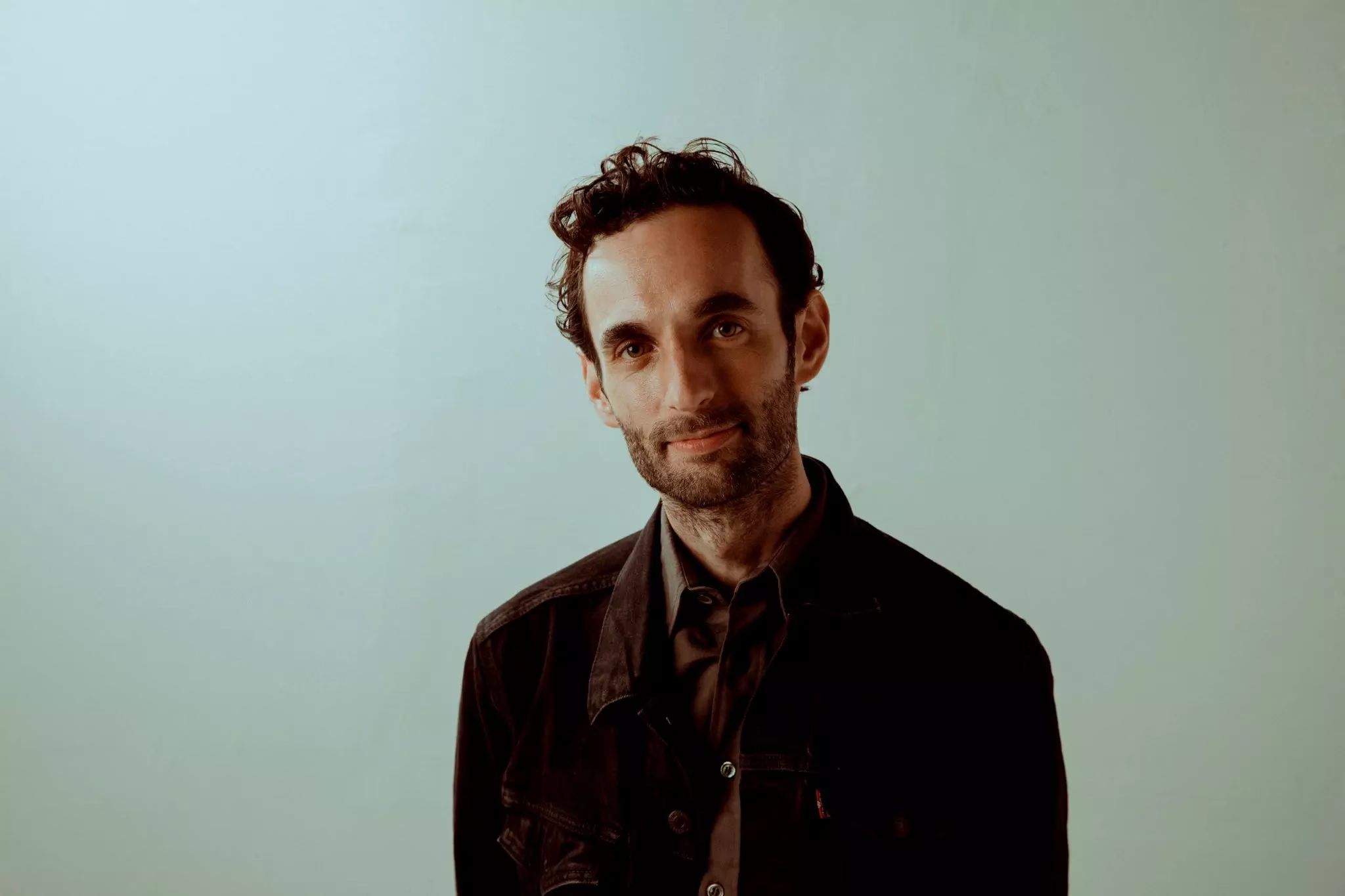
Ever hear of the "iceberg" theory of success? As writer Thomas Oppong puts it, it’s the notion that people only “see the end goal, the glory, the monumental win.” Julian Lage's performance of "I'll Be Seeing You" at the defunct L.A. club the Blue Whale is a perfect example of the metaphor.
In the clip—which, at press time, has garnered more than two million views—the then-28-year-old Lage plays the jazz standard with utter panache. Watch him observe a momentary interchange between bassist Scott Colley and drummer Kenny Wollesen, silently ponder for a moment like a contractor studying a foundation, then apply just the right swinging, melodic information. Ergo: The performance is the tip, jutting out of the water, obscuring a submerged mass.
Lage didn't pop up like this fully-formed; he simply worked harder than almost anybody else. This involved honing his natural voice in his discipline. Recently, he watched a video of himself playing as a child: "I sounded better then," the virtuoso tells GRAMMY.com over Zoom with a grin. "Because I didn't question it. There were a lot of years of questioning it and wondering about it. But essentially, it's the same kid."
<style>.embed-container { position: relative; padding-bottom: 56.25%; height: 0; overflow: hidden; max-width: 100%; } .embed-container iframe, .embed-container object, .embed-container embed { position: absolute; top: 0; left: 0; width: 100%; height: 100%; }</style><div class='embed-container'><iframe src='https://www.youtube.com/embed//-MI7oBlIGEU' frameborder='0' allowfullscreen></iframe></div>
While Lage has been around for many years, in some ways, he's just getting started. That's because Squint, his debut album on Blue Note, releases June 11. Being on their roster puts Lage among some of the greats of all time: John Coltrane, Grant Green, Joe Henderson, scores more—and this development may just be charting a course for the rest of the 33-year-old guitarist’s career.
Co-produced by Margaret Glaspy and Armand Hirsch, the album features bassist Jorge Roeder and drummer Dave King, running through a set of Lage originals like "Boo's Blues," "Familiar Flower" and "Short Form."
Throughout the Zoom call, Lage is kind, mild-tempered and communicative, asking as many questions as answering them. His demeanor says a little something about his dialogue with his trio on Squint: He listens as much as speaks.
GRAMMY.com caught up with the guitarist to discuss the aesthetic of Squint, his relationship with Blue Note's legacy and why everyone has a creative voice—even if they think they don't.
<style>.embed-container { position: relative; padding-bottom: 56.25%; height: 0; overflow: hidden; max-width: 100%; } .embed-container iframe, .embed-container object, .embed-container embed { position: absolute; top: 0; left: 0; width: 100%; height: 100%; }</style><div class='embed-container'><iframe src='https://www.youtube.com/embed//bFRVK_1o2cU' frameborder='0' allowfullscreen></iframe></div>
This interview has been edited and condensed for clarity.
What's your relationship with the Blue Note catalog, and how did you perforate their sphere?
The most obvious thing is as a fan, as a jazz musician, Blue Note is the mecca of recorded music. All the greatest records come from Blue Note. Since I was a child, that's been the guiding light. McCoy Tyner, Joe Henderson, Grant Green, Eric Dolphy, Bobby Hutcherson, [John] Coltrane—all these artists are synonymous with what I think is the Blue Note tradition.
That's the legacy of Blue Note, but at the same time, they've been such a supporter of new artists for such a long time. Those artists, in their day, were new as well. So I think there's always a sense that as a jazz musician, it would be a dream to be on Blue Note because they cultivate musicians, support innovation and understand jazz as an artform—the social constructs that exist within jazz and the fact [that] it is [an] abstract art.
It's helpful to treat it as such. Not as failed popular music … I know [Blue Note president] Don [Was] is one of the greatest cats around … As I was looking around for a new label partner, it was just an organic fit [.]
I think Don is an excellent steward of the label. His ability to identify and fix problems and music-first attitude are to be commended. What have your interactions with him been like?
They've been wonderful. Don's a friend of mine. I used to teach his son at Stanford Jazz Workshop. As I said, he's a fellow musician, so there's mutual respect. Just kindness. He's only been supportive. When I was making this record, I sent him demos and [asked], "What do you think about this?" He said, "This sounds great, keep going!" or "You can do less of that," or "More of this." He's just present. He's really present. And I think that brings out the best in everyone around him.
When it came time to record Squint, how did you arrive at this particular aesthetic—a trio album, featuring these songs, with this specific production style?
I've been playing with this trio now for a couple of years, so it wasn't so much arriving at it. It was understood that this is my project, this is a thing I've done for a couple of records and we would feature it on Blue Note. It wasn't a diversion. That was already in play.
<style>.embed-container { position: relative; padding-bottom: 56.25%; height: 0; overflow: hidden; max-width: 100%; } .embed-container iframe, .embed-container object, .embed-container embed { position: absolute; top: 0; left: 0; width: 100%; height: 100%; }</style><div class='embed-container'><iframe src='https://www.youtube.com/embed//Jx_CuxesjmU' frameborder='0' allowfullscreen></iframe></div>
You hit the scene young. Was it challenging to be public-facing as a kid?
No, I grew up in a different era. Nowadays, there's more potential for exploitation, just being everywhere, being on video, being on social media. I [grew] up in the mid-to-late '90s and early 2000s, so I just practiced a lot of guitar. When I would do things that were public-facing, they were usually very professional.
There was no middle ground. I was home practicing the guitar or I was on the GRAMMYs, or I was home practicing guitar or I was with Gary Burton's band traveling. It made it very clear. It was always very professional. There wasn't this constant [sense] of being on display and self-reflecting. That was my choice, too. I think if you wanted that, you could do it.
But to be a young person today with YouTube and Instagram, there are a lot of pressures I never felt. I just felt I had a head-start, in a way: "When I grew up, I wanted to do this, so I'd better work hard now on it so someday I can maybe do this." I have empathy for any young person today and their parents because it must be weird to navigate the seduction of it.
Like the lure of wanting to court more followers?
Sure. Even the concept of cultivating fans never would have occurred to me for the first 15 years of my life. You're a practitioner. You're just trying to do the work.
It's funny: I have some students. To me, they're students. They're young, but in their world, they're like Instagram-influencer kinds of people. It's interesting hearing them talk about the pressures. It's very aggressive. It's a popularity thing. I don't envy needing to keep that going, but I do think it's seductive. It's gratifying; it's cool. Why wouldn't you? I get it. I just wasn't around that energy growing up, so I can't relate to it.
How did you develop your own "voice" on your instrument? Most of us start out copying other guitarists.
I never was that good at that. I couldn't sound like the people I wanted to. I struggled with it. I learned solos, but it didn't catch. I know players who do. They have that power of metabolizing music and being like, "Here it is again!" I just never was that good at it. I'm still not.
I come from a certain tradition of thinking about it, which presupposes that everyone has their own musical voice the same way they would their own speaking voice. A lot of the attention that's required is really about just contextualizing parts of your voice that you feel are worthwhile.
I think what that means for me over the years is, "What does it look like when it's super virtuosity-forward? Do I like that contextualization? Do I like it more when the contents I write are to support the lyricism or melodicism?" I think, whether I like it or not, there's a voice there. It's not for me to like or dislike, but I do have the ability to frame it in a way that feels sincere.
Recently, I saw a video of myself playing when I was a kid. I sounded exactly the same. I sounded better then, in many respects, because I didn't question it. There were a lot of years of questioning it and wondering about it. But essentially, it's the same kid. That's how I hear it.
<style>.embed-container { position: relative; padding-bottom: 56.25%; height: 0; overflow: hidden; max-width: 100%; } .embed-container iframe, .embed-container object, .embed-container embed { position: absolute; top: 0; left: 0; width: 100%; height: 100%; }</style><div class='embed-container'><iframe src='https://www.youtube.com/embed//v21st5PcUOU' frameborder='0' allowfullscreen></iframe></div>
From the guitar tradition, which wells did you draw from while making Squint?
It's a lot of swing-based music. A lot of this record is a study of, frankly, medium swing. 4/4 music. It's more centered on that time feel and that cadence. So, if you have something like "Boo's Blues" or "Squint" or "Familiar Flower" or "Short Form," they're all kind of orbiting the same DNA, feel-wise.
The interaction with it, on one song, might be more learning toward Lennie Tristano's tradition of feeling the swing pulse. I think something like "Squint," is more in that tradition. Then, you have something like "Familiar Flower," which is more of an ode to Old and New Dreams—the way Ed Blackwell and Charlie Haden would have felt time. And Dewey [Redman] and Don Cherry.
It's not about locking together. It's kind of like everyone has their own place, own tempo, own variation, and it just kind of goes and builds this beautiful tension. Then, you have "Boo's Blues," which is far more aligned with the Art Taylor, Billy Higgins tradition coming out of Dexter Gordon. That's a different thing. Also in the Blue Note tradition. That's a major musical context: Looking at the same feel from different perspectives.
Bill Frisell On His New Trio Album, Missing Hal Willner & How COVID-19 Robbed Jazz Of Its Rapport