
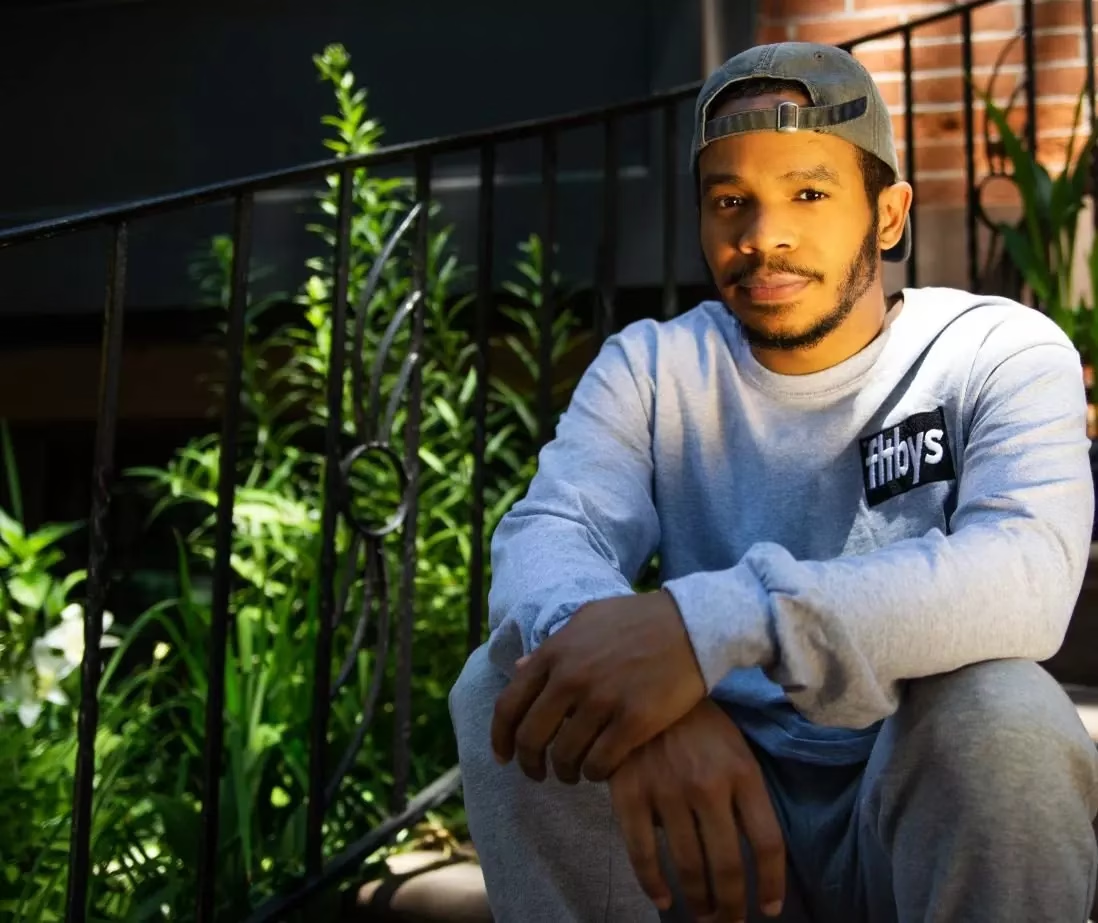
Kota The Friend's latest project, Lyrics to GO, Vol. 2, which dropped Jan. 18, is a snapshot in time. "It's like one stream of consciousness, not necessarily a full song, just an idea," the Brooklyn MC tells GRAMMY.com over Zoom. "Just to show people where I'm at mentally."
Kota has gained attention for laid-back raps and chill beats on 2018's Anything., 2019's FOTO, 2020's EVERYTHING, and his Lyrics to GO series. To him, connecting with others is vital and, if he has it his way, lyrics are the way people relate to him. "A lot of people have told me that my music helps them deal with their situations," he says. "So I focus on my lyrical content."
An independent artist, he's captured ears on SoundCloud and major streaming platforms like Spotify without a major label to back him up. So when it comes to success, Kota looks at the bigger picture. "It's about longevity," he says. "You don't necessarily think about a hit, or putting out a hit record … every time we put out something, and we just want to do a little bit better."
He may not be the first indie artist to want to make it without a label, but he intentionally uplifts Black artists along the way. "The music business has a long history of exploiting Black talent," he says. "I'm not shy about saying, "Yeah, I'm Black, and I'm independent, and you can do it too."
The rapper spoke with GRAMMY.com about his most useful tools as an independent artist, how he's paving the way for other Black artists, and his new music.
<style>.embed-container { position: relative; padding-bottom: 56.25%; height: 0; overflow: hidden; max-width: 100%; } .embed-container iframe, .embed-container object, .embed-container embed { position: absolute; top: 0; left: 0; width: 100%; height: 100%; }</style><div class='embed-container'><iframe src='https://www.youtube.com/embed//rbSRi024Kyk' frameborder='0' allowfullscreen></iframe></div>
This interview has been edited and condensed for clarity.
What's your first memory of music?
People in my family say that I had a really strong connection to a Mary J. Blige song, "I'm Going Down." They say I used to walk around the house singing the song all the time.
Was it played a lot when you were growing up?
I don't know. I think I just connected to it. And I think my cousin used to play it a lot. And I just memorized the song, and I would just walk around singing it.
Good taste. What's the story behind your name?
When I was trying to come up with my name, I just wanted a simple name that sounded down-to-earth. I had watched that movie called Brother Bear, and the little bear's name was Kota. I was like, "I like that name." So I looked up the name, I looked at what it meant, and it was a Native American name meaning "friend." And so I put those two things together.
You recently released Lyrics to GO, Vol. 2. What inspired this album?
It's not really an album. Lyrics to GO is a series of one-and-a-half-minute tracks. It's like one stream of consciousness—not necessarily full songs, just ideas. Ideas that I want to present in a short period and messages that I want to get across in these one-and-a-half-minute periods, but I just decided to package them up into ten tracks each.
We put out Lyrics to GO, Vol. 1 last year, and every year, I want to put out a Lyrics to GO volume and just to show people where I'm at, mentally.
Why is that important for you—to let people know where you're at?
I think it sets the tone for whatever I'm about to release. I think it kind of fills in the gaps between each story. If every album is a story, I'll say Lyrics to GO really helps you. It helps you transition into the next part of the story.
<style>.embed-container { position: relative; padding-bottom: 56.25%; height: 0; overflow: hidden; max-width: 100%; } .embed-container iframe, .embed-container object, .embed-container embed { position: absolute; top: 0; left: 0; width: 100%; height: 100%; }</style><div class='embed-container'><iframe src='https://www.youtube.com/embed//2p0CbgyM-W0' frameborder='0' allowfullscreen></iframe></div>
You're releasing a track that features Lupita Nyong'o, right?
Yeah.
Tell me more about that track and why you decided to feature her words.
Well, I look up to Lupita. I enjoy what she creates on the screen, and her roles and everything. It's the same with LaKeith Stanfield. To me, those are two of the most influential Black artists and actors out there.
And so I felt like when I was making the album, I was asking people, "What does everything mean to you?" I felt like their voices would connect with so many people because they naturally inspire so many people.
You were on the official Biden-Harris playlist. What does it mean for you to appear on such a big list as a rising artist?
It's a big opportunity. It was super unexpected for me. And to be featured on it put a lot of different eyes on me that weren't necessarily looking at me before, like a couple of days after that playlist came out, I had a Wikipedia page. So I feel like as time progresses, I'll continue to learn what that did for me.
And you're an independent artist, so it's a huge deal that you're getting attention through various ways. How do you think being independent has shaped your success?
I think it has allowed us to carve out our path. I feel like our path is just very special. It's so unconventional how everything is going. The steps that we took aren't like the steps that everybody is taking in. So I think it gives us free rein to be ourselves and be free and learn as we go and get better in it.
Because this happened so slow, it's more of a slow burn. It's long-term. I think me and my whole team look at it like it's a long-term thing. It's about longevity. And so that's what we focus on. We don't necessarily think about putting out a hit record. We don't look at one project as like, "Oh, this is what's going to take us to the top." No, it's like we just want to do a little bit better every time we put out something.
And if we do a lot better, with a project we put out is great, but overall, it's just about continuing to put out great content—great art—and moving forward.
Are there any tools that you use as an independent artist?
There's a Spotify artist tool that allows you to submit your new release, get it put on a playlist, and things like that. That's been useful for us. Any tool that we can monitor our growth and see like, "Oh, on this day we got a lot of streams, on that day we got way more streams" —we're able to kind of understand what's helping us grow.
Any tool that we can use to monitor that growth is necessary as an independent artist, and I think the more you can monitor your growth, the better you'll be.
For an artist following the traditional route with a label, one of their first significant milestones or achievements may be getting that label contract. As an independent artist, how do you measure your success?
The more listeners I get, the more I feel like I'm succeeding, and I'm pushing it forward. Last year, we hit a million monthly listeners on Spotify, and this year we're almost at... well, we've surpassed 2.8 million.
I hope we'll get to like five, six million monthly listeners in 2021. For me, I just measure really how many people are listening and how many people are getting on the chain and becoming part of this tribe.
How do you wish to connect to your audience? Do you focus more on your lyrical content or sound?
Lyrical content. I think that's the most important thing for me. Many people have told me that my music helps them deal with their situations and get out of them. And understand certain things that they need to do to get out of bad situations. It's very real to them. And so, I focus on my lyrical content.
I'm very careful about what I say. I understand that you can manifest things positively or negatively through your words, so I pay very close attention to what I say. I feel like no matter what the music sounds like—the beats and [instrumentation]—what's most important is the things I'm talking about and the messages I'm trying to convey.
Do you feel like you're creating a space to celebrate Black music and Black artists through your journey? If so, how?
Yeah. In pretty much every album that I've ever made, I highlight what it's like to be a Black artist and just a Black person in America. In my journey as an independent Black creator, I've never been shy about expressing how good it feels to be Black and independent.
The music business has a long history of exploiting Black talent. I'm not shy about saying, "Yeah. I'm Black, and I'm independent, and you can do it too." We can all do it. None of us have to be pushed around by an industry or company, or anybody. We can all be free.
I've never been shy about showing people the blueprint of how I do it—the things that I do and the tools that I use. I'm completely transparent with my friends in music. I've shown people how I do it, and I've seen people use it and gain success.
<style>.embed-container { position: relative; padding-bottom: 56.25%; height: 0; overflow: hidden; max-width: 100%; } .embed-container iframe, .embed-container object, .embed-container embed { position: absolute; top: 0; left: 0; width: 100%; height: 100%; }</style><div class='embed-container'><iframe src='https://www.youtube.com/embed//i_kjSJsqjKk' frameborder='0' allowfullscreen></iframe></div>
How can aspiring artists follow you on your journey? Is it through social media?
It's really through social media. If I'm not posting a video or a piece of content on social media, I'm making the content. I don't do much else. Maybe I should have somebody working on a newsletter or something like that, but I'm more focused on organic word of mouth. We just built up an email list, so maybe that's next.
Are you concerned at all with what the industry should do for Black artists? Or are you more focused on showing people what you're doing as an independent artist?
Whenever you talk about the industry, I feel like it's just something going on for so long—Way longer than I've been a person. Understanding and battling that machine is tough when you don't have the proper tools and knowledge of that history.
But I think I'm a rebel in that I fight against it in my way, and I try to show the people around me what I'm doing. How I'm kind of like saying no to what it is and how I think it could be better. I feel like it could be better, but there's so much to it.
I feel like it gets complicated, and it's hard to understand. But I think with knowledge and a better understanding, the more we move forward with it, the more we'll learn how to better get to people and explain why certain things are wrong. If you do certain things, you could break free from that and grow beyond a record label.
You're from Brooklyn, and you're a part of this long history. There are so many rappers that have come before you. How do you feel like your work is adding to hip-hop's history?
I feel like growing up there, I listened to Nas, and Jay-Z, and Biggie— they're all great New York artists, like Biggie grew up, blocks away from where I live, Jay-Z grew up, blocks away to the left, Nas, I could take the train to where he grew up. When they were speaking their music, we knew.
I could connect with the things they're saying. And they created me as an artist. Without them, there would be no me. I got my cadences, and my flows, and my musical ideas from them. And I think I use those ideas to express what the city is like in these times and what's going on around me in these times.
Because it's not the '90s anymore; It's not the '80s anymore. But I think I expressed what it's like growing up as a kid in Brooklyn. I didn't have the toughest upbringing; you know what I mean? But I experienced a lot, and I have a unique experience. And I carry the torch just by being genuine, being authentically myself, and telling my story and talking about pretty much a city from my perspective.
I think it adds a perspective. People that grew up as I did can see it and be like, "Yo, I relate to what he's saying. And it's real. It's not fake."
"Luke Cage," from your latest mixtape, really caught my attention. There's a line where you rap, "I'm trying to save my city like Luke Cage." What do you mean by that line?
I feel like New York music is the stuff that the radio and things [like that] highlight. And the world looks at New York music like one thing: What you hear on the radio and what's popping.
But there's so much more to New York music. I'm a representation of what that is. It's bigger than what you have on Hot 97, and it's bigger than what you have on New York's Power 105.1 and what people are deciding to distribute to the masses.
I think that there are so many artists in New York that don't get the love because they're not making drill rap right now. And I'm just saying that I'm here to show you that there's more to New York.
You're starting the process of becoming a part of the Recording Academy. What do you want to get out of that?
Growing up, we always watched the GRAMMYs. It was a big thing to see who's going to win this and was going to win Best New Artist, and so I think for me, it's nostalgic for me to be, if I could ever be grand and nominated for a GRAMMY or win a GRAMMY, it's a moment for my family. It's a moment for my cousins and me and my team.
I think it's less about me. It's less about becoming and being the best and more about me sharing this moment with the people I love, with the people that come from, where I come from.
Last year, the Recording Academy launched the Black Music Collective. What do you think about institutions like the Recording Academy launching something to bring attention to black music specifically?
I think that's important. I think it needs that because I think there was a time when rappers would boycott the GRAMMYs. So, MYs to come that far and admit that we need to bring more attention to Black music, I think that's a big win. It's necessary.
