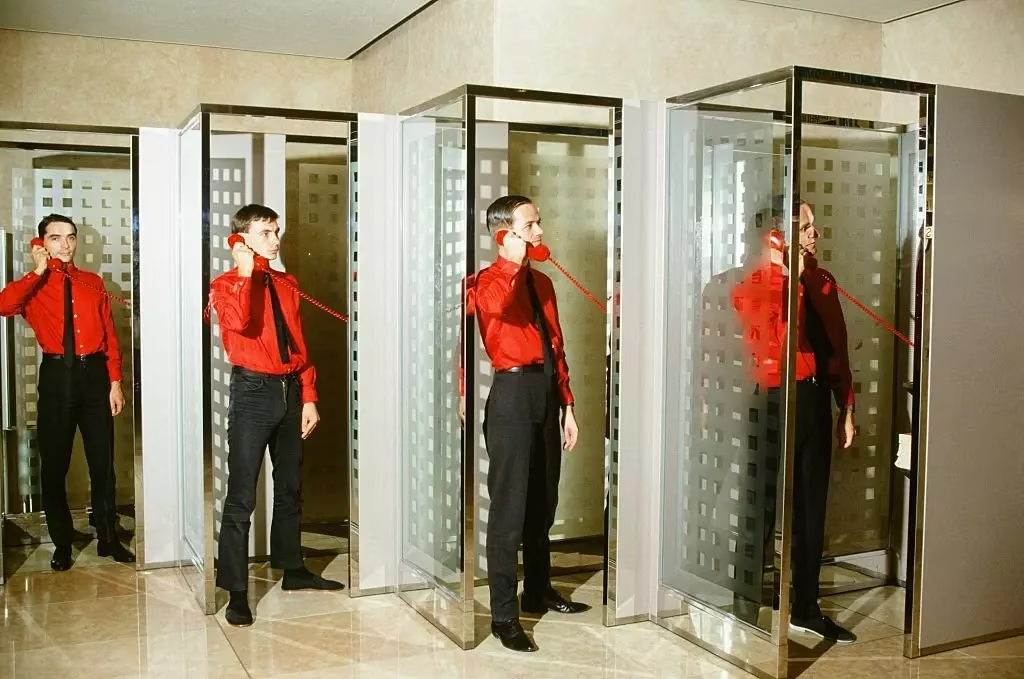
Quick, rattle off music’s worst, most obvious clichés: country music is exclusively about trucks, the Beach Boys only sang about waves, Yoko Ono broke up the Beatles. Then, add Kraftwerk, and their late founding synthesist Florian Schneider, to the list of the wronged. The prevailing narrative that the German electronic music pioneers are cold, calculated, lacking a megabyte of soul—a quality only unlocked by real instruments, mind you—similarly begs to be dragged to the Recycle Bin.
The Village Voice’s Robert Christgau described Kraftwerk’s 1975 album Autobahn as "a melody or two worth hearing twice emanated from a machine determined to rule all music with a steel hand and some mylar." About its 1975 follow-up Radio-Activity, Rolling Stone offered that "maintaining an icy detachment from its popularity... might have been the best attitude to assume." In a 2013 live review, Space March described the sight of them as "four oldish, unanimated German men standing in a row behind their black, faceless synth workstations."
Which isn’t wrong, exactly. No band has computer love like Kraftwerk—they’re known for performing amid futuristic video projections, plasticine doppelgangers of the band members, and conspicuous exposed wires. "Along came this music that sounded as mechanized as a Ford assembly plant," a statement read when the band won the GRAMMY Lifetime Achievement Award in 2014, "and music would never be the same."
This wouldn’t be possible if their music was passive bleeps and bloops, the product of an app rather than a curious mind. Schneider’s passing of cancer "a few days after" his April 7 birthday at 73, as confirmed by the band and reported by The New York Times, serves as a chance for those on the fence about Kraftwerk to reexamine their run of 10 albums—which, as it turns out, aren’t tailored to robots' experiences, but humans'.
<style>.embed-container { position: relative; padding-bottom: 56.25%; height: 0; overflow: hidden; max-width: 100%; } .embed-container iframe, .embed-container object, .embed-container embed { position: absolute; top: 0; left: 0; width: 100%; height: 100%; }</style><div class='embed-container'><iframe src='https://www.youtube.com/embed/CFmmzFcM-MA' frameborder='0' allowfullscreen></iframe></div>
Like the by-all-accounts-bright Marilyn Monroe playing dimwitted dames so immaculately that viewers failed to separate fact from fiction, Schneider and co-founder Ralf Hütter did their bit so well that some likened them to a governmental task force hellbent on extracting humanity from music. But it’s worth noting that Kraftwerk wasn't predicated on computers from the beginning—far from it, actually.
An early version of the band (then called Pissoff) had a format not dissimilar to Jethro Tull—Hütter on Hammond organ, Eberhard Kranemann on bass, Paul Lovens on drums, and Schneider on flute. "I studied seriously up to a certain level, then I found it boring… I found that the flute was too limiting," he said in the 1993 book Kraftwerk: Man, Machine And Music. "Soon I bought a microphone, then loudspeakers, then an echo, then a synthesizer. Much later I threw the flute away."
<style>.embed-container { position: relative; padding-bottom: 56.25%; height: 0; overflow: hidden; max-width: 100%; } .embed-container iframe, .embed-container object, .embed-container embed { position: absolute; top: 0; left: 0; width: 100%; height: 100%; }</style><div class='embed-container'><iframe src='https://www.youtube.com/embed/vkOZNJYAZ7c' frameborder='0' allowfullscreen></iframe></div>
Flute or no flute, the addition of gadgetry couldn't smother Kraftwerk's beating heart. Their greatest songs, like "Europe Endless," "The Model" and "Pocket Calculator," are full of wistfulness, playfulness, cheeky humor—qualities unreproducible by machines. "I find their music as impersonal as it is original," Can's keyboardist Irmin Schmidt admitted in the book, "but it is saved by its humorous side."
Take the former song, a co-write between Schneider and Hütter from their 1977 classic Trans-Europe Express, which is meant to evoke the feeling of traveling by commuter rail across Europe, watching the sights whiz by. "Promenades and avenues / Real life and postcard views," Hütter reports deadpan, answered by a lonely, percolating synth melody from Schneider. Almost everyone knows what it’s like to be gently hypnotized on public transport in an unfamiliar place; "Trans-Europe Express" nails it.
<style>.embed-container { position: relative; padding-bottom: 56.25%; height: 0; overflow: hidden; max-width: 100%; } .embed-container iframe, .embed-container object, .embed-container embed { position: absolute; top: 0; left: 0; width: 100%; height: 100%; }</style><div class='embed-container'><iframe src='https://www.youtube.com/embed/Ms6kC-3yq0k' frameborder='0' allowfullscreen></iframe></div>
Then consider "The Model," a highlight from their 1978 album The Man-Machine. Here, their self-consciousness boils from mere artifice into laughs: the music is swanky yet devoid of swing, and Hütter sings about a seductive woman with his accent bleeding through: "She's going out tonight but drinking just champagne / And she has been checking nearly all the men." If Schneider added authentically sexy music, the joke wouldn’t land: the track seems to envision C-3PO on the dating market.
And Kraftwerk songs don’t get more delightful than "Pocket Calculator" from 1981’s Computer World. Over a danceable chiptune beat, Hütter warbles about all the things his Texas Instruments or Casio can do: add, subtract, control, compose. If you’re looking for a steely, forbidding electronic act, pick up an Autechre record; all the supercomputers on the planet couldn’t recreate the unfettered joy of this classroom-device jam.
It’s unclear if Kraftwerk will continue without Schneider co-manning the controls; while they haven’t released an album since 2003’s Tour de France Soundtracks, they continued to perform live well past his departure from the band in 2008. Whether or not they’ll continue to don Tron-style jumpsuits and churn out mechanical rhythms, don’t forget that their man-machine is far more the former than it is the latter.
<style>.embed-container { position: relative; padding-bottom: 56.25%; height: 0; overflow: hidden; max-width: 100%; } .embed-container iframe, .embed-container object, .embed-container embed { position: absolute; top: 0; left: 0; width: 100%; height: 100%; }</style><div class='embed-container'><iframe src='https://www.youtube.com/embed/oD7rJ4ufciM' frameborder='0' allowfullscreen></iframe></div>
Kraftwerk Co-Founder And Lifetime Achievement Winner Florian Schneider Dies At 73