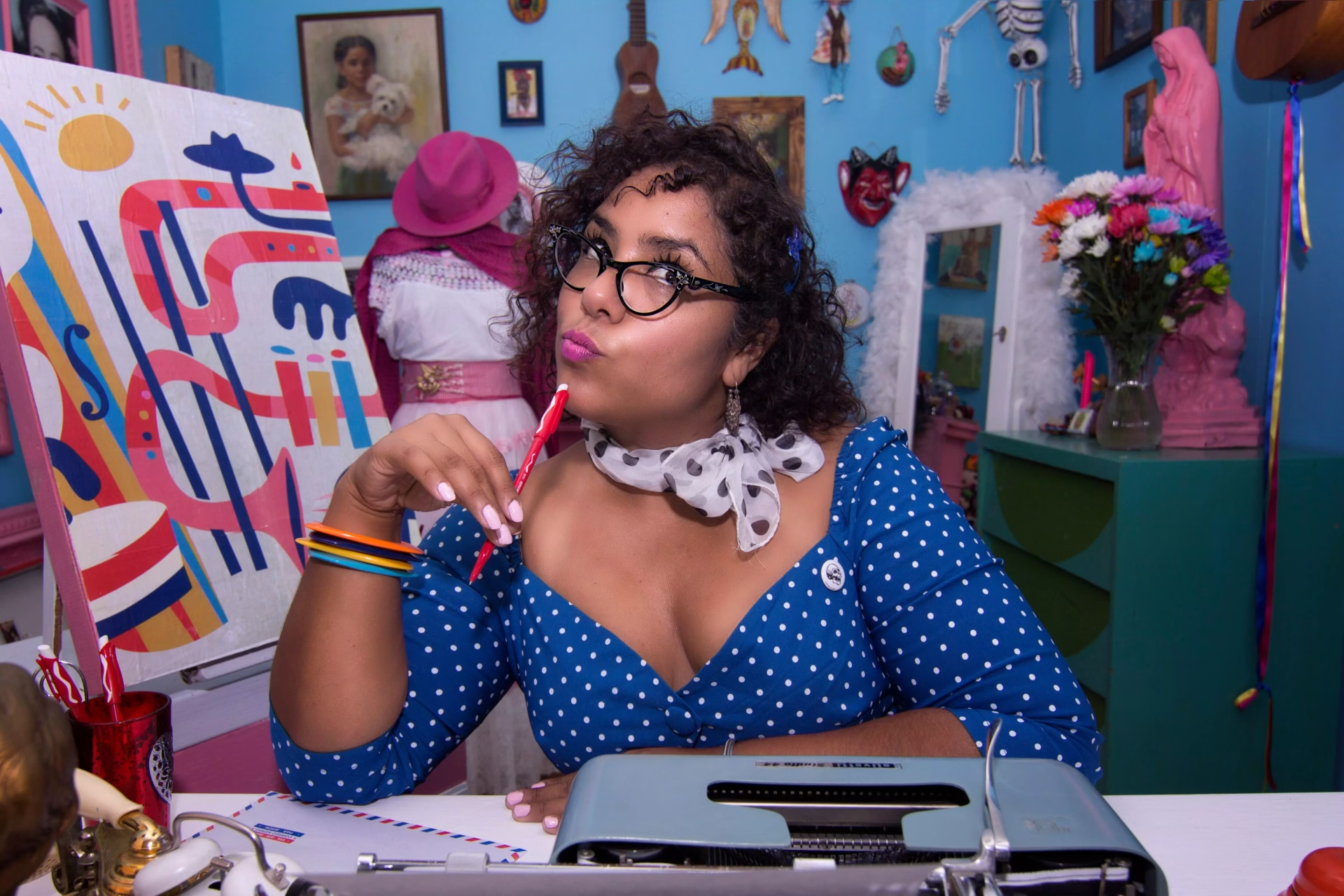
La Marisoul is known as the soulful vibrant voice behind the GRAMMY-winning band La Santa Cecilia. But, this year looked a bit different for the lively singer who is usually seen behind a mic, swaying to the Los Angeles' group's feel-good fusion of cumbia, bossa nova, rock and R&B, among other sounds. Before COVID-19 came and changed the world as we knew it, she stepped into the spotlight with a project that is all her. The result is La Marisoul and The Love Notes Orchestra Vol. 1, a seven-track album in which she covers some of the Spanish language's biggest classics from a timespan that dates back to the ‘50s and ‘60s.
The album, released Oct. 9, is the first of two installments and comes from a different era—not only because you're instantly transported back in time as she lends her rich voice to classics like "Un Telegrama" interpreted by Monna Bell and "Angelitos Negros" interpreted by Eartha Kitt and Toña La Negra. She recorded the album earlier this year, before the world even learned what social distancing was, with a 24-piece live orchestra. The album packages musical notes with lyrics about different stages of love—from heartbreak to infatuation; A theme which is very much on-brand for the singer who belts out heartfelt romantic ballads with La Santa Cecilia. Yet the album also represents another first for la Marisoul: a producer title.
"I feel it just empowered me to feel that I can do anything and that whatever I want to create," she told GRAMMY.com about stepping into the new role.
The album is also a kind of tribute to her late father who had suggested she should play with an orchestra. "He loved to dance and wear his hat and his suit, and he loved orchestra music. He loved boleros. He was always a huge inspiration for me," she said.
Before the album dropped, the GRAMMY-winning singer spoke to GRAMMY.com about the special project, selecting the first songs to release and sharing the music with her daughter. She, an advocate for immigrant communities and anti-racism, also talks how she thinks Latinx communities can tackle anti-Blackness and more.
This interview has been edited and condensed for clarity and length. Parts have been translated from Spanish to English.
I spoke to you, it was in late 2019, and it was with La Santa Cecilia. Tell me, how have you been since then?
Well, I mean, we've been surviving this 2020, right. Surviving this pandemic and these crazy times we're living in, but thankfully, always accompanied by my good friends in La Santa Cecilia and by music, by creativity. And I think that's what's been, at least for me, saving me and keeping me busy. Now, I also have a daughter. I have a four-year-old… We're good. Thankfully, right now I feel it's like a time where you just count your blessings. You count your blessings, you're appreciative of everything that you have, every moment that you have with your family, anything positive you can focus on is what we try to do. And try to feed and to inspire people by continuing to create music, things that'll uplift people.
La Santa Cecilia’s last album had tough themes. Some of you lost your family members during the process of making it. This album is different. It is a little bit happier. How was it different working on this album after that period?
Well, it's different because, yes, the last one for the Cecilia record was a way for us to let go of a lot of emotions and a lot of things, really bad things that we went through, loss and change. And change sometimes isn't easy and isn't pretty, right? But what happened with this project, La Marisoul and The Love Notes Orchestra, was that it wasn't something that I planned. This just happened. In this past February, I was invited to do a performance. They said, "We'd love to host you, La Marisoul, and host you in doing whatever you want to do." And I thought, "Cool, whatever I want to do, as La Marisoul" … it was going to be my dad's one-year anniversary of him leaving us, of him passing away ... I miss my dad, and I remember the things we spoke about, the things we shared, and one of those things was that he always would say, "Hija, you should sing with an orchestra. You should do a show or a record, hija. Como La Sonora Santanera.” He was a man that loved to dress up. He loved to dance and wear his hat and his suit, and he loved orchestra music. He loved boleros. He was always a huge inspiration for me.
So when I got the opportunity to do something as La Marisoul, I thought I should get out of my comfort zone, inspired by my dad, and try this out, you know? And I asked my friend Carlos Ordiano who sometimes plays keys in La Santa ... and he says, "Yeah man, you should do something with an orchestra." He arranged everything, and on February 22, we performed this show called La Marisoul and The Love Notes Orchestra … And it was just a way of being creative, of just finding new ways of just expressing myself and in a way, of course, honoring my father.
So here we are now, with La Marisoul and The Love Notes Orchestra Vol. 1, and mainly what it is, it's just like an offering, man. We're going through such strange times, such sad times, that mainly it's an offering of music, un abrazo musical. (A musical hug.)
Watch: La Santa Cecilia Scroll Down The Feed With "Winning" For Press Play
We know you as a frontwoman of La Santa Cecilia and when I think of you, I think of courage, I think adventurous. You said you were stepping out of your comfort zone on this album. Tell me more about what was uncomfortable about being on your own.
Well, first of all, that it was my idea … it was me like, "Hey, Carlos, do you want to do this?" "Cool, let's do this." And rehearsing with 24 other musicians, yeah, I'm used to rehearsing with my five bandmates, but it's very different to walk into a room with 24 men and attempt to sing this style of music. I sing bolero. I'm a bolero singer, that's my school. That's how I learned how to sing, but with a trio, not with horns and the whole deal. I've always loved that music, but it's something that I had never ever really done, and I didn't have anyone saying, "I'm going to set it up for you." I planned this whole thing. I was like, "All right, I'm doing this," from the idea of it to, "Hey, why don't we just record it to document this?" With La Santa Cecilia, it's like a democracy and it's teamwork … in this case, I was able to just decide everything for myself. From the look of the poster for the show, to wanting the guys to wear red ties when they play.
Then for making the artwork for this album now too. My partner in crime, Humberto Howard, did the artwork. He's my partner in real life and the video. I'm not sure if you saw the video, but it is very much me and it's only me. And I love it because I get to be super girly and funny and kooky and it's just me. I don't have to worry about my bandmates thinking it's too cheesy or too girly or too anything ... And if you see the world that I created in the video of "Un Telegrama," all the little details, those are all things from my house and from my personal life … I'm a woman who is very much connected to her roots, who's very much inspired by traditional music, Latin American music, Mexican music, but I'm also an all-American girl too.
[Points to wall background] So this is why it's all like this here, and this is why here [on this side], I have Toña La Negra, who was a singer from Veracruz. She sang “Angelitos Negros,” which is on the album. [Up here, I have] Celia Cruz. Behind me is Pérez Prado, up here is Ella Fitzgerald. Down here, I have Olga Guillot. What I wanted to do with this, is kind of share with you guys who my inspirations are in this record. These are the women that were singing this type of music, that were just amazingly talented women, but not only that. What empowers me and what inspires me about these women is that these women were women of color. Black women. Or Afro-Latinas. [And] they were bigger women.
They didn't fit the mold, which I feel like I don't at times too, you know? And I wanted to share that because I feel like more than ever now, we need to feel empowered and inspired by women like this, no? Because and I'm sure you know, in media, we don't see that, especially in Latino media. Now more than ever, we're talking about racism. A lot of things are going on about that, and it's been going on for a long time.
Right.
And I feel like in the Latino community, sometimes we say, "Oh, it's racism? What's that? There is none of that here," but [there] is. It's been present forever. The fact that I can't ... How many Latina singers of the past 10, 20, 30 years can I put on my wall that looked like me? These are the ones.
Read: Amid Black Lives Matter Conversations, Black Latinx Artists Urge Non-Black Latinx To Do Better
There were a lot of conversations after George Floyd's death that kind of made the community become introspective. Are you happy that this is finally out? What are some things you think the community should do to continue making space for all these artists that you're speaking of?
Well, I don't think that it is finally out. It's been happening. I mean, I grew up here in Los Angeles. I was a kid when Rodney King was beaten by the police. So, I'm aware and I've been aware of the racism in this country and police brutality, but I do think it's something that ... I saw this a lot and it bugged me, on social media to see artists, I guess, try to become allies, but really what are you going to do? Artists or media? Media themselves, like Latino media? Okay, yes, Black lives matter, but do Black lives matter in Mexico or in Latin America? Do Black lives matter? Do they matter to you? And I'm not trying to blame one or the other, but does it matter to you, Univision, or to you, Telemundo? Or to the magazines and to all those companies that sell things to us and sell them to us with European-looking white people, white Latinos that don't look like us. When I go to Mexico, when I see TV, movies, telenovelas, commercials, posters, billboards, they're all white Latinos. None of them look like me. If you go to Instagram, it's a place of these platforms. It's all white, and I get emotional because … I think it's hypocrisy.
You bring up a really good point. The conversations have been around, but I don't think at this level of infiltrating pop culture. There's all these messages that have been kind of sold to us, like whiteness, whiteness, whiteness. So, do you see that as a positive, it kind of infiltrating at a bigger level now?
I mean, I want to see it infiltrated, but I want to see it support Brown artists, support movements. There's a song that I sing in this album called "Angelitos Negros," which asks the painter to paint Black angels. If you have a soul in your body, why don't you think about black angels? To me, it's the media, all these platforms that have power, and Latino media. So, how are you, the painter, going to support and going to really try to change how things are and how we see ourselves and what you promote to people? Because it's always just white people, light-skinned Latinos that people growing up in Latin America and Mexico see, or me who grew up here in the United States, watching these TV shows with my mother and feeling like I could never do anything like that. [Feeling like] I could never succeed, because I don't look like these people.
I think you're actually helping create space for people that aren't white and, like you mentioned, thin. How do you feel about that?
I mean, if my existence is helping in any way to inspire someone ... that's a positive thing. I guess too, when you have to walk the walk when you talk the talk, but then you have to walk the walk, sometimes it's hard. It's hard because people [maybe on the outside see you] and they say, "Oh yeah, you're an inspiration because of what you look like or who you are," but it's like, "Oh, but I'm living in this skin. I'm living in my body, and I'm trying to find a way of placing myself and finding people that will help me tell my story, tell these stories, of where I come from, of who I am." ...And I guess I get emotional because of that too, because I feel it's hard, man …
I can never compare myself to the things that other people have to deal with and the racism that other people have to deal with. You know what I mean? But I can only try to change and affect and inspire in my little world that I've created or the music … I would like to see this continued to be talked about and not be forgotten in a few months.
Going back to the album, how did you decide that these seven songs needed to be released first?
I mean, they're all my favorite. The first song that comes in the album is called "Como Fue," and I feel like that's just beautiful. That was the way we started the show that night. So these are all songs that I grew up with that I love. "Bonita" is a song that I love, from watching Tin Tan movies. “Mar Y Cielo,” ‘Amar Y Vivir,” these are songs that I learned singing with my dad, that sometimes I didn't even know what I was singing yet until I was able to live these songs.
Are you sharing them with your daughter? Have you played them for her?
Yeah, yeah. Oh man. We had a blast when we started hearing the music. We were dancing in the kitchen, and she was just loving it. And I think mainly that's the whole point of sharing La Marisoul and The Love Notes Orchestra … What this experience was in sharing these recordings is, I know that we're going through a difficult time right now. It's hard, and I find myself trying to go back to the things that made me feel good, so that I can continue to fight, so that I can continue to create, so I can continue because we have to. We have to keep going. We have to push forward, even if the future might look bleak, and we have to find ourselves some way to continue, no? So mainly what this is, it's just like an offering of comfort food. You've heard these songs before. They're songs you grew up with, they're songs that you can remember with your grandma or songs that you can learn to fall in love with, songs that can teach you about life.
You also produced this album. What did that teach you about the album-making process?
I mean, I feel it just empowered me to feel that I can do anything and that whatever I want to create, I can create. And if I want to go up and sing with an orchestra of 24 musicians, I'm highly capable of figuring it out and making it happen. So that just makes me feel more empowered to keep creating, and I mean, why not? If I could be the lead singer of this band and be a GRAMMY-winning musician, man, I could be a producer too and produce beautiful things to share with people to hopefully uplift them. That just inspires me more to want to continue, to tell stories and to share musical magic with people.
