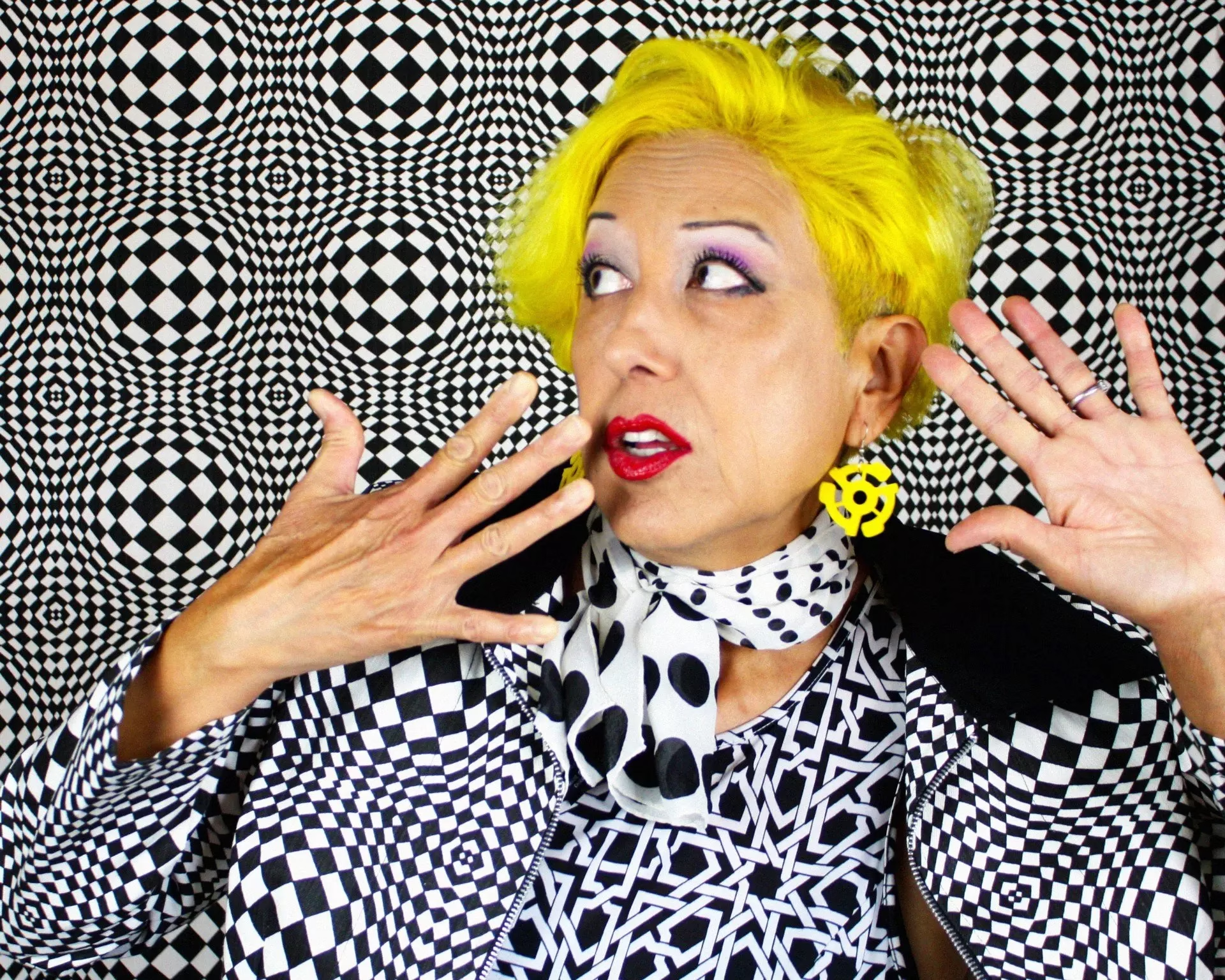
When we called up revered punk artist/activist Alice Bag in March, the coronavirus pandemic was only just starting to pervade an increasingly dire news cycle. The feminist punk pioneer didn’t seem overly rattled by the poor timing, though. Unlike legions of artists going into panic mode over the idea of canceled tour dates and a drowned-out album cycle, Bag—who recently released her third solo record, Sister Dynamite—is keeping calm and paring down (and working out).
"I grew up poor," she tells the Recording Academy. "My first instinct was to buy a bag of beans and a bag of rice. If I run out of toilet paper, I know how to use water to clean myself. I have Tylenol if I need Tylenol. And I have shelter. So, I feel like I have everything that I need to stay alive, to keep myself alive, to keep my family fed. It's all just extras that we're spoiled with… I think it's forcing me to reevaluate how many different ways I've been spoiled over the past few years."
The last few years have been pivotal ones for Bag, who came of age in 1970s East L.A. and performed in the short-lived but highly influential first-wave punk outfit The Bags. In 2011, the 61-year-old former teacher released the must-read memoir Violence Girl, From East LA Rage to Hollywood Stage – A Chicana Punk Story, and five years later, in 2016, she unveiled her first official solo record. Her latest work, Sister Dynamite, is a pop-punk masterpiece of razor-sharp riffs and chantable turn-of-phrase. In the fall, assuming that the ongoing quarantine is lifted, she'll play a handful of dates with feminist-punk acolytes Bikini Kill.
The Recording Academy recently spoke to Bag about her vision behind Sister Dynamite, the silver linings of this pandemic and what it means to "communicate, not indoctrinate."
<style>.embed-container { position: relative; padding-bottom: 56.25%; height: 0; overflow: hidden; max-width: 100%; } .embed-container iframe, .embed-container object, .embed-container embed { position: absolute; top: 0; left: 0; width: 100%; height: 100%; }</style><div class='embed-container'><iframe src='https://www.youtube.com/embed/yj_gRIRwAGo' frameborder='0' allowfullscreen></iframe></div>
How are these last couple weeks been for you?
They've been kind of crazy. I played a show right before L.A. started shutting things down. So, my band and I were actually a little bit nervous that we were going to come back with [something] And we played in Seattle. So, my band and I have been checking in and making sure that nobody is sick. So far, so good.
This whole experience has really made me look at things from a different point, from a different perspective. It all seems like you know what? If I can't do a tour this year, I'll do it next year. If my record doesn't come out when it was supposed to, that's okay. It will come out when the time is right. It's all about keeping your eye on what it important.
Right. It sounds like you have a pretty Zen outlook about this. Do you foresee having to make any lifestyle changes this year, in light of all of these widespread music cancellations?
Yeah. I definitely am going to change. I already have, but I grew up poor. My first instinct was to buy a bag of beans and a bag of rice. And I thought, okay ... a big bag of beans and a big bag of rice. And I've lived on that. I have, in the past, managed to feed myself with that. If I run out of toilet paper, I know how to use water to clean myself.
And I have Tylenol if I need Tylenol. And I have shelter. So, I feel like I have everything that I need to stay alive, to keep myself alive, to keep my family fed. You know, it's all just extras that we're spoiled with. I can't have my Morningstar patties but I'm going to survive anyway. And maybe I was having them too often. I think it's forcing me to reevaluate how many different ways I've been spoiled over the past few years.
Also, I like to think that there's a silver lining—that people are changing their values. They're forced to spend time with their families. And it's going to be hard at times, but it could also be a really good thing and a time for growth in a different direction. People might have to change jobs because certain industries might not exist after this is over. People might have to look at other fields to get into. And those fields might be things that promote a healthier environment. I mean, I know it's going to be devastating, but I'm hopeful that there will also be good things that come out of it.
Assuming that Sister Dynamite does come out on time [editor's note: it did]—and it really is a killer record—can I ask who you were thinking about when you decided to call it that?
You know, a lot of time, I just write records. I mean, songs just come to me and I don't really have ... I don't think of it as a whole album. I just think of the individual songs. I think what happened with this is I was just writing. I write every day. And I was interrupted by a request from the band, Fea, in San Antonio to go out to Texas and produce their album. So, when I went out, I got to spend a lot of time in the rehearsal studios. And then, they recorded in a place in El Paso that is kind of a sleep-away camp. It's called Toxic Ranch. And you get to live in this very creative environment while you're involved in recording the record.
I felt totally revitalized. I've been a musician for so long that it's very easy for me to just let my imagination go wild and just say, "Oh, I want a flute on this song," or, "I want a violin or a cello." And just call somebody and say, "Come and play on this song." But because I had that time of bonding in the small group set, I really wanted to have this song be more about my band, about the people that I usually play with, people that I do live shows with. And I really wanted it to be just all upbeat songs instead of having some ballads. I love ballads. I could write those all day long. But I feel like ... I challenged myself to try and figure out ways to put more texture but with less instruments.
Theme-wise, I think there were just things that come up on a day-to-day basis where somebody will say something or I'll read an article and I'll start to write a song about it.
<style>.embed-container { position: relative; padding-bottom: 56.25%; height: 0; overflow: hidden; max-width: 100%; } .embed-container iframe, .embed-container object, .embed-container embed { position: absolute; top: 0; left: 0; width: 100%; height: 100%; }</style><div class='embed-container'><iframe src='https://www.youtube.com/embed/wZZdj2e05Gg' frameborder='0' allowfullscreen></iframe></div>
Right. There’s been no shortage of infuriating news, even well before coronavirus. Do you ever feel overwhelmed by the onslaught of bad news out there when creating?
Definitely. I do feel overwhelmed at times. Right now, especially. When this whole coronavirus started making the news, I was glued to the television. I was like, "Okay, how many cases? When are vaccines coming? How is testing going to work?" I was expecting answers. And here we are a few weeks in, and there are no answers, but I feel like, "I have to stop watching because every time I watch, I just get more and more anxious." So now, I'll take little breaks. I'll check in on the news maybe once or twice a day just to see if there's anything really important. I know that I get texts from the governor's office and the mayor's office telling me this is what's happening. So, I feel like I am as connected to the crisis as I need to be, but I think for my sanity, I also need to have a little bit of insulation. It's like that one song about noise. There's a lot of noise. Only some of it needs to be getting to me. A lot of it is just causing anxiety.
I heard that the sequencing Sister Dynamite record felt important to you. Is that true?
Yeah. In the past I haven't really done that. I just gave myself a really free rein at first. And I think that came from the fact that I had been writing for years and years and I hadn't put out anything. So, I had songs in my little song folder, my little song binder, that were from five, 10, or 15 years ago that I actually, for the first album, that I pulled out and I was like, "This song is still good. I still like it. I'm going to put it on my first album."
So, the first album [2016’s self-titled], especially, has a lot of different instrumentation, different feelings. I mean, I don't want to dis that album, because I really like it, but it really is much more challenging for the listener because it switches from style to style. Because obviously, you can't be a 60-year-old musician—well 61 now—without going through different stages in your life where you were listening to different types of music and all those influences keep changing.
So, I think in the first album, you hear all those different influences. And then, now I think I really tried to hone it in on this more of a punk/pop influenced record.
I love it for that reason. I'm a sucker for anything pop-punk.
Oh good. Yeah. Whatever order it's in, it's got both those influences. And you know, the song “Subele” really reminds me of growing up and listening to Mexican pop with my mom. There's definitely certain ... when I was singing it, I felt like, "Oh, if my mom could hear this, she would like this song."
Of album opener "Spark," you had said that it was a meditation on attempting to tone yourself down a bit and feeling unsuccessful. Were you thinking of a particular time in your life had you felt like you had to do that?
I think it's definitely when I was younger and feeling like I have to be somebody else to be successful in this environment. Even when I was teaching, I felt like I wore a costume. I didn't let anybody know that I was in a punk band. But that was purposeful. That wasn't because I was ashamed of who I was... That was more like I was more like, "I'm not going to share this part of myself with you."
When I was younger, I really felt like in order to be accepted in certain circumstances like school or work, I had to try and tone it down, like maybe not dress the way I did or not express certain things. But I couldn't. Even just yesterday, I was at the dentist's office because I have a crown that broke and I was looking on my phone and I saw that somebody had posted a nasty, misogynist comment on Facebook. And I thought, "Okay, am I going to ignore this or am I going to say something about it?" And I thought, "Do I want to invest my energy and get into this little war online with this person because they said this thing?" And I decided, "Yes, I can't keep quiet. I have to say something about it."
So, I think ["Spark"] is about that, about not keeping things in. And when I do keep it in, I always feel bad about it. There are times when it's worth walking away and cooling down. But there are also times when you just have to let it out or you feel like if I don't say something, then I'm going to just take all this poison in and let it fester in my body.
Nowadays, it’s not as common for me to feel like I have to tone it down. I feel like as soon as I turned 50, I felt completely liberated. It was a turning point for me where I felt like I could do anything I wanted to. I didn't feel like I had to look any way. I don't have to dress any way. I don't have to keep my thoughts controlled. I'm just going to say whatever I want and do whatever I want.
But then, there's a commitment that goes with that. If you're going to share your ideas, you have to be willing to commit. The same with your outfits. If you're going to wear a crazy hairdo and clothes that are loud, somebody is going to look at you and think, "Oh, you're a kook," or they might say things about you and you have to be self-confident enough to either ignore them or say, "F**k you," or whatever.
But it is a process. When you're younger, it's much harder to know that you're going to get to a point where it's like you really don't care and you are who you are and you're not going to let anybody dim your spark.
<style>.embed-container { position: relative; padding-bottom: 56.25%; height: 0; overflow: hidden; max-width: 100%; } .embed-container iframe, .embed-container object, .embed-container embed { position: absolute; top: 0; left: 0; width: 100%; height: 100%; }</style><div class='embed-container'><iframe src='https://www.youtube.com/embed/1PfiHLK9GWU' frameborder='0' allowfullscreen></iframe></div>
It's definitely an evolution. Just hearing you describe that last thought—it made me think about the year I graduated from college and my father took me out to get some job interview clothes. He took me into a Banana Republic and I tried on this thick, grey wool dress that I would never have worn before that. It felt like a costume. Like I was wearing somebody else's clothes and go live somebody else’s life.
Yeah, I did the same thing. I have pictures of myself right after I started teaching, and I'm so playing the role of a prissy teacher. I have a picture where I look like I'm running for Congress. And another one where I have a little beret on and a blazer. I look really like just what I imagined a teacher was supposed to look like. But since I was a little kid, I've always loved playing dress-up. But I think that I actually got into this idea like, "Oh, this is my teaching costume and this is who I really am. This is the punk that comes out at night." It's almost like Batman or something or some superhero that has a daytime persona, and then, transforms into something powerful.
Looking forward a bit, you’re scheduled to do some live dates with Bikini Kill in the fall. You also opened for them at their first reunion show last year, and you teamed up with Kathleen Hanna a couple of years back in the "77" video. I’m curious, how did you and Kathleen originally connect?
Yeah, I met Kathleen Hanna just about two years ago, maybe three. I'm not sure. But I remember hearing Bikini Kill and Le Tigre and Julie Ruin. But I didn't know her personally. It was she was in L.A. and was going to have a party for a mutual friend. She sent word through Allison Wolfe and my friend, Rudy Blue, that she wanted to invite me. So, of course, I was going to go. So, I went to a party at her house and she came up to me and introduced herself and she told me that she had read my book, Violence Girl. We talked a little bit about that. She was just super friendly. Really, really cool person.
And then, I was, at that time, recording my album, Blueprint, and I remember inviting Allison Wolfe into the studio a couple of weeks later after I had been to this party at Kathleen's house. And she, Allison heard one of the songs and said, "Wow, this would be great for Kathleen to sing on." And I'm like, "Yeah, it would be but I don't know her that well." And Allison said, "I'll ask her." So, Allison actually took the initiative and asked Kathleen and Kathleen said yes. And then, we got to hang out in the studio and we got to hang out at the video shoot for "77."
I'm really impressed by Allison Wolfe and Kathleen. When they talk about being feminists, they live it. And I have to just throw in Shirley Manson [of Garbage], too.
Ah, yes. I love her.
Shirley, she totally came out of the blue. She hadn't been in the studio or anything. I had just met her at a party also. It was the night before we were going to shoot "77" and we were in a little coffee shop planning out the next day's schedule. The person who directed the video for "77," his name is Scott Stuckey. He was going through the schedule and I said, "In the film 9 to 5 there's a character of the two fast to the boss. Right? This woman that's kind of spying on what the three main characters are doing." And I said, "It would be great if Shirley wanted to come by and do that."
And he's like, "That's a great idea. I'll ask her." And he asked her that night, and the next day, she showed up at the video shoot. In her own outfit that she planned at home, fully ready to go.
<style>.embed-container { position: relative; padding-bottom: 56.25%; height: 0; overflow: hidden; max-width: 100%; } .embed-container iframe, .embed-container object, .embed-container embed { position: absolute; top: 0; left: 0; width: 100%; height: 100%; }</style><div class='embed-container'><iframe src='https://www.youtube.com/embed/ZmnTGTyRjEM' frameborder='0' allowfullscreen></iframe></div>
That’s amazing. All of those women seem to embody the "communicate, not indoctrinate" mantra you mentioned in your press materials. Can you tell me a little more about the meaning of that phrase?
I was volunteering for the Literacy Campaign and I spent some time just living with a Nicaraguan family, which is another reason that I'm very confident that I can live on beans and rice forever. During my experience there, I realized that education can be a really liberating tool if you help people make their own decisions—if you facilitate exploration and ideas. It's so easy to come at people and say, "This is what happened. Learn it. Spit it back." This refers to "banking education," which is just filling people up with information that they're supposed to assimilate.
The kind of education that I saw taking place in the mid-'80s in Nicaragua was all about people making their own decisions. Taking all the information in, having constructive dialogue, learning how to listen respectfully. And not necessarily having to win the argument. Everybody wins if everybody is thinking for themselves and making their own choices. We do have to come to agreements about stuff, but if everybody is just listening to each other and making their own choices, then it's much more productive.
In the past year or so, I've been asked, "How do you feel about this or that candidate?" And I'm like, "I'm not going to say anything about any candidate. There's so much information about all of the candidates. All you have to do is listen, read, stay informed, and then, make your own choice."
In the past, there have been times that I want to shake people up and say, "Do this," but I don't. I have to resist because that's not the way to go. It doesn't work in education. It doesn't work when you're being a parent. It doesn't work when you're a partner in a relationship. It doesn't work in society either.
Yeah, I think that we could all stand to listen a lot more. When you meet someone who you know doesn't agree with you, you may not be as inclined to listen to them because you just think, "Well, I already know what they're going to say."
I totally agree with you. That happens a lot. You think, "I know what that group of people thinks," and you don't.
Because I lived in Arizona for a long time, which is very conservative—there are a lot of very conservative people that were my neighbors. I don't consider myself a very conservative person. But these were people that I became friends with that were my community and they had made assumptions about me and I had made assumptions about them. And yet, we could get together and play Scrabble or go for a walk or do something. It's like, "Wait, you need to really see me and I need to really see you. And I need to understand why you're making the choices you're making. And you need to know that your choices are affecting me this way." So, it's really about teaching people to talk to each other and to listen to each other because that's the only way we're ever going to have peace.
