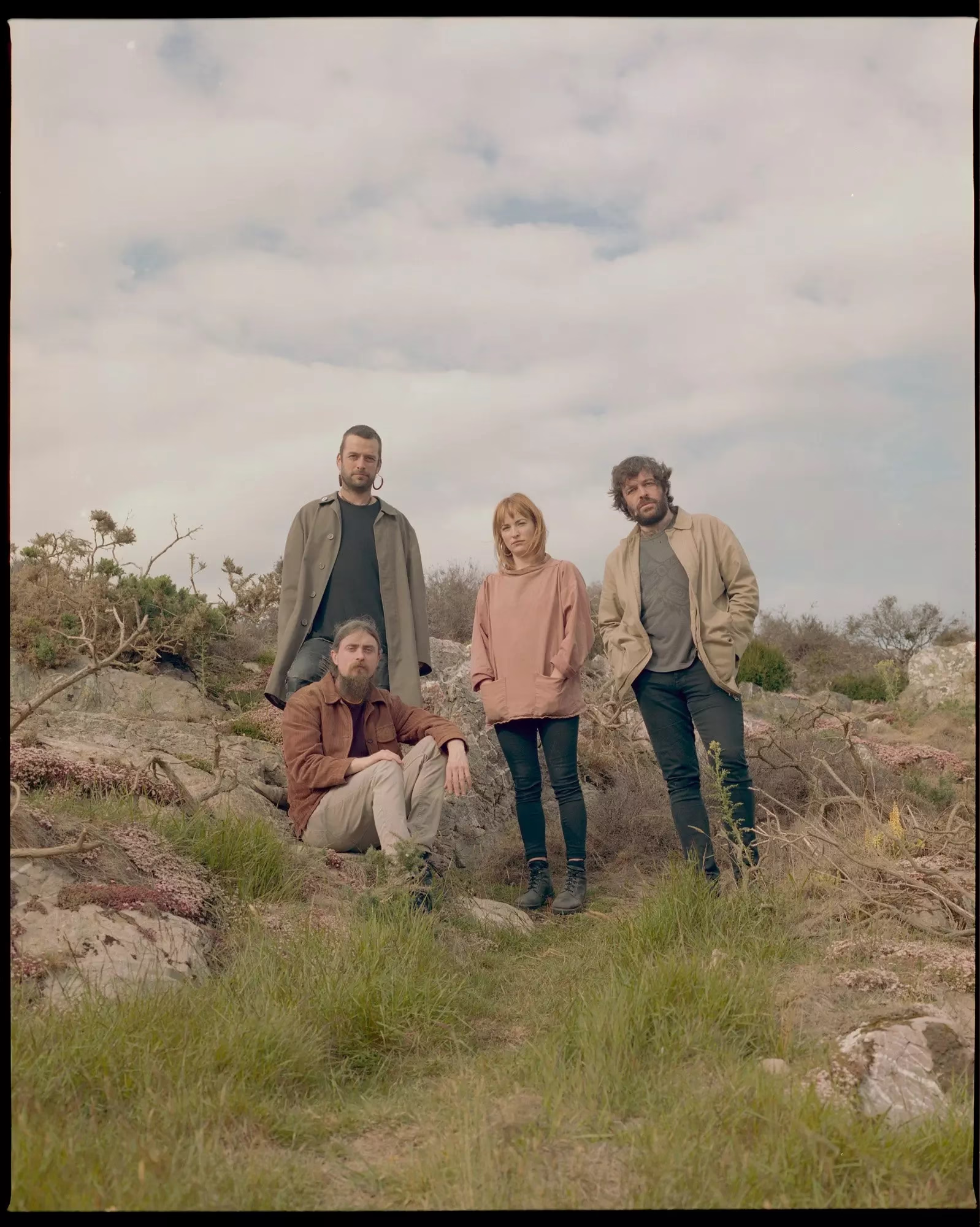
Timing, as they say, is everything. In early March, before the music world went on COVID-19 lockdown, the Recording Academy had arranged to speak with the Lankum's Radie Peat over the phone, and the call that just happened to coincide with the moment her band were announced as this year's winners of the Choice Music Prize, a top honor in their homeland of Ireland, for Album Of The Year for their stunning third LP, The Livelong Day.
"I'm a little bit shocked," Peat said over the phone just moments after they'd won. "It's crazy, we didn't expect to win at all. It's strange to win things, I'm not used to it. We were really surpirsed and everyone just started hugging eachother."
<style>.embed-container { position: relative; padding-bottom: 56.25%; height: 0; overflow: hidden; max-width: 100%; } .embed-container iframe, .embed-container object, .embed-container embed { position: absolute; top: 0; left: 0; width: 100%; height: 100%; }</style><div class='embed-container'><iframe src='https://www.youtube.com/embed//lUReQ9GhT8s' frameborder='0' allowfullscreen></iframe></div>
At the time, Lankum were on the road on the U.S. East Coast dealing with the equally as unexpected (but far less exciting) cureball of having their van breakdown while in transit between what would end up being their final handful of dates before the coronavirus crisis. The NPR darlings, who earned an impressive No. 8 spot on NPR's Top 25 Albums of 2019 list, had just recorded their own "Tiny Desk" perfomance in Washington, D.C. and had a string of American dates before heading back abroad for some big shows in the U.K. and throughout Europe.
Lankum's familiar-yet-forward-facing sound has been earning the group more fans in more places around the world than their busy touring schedule could keep up with. NPR's Bob Boilen, a massive fan of the band and the album, said it well: "This stunningly beautiful, trance-inducing album record draws heavily on traditional Irish folk music, but with a deep dark Dublin twist...The Livelong Day makes the past entirely fresh and present."
Our phone interview with Peat picked back up the day after they'd won the Choice Music Prize, while the band were en route to the next tour stop. We asked Peat about Lankum's unique modern spin on the Irish folk music tradition, the odd process of of being musically categoriezed, the process of creating their brilliant reinvention of their transfixing song "Wild Rover" and more...
Congratulations on winning the Choice Music Prize for Album of the Year last night for The Livelong Day. Did you and the band celebrate?
Thank you. Oh no, we didn't really celebrate. We just got in the van and drove to D.C. because we were filming for "Tiny Desk" so we had to be in D.C. last night to get there early enough. It was a very short celebration and then back in the van.
How did the "Tiny Desk" filming go? What was your experience like?
It was pretty nerve-racking just because I've watched so many of them. I think it's always more difficult when you're a fan of the program. I think it went well. They're short as well, it's only half an hour, 20 minutes or something. But, yes, I enjoyed it. It was very cool to be in the NPR headquarters there.
They've been some of your biggest fans here in the States. With so much acclaim in the States, how has it been connecting with American audiences?
I think everywhere is slightly different. But when we play outside of Ireland, there's always been a element of Irish people, ex-pats maybe, coming to gigs. In America you have this element of Irish-Americans. There would be similarities across the board between back home and over here and in Europe. It's starting to become a crowd that know what they're coming for and for some reason enjoy it, which is brilliant.
The Livelong Day is your third record, while you were working on it did you really feel that you were creating something that you know would be hailed as a masterpiece?
I think you'd be in big trouble if you thought that while you' were recording anything. I think that would be a sign that you've gone into egomania.
We got very excited doing it, definitely. We actually started recording it a year ago yesterday so it's kind of its anniversary. But, no, I think we got very excited and it did feel like it was coming together in a way that maybe felt a bit more natural or easier than the other two albums. Just, right from the get-go things were sounding more like what we imagined them sounding like.
A lot of that was to do with our producer. John Spud Murphy was working on it from the very beginning of the recording process with us… We also had left quite a lot of things to be decided in the studio so that got to be a bit more creative this time which was really exciting. The praise has been amazing, to be honest. I imagined we'd get at least a bit of flack or a bit of negativity, but we've been very spoiled, to be honest, with the reception it's gotten. It's very flattering.
Was there a specific worry about the flack that you were thinking this album might draw?
Probably just general paranoia. You've made a thing and you put it out into the world. There's always a little… I don't know. You never know. All you can do is you try to make it as good as it can be. Make sure you put in 100 percent of what you can and then it basically has a life of its own once it's left you. You can't control how people are going to receive it or what kind of life it then has once it's out.
There's always a bit of anxiousness and excitement about that as well, because you don't know which way it's going to go. Hopefully at that point you just want to be really proud of what you've done and then no matter what happens from that point, it doesn't really matter because you were proud of it when it was finished. That's the way we would think about it.
Your sound is unique - do you enjoy watching the music journalists and critics scramble to do what they do, to try to classify or pinpoint a genre or description?
Sometimes I kind of enjoy it. I find it interesting when people ... like, what you're saying about trying to find a way of describing it because, honestly, when people ask us, "What kind of music do you play?" or whatever, it's incredibly difficult to answer the question ourselves, even. That idea of trying to put words on it and describe it in a way that can give a flavor of what it is without hearing it, I think that's an incredibly difficult thing to do anyway.
So yeah, there is a curiosity in how people will receive it but at the same time, again, it's out of your control. I think that it's important to maybe not put too much importance, to attach too much importance to what people say about it, you know? [But] there's definitely a curiosity in terms of, "What will they say this is?"
The album opener, "Wild Rover," is such a lush interpretation and reinvention of the song. Can give us some insight as to how you and the band put that arrangement together.
Myself and Ian [Lynch] had originally, or maybe all of us, but definitely Ian, had originally heard a singer called, Dónal Maguire, do that version of "Wild Rover." It's an unusual version... We had never heard that before, that version, and just fell in love with it. We just thought that it just communicated a totally different pain to any of the other versions we'd heard. It seemed almost like an opposite. It seemed really mournful, like the melody.
<style>.embed-container { position: relative; padding-bottom: 56.25%; height: 0; overflow: hidden; max-width: 100%; } .embed-container iframe, .embed-container object, .embed-container embed { position: absolute; top: 0; left: 0; width: 100%; height: 100%; }</style><div class='embed-container'><iframe src='https://www.youtube.com/embed//5rukIHD7rNY' frameborder='0' allowfullscreen></iframe></div>
There's obviously extra lyrics in it as well to give a bit more of a context to the rest of the song. Then we were talking about doing that and then what always happens with any song is that we don't rule anything out. We'll try a number of things and whatever seems is the most effective way of communicating the song is what gets picked. There's no, "This person has to play this instrument," or anything like that. We'll try, actually, to do a lot of different permutations sometimes before we arrive on what we think is the most honest version of it. Then sometimes things come together very fast. Other times, though, they'll take a little bit more hashing out.
"Wild Rover" was very fun to do because I don't think we had envisioned… that kind of outro at the end came a bit after playing around with the rhythm within the song. That was very exciting to do in studio actually. That was very fun because you got to layer up stuff and make a thing that we haven't heard before.
Both myself and Ian, when we heard this version, we actually had an emotional reaction to the song for the first time ever. The idea was to try to communicate a similar [emotion] and to try and get the emotional reactions that we had gotten when we heard it. Just a mournful, sense of dread, as well, and just sorrow.
The dissonance in your version is really powerful, and the payoff is such a beautiful moment. Where do you feel the most ideas come to you? Is it on the road, like you are now, or is it when you get some peace and quiet back at home?
I think we have put stuff together on the road but it is more rare. The way we wrote The Livelong Day was we managed to get a room in the basement of this, actually, really historic building in Dublin called Liberty Hall. I think the only band that ever used it for music was The Dubliners, which is quite cool. We had that room, and so that was a brilliant resource. We just went in there every day for, I don't know, maybe a month and a half, two months, and that actually is really good to just tap away at it every day. Like you're going to the office or whatever. You go in and you just tap away at ideas everyday because then it does accumulate and you'll get some good stuff out of it. It's just, when you're on tour, sometimes it can be hard to have brain space because you don't have much time off or time to yourself. A lot of it is just traveling and doing the gigs. Sometimes you might get an idea but it could be later and you'll actually start putting it into practice, when you have time.
<style>.embed-container { position: relative; padding-bottom: 56.25%; height: 0; overflow: hidden; max-width: 100%; } .embed-container iframe, .embed-container object, .embed-container embed { position: absolute; top: 0; left: 0; width: 100%; height: 100%; }</style><div class='embed-container'><iframe src='https://www.youtube.com/embed//JxKx-BBWX8Q' frameborder='0' allowfullscreen></iframe></div>
What it's like playing in a band with brothers [Ian and Daragh Lynch]?
It's an interesting dynamic. I think everyone always just, they always think of Oasis when they think of brothers in bands. It's like we're all siblings at this point, to be honest. But it's interesting and I think that there's this thing with siblings, sibling voices, sometimes, that's really beautiful, where they blend in a way that is really unusual to get if people aren't related, you know? That can have a magic-y thing going on sometimes, sibling harmonies. Especially when they sing together, they sing the same line, it's very hard to tell who's who. Which I think is pretty cool.
Record Store Recs: Patrick Holland A.K.A. Project Pablo Shares Montreal's Vinyl Treasure Troves