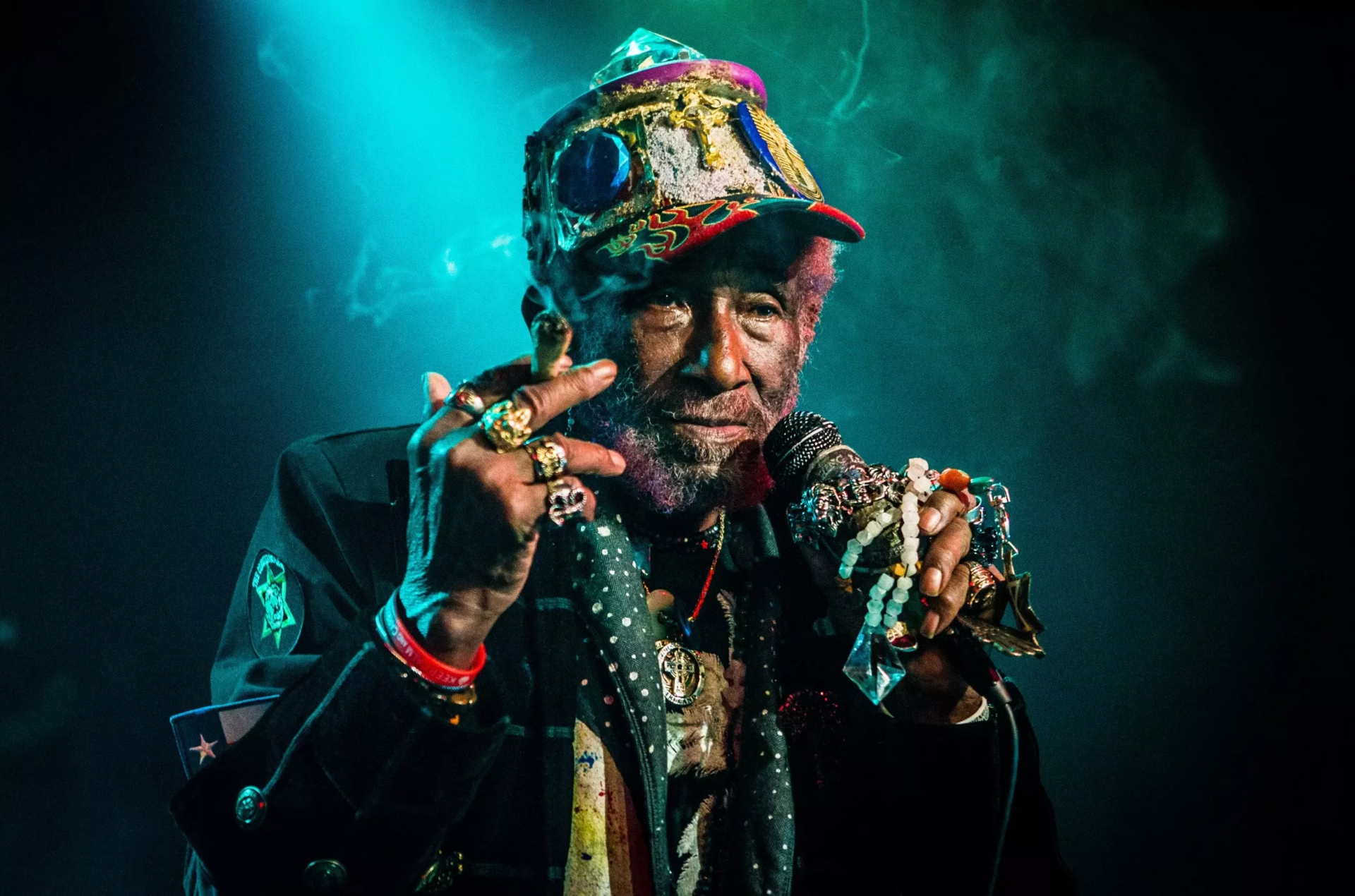
Lee "Scratch" Perry, one of the giants of reggae music, is known as the Upsetter. His musical creations, for both himself and others, upended the sound of Jamaican music and reverberated around the world for multiple generations.
"To upset people, uplift the people, and another part means to destroy them. The word can do anything; it's a two edges sword," Perry says in The Upsetter: The Life and Music of Lee Scratch Perry, a 2008 documentary now streaming for the first time through the Criterion Collection. Putting Perry's particular brand of genius on display, the documentary is an art piece that attempts to capture the eccentric (and sometimes mad) energy of one of reggae's greatest minds.
"People just think he was this crazy guy who's in the lab making these crazy songs," Adam Bhala Lough, who co-directed the film with Ethan Higbee, tells GRAMMY.com. "But no, he's a musical genius, a music historian, an art historian, a really brilliant mind."
Prior to his death in August 2021 at age 85, Perry was nominated for five GRAMMYs and won Best Reggae Album at the 2003 GRAMMY Awards. The Upsetter serves as something of a time capsule, capturing Perry on the verge as he returns from self-imposed obscurity and isolation to performance.
A country boy, Perry moved to Kingston, Jamaica in the early 1960s and gravitated toward the city's exploding ska scene. He worked at the three major recording houses — owned by pioneers Coxsone Dodd, Duke Reid and Prince Buster — working his way up from janitor to producer and, often, uncredited songwriter. Eventually, Perry became his own musical force with a band, label and record shop.
In addition to hits for his own group — his house band, the Upsetters— Perry created hits for a young Bob Marley and the Wailers and was majorly responsible for getting the Wailers to a global stage. Perry also produced Marley as a solo act, giving him the courage and content to become a legend. At his height, Perry produced 20 songs a week for hundreds of artists, including Burning Spear and Jimmy Cliff, for five years straight.
From his home studio the Black Ark, Perry invented dub music — a genre of reggae that would serve as the forebearer to all modern electronic music. Utilizing the mixing board as an instrument, Perry pioneered manipulating sound by removing vocals, emphasizing drum and bass, and adding effects. Singers and DJs would "toast" (talk and sing in rhythm) over Perry's instrumental tracks, a style that would take flight to New York via Jamaican immigrants and form the basis of hip-hop.
Read More: Remembering Reggae Legend Lee "Scratch" Perry, The Dub Afrofuturist
Yet, a series of unfortunate occurrences — including a falling out with the group of Rastafarians living at the Ark; numerous people attempting to hustle Perry for his money; and a devastating fire at the Ark, which Perry himself set — culminated in Perry's descent into what some may call madness. The Upsetter captures much of that energy, giving ample space to Perry's rambling speeches while imbuing much of the film with a psychedelic overtone.
"We made this pretty radical decision to just give space to Lee to tell his story, whether it was factual or unfactual," says Bhala Lough. "To me, it's vitally important that if you have that type of access, you give space to that voice."
The documentary ends in 2006, 15 years before Perry passed. While much happened in that last decade-plus of his life, The Upsetter ends triumphantly, with Perry returning to the stage after a multi-year hiatus from performing. Told in his own words — with minor narration from Oscar-winning director Benicio del Toro, "the biggest Lee Perry fan in Hollywood," according to Bhala Lough — the film is an attempt to capture a peculiar, prolific man whose influence far outlasts his lifetime.
Ahead of its streaming debut on Criterion, GRAMMY.com spoke with Bhala Lough to to discuss Lee "Scratch" Perry's music, idiosyncrasies and the need to decolonize reggae music.
This interview has been edited and condensed for clarity.
What was your thought process constructing this documentary? It's just Lee, in his own words, and I was kind of expecting interviews with other people.
That was a specific choice we made very early on. We only wanted Lee's voice in the film; we wanted Lee to tell his story. We really felt like the history of reggae has been, in a way, hijacked by a white perspective. It comes from such a painfully colonialist perspective. We actually went and interviewed tons of these people — from Adrian Sherwood to Chris Blackwell — as research in a way. But we just had no interest in trotting out the white man to tell the story or even comment on Lee.
I think that the Caribbean voice, the Afro-Caribbean voice, is often kind of forgotten in the story of Black history. So to have an opportunity to have a Jamaican man tell his story, the way that he lived it — whether it's correct or incorrect, or, you know, revisionist, or whatever — is, I think, a duty of a filmmaker.
What was the filming process like?
We got in touch with Lee and he basically said, "Listen, I'll do it, but you need to bring me a shoe box with $5,000 cash in it." So Ethan [Higbee, his co-director] got the advance from this Argentinian trucking company and went to London. Ethan was thinking he was going to have a normal meeting with Lee, but he ended up at a dinner with Lee and all of Lee's ex wives and all their children. [Laughs.]
He gave him the box and Lee gave him his address in Switzerland, where he was living at the time. We showed up on his doorstep — we had no way to contact him, so it wasn't like he knew we were coming. He didn't do email, he didn't text. There was a landline, but never no one ever answered it.
Day one, we pulled up, he recognized us, and he was ready to go. We spent eight days there at the house with him [in 2003 or 2004], just filming around the clock. By the end of it, we felt like part of the family. We had dinner with his wife and children every night.
We also had arrived at a very good time; he had just gone sober. Completely sober — no weed, no alcohol, no nothing. And he was very much ready to tell his story. So it was very much like a fortuitous arrival. As you can see in the film, we just kind of continued to pop in and out and travel around with him for the next, like, five or six years.
It also seems like you guys operated in the same way he did at his legendary studio in Jamaica, the Black Ark — just hanging out, coming and going as you please, creating 24/7. Did it feel like that to you at all?
That was definitely the whole vibe. And it was really quite thrilling.
Lee is eccentric, to say the least, and I felt a little unhinged watching parts of the documentary. Was that intentional?
Lee, I think, was an eccentric man from birth. I think that he played the role of a madman to a large degree to keep people away from him.
We wanted the film to be both historical and biographical, and experiential in the sense that it was almost impressionistic. At some point, the film started to become mad, in a way, in the same way he did. The process of making it was very much like a collage. It is an art piece.
I think it was misunderstood when it came out. People were very much expecting a traditional bio doc from a white European perspective, very bland VH1 style. It should be seen more as a weirdo art piece that you would stumble upon on cable access at midnight when you're drunk and stoned.
What do people misunderstand about Lee, or misconstrue, that your film best highlights?
The number one misunderstanding, that hopefully we can correct, is this idea that Chris Blackwell made Bob Marley famous and put Bob Marley on; that the American and English recording industry made Bob Marley. This is a complete fabrication of the truth. The fact is, Lee Perry made Bob Marley.
I'll watch these docs and read books [about Bob Marley] … and Lee may be mentioned in a half a chapter or there's one interview. Everything else is about how a white man came down to Jamaica and discovered him, and then another white man and America put him on and made him famous. It is such bullshit. Lee Perry created Bob Marley.
"Dreadlocks in Moonlight" — which I think is Lee's greatest song — he wrote that for Bob and he voiced it for Bob. It was actually a vocal track that Lee just put down for Bob to copy. When [Marley] heard it, he was so emotionally riveted by it that he's like, "Dude, you need to just release this yourself."
Bob would copy [Lee's] flow, the voice. We talked to some people in Jamaica, engineers and stuff like that, who couldn't tell the difference between Bob and Lee's voice at some points.
It seems that Lee was kind of tortured by his relationship with Bob over the years, because it was so up and down. Is that accurate?
I don't know if Lee would agree with that. Bob obviously got so big, and Lee would say Bob was kidnapped by the white devil — which is an extreme exaggeration, but that's how Lee would talk.
But there is something to it, right? Bob was kidnapped by a white, American, European establishment in some ways. So I think that obviously alienated Lee, because Lee would have no part of that.
Lee seems to be a bit wild, that he likes to egg people on. That final scene in the store in San Francisco, where he gets into a confrontation with a customer, was a bit confusing to me. To be honest, I'm not sure what happened or why you decided to include it in the film.
It was so unnerving; I honestly thought we were gonna have to put the cameras down and fight this guy. The guy was a racist — he was one step away from like, using the N word.
Lee is like a king, right? He's like this little king walking around with his crew and this white man just could not handle it. This is, undoubtedly, something that had probably happened to Lee hundreds of times.
Being a successful Black man who sticks out like a sore thumb — he has red hair, rings on every finger, 67 years old — he draws a lot of negative attention. He would say that he would draw out the devil. Like, evil would come for him wherever he went just as much as good.
Is there anything about Lee that differentiates him from other artists of his generation, or others in his field?
One thing about Lee that I think people overlook is just how brilliant he was. There are certain things he would do that would [make you think] he's a madman, but then he will start talking about music history, Black music history, in such a way that you're like, oh my god, he knows everything. He's very studied; his whole genius is deliberate.
People just think he was this crazy guy who's in the lab making these crazy songs. But no, he's a musical genius, a music historian, an art historian, a really brilliant mind. I think that if somebody had given him an IQ test, that would have been off the charts. He didn't really show people that side.
The Upsetter ends in 2007, but you stayed in touch with Lee through the years until his death in 2021. How did Lee evolve, if at all, during that time?
Like anyone, he softened up over the years. There was a certain way that he acted around white people that was very different than he acted around Jamaicans. If it was all Jamaicans in a room, and then us with cameras, he was very much a tough guy. I mean, I can only imagine what he went through, coming to Kingston from the country and trying to make it in the music industry. He got in a lot of physical confrontations, and he had a lot of guns stuck in his face. He definitely had kind of a thuggish persona that would come out.
The last time I saw him, he was just a big teddy bear. He was doing a live painting in Ethan's Gallery in West Hollywood and [we brought] our children, who were toddlers at the time. He had all the children painting with him.
There has been a fair amount of work about Lee "Scratch" Perry since the release of your documentary. What do you think makes your film unique and continue to be relevant?
The interview that we did with Lee at the time in his life, where he was really ready to talk, has great historical significance and will decades into the future.
The really sad thing is that Ethan's house burned to the ground in the Thomas Fire a couple years ago and we lost everything — all the mini DV tapes of that interview of that eight days, all gone.
Lastly, how did Benicio Del Toro come to narrate the documentary?
Ethan was Ryan Phillippe’s driver for the movie Crash and they became buddies. [Ethan] would play Lee Perry in the car and Ryan was like, "What's up with the Lee Perry music?" Ethan's like, "I'm doing this documentary," and Ryan was like, "You need to talk to Benicio Del Toro, he’s the biggest Lee Perry fan in Hollywood." Ryan put us in touch with Benicio and that was it.
[Benicio] rewrote all the narration, which we thought was really cool. He was so into the film; he had really studied it. We had no expectations, but since then, he's been such a great champion of the film. It's one of the few things that he loves to talk about — and that means a lot to us.
