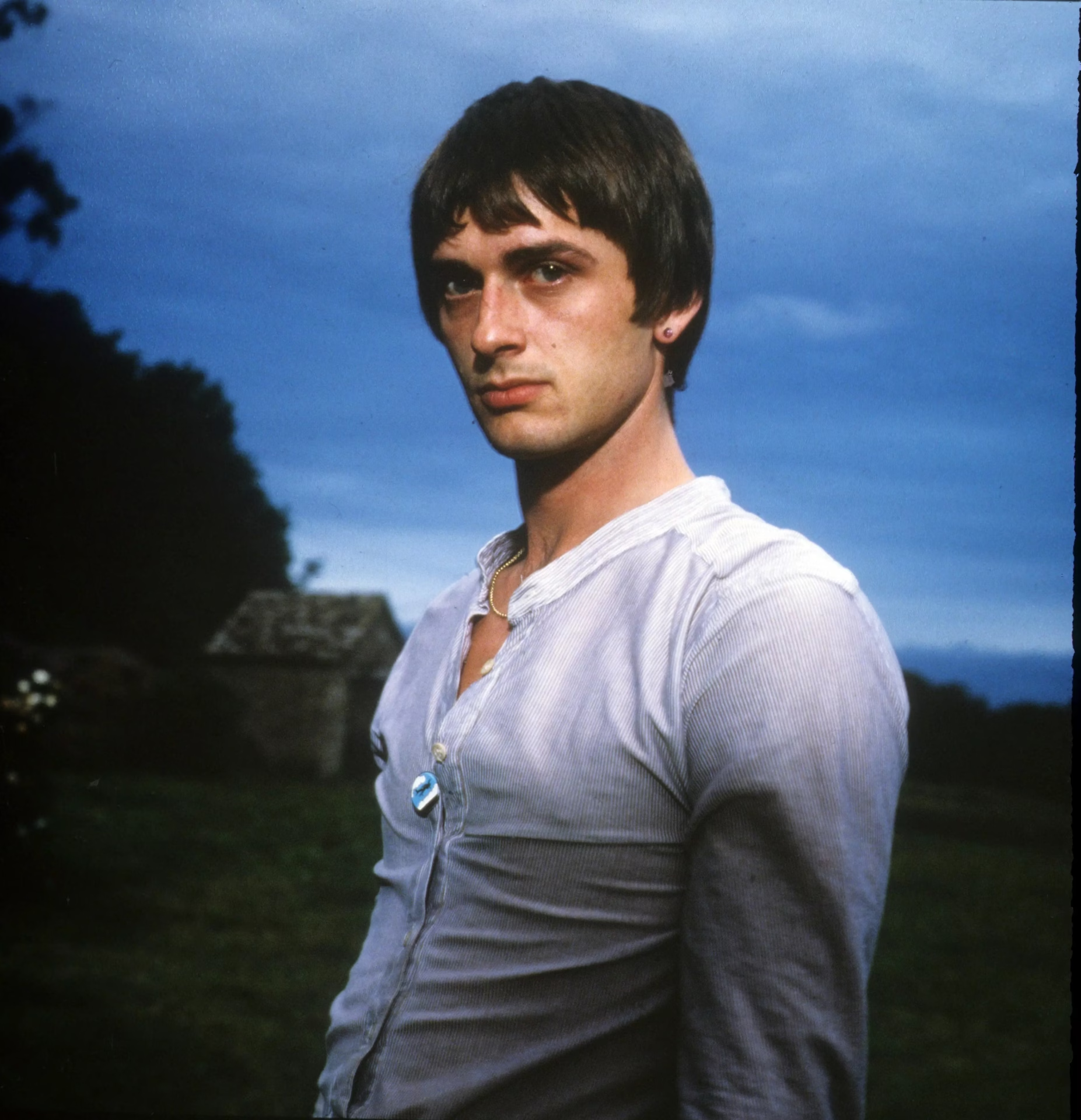
Bold. Idiosyncratic. Progressive. While it's difficult to put Mike Oldfield's Tubular Bells into words, these adjectives are in the ballpark.
<iframe width="620" height="349" src="https://www.youtube.com/embed/pm0J9GIHVns" frameborder="0" allow="autoplay; encrypted-media" allowfullscreen></iframe>
Over the course of nearly 50 minutes, the Englishman's 1973 magnum opus fused prog rock, world, folk, classical, jazz, electronic, and ambient elements. Combined with a minimalist track listing — which simply comprised "Tubular Bells, Part One" and "Tubular Bells, Part Two" spread out over two sides — Oldfield's musical mish-mash yielded an experimental symphony of sorts.
Some of the compositions' movements are beautiful; some drip with acid-rock peculiarity. There are optimistic melodies answered by haunting musical motifs. Strange instruments intervene against the backdrop of odd time signatures. It all yields a complex, introspective listen — but one that is surely worth a stream.
To help prep you for the musical joyride, here are five facts about Oldfield's dead ringer for a GRAMMY Hall Of Fame-inducted album.
1. A One-Man Teenaged Show
<iframe width="620" height="349" src="https://www.youtube.com/embed/6UfGgXP31CQ" frameborder="0" allow="autoplay; encrypted-media" allowfullscreen></iframe>
Born in 1954, Oldfield began recording Tubular Bells in late 1972 at the ripe age of 18. Foreshadowing the work of trendsetting DIY artists such as Prince and Trent Reznor, Oldfield preferred to do the musical heavy lifting himself. Although a guitarist at heart, Oldfield played a cornucopia of instruments on the album, including grand piano, glockenspiel, Farfisa organ, Hammond organ, bass guitar, electric guitar, acoustic guitar, classical guitar, tubular bells (duh), and concert tympani, among others.
"I didn't start out trying [for the album to] be any particular thing. I just had a sound picture of what I wanted to hear," Oldfield told RecordProdction.com.
As a result, the nascent Oldfield expended an incredible amount of time and resources to finish the project.
"I worked a marathon and did over 1,800 individual takes, working 20 hours a day," he told Electronic Musician.
2. Virgin's First
Oldfield's Tubular Bells was not only his debut album, it was the opening salvo for Richard Branson's Virgin Records label. Originally, the entrepreneur tried to sell Tubular Bells to other record companies. But when labels balked at the release — likely due to its outside-the-box nature — Branson was persuaded by colleagues to release it on his new label.
In a tip of the hat to Tubular Bells' significance to his empire, Branson named one of his first Virgin America aircrafts, an Airbus A319-112, N527VA Tubular Belle.
"We've named one of our Virgin aircraft Tubular Belle and we are going into space this year," Branson told The Guardian in 2013. "I doubt any of that would have happened without Tubular Bells. I've listened to it so much, my wife won't let me play it anymore."
3. The Exorcist Connection
<iframe src="https://tools.applemusic.com/embed/v1/album/994663630?country=us" height="500px" width="100%" frameborder="0"></iframe>
Some iconic music-and-film moments result from happy accidents. That's the case with part one of Tubular Bells landing placement in the 1973 horror classic The Exorcist. As the story goes, director William Friedkin scrapped the original score by GRAMMY winner Lalo Schifrin and was on the hunt for replacement music. Friedkin was visiting the offices of Ahmet Ertegun, president of Atlantic Records, the label distributing Tubular Bells in the U.S., and gleaned a promo copy of the album. Upon dropping the needle on his record player, Friedkin was convinced he found the music that would be perfect for his supernatural horror flick.
Although the introduction of " …. Part One" only features briefly in two scenes in the movie, it has become synonymous with what is often argued as the scariest film of all time.
"Most music is in 4/4 time, but that curious little figure at the beginning is in 15/8. It's like a puzzle with a little bit missing. That's why it sticks in the brain," said Oldfield. "And that's why it worked so well as the soundtrack to The Exorcist — with that little bit missing everything is not quite right."
An interesting bit of related trivia? In 2014 Oldfield confessed to The Guardian that he didn't see The Exorcist until a decade after it was released.
4. A Live Performance For A Car
Recording Tubular Bells in the studio was one thing, but taking it on the road? Talk about a huge undertaking. Branson eventually set up for Oldfield to play a one-off show to perform the album in its entirety at London's Queen Elizabeth Hall on June 25, 1973. Understandably reticent to attempt to recreate Tubular Bells live, on the day of the concert Oldfield got cold feet and did not want to move forward with the performance.
This last-minute problem got Branson's motor running.
"I didn't feel I could reproduce the album on a stage," Oldfield told The Guardian. "Richard gave me his Bentley so I would do it, but I later discovered the car cost more to repair than it was worth."
5. Golden Bells And Sequels
To capitalize on the momentum of being featured in The Exorcist, a single version of "Tubular Bells, Part One" was released in February 1974 in North America, rising as high as No. 7 on the Billboard Hot 100. At age 21, Oldfield earned his first career GRAMMY for Best Instrumental Composition for "Tubular Bells — Theme From The Exorcist" at the 17th GRAMMY Awards in 1975. As a testament to its lasting and influential impact, the recording was inducted into the GRAMMY Hall Of Fame in 2018.
Though Oldfield has admitted to being "unhappy with [Tubular Bells] since he made it," the LP has sold more than 18 million copies worldwide. It has birthed sequels such as Tubular Bells II (1992), Tubular Bells III (1998), and The Millennium Bell (1999). And there may be more bells on the way: Oldfield hinted in 2017 that part IV is in the works.