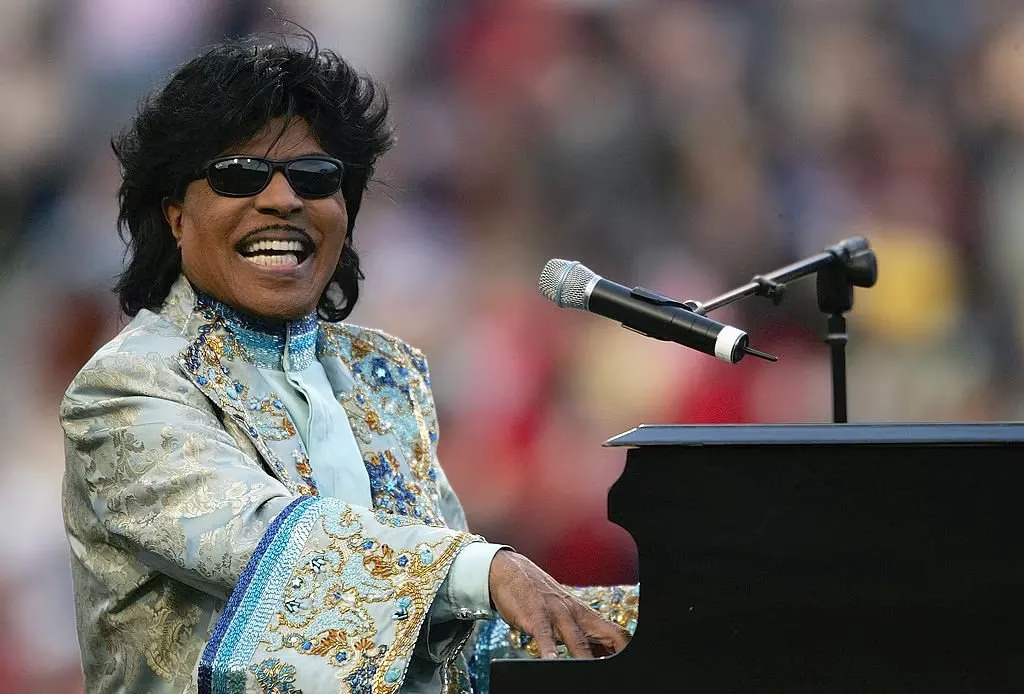
Musical icon Little Richard, an architect and pioneer of rock 'n' roll, a GRAMMY Lifetime Achievement Award Recipient and a GRAMMY Hall Of Fame inductee, died Saturday (May 9). He was 87.
His son, Danny Jones Penniman, confirmed the news of Little Richard's death to Rolling Stone, with the artist's lawyer, Bill Sobel, citing bone cancer as the cause of death.
<style>.embed-container { position: relative; padding-bottom: 56.25%; height: 0; overflow: hidden; max-width: 100%; } .embed-container iframe, .embed-container object, .embed-container embed { position: absolute; top: 0; left: 0; width: 100%; height: 100%; }</style><div class='embed-container'><iframe src='https://www.youtube.com/embed/ivhauEr3KxU' frameborder='0' allowfullscreen></iframe></div>
Harvey Mason jr., Chair and Interim President/CEO of the Recording Academy, shared a touching message about Little Richard's passing on behalf of the organization.
"As one of the founding fathers of rock and roll, Little Richard's music and persona is one of the most recognized and celebrated voices of American music, influencing artists across all genres today," Mason jr. said. "Little Richard's legacy will be remembered by music fans for generations to come."
With a career spanning over six decades, Little Richard played an integral role in shaping the sound and establishing the foundation of the then-burgeoning rock 'n' roll genre. His high-energy music, flamboyant performance style, impassioned sing-shout vocals, outrageous costumes and androgynous onstage persona comprised the singer's signature look and sound on an individual level, while also personifying and defining some of the key sonic and visual elements that would inform the rock genre. While his music ranged in the rock and R&B umbrella genres, the singer impacted artists from a wide array of backgrounds, from rock to hip-hop, with several of his contemporaries recording covers of his originals, including The Beatles, Elvis Presley, Buddy Holly and Jerry Lee Lewis, among many others. As well, his music also helped shape whole genres, including funk and soul. Little Richard ultimately earned the nickname the "Architect Of Rock And Roll."
Born Richard Wayne Penniman in Macon, Ga., in 1932, he first broke out as Little Richard in the mid-'50s on the strength of a string of hit singles, including "Tutti Frutti," "Long Tall Sally" and "Rip It Up," all in 1956, followed by "Lucille" in 1957 and "Good Golly Miss Molly" in 1958, all of which became his staple songs and "part of the rock & roll canon," Rolling Stone notes.
Read: Little Richard Was The Lightning Storm That Awakened Rock
Born into a large religious family—he was one of 12 children—Penniman began his musical career signing in a local church at a young age before leaving his home at 13 after his father accused him of being gay.
Sister Rosetta Tharpe, a rock 'n' roll pioneer herself and a major influence on Little Richard, gave Penniman his first paid live music gig, opening her show at Macon City Auditorium, in 1947 when he was 14. The event would convince Penniman to pursue music as a full-time career. On a professional level, Penniman landed his first record deal in 1951, signing with RCA. However, his stint with the label failed to produce national success.
Penniman would finally gain national chart success with "Tutti Frutti." Released on Chicago imprint Specialty Records in 1955, the song became Little Richard's breakout single and his first major hit, reaching No. 17 on the pop charts. The iconic song, which contained Little Richard's eternal balderdash lyrics, "A-wop-bom-a-loo-mop-a-lomp-bom-bom," has been covered by Pat Boone, Elvis Presley and The Beatles.
<style>.embed-container { position: relative; padding-bottom: 56.25%; height: 0; overflow: hidden; max-width: 100%; } .embed-container iframe, .embed-container object, .embed-container embed { position: absolute; top: 0; left: 0; width: 100%; height: 100%; }</style><div class='embed-container'><iframe src='https://www.youtube.com/embed//hCPTLd3ZPX8' frameborder='0' allowfullscreen></iframe></div>
Little Richard released his debut album, Here's Little Richard, in 1957; the LP reached No. 13 on what was then known as the Best Selling Pop Albums chart, according to Billboard. Later that year, the singer announced he was quitting music professionally and turning to religion, becoming an ordained minister. He released a gospel set, God Is Real, in 1959, according to Rolling Stone.
After his gospel career failed to take off, Little Richard returned to secular music in the early '60s, though his music would never reach the success he achieved during his breakout run in the '50s, outside of occasional charting songs.
Following an addiction to cocaine, Little Richard again quit music for religion in the mid-'70s; he released another gospel album, God's Beautiful City, in 1979. He stopped making albums altogether in 1992, Billboard notes. He continued to tour and perform extensively into his later years. However, after a hip replacement surgery in 2009, he announced his retirement from performing in 2013.
<style>.embed-container { position: relative; padding-bottom: 56.25%; height: 0; overflow: hidden; max-width: 100%; } .embed-container iframe, .embed-container object, .embed-container embed { position: absolute; top: 0; left: 0; width: 100%; height: 100%; }</style><div class='embed-container'><iframe src='https://www.youtube.com/embed/fzDJOyZjTVg' frameborder='0' allowfullscreen></iframe></div>
Outside of music, Little Richard also dabbled in acting. He had roles and cameos on films like Down And Out In Beverly Hills and The Naked Truth as well as TV shows like "Full House," "Baywatch" and "The Simpsons" between the '80s and 2000s. The 2000 eponymous biopic, Little Richard, starring actor/singer Leon in the lead role, chronicled the singer's early years and rise in music through the '50s and '60s.
Recognized as one of the first black crossover artists, Little Richard's music and legacy also challenged, and often broke, many cultural and societal barriers. In a 1984 interview on "Today," he told Bryant Gumbel his "joyful music" "brought the races together."
"White people were sitting upstairs, black people downstairs. And the white people, when I started singing, they would jump over the balcony and come down there with us, so it brought them together," Little Richard said in the interview, speaking of his early music days in the American South when concerts were still largely segregated.
Little Richard also noted the importance of his 1956 hit song, "Tutti Frutti," in breaking color barriers. "'Tutti Frutti' really started the races being together … From the git-go, my music was accepted by whites," he told Rolling Stone in 1990.
He also shattered sexual stereotypes in rock and pop culture through his androgynous image and stage persona. He performed in drag in his early years, and his flamboyant, effeminate performance style and personality would "set the standard for rock & roll showmanship," Rolling Stone writes. His influence in this space would later be seen in fellow gender-bending rock stars like David Bowie, Freddie Mercury and Prince.
In addition to being inducted into the Rock & Roll Hall Of Fame as part of the institution's inaugural class in 1986, Little Richard is also an inductee of the Songwriters Hall Of Fame. He received the Recording Academy's Lifetime Achievement Award in 1993. Four of his recordings were inducted into the GRAMMY Hall Of Fame: his 1957 debut album, Here's Little Richard, in 2013, as well as his classic songs "Tutti Frutti" in 1998, "Long Tall Sally" in 1999 and "Lucille" in 2002.
Little Richard is survived by his son, Danny Jones Penniman; a complete list of surviving family members is not yet available, The New York Times reports.