
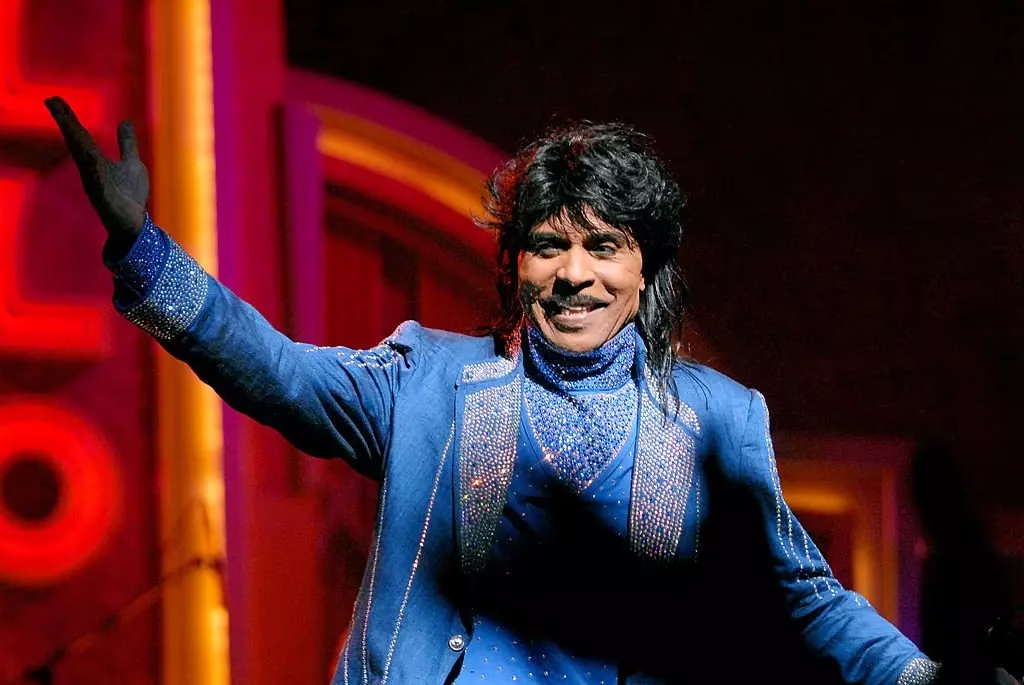
In your mind's eye, picture a few rock superstars: Paul McCartney, Bob Dylan, David Bowie, Jimi Hendrix, Tina Turner, Elton John, AC/DC, Prince. Chances are you thought about one of them in the past week. Now picture none of them picking up an instrument, none of them writing a tune, none of them entering your life. If Little Richard hadn't been born in 1932, this would arguably be the world we live in—a passable, but perhaps joyless place.
Little Richard didn't just play the piano passionately, or sing about joyful subjects. He was like an alien dispatched from Andromeda to administer humanity a joy inoculation. Imagine 1950s America getting an eyeful of him: his circus-freak pompadour, his gender- and race-ambiguous makeup, his flash of sequins. Just as exotic was the tortured glossolalia he screamed as if he was on fire: "A-wop-bop-a-loo-bop-a-wop-bam-boom!" from 1955's "Tutti Frutti." But as the first chapter of nearly every rock biography will attest, pent-up girls and boys all around the war-torn world read him loud and clear.
<style>.embed-container { position: relative; padding-bottom: 56.25%; height: 0; overflow: hidden; max-width: 100%; } .embed-container iframe, .embed-container object, .embed-container embed { position: absolute; top: 0; left: 0; width: 100%; height: 100%; }</style><div class='embed-container'><iframe src='https://www.youtube.com/embed//NnIIvWnpaBU' frameborder='0' allowfullscreen></iframe></div>
The artist born Richard Wayne Penniman, who died Saturday (May 9) at 87, wasn't the King Of Rock 'N' Roll (that's Elvis Presley), and he wasn't its founding father either (that's Chuck Berry). Watch the 1931 film Frankenstein: If rock music is Promethean Man in the watchtower lab, then Little Richard is the electrical storm that animates him, and the terrified populace is ... well, the terrified populace. But while a mob eventually cornered Frankenstein's monster in a windmill and set it ablaze, Little Richard's impact was, and still is, uncontainable.
Soon after Little Richard dropped "Long Tall Sally" in 1956, Paul McCartney decided it'd be the first song he sang in public. When asked to describe his life's aspiration in his high school yearbook, Bob Dylan wrote: "To join Little Richard." A pre-Ziggy Stardust Bowie took notes on his hairdo, among other things. Hendrix would join his band in a decade and form The Experience a year after he left. Tina Turner based her early vocal delivery on Little Richard's. Elton John heard him and closed the menu of life choices: "I didn't ever want to be anything else." AC/DC singer Brian Johnson once described him in Genesis 1:1 terms: "There was nothing, and then there was this." As for Prince, the "gestures vaguely at everything" meme will have to do. Little Richard was a bell nobody could unring, and his chime still resonates unceasingly.
Even among his fellow rock 'n' roll pioneers, Little Richard was something strange and different. While Presley was a humble country boy and Berry was a poet with a guitar, Little Richard was a living remix of Baptist and Pentecostal church and the minstrel shows, traveling circuses and drag revues on which he cut his teeth. Beginning when he was 18, he had a few false starts in the studio: Incensed by his flamboyance and perceived impudence, Peacock Records owner Don Robey beat Little Richard so badly, he required surgery. Undeterred, Little Richard sent Specialty Records a demo two years later; producer Robert "Bumps" Blackwell described the tape as "looking as though someone had eaten off it." After Little Richard repeatedly called their staff begging them to listen to it, they relented and set up a recording date at J & M Studio in New Orleans.
Still, the recording session wasn't working; Little Richard was frustrated that his sound wasn't catching fire. He remembered "Tutti Frutti," a naughty song he had absentmindedly written while working as a dishwasher at a Greyhound station. He cleaned up the song's sexual references, and after a lunch break, he let it rip with that nonsensical, unforgettable refrain. The exuberant resulting single, which was a watershed for black vernacular in a pop song, hit No. 2 on the Billboard Rhythm and Blues Chart and was added to the Library Of Congress National Recording Registry in 2010. In 1998, "Tutti Frutti" was inducted into the GRAMMY Hall Of Fame.
<style>.embed-container { position: relative; padding-bottom: 56.25%; height: 0; overflow: hidden; max-width: 100%; } .embed-container iframe, .embed-container object, .embed-container embed { position: absolute; top: 0; left: 0; width: 100%; height: 100%; }</style><div class='embed-container'><iframe src='https://www.youtube.com/embed//XkkrTuuG0X8' frameborder='0' allowfullscreen></iframe></div>
"I wrote 'Tutti Frutti' in the kitchen, I wrote 'Good Golly Miss Molly' in the kitchen, I wrote 'Long Tall Sally' in that kitchen," Little Richard later explained to Rolling Stone in 1970 about the bus stop gig; he followed up "'Tutti Frutti" with those just-as-exultant barnburners. The cover of his 1957 debut album, Here's Little Richard, featuring a close-up of Richard in mid-scream that would make Edvard Munch proud, is the ultimate truth in advertising: There's zero ambiguity about what the music inside will sound like.
And that sound was unbridled liberation—from whitewashed suburbia, from hellfire religion typified by the preacher in 1978's The Buddy Holly Story, from the anodyne pop on the airwaves. (The Billboard pop chart in 1954 was full of downtempo tracks by Rosemary Clooney, Kitty Kallen and The Crew-Cuts.) After Little Richard experienced a religious conversation and left secular music in 1962, coming back to a music scene dominated by the British boys who idolized him, like The Beatles and The Rolling Stones, was no easy task. After flower power and Woodstock made his provocations seem quaint, he soon became a thing of the rock 'n' roll revival circuit.
<style>.embed-container { position: relative; padding-bottom: 56.25%; height: 0; overflow: hidden; max-width: 100%; } .embed-container iframe, .embed-container object, .embed-container embed { position: absolute; top: 0; left: 0; width: 100%; height: 100%; }</style><div class='embed-container'><iframe src='https://www.youtube.com/embed//E68N5E1d0_M' frameborder='0' allowfullscreen></iframe></div>
A zip code away from his macho peers, Little Richard was a rock star that LGBTQ folks could look up to before coming out was the norm, and he galvanized Bowie and Prince to tear up the rulebook of gender expression. And his unspoken message, whether to those in a bind over their sexuality or not, was abundantly clear: No matter who you are, scream it out. That scream was one-size-fits-all for the human experience. When you hear Macca howling like a maniac on "I'm Down," "Hey Jude" and "Oh! Darling," understand that The Beatles' keyhole to jubilation—and therefore, everyone's—had a Little-Richard-shaped key.
The songs Little Richard co-wrote or interpreted all have the same feeling of anticipation, which is applicable to every stage of life: the last minutes of school on a Friday, the beginning of an unforgettable night out, the first blush of romantic attraction. He's ready to cause trouble, but the good-natured kind—the kind that doesn't put anybody down, but instead drags everyone off the couch and into a raucous block party. His songs exist at the perpetual "here we go" moment, the exhilarating flash on the rollercoaster when your stomach plunges.
We're gonna have some fun tonight. Everything's all right.
