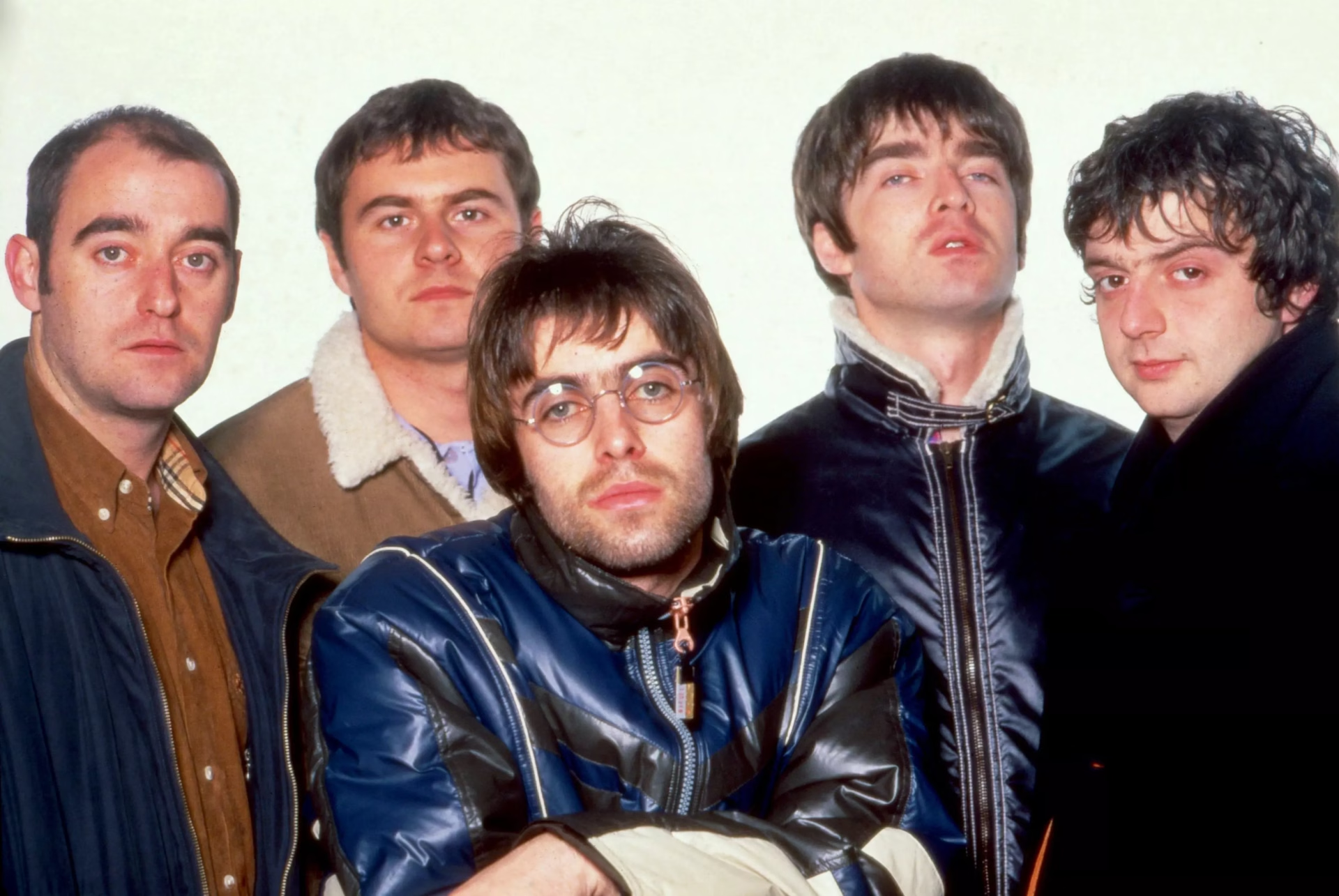
Rightly considered one of the eminent forces of 1990s Britpop, Manchester troupe Oasis found sizable acclaim and attention with 1994's Definitely Maybe. Like Radiohead’s Pablo Honey the year before, though, it was a strong but noticeably raucous and rudimentary debut. That said, there was enough potential to assume that its follow-up would feature more refined arrangements, production and songwriting. Fortunately, 1995's (What’s the Story) Morning Glory? offered precisely that.
True, a few songs became too big for their own good (you know the ones); plus, it was a more traditionally retro second effort than, say, Radiohead's innovative and diverse The Bends or the characteristically strange first releases from Oasis’ ostensibly direct rivals, Blur; yet, (What’s the Story) Morning Glory? was a major step forward for the famously combative Gallagher brothers and crew. Twenty-five years on, it remains a top-notch slice of Britpop wistfulness.
Following the success of Definitely Maybe, Oasis were already showing signs of external triumph and internal turmoil. They’d spent much of 1994 touring and living the typical rock star lifestyle; as a result, the now-legendary tensions between Noel and Liam Gallagher truly began, with a September 1994 show in Los Angeles resulting in Liam throwing a tambourine at his brother, leading to Noel momentarily quitting the band. Thankfully, they reconciled, continued playing gigs, and focused on writing what would become (What’s the Story) Morning Glory?
<style>.embed-container { position: relative; padding-bottom: 56.25%; height: 0; overflow: hidden; max-width: 100%; } .embed-container iframe, .embed-container object, .embed-container embed { position: absolute; top: 0; left: 0; width: 100%; height: 100%; }</style><div class='embed-container'><iframe src='https://www.youtube.com/embed/cmpRLQZkTb8' frameborder='0' allowfullscreen></iframe></div>
Predictably, they stayed with Creation Records, and the main quintet from Definitely Maybe carried over here; however, the sequence served as a transitional work in terms of drummers, with founder Tony McCarroll only playing on one track—"Some Might Say"—while his replacement, Alan White, played on everything else. Rather than create in several locations, they stuck to just one place—Rockfield Studios in Wales—and simplified further by using just two returning producers: Noel Gallagher and Owen Morris. By most accounts, the recording sessions were smooth, swift, and fruitful.
In the run-up to release, the press helped Oasis stir up more controversy with Blur. Specifically, both bands issued singles on August 14, 1995, with Blur’s "Country House" quickly outselling Oasis’ "Roll With It" by about 50,000 copies. In response, Noel told The Observer the following month that he wished members of Blur would "catch AIDS and die." He issued an apology shortly thereafter, but the remark continued to serve as a chief example of Oasis’ well-known bitterness.
<style>.embed-container { position: relative; padding-bottom: 56.25%; height: 0; overflow: hidden; max-width: 100%; } .embed-container iframe, .embed-container object, .embed-container embed { position: absolute; top: 0; left: 0; width: 100%; height: 100%; }</style><div class='embed-container'><iframe src='https://www.youtube.com/embed/tI-5uv4wryI' frameborder='0' allowfullscreen></iframe></div>
Despite all of that disorder, (What’s the Story) Morning Glory? outdid its predecessor commercially. In fact, it sold nearly 350,000 copies in its first week alone and entered the U.K. charts at No. 1. (It remained at the top of the charts for the rest of the year and eventually became one of the best-selling U.K. albums of ever.) Comparably, it reached #4 on the Billboard 200, with six singles being out out between April 1995 and May 1996. It also fared quite well in Canada, Sweden, New Zealand and elsewhere, so it’s fair to say that the LP was a global hit.
It’s a bit ironic, then, that initial critical reviewers weren’t entirely enthusiastic, with publications like Q, the Chicago Tribune, Melody Maker and The Independent voicing significant gripes. In contrast, Entertainment Weekly, the Los Angeles Times, NME, and Rolling Stone were more positive. Of course, the record is now considered a classic, with a high ranking in several articles and books about the greatest albums of all time. It even won "British Album of 30 Years" at the 2010 Brit Awards.
<style>.embed-container { position: relative; padding-bottom: 56.25%; height: 0; overflow: hidden; max-width: 100%; } .embed-container iframe, .embed-container object, .embed-container embed { position: absolute; top: 0; left: 0; width: 100%; height: 100%; }</style><div class='embed-container'><iframe src='https://www.youtube.com/embed/dxOn-aZZ9z0' frameborder='0' allowfullscreen></iframe></div>
Although other releases from back then may have pushed more boundaries, (What’s the Story) Morning Glory? still shines in terms of recalling the splendor of the 1960s British Invasion within a modern edge. For instance, "Roll with It"—with its poppy melodies, backing chants and twangy guitar strums—sounds like a lost Lennon tune from Help! or Rubber Soul. The same can be said for the brighter and more playful "She’s Electric"; the dreamily epic "Cast No Shadows"; and the decidedly biting and symphonic "Hey Now!" That’s not to say that Oasis were being too derivative—rather, they incorporated such homages into an irresistibly invigorating and poignant new stew.
Similarly, the immensely popular "Wonderwall," "Don’t Look Back in Anger" and "Champagne Supernova" are still among the best tunes from the Britpop era. In particular, "Wonderwall" is a quintessential example of a 1990s acoustic rock ode complemented by strings, with a lovely juxtaposition of hip verses and compelling choruses. The piano-led "Don’t Look Back in Anger"—their first single with Noel on lead vocals—is just as gripping yet even more nuanced, touching and charming. As for "Champagne Supernova," its cryptically poet lyricism and fiery guitarwork (courtesy of Paul Weller) taps into 1970s classic rock while also harnessing the optimism and softness of the previous decade’s folky warmth.
<style>.embed-container { position: relative; padding-bottom: 56.25%; height: 0; overflow: hidden; max-width: 100%; } .embed-container iframe, .embed-container object, .embed-container embed { position: absolute; top: 0; left: 0; width: 100%; height: 100%; }</style><div class='embed-container'><iframe src='https://www.youtube.com/embed/bx1Bh8ZvH84' frameborder='0' allowfullscreen></iframe></div>
Even the unruliest tunes—"Hello," "Some Might Say" and “Morning Glory”—manage to conjure Definitely Maybe whilst showcasing advanced techniques. The hooks are bigger, the layers are denser and the scopes are larger. There are also the two "Untitled" entries (a.k.a "The Swamp Song—Excerpt 1" and "Excerpt 2"): the first is a quick and relatively abstract interlude full of vibrant post-punk carnage, while the second cleverly reprises its forebearer beneath the soothing sounds of water. Sure, they may not be significant when heard in isolation, but the ways in which they tie together—as well as how they segue in and out of the tracks around them—give the LP a stronger sense of continuity and ambition.
Two-and-a-half decades later, (What’s the Story) Morning Glory? is still a great record. At the time, it propelled Oasis further creatively, commercially, and—at least to an extent—critically, all the while dominating the high school hangouts and dorm room memories of countless Gen Y fans. Thus, it’s a significant time capsule as much as it is a superb piece of entertainment, and while real-life incidents may have marginally marred our nostalgia for it, when considered outside of that drama, it’s well worth looking back in appreciation.
