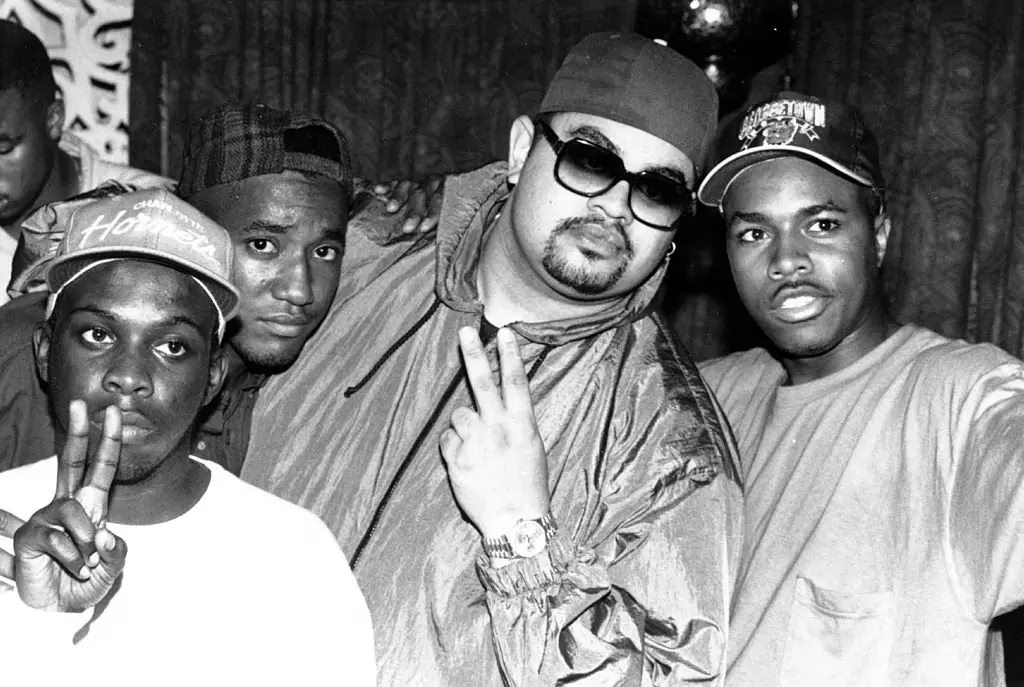
There's no denying that 1990 was a watershed year for golden age hip-hop. Falling between the mid-'80s pop-cultural cannonball brought on by platinum-selling progenitors like Whodini, Run-D.M.C., Beastie Boys, LL Cool J, and Fat Boys and the mid-‘90s boon of genre-perfecting classics from Dr. Dre, Tupac, Nas, Wu-Tang Clan, and Snoop Dogg, the hip-hop scene of 1990 provides a vibrant snapshot of both the limitless sonic bounds of the genre and also the kaleidoscopic variety of talents and personalities from the MCs, writers, DJs, producers, and hype men who were all raised on a musical ethos of telling your own stories, creating your own sounds, and (at least according to A Tribe Called Quest) devoting yourself to the art of moving butts.
Some of the more memorable hip-hop albums released in 1990 found solo artists and groups taking the party to the pop masses via Top 40 radio and MTV (MC Hammer’s Please Hammer, Don’t Hurt ‘Em, Digital Underground’s Sex Packets), others were infusing bombastically heavy doses of socio-political commentary into their lyrics and aesthetics (Public Enemy’s Fear Of A Black Planet, Brand Nubian’s One For All), some first-gen pioneers were reclaiming their territory with new creative forces (LL Cool J’s Mama Said Knock You Out, Run-D.M.C.’s Back From Hell), while others were helping to bring increased national exposure to the grittier hardcore subgenres first popularized by Ice-T, N.W.A., and others (Ice Cube’s AmeriKKKa’s Most Wanted, Too Short’s Short Dog’s In The House).
However, there’s possibly no greater singular encapsulation of the eclectic kitchen-sink sampling, poetic lyricism, production adventurousness, bohemian aesthetics, socially conscious intellectualism, musical magpie sensibilities and charismatic MC magnetism that was overflowing in the early-‘90s hip-hop scene than People’s Instinctive Travels And The Paths of Rhythm, the debut album from A Tribe Called Quest.
Although it is often recognized as one of the most groundbreaking and influential hip-hop albums of all time (thanks, in large part, to its trio of iconic singles "Can I Kick It?," "Bonita Applebum" and "I Left My Wallet In El Segundo"), People’s Instinctive Travels And The Paths Of Rhythm was birthed from seemingly simple beginnings. The Jamaica, Queens group started out as a foursome of high school teenagers: Jonathan "Q-Tip" Davis, Malik "Phife Dawg" Taylor (who died from diabetes-related complications in 2016), Ali Shaheed Muhammad and Jarobi White (who left the group in 1991 and returned for their final album, 2016’s We Got It From Here… Thank You 4 Your Service). Through a series of intersecting relationships—Q-Tip and Phife were elementary school friends, Phife and Jarobi met in middle school, and Ali joined the trio during their high school years—the quartet came together under the name Quest. A couple of years after forming, they altered their name to A Tribe Called Quest—a moniker bestowed upon them by Afrika Baby Bam of Jungle Brothers, another hip-hop crew from their same high school.
<style>.embed-container { position: relative; padding-bottom: 56.25%; height: 0; overflow: hidden; max-width: 100%; } .embed-container iframe, .embed-container object, .embed-container embed { position: absolute; top: 0; left: 0; width: 100%; height: 100%; }</style><div class='embed-container'><iframe src='https://www.youtube.com/embed/6HqVL4naP2c' frameborder='0' allowfullscreen></iframe></div>
Throughout the late '80s, the group furiously dug through as many records as they could procure to build their own diverse catalog of relaxed breakbeats and vintage jazz, rock, soul and R&B samples in order to craft a demo that would land them a record deal. Simultaneously, Q-Tip was becoming an insatiable studio rat—an invaluable learning experience that would indelibly inform both his production work in Tribe and also his eventual career path producing songs for such renowned artists as Mariah Carey, Mobb Deep, Nas, Whitney Houston, Kanye West, Jay-Z, Quincy Jones, Santigold and many more. Before Tribe had even released their first album, Q-Tip had already found his way onto two songs ("Black Is Black" and "The Promo") from Jungle Brothers' 1988 album Straight Out The Jungle and is reported to have been in the studio for every recording session of De La Soul’s landmark 3 Feet High And Rising album. The intertwined friendships, eclectic musical tastes, creative synergy and like-minded ethea between A Tribe Called Quest, De La Soul and Jungle Brothers led the three groups to form the Afrocentric hip-hop collective Native Tongues, which quickly expanded to include Queen Latifah, Monie Love, Black Sheep, Chi-Ali, and—depending on who you ask—maybe (or maybe not) a few others.
After a demo deal with Geffen Records failed to net the band a full album deal, A Tribe Called Quest eventually signed on with Jive Records—a young indie label that had earned some legit street cred for putting out a slew of notable ‘80s hip-hop records from Whodini, Schoolly D, Kool Moe Dee, Too Short and Boogie Down Productions, as well as the triple-platinum, GRAMMY-winning album He's The DJ, I’m the Rapper from DJ Jazzy Jeff and the Fresh Prince. Jive set the group up in N.Y.C.'s Calliope Studios, which was already establishing itself as the inspirationally fertile ground zero for Native Tongues. As Phife describes the moment to journalist Harry Allen in the liner notes for the 25th-anniversary release of People’s Instinctive Travels And The Paths Of Rhythm, "Jungle in one room, recording… De La Soul in another room, recording. Latifah in another room, recording. Prince Paul… Everybody was there." In the same retrospective essay, Q-Tip refers to the secluded, musically rich, distraction-free environment as a literal utopia: "We didn’t have the cell phones, we didn’t have the internet… When we got to the studio, the specific job was to make music."
<style>.embed-container { position: relative; padding-bottom: 56.25%; height: 0; overflow: hidden; max-width: 100%; } .embed-container iframe, .embed-container object, .embed-container embed { position: absolute; top: 0; left: 0; width: 100%; height: 100%; }</style><div class='embed-container'><iframe src='https://www.youtube.com/embed/O3pyCGnZzYA' frameborder='0' allowfullscreen></iframe></div>
And make music they did. Some of the most memorable music in all of hip-hop history, in fact. The instrumental joie de vivre on People’s Instinctive Travels And The Paths Of Rhythm flawlessly combines chopped-up samples both immediately recognizable (the opening motif of Stevie Wonder's "Sir Duke" is lifted for the intro of "Footprints," the impeccably minimalist bassline from Lou Reed's "Walk On The Wild Side” propels the mellow groove of "Can I Kick It?," and a processed one-word vocal snippet from Earth, Wind & Fire’s "Brazilian Rhyme" becomes the hypnotic refrain of "Mr. Muhammad") and also more obscure (album opener "Push It Along" glides on a combined loop of Grover Washington, Jr.’s "Loran’s Dance" and the drums from Junior Mance’s cover of Sly Stone’s "Thank You (Falletin Me Be Mice Elf Agin)" and the whimsically cinematic road-trip-gone-awry saga of "I Left My Wallet In El Segundo" dances between the slinky interplay of the guitar and drums of "Funky" from The Chambers Brothers and is introduced by the flamenco-inspired into to The Young Rascals' "Sueno"). They even created a few sample-within-a-sample meta moments, like when they lifted the snippet of "La Marseillaise" that The Beatles used to open "All You Need Is Love" to serve as their own intro for "Luck Of Lucien."
While experimentally playful album cuts like "Youthful Expression," "Luck Of Lucien" and "Go Ahead In The Rain" (featuring a lovely bluesy vocal bit of Jimi Hendrix's "Rainy Day Dream Away") paint a broad sonic picture of the group’s relaxed charisma and musical eclecticism, it’s the album’s singles that have really helped to cement People’s Instinctive Travels And The Paths Of Rhythm as the true gamechanger it is.
<style>.embed-container { position: relative; padding-bottom: 56.25%; height: 0; overflow: hidden; max-width: 100%; } .embed-container iframe, .embed-container object, .embed-container embed { position: absolute; top: 0; left: 0; width: 100%; height: 100%; }</style><div class='embed-container'><iframe src='https://www.youtube.com/embed/WILyWmT2A-Q' frameborder='0' allowfullscreen></iframe></div>
The album's whimsical lead single, "I Left My Wallet In El Segundo," immediately set the stage for Tribe’s fun-over-fronting ethos. With its bouncy Chambers Brothers sample providing the bedrock for Q-Tip's laid-back travelogue, the song's emphasis on melody, breezy grooves, and non-posturing self-effacement, were all bold antitheses to the more aggressive braggadocio of their hip-hop contemporaries. Once the video hit MTV, Tribe's seemingly fully realized set-apartness was even more on display for all to see. The group is charming, chill and undeniably photogenic, while their emblematic four-ank and stick-figure logo (courtesy of artist Dave Scilken) got its first introductory roll-out ahead of becoming one of the most iconic hip-hop logos this side of Run-D.M.C. and Public Enemy.
As the summer of 1990 hit, Tribe released the follow-up single from People’s Instinctive Travels And The Paths Of Rhythm, the immediate hit turned legendary classic, "Bonita Applebum." While the slinky song and memorable video did well in its day, "Bonita Applebum" quickly became a sonic touchstone for other artists to show their love and respect for A Tribe Called Quest. The following year, P.M. Dawn interpolated the vocal hook into the lyrics of their Billboard No. 1 hit "Set Adrift On Memory Bliss," and the song's titular character has been name-dropped in songs by Jay-Z, Lil Wayne, Biz Markie, Redman and many others. Even the instrumental sections of "Bonita Applebum" (themselves a mixture of samples from Rotary Connection, RAMP, Little Feat and The Dave Pike Set) have been re-sampled in songs by Monica, Wyclef Jean, B.o.B, and most notably in the Fugees' GRAMMY-winning cover of Roberta Flack's "Killing Me Softly" in 1996.
<style>.embed-container { position: relative; padding-bottom: 56.25%; height: 0; overflow: hidden; max-width: 100%; } .embed-container iframe, .embed-container object, .embed-container embed { position: absolute; top: 0; left: 0; width: 100%; height: 100%; }</style><div class='embed-container'><iframe src='https://www.youtube.com/embed/HU_4pf8BSQw' frameborder='0' allowfullscreen></iframe></div>
"Can I Kick It?" was the third and final single culled from the album, released in the late fall of 1990. While the song’s popularity could easily be attributed to the delightfully inescapable call-and-response chorus chant or the familiar Lou Reed bassline sample, there was also an ever-increasing buzz building around Tribe’s music, aesthetic, and approach to life that seems to really shine through the music video for "Can I Kick It?" with its confident but not arrogant, playful but still artful, sharing the good times with your friends vibe (members of De La Soul even appear throughout).
The game-changing impact of People’s Instinctive Travels And The Paths Of Rhythm was immediate. Reviews were widely positive, with The Source bestowing its first hallowed "Five Mic" rating and calling it "a completely original musical and spiritual approach to hip-hop… with sophisticated production invoking a jazz flavor." NME’s Ian McCann famously wrote that "A Tribe Called Quest put no feet in the wrong place here. This is not rap, it's near perfection." Tribe even became the first hip-hop act to perform on MTV Unplugged, opening the Yo! Unplugged Rap hybrid show with "Can I Kick It?" (which was coincidentally recorded on the album’s one-year anniversary).
<style>.embed-container { position: relative; padding-bottom: 56.25%; height: 0; overflow: hidden; max-width: 100%; } .embed-container iframe, .embed-container object, .embed-container embed { position: absolute; top: 0; left: 0; width: 100%; height: 100%; }</style><div class='embed-container'><iframe src='https://www.youtube.com/embed/TCQDEbmjMRU' frameborder='0' allowfullscreen></iframe></div>
Looking back over Tribe’s entire catalog, there are certainly other albums that received more quantifiable accolades and, maybe to some, even appear to outshine their debut. Sophomore album The Low End Theory gave the band their first platinum record and features the greatest posse cut of all time, "Scenario" (introducing Busta Rhymes to the masses and giving us one of the best early-90s, computer-centric music videos ever). 1993's Midnight Marauders gave the group its best chart performance (at that time), hitting No. 1 on the Billboard R&B/Hip-Hop Albums and No. 8 on the overall Billboard 200. 1996's Beats, Rhymes, and Life went so far as debuting at No. 1 on the Billboard 200 and it gave the group their first two GRAMMY nominations. However, when you talk about A Tribe Called Quest, it’s impossible to not begin and end the discussion with their debut shot across the bow, People’s Instinctive Travels And The Paths of Rhythm. Other albums may have changed A Tribe Called Quest’s individual career path, but their debut changed the whole trajectory of hip-hop in ways that still reverberate and inspire today. When it comes to rhythms, Quest is (still) your savior.
On 'Things Fall Apart,' The Roots Deepened Hip-Hop