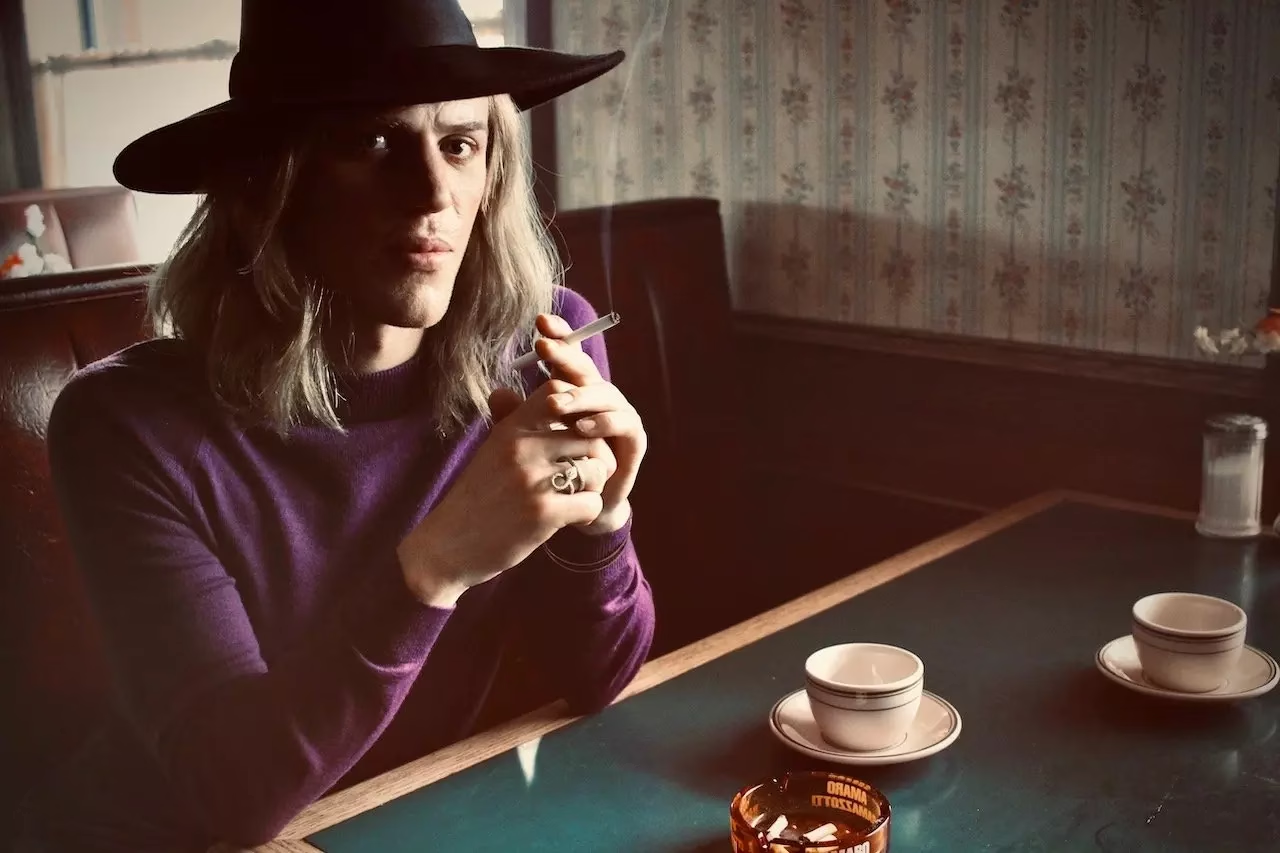
The hunger for a David Bowie biopic has intensified in the four years since the icon's death and in the wake of the breakout box office success of music films like Bohemian Rhapsody and Rocketman. But despite its perfect title and marketing that might suggest otherwise, Stardust had zero aspirations to embody the big Bowie biopic daydream.
Released last month (Nov. 25) on multiple streaming platforms, Stardust is an intriguing, somewhat arty interpretation encompassing a short but influential window of time before Bowie broke big. The film follows a young Bowie, played by British musician/actor Johnny Flynn, in his pre-Ziggy, boho-rock days. Aided by Ron Oberman, played by comic and podcast king Marc Maron, the record company PR guy tasked with promoting the singer in the U.S. at the start of his career, Bowie takes an ill-fated press trip to America in 1971 that ultimately helps shape the sound and style of one of music's most revered figures: Ziggy Stardust.
<style>.embed-container { position: relative; padding-bottom: 56.25%; height: 0; overflow: hidden; max-width: 100%; } .embed-container iframe, .embed-container object, .embed-container embed { position: absolute; top: 0; left: 0; width: 100%; height: 100%; }</style><div class='embed-container'><iframe src='https://www.youtube.com/embed//U82heDabn5k' frameborder='0' allowfullscreen></iframe></div>
Despite a disclaimer that states "what follows is (mostly) fiction" at the start of Stardust, the film's basic premise is based on true facts. Bowie did have to stay with the real Oberman and his family in Maryland before embarking on a bare-bones road trip to promote his music, and due to visa problems, the singer was not able to play any substantial venues or even play his own music during the tour. He was clearly struggling with some identity issues as an artist before he evolved into the Starman, and as depicted in the film, his relationship with his overbearing wife, Angie (Jena Malone), became more and more strained as he grew as an artist, fleshing out his flamboyant, cosmic persona and music.
While Stardust is indeed a music film, the music logistics for the movie were no easy road. Last February, Bowie's son, Duncan Jones, announced on Twitter that he and his family would not authorize the use of his dad's music for the film. Consequently, fans quickly denounced the project. But the film's writer/director, Gabriel Range, had very specific intentions, and music wasn't necessarily essential to explore them.
"He didn't want to give us the music, but that's great because it provided us more freedom," Maron said during a joint interview with Flynn before the release of Stardust. "We couldn't afford it anyway. The idea that we can't interpret this moment in David Bowie's life out of respect is ridiculous. David was a public figure who contributed so much to artistic innovation, to creativity in his work, and it's been out there in the world for 50 years. This idea that it's off-limits by any means to express interpretation of this man is ridiculous. They are protecting the brand more than they are protecting the person."
<style>.embed-container { position: relative; padding-bottom: 56.25%; height: 0; overflow: hidden; max-width: 100%; } .embed-container iframe, .embed-container object, .embed-container embed { position: absolute; top: 0; left: 0; width: 100%; height: 100%; }</style><div class='embed-container'><iframe src='https://www.youtube.com/embed//qBtLDnagAlk' frameborder='0' allowfullscreen></iframe></div>
For his part, Flynn, who in the film sings covers Bowie often played live and does a glammy new song he wrote for Stardust called "Good Ol' Jane," didn't take the lead role lightly.
"He's a big hero to me in lots of ways," he explained. "I passed on an earlier version of the script because I thought this is not a story that needs to be out there; it was more like the jukebox musicals that we've seen out there recently."
Flynn, an acclaimed musician in his own right and a promising actor, reconsidered when Range, working alongside writer Christopher Bell, came on board and took the film in a new direction.
"He knew Bowie really well and he said, 'We just want to look at this tiny, tiny moment of his life," the actor explained. "I went to see the “David Bowie Is" exhibition in Brooklyn, and I was walking around the exhibit. It was so interesting. He was desperate to escape this sense of mediocrity and what he thought of as banality. [Range is] always looking for interesting truths about situations that change people's opinions of what a certain time might have been. We took things step by step, and it felt right at every step. This is such a small film and it doesn't negate or tread on the toes of a big, estate-backed film about Bowie. This can exist, too."
Indeed, it can. What's explored in Stardust would have probably taken about 10 minutes in a traditional biopic. Though its limited scope and intimate approach is far from the grandiose, glam-rock affair some might have hoped for, the film has many endearing moments music fans, if not the hardcore Bowie base awaiting a blockbuster life exploration, can enjoy. There's a nice chemistry between the two leads, for one, and in many ways, the film is a classic buddy flick/road trip, quasi-comedy featuring two opposites coming together and learning from each other.
Of course, the monumental undertaking of tackling a beloved and legendary figure like Bowie on film is a big risk for any actor or creative. The haters were not silent.
Naysayers pointed to Flynn's lack of facial resemblance to Bowie, but the actor wasn't going for a gauche impersonation.
"I tried on the wig, then we tried some songs and some scenes, just to see how we could get on with that. And each step that we took just felt like encouragement to move to the next," Flynn said of playing Bowie in the film. "I didn't know if the story we were trying to tell would work, but it felt right. And this era is the only David that I would have been happy with portraying."
Read: "Space Oddity": 7 Facts About David Bowie's Cosmic Ballad | GRAMMY Hall Of Fame
Rock movies are often in danger of coming off as corny or cliche. Stardust, and the cast and creative team behind it, mostly avoided this by keeping the narrative ambitions specific and the acting fairly measured.
As for the fan community and their critiques of the film, Maron is pragmatic. "I dealt with that with the Marvel idiots when I did Joker, too," he shared. "The nature of fanaticism and the idea of fans and that kind of religious dogma that goes around what they think is honoring their 'God' is really problematic in terms of moving art forward in a lot of ways."
Flynn, on the other hand, took the feedback as an indicator of Bowie's impact and lasting legacy.
"What made all the reactions interesting to me is the fact that [Bowie is] such an influence, and he's a different person to everybody," the actor added. "For Marc, it was the Scary Monsters era. For me, I discovered him during like "Space Oddity" and the early stuff, but mixed in with Ziggy and Hunky Dory, which is probably my favorite album. I think that makes it worthwhile to examine who this person was. It is fascinating, in terms of cancel culture and people saying, 'You can't touch that.' [But] I'm happy that there's a dialog around it and somebody who is such a beacon of liberal expression and artistic freedom."
David Bowie's '…Ziggy Stardust…' | For The Record