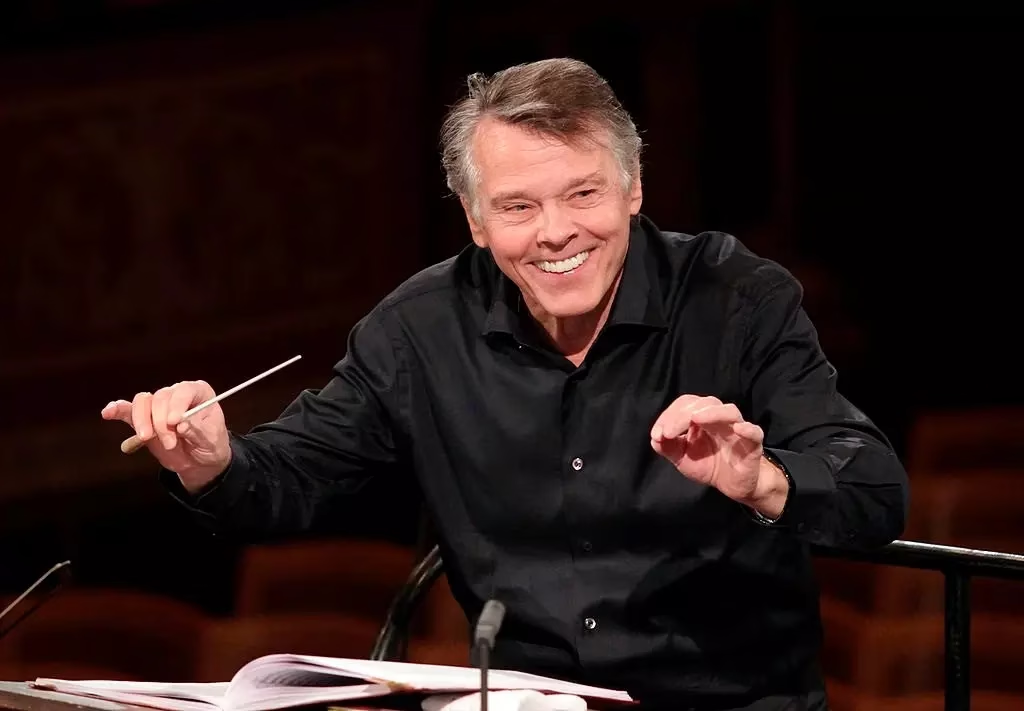
Widely acclaimed conductor Mariss Jansons died on Nov. 30 at his home in St. Petersburg, Russia, after years of living with a heart condition. He was 76.
<blockquote class="twitter-tweet"><p lang="de" dir="ltr">Danke Mariss! <a href="https://t.co/mAGMaMsKz7">https://t.co/mAGMaMsKz7</a></p>— BR_KLASSIK (@BR_KLASSIK) <a href="https://twitter.com/BR_KLASSIK/status/1201103151597789184?ref_src=twsrc%5Etfw">December 1, 2019</a></blockquote> <script async src="https://platform.twitter.com/widgets.js" charset="utf-8"></script>
Born in what is now independent Latvia to a conductor father and an opera singer mother, Janson grew up in the Soviet Union and studied at the Leningrad (now St. Petersburg) Conservatory. His conducting career began to take flight with his first major international appointment with the Oslo Philharmonic in 1979. Jansons went on to lead some of the world's top ensembles, including the Pittsburgh Symphony Orchestra from 1997-2004.
“He conducted every concert like it was his last,” Michael Rusinek, the PSO’s principal clarinetist, told the Pittsburgh Post-Gazette. “With Mariss, everything was incredibly passionate and incredibly energetic.”
After his impressive run with the PSO, he became principal conductor of the Royal Concertgebouw Orchestra, where he stayed until 2015 Twice during that span, Jansons conducted the Vienna Philharmonic New Year’s Concert broadcast around the world. Jansons won the GRAMMY for Best Orchestral Performance for 2005 for Shostakovich: Sym. No. 13. He would earn six GRAMMY nominations in all during his remarkable career.
<blockquote class="twitter-tweet"><p lang="en" dir="ltr">We remember conductor Mariss Jansons who led nearly 50 performances at <a href="https://twitter.com/hashtag/CarnegieHall?src=hash&ref_src=twsrc%5Etfw">#CarnegieHall</a> since his 1975 debut with the Moscow State Symphony and most recently the <a href="https://twitter.com/BRSO?ref_src=twsrc%5Etfw">@BRSO</a> last month. Take a look through his performance history here: <a href="https://t.co/sLbYrEQsje">https://t.co/sLbYrEQsje</a> <a href="https://t.co/RHBlWpplBr">pic.twitter.com/RHBlWpplBr</a></p>— Carnegie Hall (@carnegiehall) <a href="https://twitter.com/carnegiehall/status/1201152739444695040?ref_src=twsrc%5Etfw">December 1, 2019</a></blockquote> <script async src="https://platform.twitter.com/widgets.js" charset="utf-8"></script>
Toward the end of his life, he was serving as chief conductor of Germany's Bavarian Radio Symphony Orchestra. Jansons was admired for his emotional intensity and will be remembered for the passion he poured into his work.
"Mariss was a musician’s musician," Christopher Wu, a first violinist in the PSO, told the Pittsburgh Post-Gazette. "He was focused on bringing out the feeling in the music more than perfect beats and technique, always trying to find ways of expressing a phrase. In rehearsal he’d say, 'Oh, you must feel this person crying,' or 'You must feel this person loving.'"
